

You're running paid campaigns across Meta, Google, TikTok, and maybe a few other platforms. Your dashboards show clicks, impressions, and conversions. Everything looks solid on the surface. But here's the uncomfortable truth: some percentage of your ad spend is going to fraudulent traffic, and you might not even realize it.
Ad fraud isn't just a theoretical problem that happens to other marketers. It's actively siphoning budget from campaigns right now, disguised as legitimate engagement. The frustrating part? Even experienced marketing teams struggle to identify it.
The challenge isn't that fraud detection tools don't exist. It's that modern ad fraud has become remarkably sophisticated, your data is scattered across disconnected platforms, and the line between suspicious activity and legitimate user behavior keeps getting blurrier. This article breaks down the specific obstacles that make ad fraud detection so difficult and shows you how to build a more effective defense.
How Fraudulent Traffic Keeps Getting Smarter
Remember when bot traffic was easy to spot? Those days are gone. Early fraud detection relied on identifying obvious patterns: rapid-fire clicks from the same IP address, traffic from known data centers, or interactions that happened at inhuman speeds. Simple rules could catch most of it.
Today's fraudsters operate with far more sophistication. They use residential IP addresses that look identical to real users. They employ click farms where actual humans perform the clicks, making the behavior patterns appear completely legitimate. They space out their activity to avoid triggering velocity-based filters.
The most advanced fraud operations now use device farms with real phones and tablets, running actual browsers with normal user agents. These setups can scroll through pages, spend time on site, and even fill out forms. To an ad platform or analytics tool, this traffic looks indistinguishable from genuine interest.
Think of it like an arms race. Every time detection methods improve, fraud tactics evolve to circumvent them. The machine learning models that platforms use to identify suspicious patterns get trained on historical fraud data. But fraudsters adapt faster than models can retrain.
Residential proxies have become particularly problematic. These route fraudulent traffic through real people's home internet connections, making the IP addresses appear completely legitimate. When combined with browser fingerprinting evasion techniques, this traffic can sail right through standard detection filters. Understanding comprehensive ad fraud detection and prevention strategies is essential for modern marketers.
The result? Detection methods that worked effectively six months ago may be obsolete today. Marketers who rely on static rules or outdated fraud prevention tools are fighting yesterday's battle while new fraud patterns drain their budgets undetected.
When Your Data Lives in Silos, Fraud Hides in the Gaps
Here's where the detection challenge gets even more complex: your marketing data probably lives in multiple disconnected systems. Meta Ads Manager shows one set of numbers. Google Analytics shows another. Your CRM has its own version of the truth. And your revenue data sits somewhere else entirely.
This fragmentation creates perfect hiding spots for fraudulent activity. A click farm can generate what looks like legitimate engagement in your ad platform, but if you're not connecting that data to actual conversions and revenue, you'll never see the disconnect. Solving marketing data integration challenges is the first step toward exposing hidden fraud.
Let's say you're running a lead generation campaign. Your ad platform reports 500 clicks and 50 conversions. Those numbers look reasonable. But if you could trace those 50 conversions through to your CRM, you might discover that only 15 of them ever engaged with a sales rep, and only 3 became actual customers.
The problem compounds when you're running campaigns across multiple platforms. Each platform uses its own tracking pixel, its own attribution window, and its own definition of what counts as a conversion. Fraudsters exploit these inconsistencies by generating activity that looks good in one system while failing to produce results in another.
Data fragmentation also makes pattern recognition nearly impossible. Sophisticated fraud often involves small amounts of activity spread across many campaigns and platforms. An individual campaign might show a slightly lower conversion rate, but nothing alarming. Only when you aggregate data across your entire marketing operation does the pattern become visible.
Consider the challenge of identifying click injection fraud, where fraudsters intercept users who are already about to convert and inject a fraudulent click at the last moment to claim credit. If your ad platform data isn't connected to your actual customer journey data, that fraudulent click looks like it drove a legitimate conversion.
The visibility gap extends to post-click behavior as well. Platform-reported metrics tell you someone clicked and converted, but they don't show you what happened in between. Did the user browse multiple pages? Did they spend time reading content? Did they return multiple times before converting? Without this context, distinguishing real engagement from fraudulent activity becomes guesswork.
Many marketers rely heavily on platform-reported conversion data without questioning its accuracy. But ad platforms have an inherent incentive to attribute conversions to their ads. They're not deliberately reporting fraudulent activity as legitimate, but their attribution models may credit clicks that didn't actually influence the conversion decision.
How Poor Attribution Lets Fraud Claim Credit
Attribution models determine which marketing touchpoints get credit for conversions. When those models are simplistic or inaccurate, fraudulent activity can claim credit for conversions it had nothing to do with.
Last-click attribution is particularly vulnerable to exploitation. This model gives 100% of the credit to the final touchpoint before conversion. Fraudsters know this, so they focus on intercepting users right before they convert. Understanding attribution modeling challenges helps you recognize where fraud can slip through.
Picture this scenario: A potential customer sees your brand mentioned in an industry publication. They search for your company name on Google. They click an organic search result and land on your website. They browse for a few minutes, then leave. The next day, they return by typing your URL directly into their browser. Just before they complete a purchase, a fraudulent click occurs through a retargeting campaign.
With last-click attribution, that fraudulent retargeting click gets full credit for the conversion. The organic search, the direct visit, and the initial brand awareness all get ignored. The fraudster successfully claimed credit for a conversion that would have happened anyway.
This type of fraud is called attribution hijacking, and it's remarkably common. Click farms and malware specifically target users who are already in the buying process, inserting fraudulent clicks at the last possible moment to steal attribution credit.
Even when marketers move beyond last-click to more sophisticated attribution models, gaps remain. Position-based or time-decay models still rely on the assumption that all recorded touchpoints were legitimate. If fraudulent clicks are mixed into your customer journey data, they'll receive attribution credit regardless of which model you use.
The challenge intensifies with cross-device journeys. A user might research on mobile, compare options on desktop, and convert on tablet. If your attribution system can't connect these touchpoints to the same person, fraudulent activity on any of those devices can claim partial or full credit. Many marketers struggle with cross-device conversion tracking challenges that fraudsters actively exploit.
Multi-touch attribution helps, but only if you have complete visibility into the actual customer journey. When your tracking is fragmented or relies solely on cookie-based data, you're missing crucial touchpoints. Those gaps allow fraudulent activity to blend in with legitimate engagement.
The solution requires tracking that connects every touchpoint to actual conversion outcomes and revenue. When you can see the full journey from first touch to closed deal, patterns emerge. Legitimate traffic shows consistent engagement across multiple sessions. Fraudulent traffic typically appears only at the last moment, with no supporting engagement history.
Why Context Matters More Than Individual Signals
A single click, viewed in isolation, tells you almost nothing about whether it's fraudulent. The same IP address might represent a legitimate customer or a sophisticated fraud operation. The context surrounding that click is what reveals the truth.
This is why marketers who focus exclusively on click-level fraud detection often struggle. They're looking at individual trees instead of seeing the forest. A fraudulent click that generates no downstream engagement becomes obvious when you have the full picture. But if you're only analyzing the click itself, it may look perfectly normal.
When Fraud Protection Blocks Real Customers
Here's the dilemma that keeps many marketers from implementing aggressive fraud detection: the risk of false positives. Block too aggressively, and you'll reject legitimate customers. Be too permissive, and you'll waste budget on fraudulent traffic.
False positives happen when fraud detection systems flag legitimate users as suspicious. This occurs more often than you might think. A customer using a VPN shows up with an IP address that doesn't match their location. Someone browsing from a corporate network shares an IP with hundreds of other employees. A user with privacy-focused browser settings blocks certain tracking scripts.
All of these scenarios can trigger fraud alerts, even though the users are completely legitimate. If your fraud prevention system automatically blocks or filters this traffic, you're turning away real customers who wanted to buy from you.
The cost of false positives extends beyond individual lost sales. When ad platforms receive signals that certain users didn't convert, their algorithms adjust targeting away from similar audiences. If those "non-converting" users were actually legitimate customers who got blocked, you're teaching the algorithm to avoid your best prospects.
This creates a balancing act. Marketers need protection from fraud, but they also need to maintain reach to their actual target audience. Set your filters too strict, and your cost per acquisition increases as you block legitimate traffic. Set them too loose, and your budget bleeds to fraudulent activity. These ad spend optimization challenges require careful calibration.
The challenge becomes even more complex with retargeting campaigns. Users who previously visited your site might return through different devices, networks, or browsers. Strict device fingerprinting or IP-based filtering can fail to recognize these as the same person, potentially blocking valuable retargeting opportunities.
Many fraud detection tools rely on blacklists of known bad IP addresses or suspicious user agents. But these lists are always playing catch-up. New fraud operations use fresh IP addresses and updated technology. Meanwhile, legitimate users occasionally end up on blacklists due to shared network infrastructure or previous device owners.
The most effective approach moves beyond simple allow/block decisions. Instead of making binary judgments at the click level, focus on conversion-level analysis. Let the traffic through, but track whether it generates real engagement and revenue. Patterns emerge quickly when you have this data.
Building Detection That Focuses on What Actually Matters
Effective fraud detection starts with a fundamental shift in perspective: stop obsessing over click-level metrics and start focusing on revenue outcomes. Fraudulent traffic has one consistent characteristic: it doesn't generate real business results.
This means your fraud detection strategy should center on connecting ad spend to actual revenue. When you can trace every dollar spent back to dollars earned, fraudulent activity becomes obvious. Those clicks that never lead to engaged users, qualified leads, or paying customers stand out clearly.
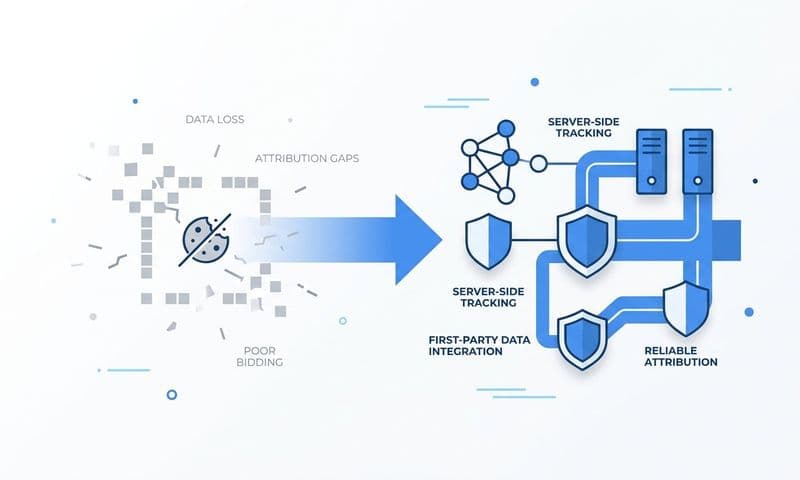
Server-side tracking provides the foundation for this approach. Unlike pixel-based tracking that runs in the user's browser, server-side tracking captures data directly on your servers. This makes it far more difficult for fraudsters to manipulate or spoof the data. However, many teams face server-side tracking setup challenges that delay implementation.
Browser-based tracking is vulnerable to ad blockers, privacy extensions, and sophisticated fraud tools that can simulate normal user behavior. Server-side tracking bypasses these issues by recording actual server requests and database changes. When someone completes a purchase, that transaction gets logged on your server regardless of what's happening in their browser.
First-party data becomes your most reliable fraud detection tool. This is data you collect directly about your customers: their email addresses, purchase history, support interactions, and product usage. Fraudulent traffic rarely generates meaningful first-party data.
Think about what happens after a legitimate customer converts. They receive confirmation emails. They log into your product or service. They might contact support with questions. They engage with your content. They make repeat purchases. This creates a rich trail of first-party data that confirms the conversion was real.
Fraudulent conversions lack this follow-through. The email address might be fake or disposable. There's no product usage. No support interactions. No repeat engagement. When you connect your ad data to your CRM and customer database, these patterns become immediately visible. Overcoming first-party data collection challenges strengthens your fraud defense significantly.
The next step involves connecting all your marketing touchpoints to actual conversion events. This means integrating your ad platforms with your CRM, your analytics with your revenue data, and your customer journey tracking with your attribution model.
When this integration is complete, you can analyze campaigns not just by click-through rate or reported conversions, but by the quality of customers they generate. A campaign might show a high conversion rate but produce leads that never engage with sales. Another campaign might have a lower conversion rate but generate customers who make large purchases and stick around long term.
This revenue-connected view exposes fraud that hide behind vanity metrics. Those campaigns generating suspicious traffic will show poor performance when measured by actual business outcomes. The clicks might look legitimate, but the revenue tells the real story.
Using Pattern Recognition to Identify Anomalies
Once you have complete customer journey data, patterns become your fraud detection mechanism. Legitimate customers follow recognizable paths: they research, compare, engage with content, and make informed decisions. Fraudulent traffic shows different patterns.
Look for campaigns or sources that generate conversions but no downstream engagement. Check for unusual timing patterns, like conversions that happen at identical intervals. Identify traffic sources that produce high click volumes but low time-on-site metrics.
The key is having the data infrastructure to spot these patterns. When your ad data, website analytics, CRM, and revenue systems are connected, anomalies stand out clearly.
How Complete Tracking Becomes Your Fraud Defense
The most powerful fraud detection doesn't come from specialized anti-fraud tools. It comes from having complete, accurate visibility into your entire customer journey. When you can track every touchpoint from first ad impression to final purchase and beyond, fraudulent activity has nowhere to hide.
Complete customer journey tracking means capturing every interaction: ad clicks, website visits, content engagement, email opens, form submissions, sales calls, purchases, and post-purchase behavior. Each of these data points adds context that helps distinguish real customers from fraudulent traffic. Many organizations face customer journey tracking challenges that leave gaps in their visibility.
A real customer journey has depth and consistency. Someone might click an ad, browse several pages, leave, return through organic search, sign up for a newsletter, engage with email content, visit again through a retargeting ad, and finally make a purchase. That journey shows genuine interest and intent.
Fraudulent traffic lacks this depth. It might show the initial click and even a conversion, but the surrounding context is missing. There's no organic return visit. No email engagement. No extended browsing sessions. The conversion exists in isolation, disconnected from the natural research and consideration process.
This is why feeding accurate conversion data back to ad platforms is so crucial. When you send detailed conversion events that include revenue values, customer lifetime value predictions, and engagement quality scores, the platform's AI can optimize toward real results instead of fraudulent activity.
Ad platforms want to deliver real conversions because that's what keeps advertisers spending. But they can only optimize based on the data you send them. If you're sending basic conversion events without context, the algorithm can't distinguish between a high-value customer and a fraudulent conversion.
Enhanced conversion data changes this equation. When you send back signals that indicate conversion quality, customer engagement level, and actual revenue generated, the platform's machine learning models learn to identify and target users who are more likely to become real customers.
This creates a virtuous cycle. Better data leads to better targeting, which reduces the percentage of your budget going to fraud, which improves your overall campaign performance, which generates even better data for optimization.
AI recommendations become significantly more valuable when they're based on complete, accurate data. An AI system analyzing fragmented or fraudulent data will make poor recommendations. But when the underlying data accurately reflects real customer journeys and revenue outcomes, AI can identify patterns that humans might miss.
For example, AI analysis of complete customer journey data might reveal that certain ad placements consistently generate clicks that never lead to revenue, while other placements produce fewer clicks but higher-quality customers. This insight allows you to shift budget away from fraud-prone sources and toward channels that drive real results.
Turning Data Quality Into Competitive Advantage
Most marketers are working with incomplete data. Their tracking is fragmented, their attribution is simplistic, and their fraud detection is reactive at best. This creates an opportunity for marketers who invest in better data infrastructure.
When you have complete customer journey tracking, accurate attribution, and revenue-connected data, you gain advantages that compound over time. Your campaigns optimize faster. Your targeting improves continuously. Your budget allocation becomes more efficient. And fraudulent traffic becomes increasingly easy to identify and eliminate.
Moving Forward With Clarity and Confidence
Ad fraud detection challenges aren't going away. Fraudsters will continue developing new tactics, exploiting attribution gaps, and finding ways to blend in with legitimate traffic. But the solution isn't more sophisticated fraud detection tools. It's better data.
When you have complete visibility into your customer journeys, when your ad data connects directly to revenue outcomes, and when you're feeding accurate conversion signals back to ad platforms, fraud loses its ability to hide. The patterns become obvious. The wasted spend becomes visible. And you gain the clarity needed to protect your budget effectively.
The marketers who win this battle are those who stop treating fraud detection as a separate problem and start treating it as a data quality issue. Build the infrastructure to track complete customer journeys. Connect your ad platforms to your CRM and revenue data. Focus on optimizing for real business outcomes rather than vanity metrics.
This approach doesn't just protect you from fraud. It makes your entire marketing operation more effective. You'll make better budget decisions, improve targeting accuracy, and drive higher ROI across all your campaigns.
The choice is clear: continue fighting fraud with fragmented data and reactive tools, or build the data foundation that makes fraudulent activity obvious while simultaneously improving every aspect of your marketing performance.
Ready to elevate your marketing game with precision and confidence? Discover how Cometly's AI-driven recommendations can transform your ad strategy. Get your free demo today and start capturing every touchpoint to maximize your conversions.