Running campaigns across Meta, Google, TikTok, and other ad platforms creates a fragmented data landscape that makes optimization nearly impossible. When your conversion data lives in silos, ad platform algorithms can't learn which audiences actually convert—leading to wasted spend and missed opportunities.
Think of it this way: you're feeding your ad platforms incomplete information about what happens after someone clicks. They see the click, maybe a pixel-fired purchase, but they miss the qualified leads, the closed deals, the high-value customers who took weeks to convert. Without this complete picture, algorithms optimize for the wrong outcomes.
Ad platform data sync solves this by creating a unified flow of conversion data back to each platform, enabling smarter targeting and better ROAS. Instead of platforms guessing which audiences might convert, they receive enriched conversion events that show exactly which clicks led to revenue.
This guide walks you through setting up a complete data sync system that feeds accurate, enriched conversion events to your ad platforms in real time. By the end, you'll have a working sync that improves algorithm optimization across all your paid channels.
Step 1: Audit Your Current Data Flow and Identify Gaps
Before you can fix your data sync, you need to understand where your conversion data currently lives and where it's breaking down. This audit reveals the gaps that are costing you optimization power.
Start by mapping your entire conversion journey. Where does data get captured first? For most businesses, this includes website analytics like Google Analytics, ad platform pixels on your site, and CRM systems where leads and customers get logged. Draw out this flow on paper or in a document—literally map where each conversion event originates and where it travels.
Next, identify which conversions aren't making it back to your ad platforms. You might be tracking purchases on your site, but are qualified leads from your CRM syncing back to Meta? When a lead closes three weeks after clicking an ad, does Google Ads know about it? These downstream conversions are often the most valuable, yet they're the ones platforms never see.
Document your data latency issues. How long does it take before platforms see conversions? If someone converts on Tuesday but the data doesn't reach Meta until Friday, the algorithm loses critical real-time learning opportunities. Platforms that offer real-time conversion tracking enable faster optimization cycles.
Pay special attention to iOS tracking limitations affecting your Meta and Google data. Since iOS 14.5, browser-based tracking has become significantly less reliable. Check your ad platform dashboards for attribution windows and estimated conversion counts—you'll likely see warnings about limited data or incomplete tracking.
Your success indicator here is a complete data flow diagram showing all gaps and broken connections. This becomes your roadmap for what needs fixing. You should be able to point to exactly where conversions get lost, where latency creates problems, and which platforms are flying blind without proper conversion data.
Step 2: Choose Your Sync Method—Server-Side vs. Pixel-Based
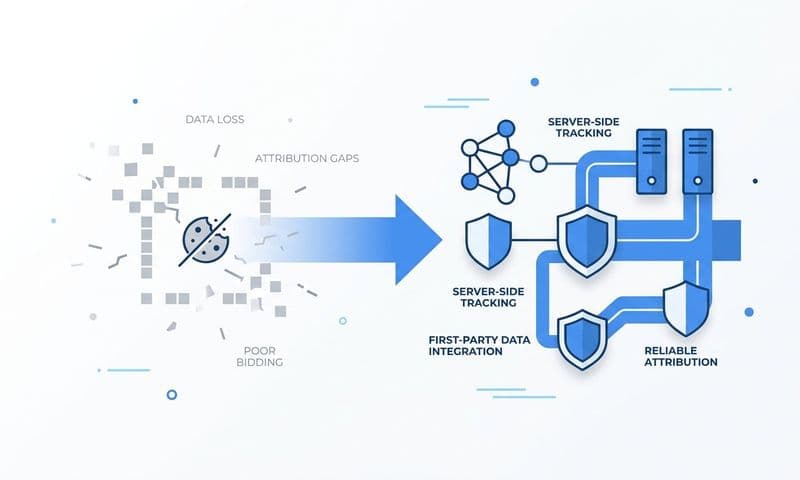
Understanding why browser-based pixels miss significant conversion data in 2026 is crucial to making the right sync decision. Pixels fire in the user's browser, making them vulnerable to ad blockers, privacy settings, and browser restrictions. When someone has tracking prevention enabled or uses an ad blocker, your pixel never fires—and that conversion disappears from your ad platform's view.
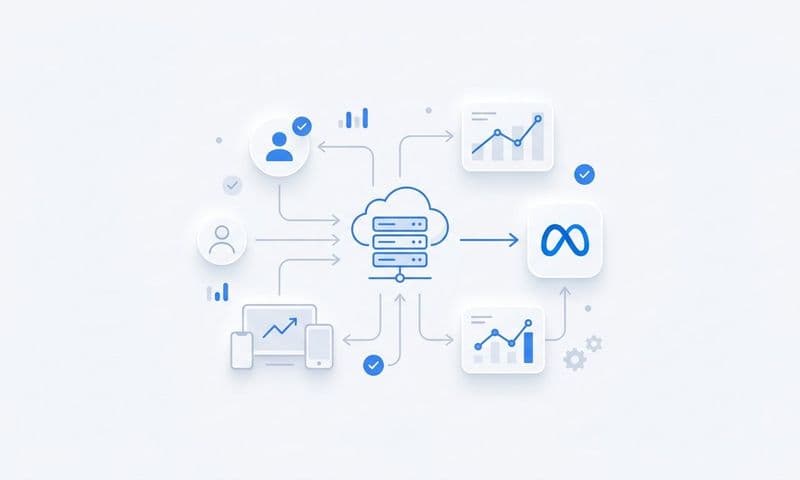
Server-side tracking bypasses these limitations entirely. Instead of relying on browser pixels, your server sends conversion data directly to ad platforms via their APIs. This approach survives iOS restrictions, works regardless of ad blocker settings, and captures conversions that pixel-based tracking would miss completely.
The trade-off is complexity. Manual API integration requires developer resources and ongoing maintenance. You need to set up secure API connections, handle event formatting correctly, implement error handling, and monitor for failures. For teams without dedicated engineering support, this can become a significant burden.
This is where attribution platforms like Cometly provide value. Instead of building and maintaining API integrations yourself, the platform handles the technical complexity while you focus on strategy. Implementing first-party data tracking through server-side methods ensures you capture every conversion regardless of browser restrictions.
Assess your technical requirements honestly. If you have engineering resources and want complete control over implementation, manual API integration gives you maximum flexibility. If you need a faster path to accurate data sync without ongoing technical maintenance, using an attribution platform accelerates your timeline significantly.
Your success indicator is a clear decision on sync method with an implementation timeline. You should know whether you're building custom integrations or using a platform solution, who's responsible for implementation, and when you'll have working connections to each ad platform.
Step 3: Connect Your Ad Platforms to Your Data Source
Setting up Meta Conversions API connection with proper event matching is your first technical implementation. In your Meta Events Manager, navigate to your pixel settings and find the Conversions API setup section. You'll need to generate an access token that authorizes your server to send conversion events.
The critical piece here is event matching. Meta needs to match your server-side events with the people who clicked your ads. This requires sending customer information parameters like email addresses, phone numbers, or Facebook click IDs (fbclid). Hash these parameters using SHA-256 before sending to protect user privacy while enabling accurate matching. For detailed implementation steps, review this guide on syncing conversion data to Facebook Ads.
Configure Google Ads Enhanced Conversions next. In your Google Ads account, go to the conversion action you want to enhance and enable Enhanced Conversions. This requires implementing either the global site tag with customer data or using the API to send conversion data with customer information parameters directly from your server.
Google uses this customer data to match conversions back to ad clicks even when cookies don't work. Send parameters like email, phone number, and address information in hashed format. The more parameters you provide, the better Google's match rate becomes.
Establish TikTok Events API for accurate attribution by accessing your TikTok Ads Manager and navigating to Events. Create a new web event source and choose the Events API option. TikTok provides similar event matching capabilities using click IDs and hashed customer information.
Before going live with real conversion data, verify each connection is receiving test events. Every platform provides a test event tool—use it. Send a test conversion through your new server-side connection and confirm it appears in the platform's dashboard within minutes. This validation step prevents you from thinking you have working sync when events are actually failing silently.
Your success indicator is all ad platforms showing 'Active' connection status with test events logged. You should see confirmation in Meta Events Manager, Google Ads conversion tracking, and TikTok Events that your server-side connections are working and receiving data properly.
Step 4: Map Your Conversion Events and Set Attribution Windows
Define which CRM events should sync back to your ad platforms based on what matters for your business model. For B2B companies, this typically includes lead creation, marketing qualified lead (MQL) status, sales qualified lead (SQL) status, and closed-won deals. For ecommerce, you're syncing purchases, add-to-carts, and potentially product views.
The key is syncing events that represent real business value, not just vanity metrics. Ad platforms optimize toward the conversions you send them, so if you only sync low-quality leads, algorithms will find more low-quality leads. Send your high-value conversion events to teach platforms what success actually looks like.
Configure event parameters for each conversion type. Value and currency are essential—they enable platforms to optimize for revenue, not just conversion volume. If you're syncing a closed deal worth $5,000, send that value. If it's an ecommerce purchase for $127.50, send that exact amount.
For ecommerce businesses, include content IDs that match your product catalog. This enables dynamic ads and helps platforms understand which products drive conversions. Specialized ecommerce data analytics software can automate much of this product-level tracking and sync process.
Set appropriate attribution windows based on your actual sales cycle length. If your average customer takes 30 days from first click to purchase, using a 7-day attribution window will miss most conversions. B2B companies with long sales cycles often need 60-90 day windows, while ecommerce might work well with 7-28 days.
Establish deduplication rules to prevent double-counting conversions. If you're sending both browser pixel conversions and server-side conversions, platforms need to know these represent the same event. Use unique transaction IDs or order IDs that allow platforms to deduplicate automatically. Meta and Google both support deduplication when you send matching event IDs from both pixel and server sources.
Your success indicator is an event mapping document with clear rules for each conversion type. This document should specify which CRM events trigger which ad platform events, what parameters get sent with each event, and how deduplication works. Anyone on your team should be able to look at this document and understand exactly what data flows where.
Step 5: Validate Data Accuracy and Troubleshoot Discrepancies
Compare synced conversions against your source-of-truth CRM data to validate accuracy. Pull a report from your CRM showing all conversions for a specific date range, then check your ad platform dashboards for the same period. The numbers won't match exactly due to attribution windows and matching limitations, but they should be reasonably close.
Check event match quality scores in Meta and Google dashboards. Meta's Events Manager shows match quality for each event, indicating what percentage of events successfully matched to user accounts. Google Ads displays Enhanced Conversions match rate in the conversion tracking interface. Match rates above 80% indicate healthy data quality.
Low match rates usually stem from a few common issues. Missing or incorrectly formatted customer parameters prevent platforms from matching events to ad clicks. If you're not sending email addresses or phone numbers, or if they're not properly hashed, match rates suffer. Double-check your parameter formatting against platform documentation.
Identify and fix incorrect event timing. If conversions are being sent with timestamps from when they sync rather than when they actually occurred, platforms can't properly attribute them. Always send the original conversion timestamp, not the sync timestamp. Understanding common conversion sync issues with ad platforms helps you diagnose problems faster.
Watch for duplicate events that inflate your conversion counts. If both your pixel and server-side integration are sending the same purchase without proper deduplication, platforms count it twice. This skews your data and confuses optimization algorithms. Implement unique event IDs consistently across all sources.
Set up monitoring alerts for sync failures or data drops. Your data sync should run continuously, but technical issues happen. Configure alerts that notify you when conversion volume drops significantly or when API connections fail. This enables you to fix problems before they impact campaign performance.
Your success indicator is a match rate above 80% between CRM and ad platform conversion counts. When you pull reports from both systems, the conversion totals should align within an acceptable margin. This confirms your sync is capturing real conversions accurately without significant data loss.
Step 6: Optimize Algorithm Learning with Enriched Data
Feed customer lifetime value data to improve platform bidding strategies. Instead of treating all conversions equally, send the actual value of each customer. When a $10,000 annual contract customer converts, that event should carry more weight than a $100 one-time purchase.
Platforms use this value data to optimize bidding automatically. If they learn that certain audiences produce higher-value customers, they'll prioritize reaching similar users. This shifts optimization from maximizing conversion volume to maximizing revenue—a crucial distinction for profitability. Implementing revenue tracking through attribution platforms makes this value-based optimization possible.
Segment conversions by quality tier so algorithms prioritize high-value leads. You might sync all leads to platforms, but mark them with different event names or parameters based on qualification level. A marketing qualified lead and a sales qualified lead represent different value levels—make sure platforms understand this distinction.
Cometly's Conversion Sync automatically enriches events with full journey data before sending to platforms. Instead of just syncing a bare conversion event, it includes attribution data showing which touchpoints influenced the conversion. This gives ad platforms deeper context about what's working.
The platform tracks every interaction from first click through final conversion, then syncs this enriched data back to Meta, Google, and other channels. Understanding the complete customer journey requires robust cross-platform ad tracking that connects touchpoints across all your advertising channels.
Monitor how improved data quality affects your cost per lead and ROAS over 2-4 weeks. Algorithm learning takes time—platforms need to accumulate enough conversion data to identify patterns and optimize delivery. As your sync feeds better data, you'll typically see learning phases complete faster and performance metrics improve gradually.
Your success indicator is ad platform learning phases completing faster with improved performance metrics. Meta and Google both show learning status for campaigns—you should see campaigns exit learning more quickly as conversion data improves. Track your CPL and ROAS trends to confirm the data quality improvements are translating to better campaign performance.
Quick-Start Checklist for Ad Platform Data Sync
You now have a complete framework for setting up ad platform data sync that feeds accurate, enriched conversion events to your campaigns. Let's recap the essential steps to get you moving quickly.
Start with your data audit. Map your current conversion flow, identify gaps, and document latency issues. This foundation shows you exactly what needs fixing. Then choose your sync method—server-side tracking provides the most accurate data, while attribution platforms eliminate the technical complexity of manual API integration.
Connect your ad platforms systematically. Set up Meta Conversions API, Google Enhanced Conversions, and TikTok Events API with proper event matching parameters. Verify each connection with test events before going live. For a comprehensive walkthrough, this guide on syncing conversions to ad platforms covers each platform's requirements in detail.
Map your conversion events thoughtfully. Define which CRM events matter for your business, configure value parameters, and set attribution windows that match your sales cycle. Establish deduplication rules to prevent inflated counts. Then validate everything—compare your synced data against CRM reports and troubleshoot discrepancies until match rates exceed 80%.
The final optimization step separates good data sync from great results. Feed customer lifetime value data to platforms, segment conversions by quality tier, and monitor how improved data quality impacts performance over time. This is where accurate data sync transforms into measurable business outcomes.
Many marketers find that managing server-side tracking, API connections, and ongoing sync maintenance becomes a significant technical burden. That's exactly why platforms like Cometly exist—to handle the complexity while you focus on strategy and optimization.
Ready to elevate your marketing game with precision and confidence? Discover how Cometly's AI-driven recommendations can transform your ad strategy—Get your free demo today and start capturing every touchpoint to maximize your conversions.