Every dollar you spend on paid advertising generates data, but how much of that data can you actually trust? For many marketing teams running campaigns across Meta, Google, TikTok, and other platforms, the answer is uncomfortable.
Between browser privacy updates, iOS tracking restrictions, cookie deprecation, and cross-device user behavior, the gap between what your ad platforms report and what actually drives revenue keeps growing. And that gap is not a minor inconvenience.
Inaccurate tracking does not just mean messy dashboards. It means you are optimizing campaigns based on flawed signals, misallocating budget toward channels that look good on paper but fail to convert, and starving the campaigns that quietly drive your best results. You might be scaling a campaign that is actually losing money, while pausing one that was your top performer all along.
The good news is that ad tracking accuracy improvement is not a mystery. It is a systematic process you can follow step by step to close the data gaps, validate your numbers, and build a foundation of marketing data you can confidently act on.
In this guide, you will walk through six concrete steps: auditing your current tracking setup, fixing the structural issues that cause data loss, implementing server-side tracking, unifying attribution across platforms, feeding better conversion data back to ad platform algorithms, and building an ongoing accuracy monitoring process.
Whether you are a solo marketer managing a few campaigns or part of a team spending six or seven figures monthly on ads, these steps will help you move from guessing to knowing what is actually working. Let's get into it.
Step 1: Audit Your Current Tracking Setup for Data Gaps
Before you fix anything, you need to understand exactly where your tracking breaks down. Jumping straight to solutions without this foundation is like patching a roof without knowing where the leaks are. The first step in any serious ad tracking accuracy improvement effort is a structured audit.
The most effective way to run this audit is to compare what your ad platforms report against what your CRM or backend data shows for the same time period. Pull reported conversions from Meta, Google, TikTok, and LinkedIn for a recent 30-day window. Then pull the actual leads, purchases, or signups recorded in your CRM or payment processor for that same window. The gap between those two numbers is your starting point, and understanding the common ad tracking data discrepancy causes will help you interpret what you find.
Here is what typically causes that gap:
Browser ad blockers: A growing share of internet users run ad blockers that prevent tracking pixels from firing entirely. When a pixel cannot load, the conversion goes untracked on the platform side, even though it happened in reality.
iOS App Tracking Transparency: Since Apple introduced ATT in iOS 14.5, users can opt out of cross-app tracking. Many do. This directly limits the data Meta and other platforms receive from mobile users, creating systematic blind spots in your attribution.
Safari's Intelligent Tracking Prevention: Safari caps the lifespan of first-party cookies, which means users who take longer than a few days to convert may not be attributed correctly, even if they originally clicked your ad.
Cross-device journeys: A user might click your ad on their phone during lunch, then convert on their laptop at home that evening. Cookie-based tracking often cannot connect those two sessions, so the conversion either goes unattributed or gets credited to the wrong source.
UTM parameters stripped by redirects: If your landing page uses redirects, UTM parameters can get dropped in the process, leaving you with direct traffic in analytics when the visit actually came from a paid campaign.
To organize your findings, build a simple spreadsheet. List each platform in one column, then add columns for reported conversions, actual conversions, the raw discrepancy, and the discrepancy as a percentage. Do this at the campaign level if you can. This gives you a documented accuracy baseline: a clear picture of which platforms have the largest gaps and which campaigns are most affected.
Some variance is expected. A very large variance, particularly on platforms where mobile or Safari traffic is high, signals a structural tracking problem that needs to be addressed in the steps that follow.
Success indicator: You have a documented spreadsheet showing discrepancy percentages per platform and per campaign, giving you a clear picture of where your tracking breaks down most severely.
Step 2: Fix Pixel and Tag Implementation Issues
Once you know where the gaps are, the next question is whether your pixels and tags are even set up correctly in the first place. Many tracking problems are not caused by browser restrictions or privacy policies. They are caused by basic implementation errors that have been quietly distorting your data for months.
Start by opening your browser's developer tools and using a tag debugging extension such as Meta Pixel Helper, Google Tag Assistant, or a general tag inspector. Visit each key conversion page on your site and watch what fires. You are looking for a few specific issues.
Duplicate pixel fires: If the same conversion event fires twice on a single user action, your platform reports two conversions for one real event. This inflates your numbers and confuses optimization algorithms. Duplicates often happen when a pixel is hardcoded into a page template and also firing through a tag manager, causing it to load twice. These are among the most common pixel tracking accuracy problems that marketers encounter.
Misconfigured event parameters: A conversion event without accurate parameters, such as a purchase event missing the revenue value or currency, gives your ad platform incomplete information. The conversion gets counted, but the platform cannot optimize toward high-value customers because it does not know which conversions were worth more.
Content Security Policy conflicts: Some websites have strict CSP headers that block third-party scripts from executing. A pixel might appear to load in your tag manager but fail to actually send data because the CSP is blocking the outbound request. Check your browser's network tab for blocked requests.
Incorrect trigger conditions in your tag manager: If you are using Google Tag Manager or a similar system, verify that your triggers are set to fire on the correct conditions. A purchase event should fire only after payment confirmation is received, not on the checkout page load. Firing on page load instead of on user interaction is one of the most common causes of inflated conversion counts.
Also check for bot traffic contamination. Some tag manager setups do not filter out bot sessions, which means automated crawlers can trigger your conversion tags and inflate your reported numbers. Enable bot filtering where your platform allows it.
After making corrections, test each conversion flow manually from start to finish. Click an ad, navigate through your funnel, complete the conversion action, and confirm that exactly one event fires with the correct parameters. Do this across different browsers and devices.
Success indicator: Every conversion event fires exactly once per true user action, with accurate parameters, across all key pages and platforms.
Step 3: Implement Server-Side Tracking to Bypass Browser Limitations
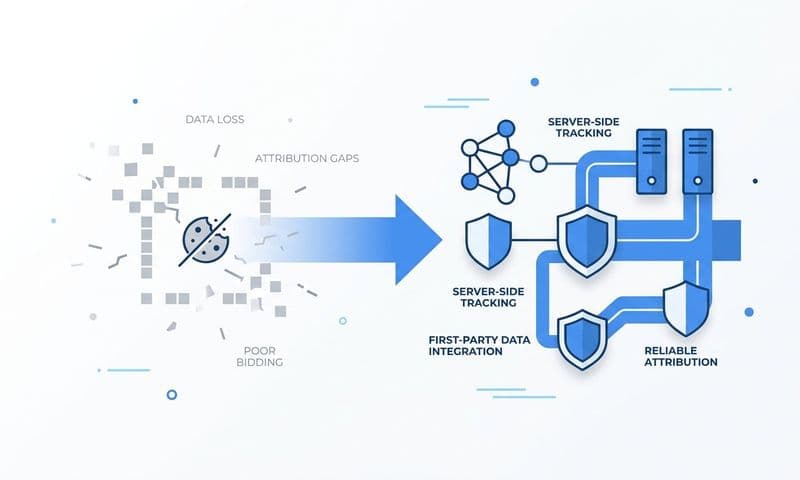
Even with perfectly implemented pixels, you are still relying on the browser to do the heavy lifting. And browsers are increasingly working against you. This is the core problem that server-side tracking solves.
Client-side tracking means a piece of JavaScript code runs in the user's browser and sends data to the ad platform from there. The problem is that ad blockers, Safari's Intelligent Tracking Prevention, Firefox's default cookie restrictions, and privacy-focused browser settings can all intercept or block that process before the data ever reaches the platform. Understanding the full scope of client-side tracking accuracy problems makes it clear why a different approach is needed.
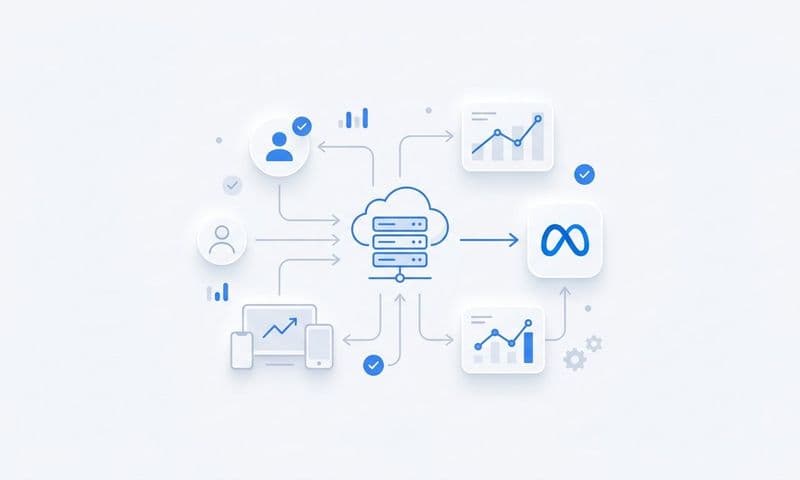
Server-side tracking flips the model. Instead of relying on the browser, your server sends conversion data directly to the ad platform via an API. The browser never has to cooperate. Ad blockers cannot touch it. Safari's cookie policies are irrelevant. The data flows from your infrastructure to the platform infrastructure, cleanly and reliably.
Here is how to set it up:
1. Meta Conversions API (CAPI): Set up server-side event sending through Meta's CAPI. When a conversion happens on your site or in your CRM, your server sends the event data directly to Meta, including hashed user identifiers like email or phone number for matching.
2. Google Enhanced Conversions and Ads API: Google's enhanced conversions allow you to send hashed first-party data alongside your standard conversion tags, improving match rates. For more advanced setups, the Google Ads API allows fully server-side conversion imports.
3. TikTok Events API: TikTok offers its own server-side events API that mirrors the functionality of its pixel but operates from your server, capturing conversions that the pixel would have missed.
4. LinkedIn Conversions API: LinkedIn's CAPI allows server-side event sending for B2B advertisers who need accurate conversion tracking for their LinkedIn campaigns.
One critical detail: when you run both client-side pixels and server-side tracking simultaneously, you must deduplicate events. Both systems may capture the same conversion, and without deduplication logic, you will double-count. Use a shared event ID that both the pixel and the server-side event include, which tells the platform they are reporting the same action.
Cometly's server-side tracking handles this process end to end, capturing every touchpoint from ad click through CRM events and providing a complete view of the customer journey without relying on cookies alone. Rather than building and maintaining separate API integrations for each platform, Cometly centralizes the data flow so your team does not have to manage the complexity manually.
After implementation, compare your tracked conversion volume from the week before versus the week after enabling server-side tracking. You will typically see an increase in attributed conversions, not because more conversions are happening, but because conversions that were previously invisible are now being captured.
Success indicator: Conversion data flows reliably even from Safari and Firefox users, and your tracked conversion volume increases compared to your pixel-only baseline.
Step 4: Unify Attribution Across All Channels and Touchpoints
Here is a scenario that plays out in nearly every multi-channel marketing operation. You add up your conversions from Meta, Google, TikTok, and LinkedIn and the total is dramatically higher than the number of actual customers you acquired. Each platform is claiming credit for the same conversions, and when you sum them up, the math does not work.
This is platform self-attribution bias, and it is a structural feature of how ad platforms are designed, not a bug. Each platform uses its own attribution window and model, and each one is incentivized to claim as much credit as possible. A user who saw a Meta ad, clicked a Google search ad, and then converted after seeing a TikTok retargeting ad may be counted as a conversion by all three platforms.
The solution is unified, multi-touch attribution: a single system that tracks the full customer journey across every channel and assigns credit according to a model you choose, rather than letting each platform grade its own homework. Following proven attribution tracking best practices is essential to getting this right.
Before you set this up, it helps to understand the main attribution models and what each one is suited for:
First-touch attribution: Gives 100% of the credit to the first channel that brought the user into your funnel. Useful for understanding what drives awareness and top-of-funnel acquisition.
Last-touch attribution: Gives 100% of the credit to the last touchpoint before conversion. Simple to implement but tends to over-credit retargeting and direct traffic while ignoring the channels that drove initial interest.
Linear attribution: Distributes credit equally across every touchpoint in the journey. More balanced, but does not account for the fact that some touchpoints have more influence than others.
Data-driven attribution: Uses machine learning to assign credit based on the actual influence each touchpoint had on conversion probability. The most accurate model for most businesses, but requires sufficient conversion volume to be reliable.
The model you choose should reflect your sales cycle and business goals. A B2B company with a long, multi-touch sales cycle might weight first-touch more heavily to understand pipeline generation. An e-commerce brand with short purchase cycles might find last-touch or data-driven attribution more actionable.
What matters most is that you connect your ad platforms, website analytics, and CRM into a single campaign attribution tracking system. Cometly connects ad platforms, CRM, and website data to track the entire customer journey in real time, letting you compare attribution models side by side and see which sources actually drive conversions versus which ones just appear in the path.
Success indicator: You have a single source of truth for attribution that does not double-count conversions across platforms, and you can see the full customer journey from first ad interaction to closed revenue.
Step 5: Feed Enriched Conversion Data Back to Ad Platforms
Most advertisers focus on tracking conversions accurately so they can report on performance. But there is a second, equally important reason to get your conversion data right: feeding better signals back to the ad platform algorithms that are making bidding and targeting decisions on your behalf.
Meta's Advantage+, Google's Smart Bidding, and TikTok's optimization systems all learn from the conversion signals you send them. The quality of those signals directly determines how well these systems can find your best customers and bid efficiently for them. Poor data in means poor optimization out.
The problem is that most advertisers only send basic conversion events: a purchase happened, a lead form was submitted. That is a starting point, but it is far from the full picture. Here is what enriched conversion data looks like in practice:
Revenue values: Instead of just telling Meta that a purchase happened, tell it the purchase was worth a specific dollar amount. This allows Smart Bidding and value-based optimization to prioritize higher-value customers.
Lead quality scores: If you are running lead generation campaigns, not all leads are equal. Sending a quality score or a downstream outcome (such as whether a lead became a paying customer) back to the platform gives the algorithm far more useful information than a raw lead count. Businesses focused on attribution tracking for lead generation see significant improvements when they implement this approach.
CRM outcomes: When you know which leads eventually converted into revenue, you can send that information back to the platforms that generated those leads. This closes the feedback loop and allows algorithms to optimize toward leads that actually become customers, not just leads that fill out a form.
Cometly's Conversion Sync feeds enriched, conversion-ready events back to Meta, Google, and other platforms, giving platform AI better training data to improve targeting, optimization, and ad ROI. Rather than manually exporting and uploading conversion data, the sync happens automatically and continuously, keeping the feedback loop tight.
To measure the impact, track your cost per acquisition and return on ad spend before and after enabling enriched conversion syncing. As algorithms recalibrate on better data, you should see efficiency improvements over time. The timeline varies depending on campaign volume and how much the data quality improved, but the direction of the impact is consistent: better signals lead to better optimization. Leveraging first-party data tracking for ads is one of the most effective ways to ensure those signals remain high quality in a privacy-first landscape.
Success indicator: Ad platforms receive higher-quality conversion signals with revenue values and downstream outcomes, and you observe improved campaign efficiency as algorithms optimize on richer data.
Step 6: Build an Ongoing Accuracy Monitoring and Validation Process
Here is the part most marketers skip: making sure all of this stays working over time. Ad tracking accuracy is not a one-time fix. It is an ongoing operational discipline.
Browser policies evolve. Platforms update their APIs and occasionally deprecate old methods. New campaigns launch with different URL structures or landing pages that were not set up with tracking in mind. A developer pushes a site update that accidentally removes a tag. An API token expires and nobody notices for three weeks. Any of these events can silently break your tracking, and if you do not have a monitoring process in place, you will not catch it until the damage is done.
Here is how to build a monitoring process that actually holds up:
Weekly or biweekly comparison checks: Set a recurring calendar reminder to compare ad platform reported conversions against your CRM or backend data. Define a threshold that triggers investigation. Many teams use a discrepancy of more than ten percent as their alert level, but you should set yours based on your historical baseline from the audit you ran in Step 1.
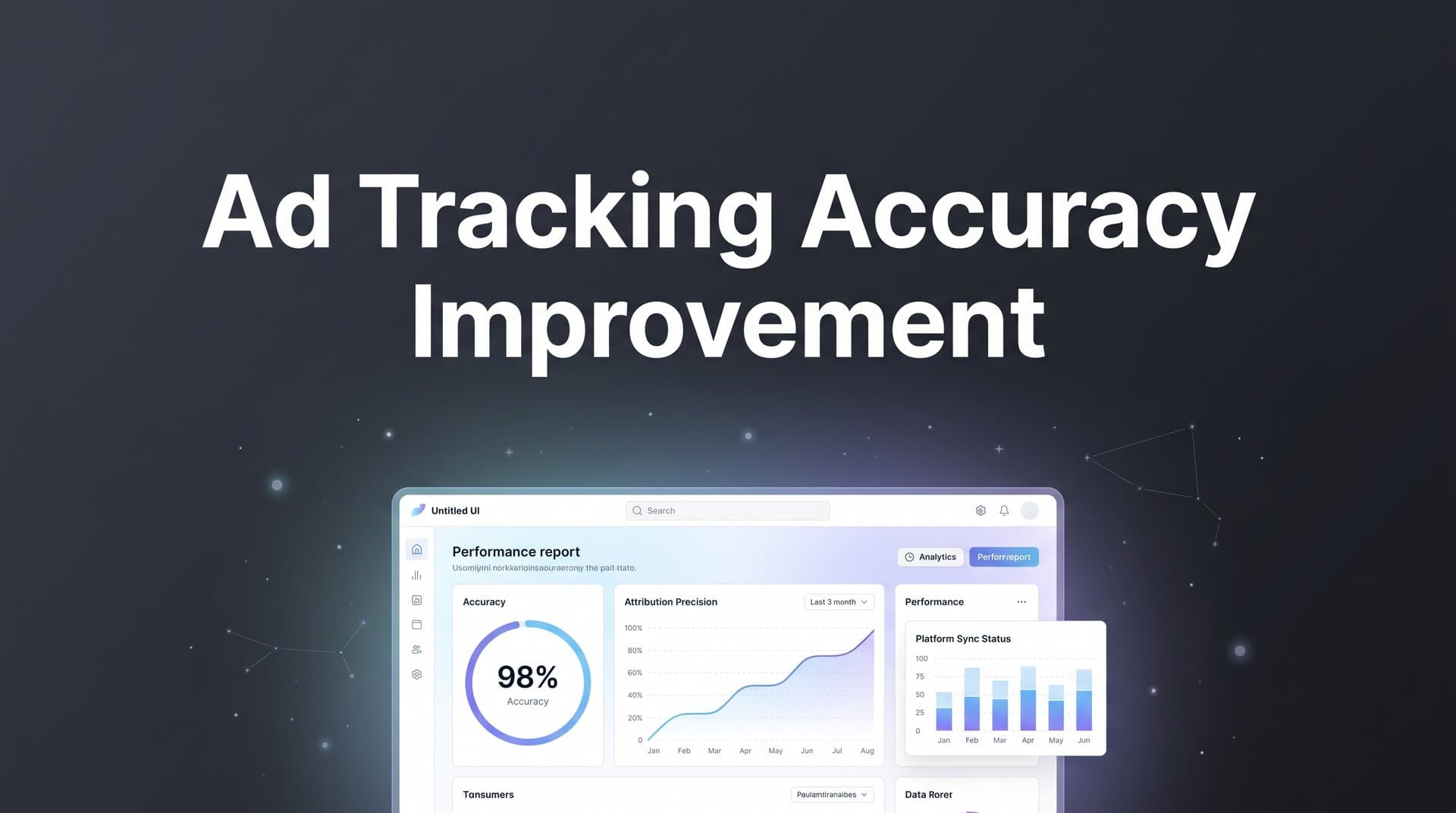
Real-time dashboard monitoring: Cometly's analytics dashboard lets you monitor attribution data in real time, so you can catch discrepancies before they compound into weeks of misallocated budget. Rather than waiting for your weekly check to notice a problem, you can see when something looks off as it happens.
Conversion drop alerts: Set up alerts for sudden drops in tracked conversions. A sharp decline in a single day often signals a broken pixel, an expired API token, or a website change that disrupted tag firing. Catching this within hours instead of days saves significant budget from being spent on campaigns operating without proper signal.
Tracking documentation: Create and maintain a document that describes your complete tracking setup: which pixels are on which pages, how your tag manager is configured, which server-side integrations are active, and what each conversion event represents. When team members change or new campaigns launch, this documentation ensures tracking standards are maintained consistently.
AI-powered performance monitoring: Beyond just catching breaks, use AI-powered recommendations to identify high-performing ads and campaigns across every channel. When your tracking data is clean and validated, AI recommendations become genuinely actionable. You can scale with confidence because you know the signals driving those recommendations are accurate. For a deeper look at how accurate data enables scaling, explore how ad tracking tools can help you scale ads effectively.
The goal of this step is to compress the time between when a tracking issue occurs and when you catch it. Teams without a monitoring process often discover problems weeks later, when they notice their CPA has drifted or a campaign has underperformed. Teams with a monitoring process catch the same issues in days, limiting the damage significantly.
Success indicator: You catch tracking issues within days of them occurring, and your attribution data stays consistently aligned with backend revenue data over time.
Your Ad Tracking Accuracy Action Plan: Putting It All Together
Improving ad tracking accuracy is not about finding a single silver bullet. It is about building a layered system where each step reinforces the others. The audit reveals where data is leaking. The pixel fixes address foundational errors. Server-side tracking captures what browsers miss. Unified attribution eliminates double-counting. Enriched conversion sync improves how algorithms optimize. And ongoing monitoring keeps the whole system honest over time.
Before you wrap up, run through this quick checklist:
Tracking audit completed: Documented discrepancies per platform and per campaign, with a clear accuracy baseline established.
Pixels and tags verified: Deduplicated, firing correctly on true conversion actions, with accurate parameters across all pages and platforms.
Server-side tracking implemented: Running alongside client-side pixels with proper deduplication, capturing conversions that browser-based tracking misses.
Multi-touch attribution unified: A single source of truth across all channels, with the attribution model aligned to your sales cycle and business goals.
Enriched conversion data syncing: Revenue values, lead quality scores, and CRM outcomes flowing back to ad platforms to improve algorithm optimization.
Weekly monitoring process in place: Alerts configured for conversion drops, and a recurring check comparing platform data against backend reality.
If you want to shortcut this process and get accurate attribution data flowing across every channel without building and maintaining each integration separately, Cometly brings all of these capabilities into one platform. From server-side tracking and multi-touch attribution to conversion sync and AI-powered recommendations, it is built for marketers who want clear, accurate data they can actually act on.
Get your free demo today and start capturing every touchpoint to maximize your conversions.