

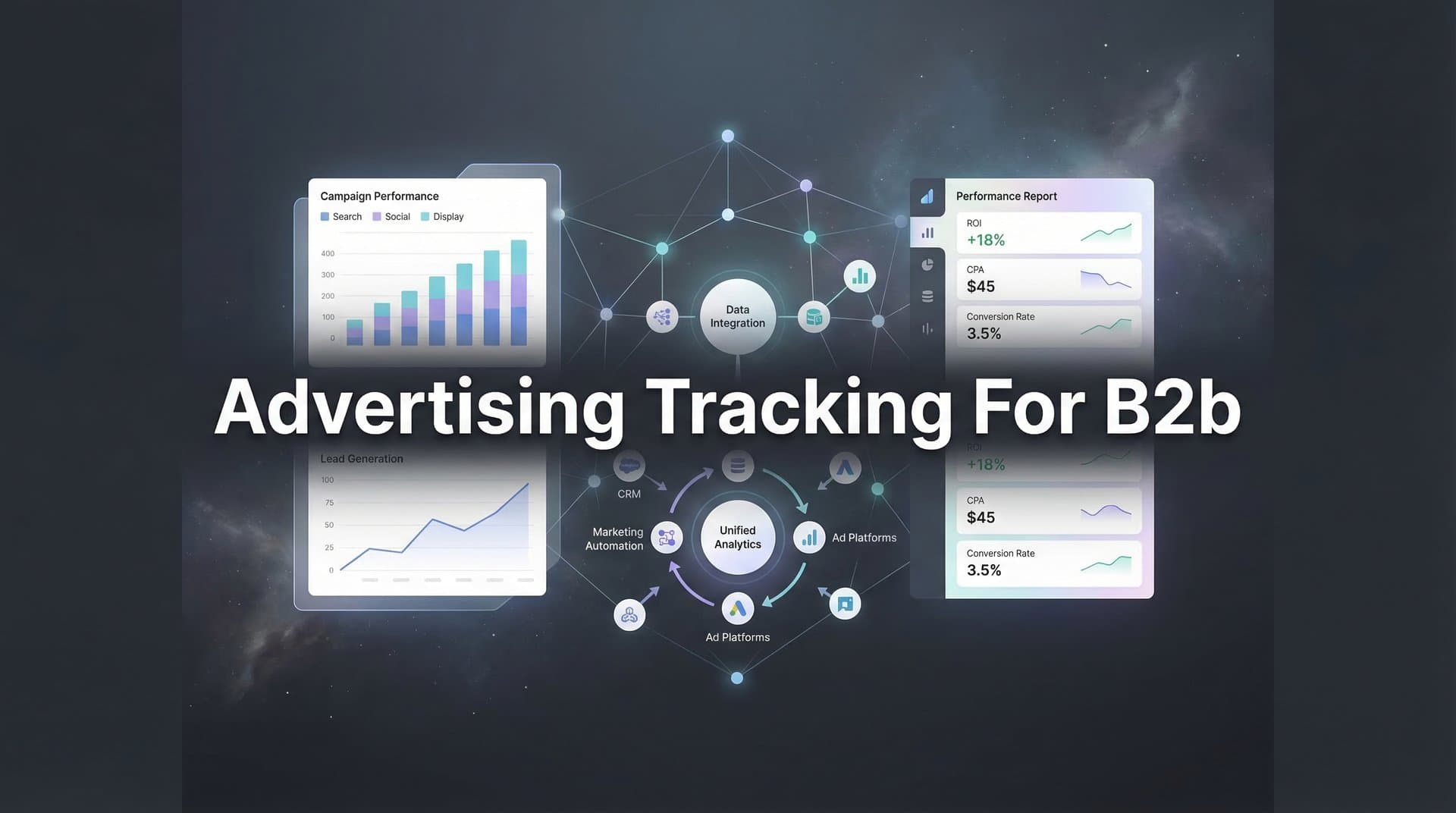
B2B advertising tracking presents unique challenges that B2C marketers rarely face. With sales cycles stretching across months, multiple decision-makers involved in each purchase, and touchpoints spanning from initial LinkedIn ad click to final contract signature, traditional tracking methods fall short. The disconnect between ad platforms reporting conversions and your CRM showing actual revenue creates a visibility gap that leads to wasted ad spend and missed optimization opportunities.
This guide delivers seven actionable strategies specifically designed for B2B advertising tracking—from connecting your entire tech stack to implementing server-side tracking that survives privacy restrictions. Whether you're struggling to attribute pipeline to specific campaigns or trying to prove marketing ROI to your leadership team, these strategies will help you build a tracking system that captures the complete B2B buyer journey.
1. Connect Your CRM to Your Ad Platforms
The Challenge It Solves
Your ad platforms show you clicks, impressions, and form fills. Your CRM shows you qualified leads, opportunities, and closed revenue. The problem? These two systems rarely talk to each other, creating a massive blind spot in your tracking for B2B marketing campaigns.
When you can't connect ad engagement to actual revenue, you're forced to optimize campaigns based on incomplete data. You might be scaling ads that generate clicks but never convert to customers, while underinvesting in campaigns that drive your most valuable accounts.
The Strategy Explained
CRM integration creates a direct connection between your advertising platforms and your sales data. This integration allows you to see which specific ads, campaigns, and channels are generating not just leads, but qualified opportunities and closed deals.
The connection works both ways. Your CRM sends conversion events back to your ad platforms when leads progress through your sales funnel—from marketing qualified lead to sales accepted lead to closed won. This feedback loop gives ad algorithms the revenue signals they need to optimize for business outcomes, not just surface-level engagement.
For B2B marketers, this means you can finally answer questions like: Which LinkedIn campaign generated that $100K deal? What's the true cost per opportunity for our Google Ads investment? Which channels have the highest lead-to-customer conversion rates?
Implementation Steps
1. Identify your core conversion events in your CRM (MQL, SQL, opportunity created, closed won) and map them to corresponding stages you want to track in your ad platforms.
2. Set up integration using native connectors if available, or use a marketing attribution platform that connects your CRM to multiple ad platforms simultaneously for unified tracking.
3. Configure conversion value tracking to pass deal amounts from your CRM back to ad platforms, enabling true ROAS (return on ad spend) measurement instead of just conversion counting.
4. Create custom audiences in your ad platforms based on CRM data segments—target lookalikes of your best customers or exclude existing customers from acquisition campaigns.
Pro Tips
Start by tracking just one or two critical conversion events before expanding to your full funnel. Test your integration with a small campaign first to verify data accuracy. Set up alerts to catch integration failures quickly—a broken connection means lost attribution data you can't recover later.
2. Implement Server-Side Tracking
The Challenge It Solves
Browser-based tracking pixels face increasing limitations. Ad blockers, privacy-focused browsers, and iOS restrictions block or limit traditional client-side tracking, creating gaps in your conversion data. When your tracking pixel fires in the browser, you're at the mercy of user privacy settings and technical restrictions beyond your control.
For B2B marketers, this data loss is particularly painful. Your prospects often use corporate networks with strict security policies, VPNs, and ad blocking software. The result? You're making budget decisions based on incomplete information about which ads actually drive results.
The Strategy Explained
Server-side tracking shifts data collection from the user's browser to your own server infrastructure. Instead of relying on JavaScript pixels that run in the browser, conversion events are sent directly from your server to ad platforms through secure APIs.
This approach bypasses browser restrictions entirely. When a user converts on your website, your server captures that event and sends it to your ad platforms as a first-party data transmission. Ad blockers can't interfere because the communication happens server-to-server, not through browser scripts.
The accuracy improvement is substantial. Server-side tracking captures conversions that browser-based pixels miss, giving you a more complete picture of campaign performance and providing ad platform algorithms with better optimization signals. This is especially important when dealing with cookie tracking problems in advertising.
For a deeper dive into this space, see our AI advertising agent guide.
Implementation Steps
1. Set up server-side conversion tracking through your ad platforms' API endpoints—Meta Conversions API, Google Ads API, and LinkedIn Conversions API each have specific setup requirements.
2. Configure your website or application to send conversion events to your server when users complete key actions, including form submissions, demo bookings, and account creations.
3. Implement event matching parameters (email hashes, IP addresses, user agent strings) to help ad platforms match server-side events to the correct user profiles for attribution.
4. Run server-side tracking in parallel with your existing pixel-based tracking initially to validate data accuracy and identify any gaps before fully transitioning.
Pro Tips
Prioritize your highest-value conversion events for server-side implementation first. Use a marketing attribution platform that handles server-side tracking infrastructure for you if building custom integrations feels overwhelming. Monitor event match rates in your ad platforms to ensure your server-side events are being properly attributed to users.
3. Use Multi-Touch Attribution
The Challenge It Solves
Last-click attribution credits only the final touchpoint before conversion, ignoring every marketing interaction that happened earlier. For B2B companies with extended sales cycles, this creates a distorted view of campaign performance.
Think about your typical enterprise deal: A prospect might first discover you through a LinkedIn ad, return via organic search, download a whitepaper from a retargeting campaign, attend a webinar, and finally convert through a direct visit weeks later. Last-click attribution gives all credit to that final direct visit, making it appear that your paid campaigns delivered no value.
The Strategy Explained
Multi-touch attribution distributes conversion credit across all touchpoints in the buyer journey. Instead of declaring one interaction the "winner," you acknowledge that multiple marketing efforts worked together to generate the conversion.
Different attribution models distribute credit differently. Linear attribution splits credit evenly across all touchpoints. Time-decay gives more weight to recent interactions. Position-based models emphasize first and last touches while acknowledging middle interactions. Understanding attribution modeling for paid advertising helps you choose the right approach for your business.
For B2B marketing teams, multi-touch attribution reveals which channels excel at different funnel stages. You might discover that LinkedIn drives excellent awareness, Google Ads captures high-intent searches, and email nurtures prospects to conversion. This visibility enables smarter budget allocation across your full marketing mix.
Implementation Steps
1. Map your typical buyer journey to identify all meaningful touchpoints—from first awareness through conversion—and determine which interactions you need to track.
2. Implement tracking that captures and stores the complete sequence of interactions for each prospect, not just the most recent touchpoint.
3. Choose an attribution model that aligns with your business goals and sales cycle length, starting with a simple model like linear or time-decay before experimenting with custom weighting.
4. Compare attribution model results side-by-side to understand how different approaches change channel performance rankings and inform your budget decisions.
Pro Tips
Don't obsess over finding the "perfect" attribution model. The goal is better decision-making, not mathematical perfection. Run attribution reports for closed deals specifically, not just leads, to see which channels drive actual revenue. Review attribution data monthly to spot trends rather than reacting to daily fluctuations.
4. Track Offline Conversions
The Challenge It Solves
The most valuable B2B conversions often happen outside your website. A prospect clicks your ad, fills out a form, then has three sales calls before signing a contract. Your ad platform sees the form fill but has no visibility into whether that lead became a customer.
This disconnect between online engagement and offline outcomes means you're optimizing for form fills instead of revenue. You might be scaling campaigns that generate lots of leads but few customers, while underfunding campaigns that drive qualified opportunities.
The Strategy Explained
Offline conversion tracking connects ad engagement to high-value actions that happen away from your website—sales calls, product demos, contract signatures, and closed deals. By feeding these offline events back to your ad platforms, you give algorithms the signals they need to optimize for business outcomes.
The process involves capturing offline conversion data in your CRM or sales system, then sending that information back to ad platforms through API integrations. When you tell Google Ads that a specific click resulted in a $50K deal three months later, the algorithm learns which audience characteristics and creative approaches drive valuable customers.
This feedback loop dramatically improves targeting over time. Ad platforms can identify patterns in your best customers and find more prospects who match those characteristics, reducing acquisition costs while improving lead quality. Effective attribution tracking for lead generation makes this possible.
Implementation Steps
1. Define which offline events matter most for your business—typically demo completions, opportunity creation, and closed won deals—and ensure your CRM captures these with timestamps.
2. Implement click ID parameter passing in your ad URLs (GCLID for Google, FBCLID for Meta) so you can match offline conversions back to specific ad clicks when they occur later.
3. Set up offline conversion imports through your ad platforms' interfaces or APIs, mapping your CRM events to corresponding conversion actions in each platform.
4. Configure conversion windows that match your sales cycle length—if deals close within 90 days, set your conversion window to capture those delayed conversions.
Pro Tips
Include conversion values when uploading offline conversions to enable value-based bidding and true ROAS measurement. Create separate conversion actions for different funnel stages rather than lumping everything into one generic "offline conversion" event. Schedule automated daily or weekly imports to keep your ad platforms updated with fresh conversion data.
5. Build UTM Parameter Standards
The Challenge It Solves
Inconsistent UTM parameters create chaos in your analytics. One team member tags campaigns with "utm_source=linkedin" while another uses "utm_source=LinkedIn" or "utm_source=li." Your reports show three separate sources instead of one, fragmenting your data and making performance analysis nearly impossible.
When multiple people or agencies manage campaigns without standardized naming conventions, your attribution data becomes unreliable. You can't accurately compare channel performance, track campaign ROI, or make confident budget decisions based on fragmented, inconsistent tracking.
The Strategy Explained
UTM parameter standards establish consistent naming conventions and enforcement processes across your entire marketing team. By defining exactly how to tag every campaign, you ensure clean, reliable attribution data that actually supports decision-making.
A solid UTM framework specifies naming conventions for sources, mediums, campaigns, content variations, and keywords. It includes documentation that everyone can reference, examples for common scenarios, and ideally a URL builder tool that prevents manual tagging errors.
The investment in standardization pays dividends in data quality. Clean UTM parameters enable accurate channel comparison, reliable campaign tracking, and confident attribution analysis—all essential for B2B marketers managing complex, multi-channel strategies. Consider using a marketing campaign tracking spreadsheet to maintain consistency.
We compare the leading options in our ad optimization software comparison roundup.
Implementation Steps
1. Document your UTM naming conventions in a shared guide that covers all five parameters (source, medium, campaign, content, term) with specific examples for each ad platform and campaign type.
2. Create a centralized URL builder tool or spreadsheet that enforces your standards automatically, preventing team members from manually typing inconsistent parameters.
3. Audit existing campaign URLs to identify and fix inconsistencies, then redirect old URLs to properly tagged versions where possible to preserve historical data accuracy.
4. Establish a review process where new campaigns must have UTM parameters validated before launch, and assign one person to own UTM governance across your team.
Pro Tips
Keep UTM values lowercase and use hyphens instead of spaces or underscores for consistency. Include date stamps in campaign names (like "2026-q1-linkedin-awareness") to make time-based analysis easier. Document your standards in your team wiki or shared drive where everyone can access them, and review quarterly as your marketing mix evolves.
6. Feed Enriched Data Back to Ad Platforms
The Challenge It Solves
Ad platform algorithms optimize based on the conversion signals you send them. If you only report form fills, the algorithm finds more people who fill out forms—regardless of whether those leads ever become customers. This creates a quality problem where you generate high volumes of low-value leads.
The disconnect between what ad platforms see (website conversions) and what you care about (qualified opportunities and revenue) means algorithms optimize for the wrong outcomes. You end up with impressive conversion numbers that don't translate to business growth.
The Strategy Explained
Conversion enrichment sends qualified lead and revenue data back to ad platforms after your sales team has evaluated lead quality. Instead of just telling Google Ads that someone filled out a form, you later send an update: "That lead became a sales qualified opportunity worth $75K."
This enriched feedback trains ad algorithms to identify characteristics of your best prospects. Over time, the platforms learn which audience segments, creative approaches, and targeting strategies generate not just conversions, but valuable customers. The result is improved targeting, lower acquisition costs, and higher lead quality.
For B2B marketers, this strategy is particularly powerful because it aligns ad optimization with business outcomes. Implementing marketing attribution platforms with revenue tracking helps you teach platforms to find more prospects like your best customers, not just more people who click and convert.
Implementation Steps
1. Set up conversion value tracking that passes deal amounts or lead scores from your CRM back to ad platforms when prospects reach qualified stages in your funnel.
2. Create custom conversion events for key qualification milestones—marketing qualified lead, sales accepted lead, opportunity created—and configure them in your ad platforms.
3. Implement automated syncing that updates conversion data as leads progress through your sales process, ensuring ad platforms receive enrichment signals within your conversion window.
4. Enable value-based bidding strategies in your ad platforms once you have sufficient conversion value data, allowing algorithms to optimize for revenue instead of just conversion volume.
Pro Tips
Start with one high-value conversion event before expanding to multiple enrichment signals. Use a marketing attribution platform like Cometly that automates conversion enrichment across all your ad platforms simultaneously. Monitor lead quality metrics alongside conversion volume to ensure enriched data actually improves targeting over time.
7. Consolidate Cross-Platform Analytics
The Challenge It Solves
Running campaigns across LinkedIn, Google Ads, Meta, and other platforms means logging into multiple dashboards to understand performance. Each platform reports metrics differently, uses different attribution windows, and credits conversions according to its own methodology.
This fragmentation makes it nearly impossible to answer simple questions like "Which channel drives the most pipeline?" or "What's our blended cost per opportunity across all platforms?" You're forced to export data manually, reconcile discrepancies in spreadsheets, and make budget decisions based on incomplete comparisons.
The Strategy Explained
A unified analytics dashboard consolidates data from all your ad platforms and your CRM into a single view with consistent metrics and attribution methodology. Instead of comparing apples to oranges across platform-specific reports, you see true cross-channel performance in one place.
This consolidation reveals insights that individual platform dashboards hide. You might discover that LinkedIn generates expensive clicks but high-value opportunities, while Google Ads delivers cheaper conversions with lower deal sizes. Effective cross-platform attribution tracking enables smarter budget allocation based on actual business impact, not just platform-reported metrics.
For B2B marketing teams managing complex channel mixes, unified analytics transforms scattered data into actionable intelligence. You can confidently answer leadership questions about marketing ROI, identify underperforming channels to cut, and double down on strategies that drive real revenue growth.
Implementation Steps
1. Choose a marketing attribution platform that connects to all your ad platforms and your CRM, pulling data into unified dashboards with consistent attribution rules across channels.
2. Define your core metrics and KPIs that matter for business decisions—typically cost per lead, cost per opportunity, opportunity-to-customer rate, and customer acquisition cost by channel.
3. Set up automated reporting dashboards that update daily with fresh data from all platforms, eliminating manual export and reconciliation work.
4. Create channel comparison views that show performance side-by-side using the same attribution model and conversion definitions, enabling true apples-to-apples analysis.
Pro Tips
Focus on a small set of critical metrics rather than trying to track everything. Build separate dashboards for different stakeholders—executives need high-level ROI views while campaign managers need granular performance data. Schedule weekly reviews of your consolidated analytics to spot trends and optimization opportunities early.
Putting It All Together
Implementing these seven strategies transforms B2B advertising tracking from a frustrating guessing game into a reliable system that connects ad spend to actual revenue. Start with the highest-impact changes first: connect your CRM to your ad platforms and implement server-side tracking to establish your data foundation. These two strategies alone will dramatically improve attribution accuracy and give you visibility into which campaigns drive real business outcomes.
Then layer in multi-touch attribution and offline conversion tracking to capture the full buyer journey. B2B sales cycles involve multiple touchpoints across weeks or months—your tracking system needs to reflect that complexity. By crediting all meaningful interactions and connecting online engagement to offline conversions, you build a complete picture of campaign performance.
Finally, create feedback loops by syncing enriched conversion data back to ad platforms and consolidating everything in unified dashboards. These strategies improve targeting quality over time while giving you the cross-channel visibility needed for confident budget decisions. When you tell ad algorithms which leads became valuable customers, they learn to find more prospects like your best accounts.
The B2B marketers who master advertising tracking gain a significant competitive advantage. They can confidently scale what works, cut what doesn't, and prove marketing's revenue impact with data leadership trusts. While competitors optimize for vanity metrics like clicks and impressions, you're optimizing for the metrics that actually matter: qualified pipeline and closed revenue.
Ready to elevate your marketing game with precision and confidence? Discover how Cometly's AI-driven recommendations can transform your ad strategy—Get your free demo today and start capturing every touchpoint to maximize your conversions.


