You have a finite ad budget. You are running campaigns on Meta, Google, TikTok, and maybe LinkedIn. Each platform has its own dashboard, its own attribution model, and its own story about what is working. And every week, you are making allocation decisions that could make or break your return on ad spend, often based on incomplete data and a lot of instinct.
Sound familiar? This is the reality for most digital marketers today. Budget allocation across multiple platforms is one of the hardest problems in paid advertising, not because marketers lack skill, but because the complexity of cross-channel data makes confident decisions nearly impossible without the right infrastructure.
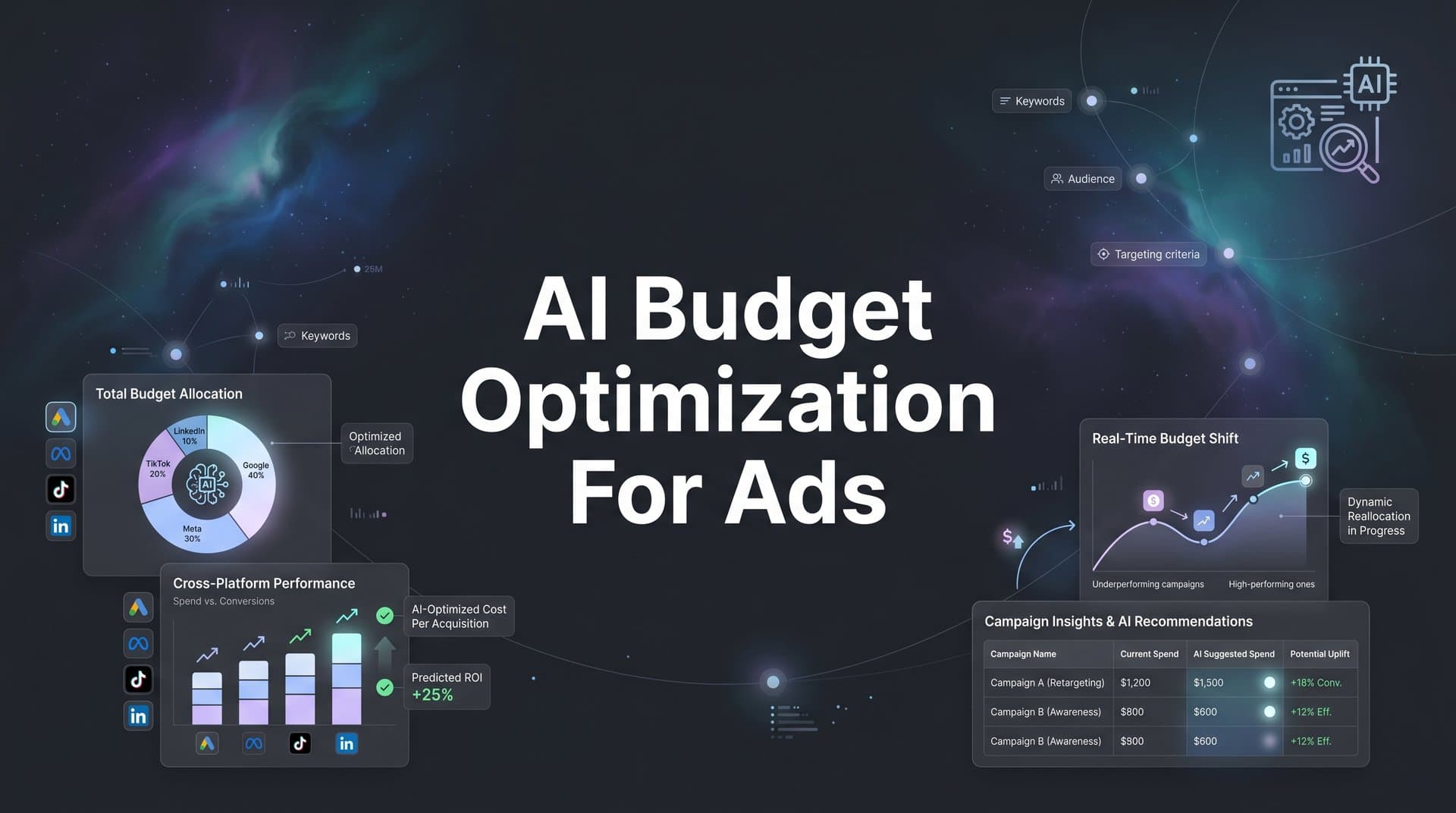
This is exactly where AI budget optimization for ads changes the game. Instead of reacting to last week's numbers and making gut-feel calls about where to shift spend, AI-driven optimization analyzes performance signals in real time, models the full customer journey, and recommends specific budget actions that are grounded in data. The result is faster decisions, less wasted spend, and campaigns that compound their results over time.
In this article, we will break down how AI budget optimization for ads actually works, why traditional approaches consistently fall short, what role attribution data plays in making AI recommendations trustworthy, and how you can set up your ad stack to take full advantage of it.
Why Traditional Ad Budget Allocation Falls Short
Manual budget allocation has a fundamental timing problem. By the time you review last week's performance data, pull reports from each platform, and make a decision about where to shift spend, the market has already moved. Campaigns that were performing well may have started to fatigue. New opportunities may have emerged. The window for optimal action has often already closed.
This is the nature of lagging indicators. Most marketers rely on weekly performance reviews, last-click attribution, and platform-native dashboards that each tell a different version of the same story. Last-click attribution, in particular, gives an outsized amount of credit to the final touchpoint before conversion, often a branded search or a retargeting ad, while completely ignoring the awareness and consideration campaigns that drove the customer into the funnel in the first place. When you optimize budget based on last-click data, you systematically defund the top of your funnel and wonder why your pipeline eventually dries up.
Cross-platform complexity compounds this problem significantly. Meta reports conversions one way. Google reports them another. TikTok has its own attribution window. LinkedIn uses different default settings entirely. When you try to compare performance across these platforms using their native dashboards, you are not comparing apples to apples. You are comparing apples to something that vaguely resembles fruit. The result is siloed decision-making where each platform looks like it is performing reasonably well in isolation, but you have no reliable view of how they interact or which one is actually driving revenue.
The real cost of this misalignment is not just inefficiency. It is compounding loss. When budget flows to underperforming campaigns because the data makes them look better than they are, and high-potential campaigns are starved of spend because their contribution is invisible in last-click models, the gap between actual and optimal performance widens over time. Every dollar misallocated today is a dollar that is not building the learning history your campaigns need to improve tomorrow. Understanding these marketing budget optimization struggles is the first step toward solving them.
Traditional budget management also requires constant human attention. Someone has to pull the reports, interpret the data, make the call, and implement the change. In fast-moving markets, this manual process creates a lag between insight and action that costs real money. AI budget optimization addresses all of these problems simultaneously, starting with the data layer.
The Mechanics Behind AI Budget Optimization for Ads
At its core, AI budget optimization for ads is a prescriptive analytics function. It does not just describe what happened or predict what might happen. It tells you what you should do next with your budget, and it backs that recommendation with data from across your entire ad ecosystem.
The process starts with data ingestion. AI models need a complete, unified view of performance across every channel you are running. This means pulling in campaign data from Meta, Google, TikTok, LinkedIn, and any other platforms in your stack, alongside conversion data from your website and CRM. The richer and more complete this data, the more accurate the AI's recommendations will be. A robust analytics platform for paid ads is essential for consolidating these data streams.
From there, the AI analyzes historical performance patterns alongside real-time signals. It looks at which campaigns, ad sets, audiences, and creatives have historically driven the strongest return. It identifies patterns in conversion timing, audience behavior, and creative performance across different channels. It factors in signals like audience saturation, creative fatigue, and competitive pressure that a human reviewer might miss when scanning a dashboard manually.
Multi-touch attribution data is what separates genuinely useful AI budget optimization from surface-level reporting. When AI has access to the full customer journey, not just the last click, it can accurately assess the contribution of every touchpoint to a conversion. A prospecting campaign on Meta that rarely closes a sale directly might still be a critical driver of pipeline because it is consistently the first touch for customers who later convert through Google search. Without multi-touch attribution data, the AI would undervalue that campaign and recommend cutting its budget. With it, the AI can see its true role and allocate accordingly.
The dynamic reallocation piece is what makes AI particularly powerful compared to manual approaches. Human budget managers review performance periodically, maybe weekly or bi-weekly. AI models can continuously recalculate optimal budget distribution as performance shifts in real time. If a campaign starts outperforming its benchmarks on a Tuesday afternoon, the AI can flag it immediately. If an audience segment starts showing fatigue signals, the AI can recommend pulling back before significant budget is wasted. Learn more about how automated budget reallocation for campaigns works in practice.
This continuous optimization loop means your budget is always moving toward the highest-performing opportunities, rather than sitting in allocations that made sense two weeks ago but no longer reflect current performance. Over time, this compounding effect of continuous small optimizations adds up to significantly better overall campaign efficiency.
The distinction between AI that surfaces insights and AI that recommends specific actions is important here. Descriptive analytics tells you what happened. Predictive analytics tells you what might happen. Prescriptive AI budget optimization tells you exactly what budget shift to make and why. That last step is where the real value lives for marketers who need to act, not just analyze.
What Accurate Attribution Data Changes About Optimization
Here is the hard truth about AI budget optimization: it is only as good as the data feeding it. The most sophisticated AI model in the world will produce flawed recommendations if it is working with incomplete or inaccurate conversion data. And for most marketers today, data accuracy is a real and growing problem.
The iOS privacy updates that began rolling out in 2021 significantly degraded the accuracy of pixel-based tracking. When users opt out of tracking, client-side pixels cannot capture their activity. This means conversions go unrecorded, attribution windows become unreliable, and the data your AI is analyzing has systematic gaps that skew every recommendation it makes. Cookie deprecation across major browsers has added further pressure on client-side tracking methods, and the trend toward greater user privacy is not reversing.
The practical consequence is that if you are relying solely on platform pixels and browser cookies for conversion data, a meaningful portion of your actual conversions are invisible to your attribution system. Your AI is optimizing based on a partial picture, which means it will consistently undervalue channels and campaigns that serve privacy-conscious audiences and overallocate to those where tracking happens to be more complete. These are the kinds of ad performance optimization blind spots that silently erode your results.
Server-side tracking solves this problem by moving the data collection process from the user's browser to your own server. Because the tracking happens server-side, it is not subject to browser-based blocking or iOS opt-out restrictions in the same way. This means you capture more conversions, more accurately, with more complete customer journey data. When that richer data feeds your AI models, the quality of budget recommendations improves substantially.
Enriched conversion data also creates a compounding benefit when synced back to the ad platforms themselves. Meta's Advantage+ campaigns, Google's Smart Bidding, and similar platform-native optimization systems all rely on conversion signals to train their algorithms. When you send more complete and accurate conversion events back to these platforms, their algorithms get smarter. They target better audiences, optimize bids more effectively, and deliver better results at the campaign level. Understanding these ad platform algorithm optimization strategies is critical for maximizing this feedback loop.
This creates a layered optimization effect. Your external AI is making better cross-platform budget recommendations because it has complete data. Simultaneously, each platform's native algorithm is performing better because it is receiving enriched conversion signals. The two systems reinforce each other, and the compounding impact on overall ad performance can be significant.
The takeaway is straightforward: before you invest heavily in AI budget optimization capabilities, make sure your attribution foundation is solid. Accurate data is not a nice-to-have. It is the prerequisite for AI recommendations you can actually trust and act on with confidence.
AI Optimization in Action: From Insights to Budget Decisions
Let's make this concrete. Imagine a marketer running paid campaigns across three platforms: Meta for awareness and retargeting, Google for search and shopping, and TikTok for top-of-funnel video. Each platform is consuming a portion of the monthly budget, and performance varies across campaigns, audiences, and creative formats.
Without AI, this marketer is logging into three dashboards, trying to normalize the data, and making allocation decisions based on whatever metrics each platform chooses to surface. With AI budget optimization, they receive a unified view of cross-platform performance alongside specific recommendations. The AI might surface an insight like this: a particular Google search campaign is driving a high volume of first-touch interactions that consistently lead to conversions, but it is currently underfunded relative to its potential. Meanwhile, a Meta retargeting campaign is showing audience saturation signals, meaning the same users are seeing the same ads repeatedly without converting. Shifting a portion of budget from the saturated retargeting campaign to the high-converting search campaign could improve overall ROAS.
That is a prescriptive recommendation. Not just a report on what happened, but a specific action to take with a clear rationale. This is the difference between AI that informs and AI that actually helps you optimize. Explore how AI recommendations for ad campaign optimization translate data into actionable next steps.
Beyond budget reallocation, AI identifies patterns that are nearly impossible to spot manually at scale. Time-of-day performance variations, for example, can be significant. Certain audiences convert at much higher rates during specific windows, and manual budget management rarely accounts for this with enough precision. AI can detect these patterns across millions of data points and factor them into recommendations automatically.
Creative decay is another pattern AI catches early. When an ad has been in market for a while, engagement rates typically decline as audiences become familiar with it. AI can identify the early signals of creative fatigue before performance drops significantly, giving you time to rotate in fresh creative before spend efficiency deteriorates. Human reviewers often catch this late, after meaningful budget has already been wasted on underperforming campaigns.
Audience overlap and cannibalization are additional areas where AI adds value. When multiple campaigns are targeting overlapping audiences across platforms, they can compete against each other in auctions, driving up costs without improving overall reach. AI can identify these inefficiencies and recommend structural changes that improve both reach and cost efficiency simultaneously.
The practical value of all this is not just marginal improvement. It is the ability to make faster, better-informed decisions across your entire ad portfolio without needing to manually analyze every data point yourself. AI handles the pattern recognition. You handle the strategic judgment calls.
How to Set Up Your Ad Stack for AI-Driven Budget Optimization
Getting the most from AI budget optimization requires the right infrastructure in place before you start acting on recommendations. Here is a practical framework for setting up your ad stack to support effective AI-driven optimization.
Step 1: Unify your data sources. AI budget optimization requires a complete, cross-platform view of performance. That means connecting your ad platforms, CRM, and website analytics into a single attribution platform. When all your data flows into one place, the AI has the full picture it needs to make accurate cross-channel recommendations. Siloed data produces siloed insights, and siloed insights produce poor budget decisions. The foundation of effective AI optimization is unified data. A dedicated marketing budget optimization platform can serve as this central hub.
Step 2: Implement server-side tracking and conversion sync. As discussed earlier, accurate attribution data is the prerequisite for trustworthy AI recommendations. Implement server-side tracking to capture conversions that client-side pixels miss, and set up conversion sync to send enriched conversion events back to your ad platforms. This two-step approach improves both the quality of your attribution data and the performance of platform-native algorithms, creating the compounding optimization effect that makes AI budget optimization genuinely powerful over time.
Step 3: Start acting on AI recommendations incrementally. When you first receive AI-generated budget recommendations, resist the urge to either ignore them entirely or implement them all at once. Start with smaller, targeted budget shifts on campaigns where the AI's recommendation is backed by strong data signals. Measure the impact of those shifts over a meaningful time window, then scale the approach to your broader portfolio as you build confidence in the recommendations. This incremental approach lets you validate the AI's logic against real-world outcomes before committing significant budget to its guidance. For a deeper dive into this process, review these best practices for real-time marketing optimization.
The mindset shift that supports this process is important. AI budget optimization is not about removing human judgment from the equation. It is about giving human judgment better data to work with. You still make the final call. The AI just ensures that call is based on the most complete and accurate picture available.
Scaling With Confidence: What to Expect as AI Optimizes Your Budget
One of the most valuable properties of AI budget optimization is that it gets better over time. Each cycle of data collection, analysis, and reallocation teaches the model more about your campaigns, your audiences, and your conversion patterns. Early recommendations are good. Recommendations six months in, when the AI has built a rich history of your specific ad ecosystem, are significantly better.
This compounding improvement is one of the strongest arguments for getting started with AI budget optimization sooner rather than later. The sooner you begin feeding accurate, unified data into an AI system, the sooner that system starts building the learning history that makes its recommendations increasingly precise. Evaluating the right real-time budget optimization tools is a critical part of this process.
In practical terms, marketers who adopt AI-driven budget optimization typically experience a few common outcomes. Visibility into true cost per acquisition across channels becomes much clearer, because the attribution model is capturing the full customer journey rather than giving all credit to the last click. Winning campaigns are identified faster, because AI can spot performance patterns in real time rather than waiting for weekly review cycles. Wasted spend on underperforming campaigns decreases, because budget reallocation happens continuously rather than in periodic manual reviews.
The mindset shift required to fully benefit from AI optimization is worth addressing directly. Many marketers are accustomed to maintaining tight manual control over every budget lever. There is a natural reluctance to trust recommendations generated by a system rather than a human with domain expertise. This is understandable, but it is also worth examining critically.
AI does not replace the strategic judgment of an experienced marketer. It amplifies it. You still define campaign goals, set strategic direction, and make decisions about brand positioning and audience targeting. What AI does is handle the analytical heavy lifting of pattern recognition and budget allocation for digital ads across thousands of data points simultaneously, something that is genuinely beyond human capacity to do manually at scale.
The marketers who scale most effectively with AI budget optimization are the ones who embrace this division of labor. They trust the data-driven recommendations for tactical budget decisions while maintaining strategic oversight of the overall campaign direction. That combination of AI efficiency and human strategy is where the real performance advantage lives.
Putting It All Together
AI budget optimization for ads is not a future capability. It is available now, and the marketers who are using it effectively are building a compounding performance advantage over those who are still managing budgets manually from siloed platform dashboards.
The key insight to take away is this: AI does not replace the marketer. It gives the marketer a powerful advantage by making faster, more accurate budget decisions possible. It surfaces patterns that are invisible in manual analysis. It recommends specific actions grounded in complete cross-platform data. And it gets smarter with every optimization cycle.
But all of that depends on one critical prerequisite: the quality of your attribution data. If your tracking has gaps due to iOS restrictions, cookie limitations, or pixel-only setups, your AI is working with incomplete information and its recommendations will reflect that. Server-side tracking, enriched conversion data, and unified attribution are not optional extras. They are the foundation that makes AI budget optimization trustworthy and effective.
Before you invest in optimization capabilities, take an honest look at your current attribution and tracking setup. Ask whether your AI has access to the complete, accurate data it needs to make recommendations you can act on with confidence.
If you are ready to build that foundation and start scaling your ad spend with AI-driven precision, Get your free demo of Cometly today. Cometly's AI-powered attribution, server-side tracking, and budget optimization recommendations give you the complete data picture and the actionable insights you need to make every dollar of ad spend work harder.