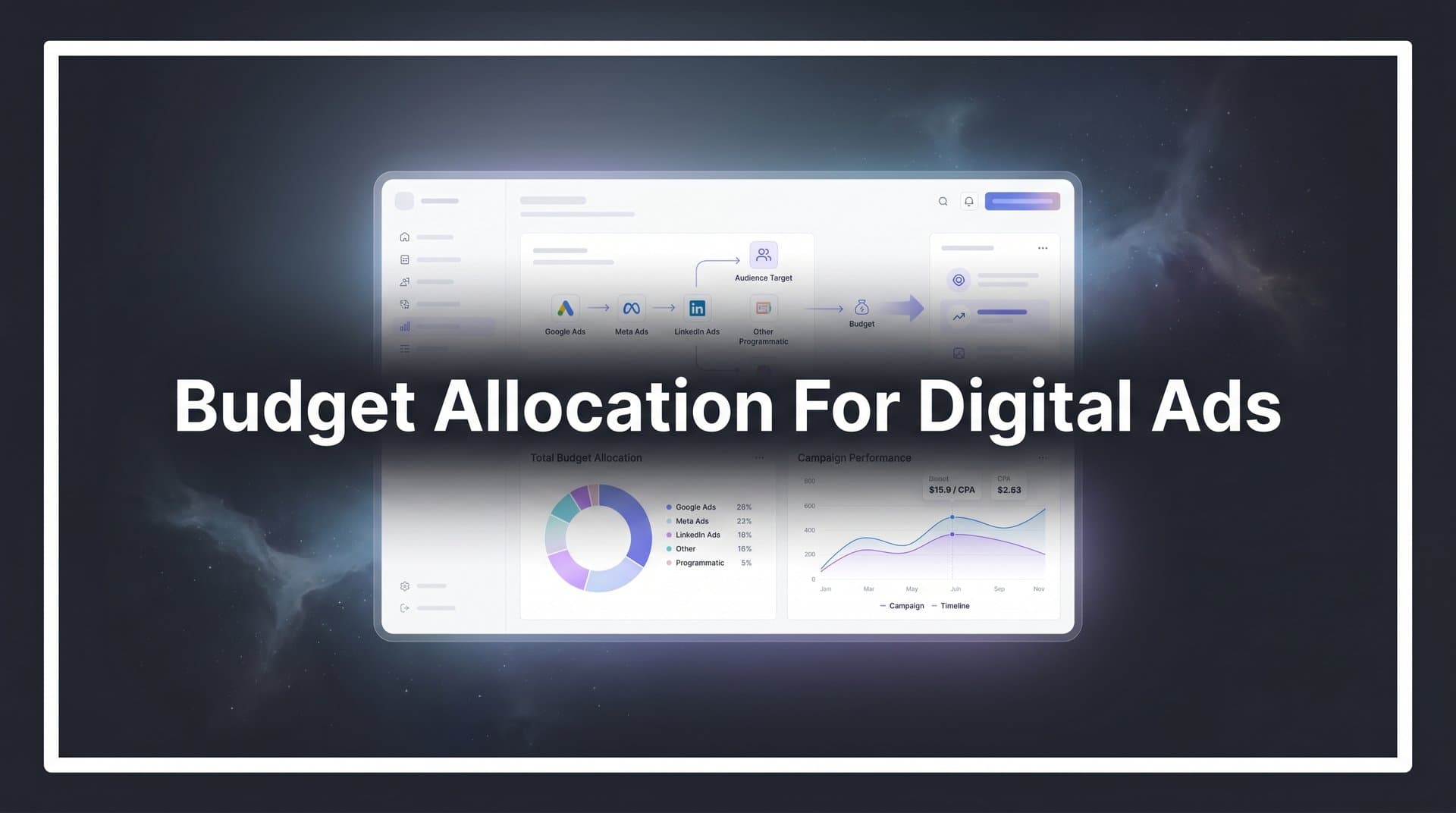
Spending money on digital ads is easy. Spending it wisely is where most marketing teams struggle.
Without a clear framework for budget allocation for digital ads, you end up pouring money into underperforming channels while starving the campaigns that actually drive revenue. The result is wasted ad spend, missed opportunities, and reports that leave leadership asking uncomfortable questions.
The core challenge is that most marketers rely on platform-reported metrics that often inflate results. Platforms double-count conversions, take credit for organic activity, and present numbers that make every channel look like a winner. When you cannot trust the data, every allocation decision becomes a guess dressed up as strategy.
There is also the multi-platform reality to contend with. Your customers do not convert after a single touchpoint. They see a YouTube ad, click a Google search result, get retargeted on Meta, and finally convert after receiving an email. If you only look at last-click attribution, you will consistently underfund the channels doing the early heavy lifting and overfund the ones just closing deals that were already in motion.
This guide walks you through a practical, repeatable process for allocating your digital ad budget with confidence. You will learn how to audit your current spend, set revenue-driven goals, distribute budget across channels using real performance data, and continuously optimize based on what is actually working.
Whether you are managing a few thousand dollars a month or scaling into six figures, these steps apply to any team running paid campaigns across platforms like Meta, Google, TikTok, and LinkedIn. By the end, you will have a clear system for making budget decisions rooted in attribution data rather than gut instinct.
Step 1: Audit Your Current Ad Spend and Performance Baseline
Before you can allocate budget intelligently, you need to understand exactly where your money is going and what it is actually producing. Most teams skip this step or do a surface-level version of it, which means they carry bad assumptions forward into every future decision.
Start by pulling spend data from every active ad platform into a single view. Google Ads, Meta, TikTok, LinkedIn, Pinterest, programmatic networks, whatever you are running. The goal is one consolidated picture of total spend, not a collection of siloed platform dashboards that each tell their own flattering story.
For each channel, document these core metrics:
Cost Per Acquisition (CPA): How much are you spending to generate one conversion? This is your most important efficiency metric, and it needs to be calculated using real conversions, not platform-reported ones.
Return on Ad Spend (ROAS): For every dollar spent, how much revenue is generated? Again, this number is only meaningful if your revenue data is accurate and verified against your CRM or payment processor.
Conversion Volume: How many conversions is each channel producing over a meaningful time period, typically 30 to 90 days? Low-volume channels are hard to optimize because the data is statistically noisy.
Here is where most audits reveal something uncomfortable: the numbers do not match. Platform-reported conversions often look significantly higher than what your CRM or payment processor records. This gap exists because ad platforms use broad attribution windows, take credit for view-through conversions that may be coincidental, and sometimes count the same conversion multiple times across platforms. Understanding why paid ads are not getting credit for sales is a critical part of diagnosing these discrepancies.
Your job in this step is to identify that gap for each channel. Flag every platform where you cannot clearly tie spend to verified revenue outcomes. These are your blind spots, and they represent budget that is being allocated based on fiction rather than fact.
Document everything in a simple spreadsheet: channel, monthly spend, platform-reported conversions, CRM-verified conversions, verified CPA, and verified ROAS. This becomes your baseline. Every future allocation decision will reference it.
The audit is not about finding channels to cut immediately. It is about establishing a trustworthy starting point. You cannot improve what you cannot accurately measure, and you cannot allocate confidently when your performance data is unreliable.
Step 2: Define Revenue Goals and Work Backward to Budget Targets
Most budget conversations start in the wrong place. Teams get handed a number, say $50,000 a month, and then figure out how to spend it. The smarter approach is to start with your revenue target and work backward to determine what budget is actually required to hit it.
This reversal changes everything. Instead of asking "how do we spend this budget?" you are asking "what does it cost to generate the revenue we need?" It is a subtle shift in framing that produces dramatically better decisions.
Here is how to do it in practice:
Start with your revenue or pipeline target. What does the business need from paid advertising this quarter? Get a specific number. If your goal is $500,000 in pipeline from paid channels, that is your anchor.
Calculate the conversions required. Divide your revenue target by your average deal value or customer lifetime value. If your average deal is $5,000, you need 100 new customers to hit $500,000. If your average deal is $500, you need 1,000. This gives you a conversion volume target to work toward.
Apply your verified CPA data. Using the baseline from your audit, apply each channel's verified CPA to estimate the budget required to generate those conversions. If your Google Search CPA is $200 and you need 60 conversions from that channel, you need roughly $12,000 in Google spend. Approaching marketing budget allocation based on data like this ensures every dollar has a purpose.
Build in a testing reserve. Set aside a portion of your total budget, typically somewhere between 10 and 20 percent, for experimentation. This covers new channels, new creative formats, new audience segments, and anything else you want to test without cannibalizing proven spend. Without a dedicated testing budget, you either never test anything new or you pull money from campaigns that are working.
Align expectations with your sales cycle. If your average sales cycle is 60 days, you should not expect this month's ad spend to show up as closed revenue this month. Build that lag into your projections and communicate it clearly to leadership. Misaligned expectations are a common source of premature budget cuts.
The output of this step is a budget target that is tied to a specific revenue outcome, not an arbitrary number. That connection gives you something to defend and optimize against.
Step 3: Map Your Customer Journey to Identify High-Impact Touchpoints
Here is a question most marketers cannot answer with confidence: how do your customers actually move from first awareness to final conversion? Not how you think they move, but how they actually behave based on data.
The answer matters enormously for budget allocation. If you allocate budget based only on last-click attribution, you will consistently underfund the channels that create demand and overfund the channels that simply capture it. Over time, this erodes your pipeline because you are harvesting intent without replenishing it.
Multi-touch attribution gives you a more accurate picture of which touchpoints contribute to revenue across the full journey. Instead of giving 100 percent of the credit to the last click before conversion, it distributes credit across every interaction that influenced the decision. Investing in the right attribution tools for digital marketing makes this level of visibility possible.
When you map the journey, you are looking for a few specific things:
Where does awareness begin? Which channels are introducing your brand to new audiences? YouTube, display, LinkedIn, and TikTok often play this role. These channels may show weak last-click numbers but consistently appear early in the paths of customers who eventually convert.
Where does consideration happen? After someone becomes aware of your brand, where do they go to learn more? Organic search, retargeting campaigns, and email often dominate this middle stage. These channels deserve credit for keeping prospects engaged.
Where does conversion happen? Branded search, direct, and retargeting typically show up here. These channels look great in last-click models, but they are often just the final step in a much longer journey that started elsewhere.
Identifying whether your funnel needs more investment at the top, middle, or bottom is one of the most valuable outputs of this exercise. A detailed guide on customer journey mapping for digital advertising can help you structure this analysis effectively.
This is where a platform like Cometly becomes genuinely useful. By connecting ad clicks to CRM events across the entire customer journey, Cometly gives you a complete, multi-touch view of how each channel contributes to revenue. You can see not just which channel got the last click, but which channels appeared in the paths of your highest-value customers. That visibility changes how you think about budget allocation entirely.
Step 4: Distribute Budget Across Channels Using Performance Data
Now you have a baseline, a revenue-driven budget target, and a clear picture of how your customer journey works. This is where you actually distribute the money.
The most effective approach uses a tiered structure that balances proven performance with strategic growth and controlled experimentation. Think of it as three buckets:
Core Channels (60 to 70 percent of budget): These are your proven performers. They have attribution-verified ROAS above your threshold, consistent conversion volume, and a clear connection to revenue in your CRM data. This is where the majority of your budget lives because the risk-adjusted return is highest. For most teams, this includes branded search, high-intent non-branded search, and your best-performing retargeting audiences.
Growth Channels (20 to 30 percent of budget): These are channels showing promise but not yet fully proven at scale. Maybe your Meta prospecting campaigns are generating leads at an acceptable CPA but have not been tested at higher spend levels. Maybe LinkedIn is producing strong pipeline from a specific job title audience. These channels get meaningful investment because they represent your next tier of scale, but they are monitored more closely.
Experimental Channels (10 to 20 percent of budget): This is your innovation budget. New platforms, new creative formats, new audience strategies. The goal here is not immediate ROAS. It is learning. You are buying data about what might become a core channel in the future.
A few principles to apply when distributing within these tiers:
Use verified conversion data, not vanity metrics. Impressions, clicks, and click-through rates tell you about activity, not outcomes. Allocate based on verified CPA and ROAS from your attribution data, not platform-reported numbers. Avoiding wasted ad budget on underperforming campaigns starts with this discipline.
Factor in channel-specific dynamics. Some channels have limited scalable inventory. Others face audience saturation at higher spend levels, meaning your CPA will rise as you push more budget through them. Account for these dynamics when deciding how much to allocate.
Avoid dangerous concentration. Putting the vast majority of your budget into a single platform creates real risk. Platform policies change. Auction costs spike. Algorithms shift. Understanding how to approach ad budget allocation between platforms is essential for managing this risk effectively.
Revisit the distribution quarterly. Channel performance changes. What was a growth channel six months ago may now deserve core status. What was a core channel may be showing signs of saturation. The tiers are not permanent labels, they are current assessments based on current data.
Step 5: Set Up Tracking That Connects Spend to Actual Revenue
Everything in this guide depends on one thing: accurate data. And accurate data depends on tracking that actually works in today's environment.
Browser-based pixel tracking, the foundation of most ad platform measurement for years, has become increasingly unreliable. iOS privacy updates limit the data available from Apple devices. Ad blockers prevent pixels from firing. Cookie deprecation continues to reduce visibility into cross-site behavior. The result is a growing gap between what actually happens and what your tracking captures. The impact of these changes has been significant since iOS 14 changed digital advertising fundamentally.
Server-side tracking closes much of that gap. Instead of relying on a pixel in the user's browser to fire and report a conversion, server-side tracking sends conversion data directly from your server to the ad platform. It is not affected by ad blockers, browser restrictions, or iOS privacy settings. The data is more complete, more accurate, and more reliable.
Here is what a complete tracking setup looks like:
Connect your ad platforms to your CRM. This allows you to trace every dollar of spend to downstream revenue, not just to a lead form submission. You want to know which campaigns generate customers, not just which ones generate leads. That distinction is critical for accurate CPA and ROAS calculations.
Implement conversion sync. This means feeding accurate purchase and lead data back to your ad platforms via their conversion APIs. When Meta, Google, or TikTok receive richer, more accurate conversion signals, their optimization algorithms perform better. They can find more customers who look like your actual buyers rather than optimizing toward proxy signals that may not correlate with revenue. Choosing the right tracking tools for digital marketing makes this process far more manageable.
Verify tracking accuracy regularly. Compare platform-reported conversions against your CRM or payment processor on a weekly basis. A consistent gap is a signal that your tracking has a problem that needs to be diagnosed. Do not assume the data is right just because the platforms say it is.
Cometly's server-side tracking and conversion sync are built specifically for this challenge. By capturing conversions that browser-based pixels miss and syncing accurate data back to ad platforms, Cometly helps marketers get reliable data flowing in both directions. That means better optimization from the platforms and more trustworthy attribution data for your own budget decisions.
Accurate tracking is not a nice-to-have. It is the foundation that every other step in this process depends on. Without it, you are allocating budget based on incomplete information, and the consequences show up in your ROAS whether you can see them or not.
Step 6: Monitor, Reallocate, and Optimize on a Regular Cadence
Budget allocation is not a one-time exercise. It is an ongoing discipline that requires a consistent review process and the willingness to act on what the data tells you.
The most effective teams operate on two distinct review cadences:
Weekly reviews for spend pacing and early signals. Each week, check that spend is tracking to plan across channels, flag any campaigns that are significantly over or under pacing, and look for early warning signs like rising CPAs or declining conversion rates. These reviews are tactical. You are not making major reallocation decisions here, you are catching problems before they compound.
Monthly deep-dives for reallocation decisions. Once a month, step back and look at the full picture. How is each channel performing against the targets you set? Has anything changed in your customer journey data? Are there channels that have graduated from growth to core status, or core channels showing signs of fatigue? Exploring real-time marketing budget allocation strategies can help you respond to these shifts more effectively.
To avoid making decisions based on emotion or short-term noise, set clear reallocation triggers in advance. For example: if a channel's CPA rises more than 30 percent above your target for two consecutive weeks, you will reduce its budget by a defined amount. If a growth channel hits your ROAS target for 30 consecutive days, it earns a budget increase. Having these rules written down removes the subjectivity from reallocation decisions.
AI-powered recommendations can surface optimization opportunities that are easy to miss in manual analysis. When you are managing multiple campaigns across multiple platforms, the volume of data is too large to review exhaustively by hand. Tools that analyze performance patterns and flag anomalies or opportunities help you act faster and more accurately.
One important caution: avoid reacting too quickly to short-term fluctuations. Campaigns need sufficient data before you can draw meaningful conclusions. A single bad week does not necessarily indicate a structural problem. Give campaigns enough runway to produce statistically meaningful results before making major changes.
Finally, document every reallocation decision and the reasoning behind it. This documentation builds institutional knowledge over time. When you revisit a decision six months later, you will understand why it was made and what you expected to happen. That context is invaluable for improving your decision-making process and for onboarding new team members who need to understand your strategy.
Putting It All Together: Your Budget Allocation Checklist
Budget allocation for digital ads is not complicated in theory. It is difficult in practice because it requires accurate data, clear goals, and the discipline to follow a process rather than react to whatever the platforms are telling you.
Here is the six-step process as a quick-reference checklist:
1. Audit current spend and baseline metrics. Pull all channel data into one view, document verified CPA and ROAS, and identify gaps between platform-reported and CRM-verified conversions.
2. Set revenue-driven budget targets. Start with your revenue goal, work backward to conversion volume requirements, apply historical CPA data, and reserve 10 to 20 percent for testing.
3. Map the customer journey with multi-touch attribution. Understand which channels contribute at each stage of the funnel and identify where your funnel needs more investment.
4. Distribute budget using verified performance data. Apply the tiered approach: core channels get 60 to 70 percent, growth channels get 20 to 30 percent, and experimental channels get 10 to 20 percent.
5. Implement accurate tracking that connects spend to revenue. Use server-side tracking, connect your CRM, and sync conversion data back to ad platforms to ensure your data is complete and reliable.
6. Monitor and reallocate on a regular cadence. Run weekly pacing reviews, monthly deep-dives, and set predefined reallocation triggers so your decisions are systematic rather than reactive.
The marketers who consistently outperform their peers are not the ones with the biggest budgets. They are the ones who build a system for continuous optimization powered by trustworthy data. Every dollar they allocate is informed by what actually happened, not what the platforms claim happened.
That kind of confidence comes from having the right attribution infrastructure in place. Cometly is built to give you exactly that: accurate, cross-platform attribution data that connects every ad click to real revenue, with AI-powered recommendations to help you act on what you find.
Ready to make every budget decision with confidence? Get your free demo and see how Cometly's attribution and analytics platform can help you capture every touchpoint, understand what is actually driving revenue, and allocate your ad budget with the clarity your campaigns deserve.