

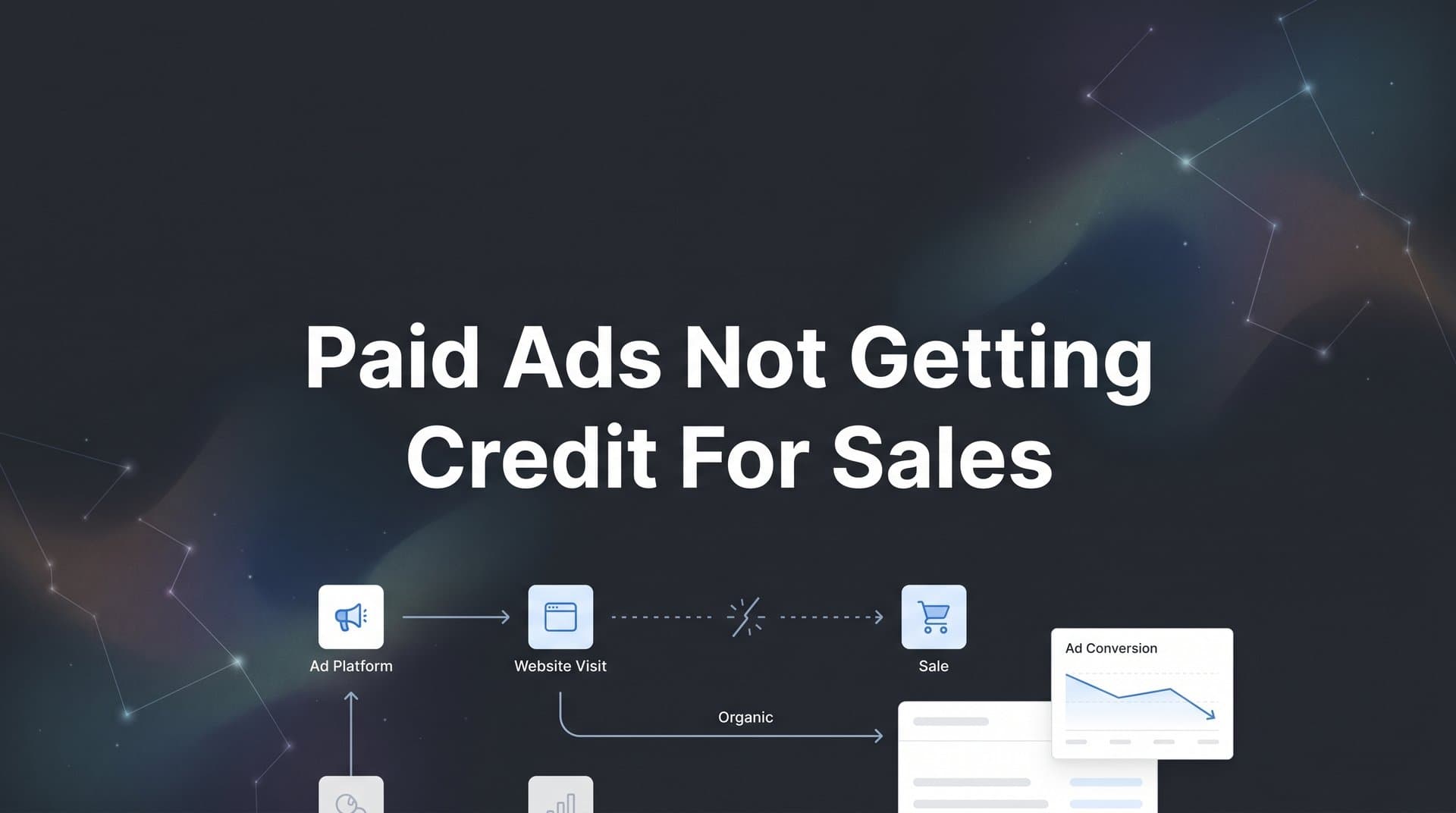
You're running paid campaigns across Meta, Google, and LinkedIn. Revenue is climbing. Your sales team is closing deals. But when you check your ad dashboards, the numbers don't add up. Meta reports 40 conversions this month. Google shows 35. Your CRM? It logged 120 new customers.
This isn't a tracking error. It's the attribution gap, and it's costing you real money right now.
When your ad platforms can't see the sales they're actually driving, you make decisions based on incomplete data. You pause campaigns that are working. You scale ads that aren't. And worst of all, the algorithms powering your campaigns learn from partial information, which means they can't optimize effectively. The disconnect between what your ads achieve and what your platforms report creates a cycle of missed opportunities and wasted budget.
The good news? This problem is solvable. In this guide, we'll break down exactly why your paid ads aren't getting credit for the sales they generate, and more importantly, how to fix it with modern attribution solutions that capture the complete customer journey.
The Hidden Disconnect Between Ad Clicks and Revenue
Picture this: someone sees your Meta ad on their iPhone during their morning commute. They're interested but not ready to buy. Three days later, they search for your product on their work laptop, click a Google ad, and browse your site. That evening, they return directly to your website on their tablet and finally convert.
One customer. One sale. Three different devices. Multiple sessions spread across several days.
To you, this is a successful conversion. To your ad platforms, it's often invisible. Meta might see the initial click but has no idea a sale happened days later on a different device. Google might track the middle touchpoint but can't connect it to the final conversion that happened outside their tracking window.
Modern customer journeys rarely follow the simple path we wish they would. Research shows that buyers interact with brands across an average of six to eight touchpoints before making a purchase decision. They switch between devices. They research on mobile and buy on desktop. They click an ad, get distracted, and return days later through organic search or by typing your URL directly.
The technical reality is that ad platforms lose visibility after the initial click. When someone leaves your website, closes their browser, or switches devices, the tracking chain breaks. Browser restrictions, privacy settings, and the natural complexity of multi-session journeys create gaps where conversions happen but can't be traced back to their source. Understanding why marketing touchpoints aren't being credited is essential for diagnosing these issues.
This creates a frustrating scenario where you know sales are happening. Your bank account confirms it. But your ad platforms show disappointing conversion numbers because they can't connect the dots across these fragmented journeys. The ads did their job, they just can't prove it.
Why Ad Platforms Underreport Your Conversions
The attribution gap isn't just about complex customer journeys. It's also a technical problem driven by privacy changes and browser restrictions that have fundamentally altered how tracking works.
Apple's App Tracking Transparency framework, introduced in 2021, gave iPhone and iPad users the power to block apps from tracking their activity. When someone opts out, Meta and other platforms can't follow what happens after the ad click. They see the click but lose visibility into whether that person eventually converted. Industry observations suggest that many users choose to opt out when prompted, which means a significant portion of mobile conversions simply vanish from platform reporting. Learning about tracking paid ads after the iOS update can help you navigate these challenges.
But iOS restrictions are just one piece of the puzzle. Cookie expiration creates another major gap in tracking accuracy. When someone clicks your ad, a cookie gets stored in their browser to remember that click. But cookies have expiration dates, and they can be deleted manually or automatically by browser settings. If someone converts after their cookie expires, the ad platform has no way to connect that sale back to the original ad.
Third-party cookie restrictions compound this problem. Browsers like Safari and Firefox block third-party cookies by default. Google has announced plans to phase out third-party cookies in Chrome, though implementation timelines continue to evolve. These restrictions mean that the tracking pixels ad platforms rely on often can't function as designed.
Cross-device journeys present yet another challenge. Someone clicks your Meta ad on their phone during lunch. That evening, they open their laptop, search for your brand, and convert. Same person, same intent, but the connection between the mobile ad click and the desktop conversion is broken. Ad platforms struggle to bridge this gap because they're tracking browser sessions, not individual people across their entire digital life.
Add in ad blockers, privacy-focused browsers, and users who regularly clear their browsing data, and you have a perfect storm of technical obstacles. Each one chips away at your platform's ability to accurately report conversions. The result? Ad dashboards that show a fraction of your actual results, making it nearly impossible to understand which campaigns truly drive revenue. If you're experiencing Facebook ads not tracking conversions, these technical barriers are likely the culprit.
The Real Cost of Missing Attribution Data
When your ad platforms can't see the conversions they're driving, the consequences extend far beyond inaccurate dashboards. This attribution gap actively damages your marketing performance in ways that directly impact your bottom line.
Budget misallocation becomes inevitable when you're making decisions based on incomplete data. You look at a campaign that shows three conversions in your Meta dashboard, calculate a disappointing ROAS, and pause it. Meanwhile, that campaign actually drove fifteen sales that your CRM tracked but Meta couldn't see. You just killed a profitable campaign because the data lied to you. Proper budget allocation for paid ads requires accurate conversion data.
The opposite happens too. You scale a campaign that appears to perform well in platform reporting, only to discover it's not actually driving proportional revenue growth. Without the complete picture, you're essentially flying blind, allocating budget based on partial information that can lead you in exactly the wrong direction.
Perhaps even more damaging is what happens to ad platform optimization. Meta's algorithm, Google's Smart Bidding, LinkedIn's campaign optimization—they all rely on machine learning that needs accurate conversion data to improve. When these algorithms can't see the conversions happening, they can't learn which audiences, creatives, and placements actually work.
Think of it like training someone to shoot baskets while blindfolding them for half their shots. They make some baskets they can see and adjust their technique accordingly. But they also make baskets they can't see, so they never learn what worked in those successful attempts. The learning process breaks down because the feedback loop is incomplete.
This creates a vicious cycle. Incomplete conversion data leads to suboptimal algorithm learning. Suboptimal learning leads to worse ad delivery. Worse ad delivery leads to higher costs and lower performance. And all of this happens while you're actually generating sales that the platform simply can't see or learn from. Many marketers wonder why their ads show conversions but no sales—this disconnect is often the answer.
The inability to scale with confidence might be the most frustrating cost of all. When you can't trust your data, every scaling decision becomes a gamble. Should you double your budget on this campaign? The platform says it's working, but is it really? Or are you about to waste thousands on ads that only appear successful because of attribution gaps?
Smart marketers know that scaling requires confidence, and confidence requires accurate data. When attribution is broken, that confidence evaporates, leaving you stuck in a cautious holding pattern instead of aggressively growing what actually works.
How Server-Side Tracking Closes the Attribution Gap
The fundamental problem with traditional tracking is that it happens in the browser, where it's vulnerable to blockers, privacy settings, and restrictions. Server-side tracking solves this by moving conversion tracking from the browser to your server, creating a reliable connection between ad clicks and actual sales.
Here's how it works in practice. When someone clicks your ad and converts on your website, that conversion data gets captured by your server rather than relying solely on a browser pixel. Your server then sends this conversion information directly to Meta, Google, or whichever ad platform you're using. This happens through secure server-to-server communication that bypasses all the browser-based obstacles that break traditional tracking.
The difference is significant. A browser pixel depends on cookies, JavaScript, and user permissions to function. If someone has an ad blocker installed, the pixel never fires. If they've opted out of tracking, the pixel can't send data. If their cookie expired, the pixel can't connect the conversion to the original ad click. Server-side tracking sidesteps all of these issues because it doesn't rely on the browser at all. Implementing proper tracking software for paid ads is essential for capturing this data reliably.
Think of it like the difference between mailing a letter and making a phone call. Traditional pixel tracking is like mailing a letter—it might get lost, delayed, or blocked along the way. Server-side tracking is like making a direct phone call—the message gets delivered reliably because it's a direct connection between two systems.
This approach maintains the critical click-to-conversion connection even when browser-based tracking fails. Someone clicks your ad on their iPhone with tracking disabled. They convert three days later on their laptop. Traditional pixels would lose this conversion entirely. Server-side tracking captures it because your server knows the conversion happened and can match it back to the original ad click using more reliable identifiers.
The technical implementation involves setting up a server-side container that receives conversion events from your website or CRM, enriches them with additional data, and forwards them to your ad platforms through their server-side APIs. Platforms like Meta's Conversions API and Google's Enhanced Conversions are built specifically to receive this server-side data.
What makes server-side tracking particularly powerful is that it can send richer, more accurate conversion data than browser pixels ever could. Your server has access to information that browsers don't, like customer lifetime value, subscription tier, or whether this is a repeat purchase. This enriched data helps ad platforms optimize more effectively because they're learning from complete, accurate information about what actually drives valuable conversions.
Feeding Better Data Back to Ad Platforms
Capturing accurate conversion data is only half the battle. The real power comes from sending that enriched data back to your ad platforms so their algorithms can learn from complete information and optimize more effectively.
When Meta's algorithm receives a conversion event, it doesn't just record that a conversion happened. It analyzes everything about that conversion—who converted, what ad they saw, when they clicked, what device they used—and uses this information to find more people likely to convert. But when the conversion data is incomplete or missing, the algorithm learns from a distorted picture of reality. Understanding why Facebook ads aren't attributing sales helps you address these algorithm learning gaps.
Conversion sync solves this by connecting your actual sales data to the ads that influenced them, then feeding this complete information back to ad platforms. Instead of Meta seeing only the conversions that happened to fire a pixel successfully, it sees all your conversions, enriched with valuable context from your CRM and analytics systems.
This matters because ad platform algorithms are remarkably good at pattern recognition when they have accurate data. Google's Smart Bidding can identify the subtle signals that indicate someone is likely to convert—but only if it knows which conversions actually happened. Meta's Advantage+ campaigns can find high-value audiences—but only if they can see which audiences generated high-value sales.
Better data input creates a virtuous cycle. When platforms see more conversions, they can optimize more aggressively. When they see enriched conversion data that includes purchase value, they can prioritize higher-value customers. When they see the complete customer journey, they can understand which touchpoints matter most and adjust bidding accordingly. This is how you improve Facebook ads performance with better data.
The impact on acquisition costs can be substantial. Algorithms that learn from complete data make smarter bidding decisions. They stop wasting impressions on audiences that don't convert. They increase bids for placements that drive valuable sales. They identify creative elements that resonate with your best customers. All of this happens automatically, but only when the underlying data is accurate and complete.
Think about it from the algorithm's perspective. If it only sees 30% of your actual conversions, it's optimizing based on a small, potentially skewed sample. But when you feed it 95% of conversions through server-side tracking and conversion sync, it suddenly has a much clearer picture of what works. The algorithm doesn't change, but the quality of its decisions improves dramatically because it's working with better information.
Building a Complete Picture of Your Customer Journey
Solving the attribution gap requires more than just fixing technical tracking issues. It demands a fundamental shift in how you think about measuring marketing performance—from isolated platform metrics to unified customer journey tracking.
The reality is that your customers don't live inside Meta or Google. They move fluidly between ad platforms, your website, email, organic search, and direct visits. A complete attribution system connects all these touchpoints into a single, coherent view of how people actually become customers. Effective customer journey mapping for paid ads reveals these hidden connections.
This means integrating your ad platforms with your website analytics and your CRM. When someone clicks a Meta ad, that interaction gets recorded. When they return through Google search, that touchpoint gets captured. When they convert and become a customer in your CRM, that final conversion gets connected back to every marketing interaction that influenced it. The result is a complete map of the customer journey, not just fragments from individual platforms.
Multi-touch attribution takes this further by helping you understand the full path to purchase rather than crediting only the last click. Last-click attribution gives all the credit to whichever ad someone clicked right before converting. But what about the Meta ad that introduced them to your brand two weeks earlier? What about the retargeting campaign that brought them back when they were ready to buy? Learning about attribution modeling for paid ads helps you distribute credit appropriately.
Multi-touch models distribute credit across all the touchpoints that contributed to a conversion. This doesn't mean every touchpoint gets equal credit—different models weight touchpoints differently based on their position in the journey or their demonstrated impact. What matters is that you can see the complete picture instead of just the final step.
When you connect your entire marketing ecosystem, you can answer questions that individual platforms can't. Which combination of channels drives the highest-value customers? How many touchpoints do people typically need before converting? Which ads are best at starting customer relationships versus closing sales? Are your retargeting campaigns actually driving incremental conversions or just taking credit for sales that would have happened anyway?
This complete view transforms how you make scaling decisions. Instead of wondering whether a campaign is really working, you can see exactly which ads drive revenue, even when that revenue happens days later through a different channel. You can identify which campaigns work best together, creating synergies where the whole is greater than the sum of its parts. Knowing how to prove which ads drive sales gives you the confidence to scale aggressively.
Confident scaling becomes possible when you trust your data. You know which campaigns to push harder because you can see their true impact across the entire customer journey. You know which channels deserve more budget because you understand how they contribute to conversions, not just whether they get last-click credit. You make decisions based on complete information rather than the fragmented view that individual platforms provide.
Putting It All Together
The attribution gap between what your ads achieve and what your platforms report isn't an inevitable reality of modern marketing. It's a solvable technical problem that's costing you money, limiting your growth, and preventing ad algorithms from performing at their best.
The solution combines three critical elements. First, server-side tracking that bypasses browser restrictions and captures conversions reliably, even when pixels fail. Second, conversion sync that feeds enriched, accurate data back to ad platforms so their algorithms can learn from complete information. Third, unified customer journey tracking that connects every touchpoint across platforms, giving you the complete picture you need to make confident decisions.
When you implement these solutions, everything changes. Your ad platforms see the conversions they're actually driving. Their algorithms optimize based on accurate data instead of partial information. You allocate budget confidently because you know which campaigns truly generate revenue. And you scale aggressively because you trust the data guiding your decisions.
The marketers winning in 2026 aren't the ones with the biggest budgets. They're the ones with the most accurate data, the clearest view of customer journeys, and the confidence to scale what actually works. They've closed the attribution gap, and it's transformed how they grow.
Ready to elevate your marketing game with precision and confidence? Discover how Cometly's AI-driven recommendations can transform your ad strategy—Get your free demo today and start capturing every touchpoint to maximize your conversions.


