Your ads are getting ignored. You've seen the data: polished brand content gets scrolled past, while raw, authentic UGC stops thumbs mid-feed. So you doubled down on creator partnerships, hired UGC agencies, and built content pipelines. Then the invoices started piling up. Five creators, ten variations, endless revisions—and you're still testing the same three winning concepts from last quarter.
Now there's a new player in the game: AI-generated UGC that looks, sounds, and performs like the real thing. No casting calls. No contracts. No waiting for creators to deliver. Just prompt, generate, launch. It sounds too good to be true, which is exactly why you're skeptical.
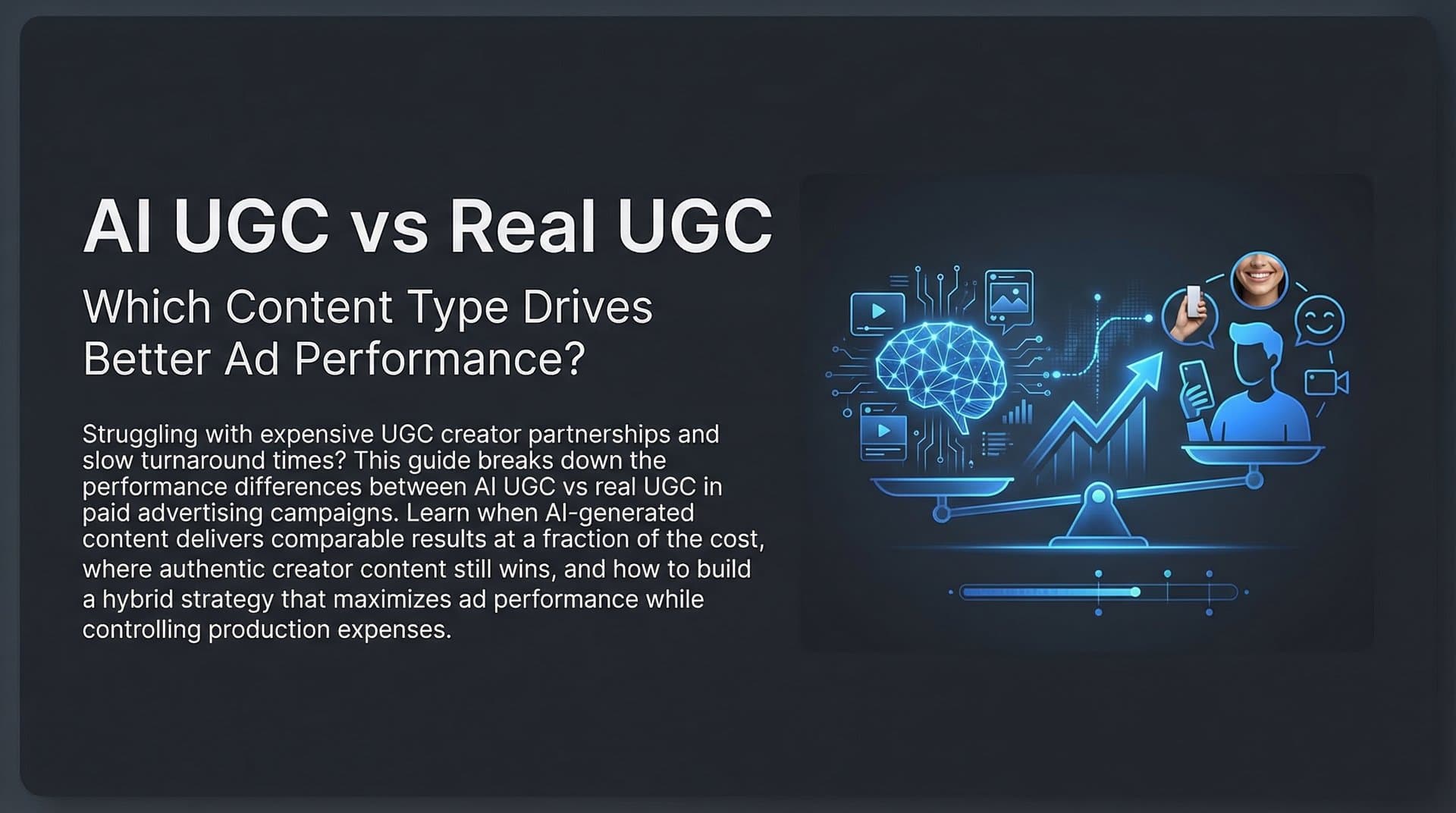
The question isn't whether AI UGC works—it's where it works, when it works, and how it stacks up against authentic creator content in the campaigns that actually matter. This isn't about choosing sides. It's about understanding which tool fits which job, and building a creative strategy that uses both intelligently.
Breaking Down the Two Content Approaches
Let's start with what we're actually comparing. Real UGC is content created by actual humans—customers filming testimonials in their living rooms, influencers unboxing products on camera, or hired creators following your brief while adding their personal touch. The defining characteristic isn't production quality; it's that a real person experienced something and captured it on camera.
This content carries specific markers of authenticity: natural speech patterns, genuine reactions, environmental context that can't be faked. When someone films a product review in their kitchen with their dog barking in the background, that's real UGC. When a creator follows your script but adds their own personality and filming style, that's still real UGC.
AI UGC represents something fundamentally different. These are synthetic videos generated by artificial intelligence—AI avatars that speak your script, AI-generated scenes that mimic casual filming styles, or AI-enhanced content that starts with real footage but transforms it beyond recognition. The technology has evolved rapidly, producing content that can be surprisingly convincing at first glance. Understanding whether AI can generate UGC content effectively is crucial for modern marketers evaluating their options.
Here's where it gets nuanced: there's a spectrum between pure authenticity and pure synthesis. You might have real creator footage that's been AI-edited for pacing. You might have AI-generated avatars delivering testimonials based on real customer feedback. You might have hybrid approaches that blend human creativity with AI production capabilities.
The key distinction isn't the technology used in production—it's whether the content represents a genuine human experience or a synthetic simulation of one. A creator using AI editing tools to polish their authentic review is still creating real UGC. An AI avatar delivering a scripted testimonial, even if based on real customer quotes, is AI UGC.
Understanding this spectrum matters because your choice impacts more than just production logistics. It affects how platforms classify your content, how audiences perceive your brand, and ultimately how your ads perform across different campaign objectives.
The Real UGC Advantage: Authenticity That Converts
There's a reason real UGC became the dominant format in paid social advertising. When someone watches another person genuinely react to a product, something psychological happens that polished brand content can't replicate. The viewer's brain processes it differently—not as advertising, but as social proof from a peer.
Our roundup of the best AI UGC generator options can help you shortlist.
This authenticity advantage shows up most powerfully in trust-building scenarios. When a real person looks into their phone camera and explains how your product solved their specific problem, they're not just delivering your messaging. They're providing evidence that real humans use and benefit from what you're selling. The imperfections—the natural pauses, the casual language, the authentic environment—actually strengthen the message rather than weaken it.
Think about the last time you made a purchase decision based on online content. Chances are, it wasn't a perfectly produced commercial that convinced you. It was probably someone like you, in a setting like yours, explaining their real experience. That's the power of genuine human testimony, and it's incredibly difficult to fake convincingly. Implementing strategies to improve your conversion rate often starts with understanding this psychological dynamic.
Platform algorithms add another layer to this advantage. Social platforms are increasingly sophisticated at detecting and rewarding authentic engagement. When real people create content that resonates with their followers, the engagement signals are genuine—real comments, meaningful shares, authentic saves. These signals tell the algorithm that the content is valuable, potentially improving organic reach and ad performance.
The social proof value extends beyond the individual piece of content. When you work with real creators, you're not just getting a video—you're potentially getting access to their audience, their credibility, and their ongoing relationship with followers. A creator with 50,000 engaged followers brings built-in distribution and trust that AI-generated content simply can't replicate.
Real UGC also captures nuances that are hard to script. The way someone's face lights up when describing a feature they love, the specific language they use to explain a benefit, the unexpected use cases they mention—these authentic moments often become the most compelling parts of the content. You can brief a creator on key points, but their genuine reactions and personal insights add dimensions you couldn't have planned.
If you're evaluating vendors, our AI UGC generator breakdown can help.
For products where trust is paramount—health supplements, financial services, high-ticket purchases—this authenticity becomes even more critical. Audiences are more skeptical in these categories, and the difference between "someone paid to say this" and "someone genuinely experienced this" can determine whether your ad drives conversions or gets scrolled past.
The AI UGC Advantage: Speed and Scale Without Limits
Now let's talk about what makes AI UGC compelling from a practical standpoint. The most obvious advantage is speed. You can generate a dozen video variations in the time it takes to brief a single creator. Need to test different hooks? Different pain points? Different calls-to-action? You can have all those variations ready to launch within hours, not weeks. Finding the best AI tool for UGC ads can dramatically accelerate your creative production.
We compare the leading options in our UGC ads roundup.
This production velocity fundamentally changes how you approach creative testing. With traditional UGC, you're limited by creator availability, production timelines, and revision cycles. You might test three or four concepts per month if you're moving fast. With AI UGC, you can test three or four concepts per day. That's not just incrementally faster—it's a completely different testing paradigm.
The cost structure tells a similar story. Hiring creators for UGC typically involves fees ranging from hundreds to thousands of dollars per video, depending on the creator's following and usage rights. Multiply that across the volume of content needed for serious creative testing, and costs escalate quickly. AI UGC flips this model—the marginal cost of generating additional variations approaches zero once you have the tools in place.
This economic advantage becomes especially powerful when you find a winning concept and need to scale it. With real UGC, scaling means hiring more creators, managing more relationships, and dealing with more variables in production quality and messaging consistency. With AI UGC, scaling means generating more variations of what's already working, maintaining perfect consistency in core messaging while testing different executions.
Creative control represents another significant benefit. When you work with real creators, you're collaborating with independent humans who have their own perspectives, schedules, and creative preferences. That collaboration often produces great content, but it also introduces variables you can't fully control. An AI UGC creator gives you precise control over every element—the script, the pacing, the visual style, the exact moment of emphasis.
This control enables systematic testing that would be impractical with human creators. Want to test the same script with five different avatar styles to see which resonates best with your audience? Want to generate versions in multiple languages with culturally appropriate contexts? Want to A/B test subtle variations in tone or emphasis? AI UGC makes all of this feasible without the logistical complexity of managing multiple creator relationships.
The ability to iterate based on performance data becomes another advantage. When an AI-generated ad shows promising results, you can immediately generate variations that build on what's working. If your data shows that a specific hook drives engagement but the call-to-action needs refinement, you can test five new endings in the time it would take to schedule a call with a creator to discuss revisions.
Performance Showdown: Where Each Type Excels
The real question isn't which content type is "better"—it's which performs better for specific campaign objectives. The answer depends heavily on where your audience is in their journey and what action you're trying to drive.
At the top of the funnel, where the goal is awareness and initial engagement, AI UGC often holds its own surprisingly well. When someone scrolls past your ad in three seconds, they're not conducting a detailed authenticity audit. They're reacting to whether the content pattern-matches their expectations and captures their attention. If your AI-generated UGC looks and sounds like the casual content they're already consuming, it can stop the scroll effectively.
The testing velocity advantage becomes particularly valuable at this stage. Top-of-funnel campaigns benefit enormously from creative diversity and rapid iteration. The ability to test dozens of hooks, angles, and formats quickly means you can identify what resonates with your audience faster than competitors who are waiting for creator deliverables. Speed often matters more than perfection when you're trying to crack the code on what makes your audience pay attention. Using real-time campaign performance monitoring helps you identify winners faster.
Bottom-of-funnel performance tells a different story. When someone is close to making a purchase decision, they're evaluating trust signals more carefully. This is where real UGC typically shows its strength. Authentic testimonials from real customers, detailed product demonstrations from genuine users, and specific problem-solution narratives from actual people carry more weight when the stakes are higher.
The specificity that real creators bring becomes crucial at this stage. Generic benefits and scripted talking points might work for awareness, but conversion often requires the kind of detailed, authentic explanation that comes from someone who actually used the product. The way a real customer describes their specific pain point and how your product solved it creates credibility that's hard to replicate synthetically.
Platform placement also influences which content type performs better. In feed placements where users are scrolling quickly, AI UGC's ability to maintain consistent quality and messaging across high volumes can be advantageous. In placements where users are more engaged and likely to watch longer content, the authenticity and depth of real UGC often wins out.
Audience sophistication matters too. Younger, digitally native audiences are often more attuned to detecting AI-generated content and may react negatively if they feel deceived. Other audience segments may be less sensitive to these cues, responding primarily to whether the content delivers relevant information regardless of its source.
The testing framework itself becomes a critical factor in performance. AI UGC enables you to test more variables more quickly, which means you can optimize faster. Real UGC might have higher individual creative quality, but if you can only test three concepts while your competitor tests thirty using AI UGC, they might find the winning angle first despite lower per-asset quality.
Building a Hybrid Creative Strategy
The most sophisticated marketers aren't choosing between AI UGC and real UGC—they're using both strategically based on specific use cases and performance data. The key is understanding when each approach delivers the most value for your particular objectives.
Deploy real UGC when authenticity directly impacts your conversion rate. High-consideration purchases, products requiring trust-building, testimonial-driven campaigns, and brand-building initiatives all benefit from the credibility that real human creators provide. If you're selling a product where customer skepticism is high or where social proof is a primary conversion driver, invest in authentic creator content.
Use real UGC when you need content that will have a long shelf life and represent your brand across multiple channels. A well-produced creator testimonial can work in ads, on your website, in email campaigns, and in sales presentations. The investment in quality real UGC pays dividends across your entire marketing ecosystem, not just in the specific ad campaign where it first appears.
Turn to AI UGC when testing velocity is your competitive advantage. In the early stages of a campaign when you're trying to identify winning angles, the ability to test rapidly often matters more than perfect authenticity. Learning how to make UGC ads with AI can dramatically accelerate your concept validation process. Generate multiple variations quickly, let performance data tell you what's working, then decide whether to scale with more AI content or upgrade to real UGC for the winning concepts.
AI UGC excels at filling content gaps and maintaining creative freshness without constant creator management. When you need seasonal variations, product-specific versions, or audience-specific adaptations of a core message, AI generation can produce these efficiently. You're not necessarily looking for breakthrough creative—you're maintaining consistent presence with relevant variations.
The hybrid approach often works best: use AI UGC to test concepts rapidly and identify what resonates, then invest in high-quality real UGC for the concepts that prove successful. This combines the speed and scale advantages of AI with the authenticity and conversion power of real creators, letting each approach play to its strengths.
Tracking performance across both content types requires proper attribution infrastructure. You need to know not just which ads drive clicks, but which creative approaches drive actual revenue. Implementing real-time attribution tracking allows you to tag your AI-generated content differently from real UGC so you can compare performance across the entire funnel, not just at the ad level.
Putting Your UGC Strategy Into Action
Start by defining clear success metrics for each content type based on your campaign objectives. Don't just measure click-through rates—track the entire journey from impression to conversion. This means understanding which creative approaches drive qualified traffic, which generate actual revenue, and which deliver the best return on creative investment.
Build a testing framework that lets you compare AI UGC and real UGC systematically. Run parallel campaigns with similar targeting but different creative sources. Give each approach sufficient budget and time to generate meaningful data. Look beyond surface-level metrics to understand the quality of engagement and conversion each content type delivers. Following an accelerated testing strategy can help you gather insights faster.
Consider tools that enable rapid creative production and testing at scale. Platforms like AdStellar AI can generate UGC-style content, launch campaigns, and surface winning creatives automatically—dramatically accelerating your testing cycles without the overhead of managing creator relationships. Exploring options for an AI UGC ad maker can streamline your production workflow significantly.
Implement proper attribution to connect your creative testing to actual business outcomes. You need visibility into which content types drive not just conversions, but profitable conversions that justify the creative investment. This requires tracking that connects ad creative to downstream revenue, customer lifetime value, and overall campaign profitability. The right attribution software makes this connection possible.
Build feedback loops between your performance data and creative production. When AI UGC identifies a winning angle, consider investing in real UGC that explores that angle more authentically. When real UGC produces breakthrough creative, use AI to generate variations that test different executions of the same core concept. Let data inform where you invest creative resources rather than relying on assumptions about which approach is "better."
The marketers who win aren't the ones who pick the "right" content type—they're the ones who test both approaches systematically, measure what actually drives results, and build creative strategies based on evidence rather than ideology. Your audience doesn't care whether content is AI-generated or creator-produced. They care whether it's relevant, engaging, and trustworthy enough to warrant their attention and action.
The Path Forward for Modern Creative Strategy
The AI UGC versus real UGC debate misses the point entirely. This isn't a binary choice between authentic and synthetic, between human creativity and artificial generation. It's a strategic decision about which tools to deploy for which objectives, informed by performance data rather than creative preferences.
Both approaches have legitimate roles in modern marketing. AI UGC delivers speed, scale, and cost efficiency that enable testing velocity and creative abundance. Real UGC provides authenticity, social proof, and emotional connection that drive trust and conversion in high-stakes scenarios. The winners will be marketers who understand when to use each approach and how to let performance data guide their creative mix.
The technology will continue evolving. AI-generated content will become more sophisticated, more realistic, and harder to distinguish from authentic creator content. Platform policies will adapt. Audience sensitivities will shift. But the fundamental principle remains: test systematically, measure rigorously, and let actual performance determine your creative strategy rather than assumptions about what should work.
Your competitive advantage comes from testing faster, measuring better, and adapting more quickly than competitors who are still debating which content type is "better" instead of running experiments to find out what actually drives results for their specific audience and objectives.
Ready to elevate your marketing game with precision and confidence? Discover how Cometly's AI-driven recommendations can transform your ad strategy—Get your free demo today and start capturing every touchpoint to maximize your conversions.