You've just spent $50,000 on a LinkedIn campaign. Three months later, a deal closes for $200,000. Your sales team credits a referral. Your CEO asks which marketing channel drove the revenue. You open your analytics dashboard and... nothing connects.
This is the attribution nightmare that keeps B2B marketers up at night. Unlike e-commerce where someone clicks an ad and buys in minutes, B2B lead generation unfolds across months, multiple decision-makers, and dozens of touchpoints. The marketing manager who downloaded your whitepaper isn't the CFO who signed the contract. The webinar attendee forwarded your content to three colleagues you'll never track. That LinkedIn ad impression happened eight weeks before anyone filled out a form.
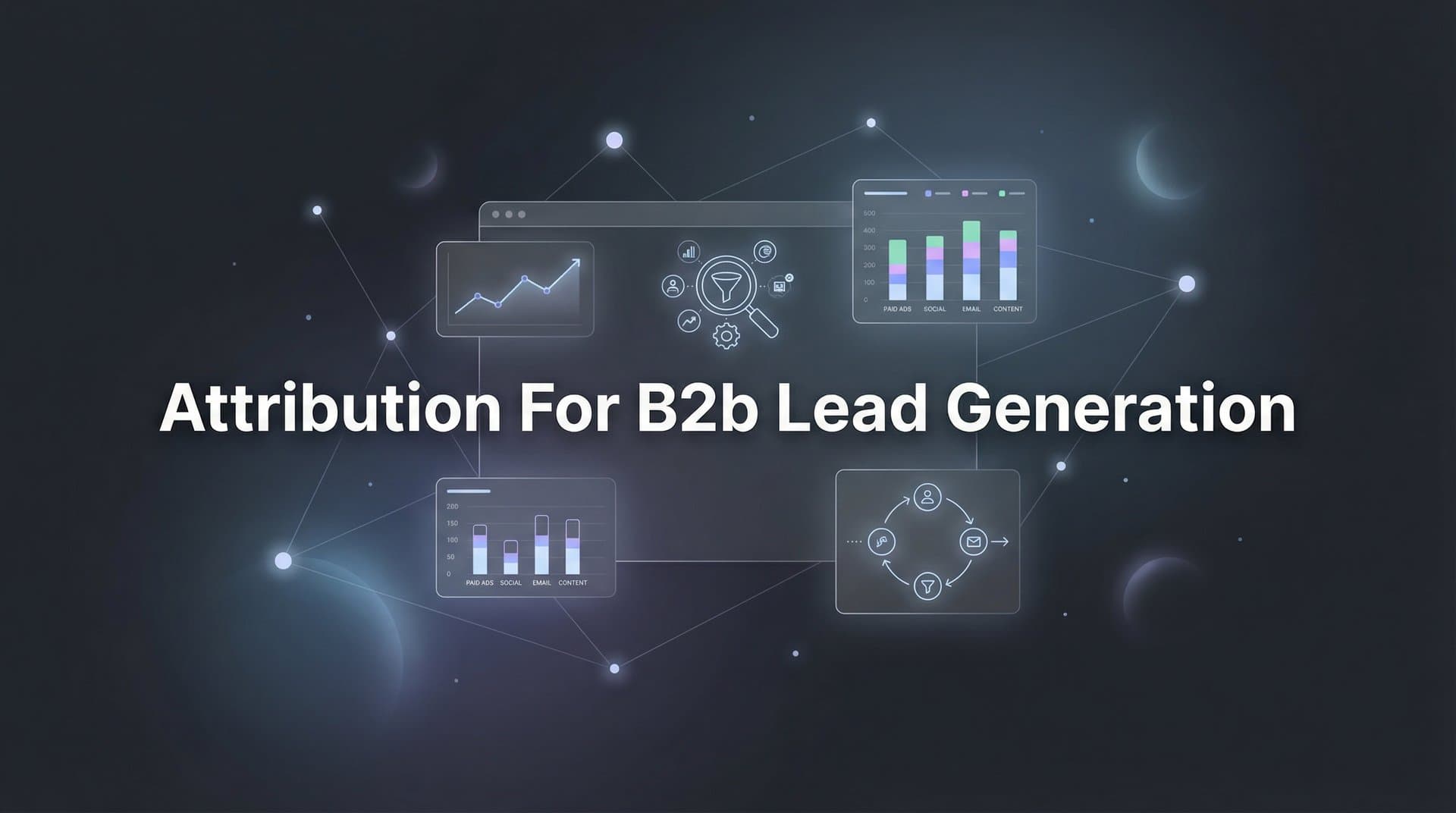
Attribution for B2B lead generation isn't just about knowing which ad got clicked—it's about connecting every marketing activity to the pipeline and revenue it actually generates. When you can see which channels drive leads that close (not just leads that look good), you stop wasting budget on vanity metrics and start making confident scaling decisions. This guide breaks down exactly how to build an attribution system that works for complex B2B sales cycles, from choosing the right models to connecting your data sources to turning insights into smarter budget allocation.
Why B2B Lead Generation Demands a Different Attribution Approach
B2B attribution isn't just harder than B2C—it's fundamentally different. When someone buys a pair of shoes online, the journey is linear and fast: see ad, click, purchase, done. Attribution is straightforward because the entire journey happens in hours, often in a single session.
B2B sales cycles span weeks or months with multiple stakeholders researching, evaluating, and deliberating. A typical B2B buyer journey might look like this: marketing manager sees a LinkedIn ad in January, downloads a guide in February, attends a webinar in March, then loops in their director who requests a demo in April. Meanwhile, the CFO has been reading your blog posts for months without ever identifying themselves. Finally, in May, someone fills out a contact form—but which touchpoint deserves credit for that lead?
This extended timeline creates attribution blind spots that standard analytics completely miss. Google Analytics will show you the last click before conversion. Your ad platforms will each claim credit for the same lead. Your CRM knows when the deal closed but has no idea which marketing activities influenced it. The gap between "lead captured" and "deal closed" becomes a black box where attribution goes to die. Understanding these common attribution challenges in B2B marketing is the first step toward solving them.
Here's what makes it even more complex: account-based dynamics mean multiple contacts from one company interact with different channels before converting. The marketing manager might engage with your content ads while their boss responds to a cold email and their colleague finds you through organic search. Traditional attribution models track individuals, but B2B deals require tracking accounts. When three people from the same company take three different paths, which channel gets credit?
The stakes are higher in B2B too. You're not optimizing for $50 purchases—you're tracking campaigns that influence $50,000 deals. A single misattributed conversion can lead to budget decisions that waste tens of thousands of dollars on channels that don't actually drive revenue. When your average deal size is measured in five or six figures, you need attribution that's sophisticated enough to handle the complexity.
Standard web analytics tools weren't built for this reality. They're designed to track short conversion windows and individual user sessions, not multi-month buyer journeys across multiple stakeholders. This is why so many B2B marketers end up flying blind, making budget decisions based on incomplete data or gut feeling rather than clear visibility into what's actually working.
The Attribution Models That Actually Work for B2B
Attribution models are frameworks for distributing credit across the touchpoints in a customer journey. Think of them as different philosophies about which marketing activities deserve recognition for generating a lead or closed deal. Choosing the right model isn't academic—it directly impacts how you evaluate channel performance and allocate budget.
First-touch attribution gives 100% of the credit to the initial interaction that brought someone into your ecosystem. If a prospect first discovered you through a Google search ad, that ad gets full credit even if they later engaged with emails, webinars, and retargeting before converting. This model makes sense when your primary goal is understanding top-of-funnel awareness and initial discovery. It answers the question: "How are prospects finding us?"
Last-touch attribution does the opposite—it credits the final touchpoint before conversion. If someone attended your webinar right before requesting a demo, the webinar gets 100% credit. This model works when you want to understand what pushes prospects over the finish line. It's useful for optimizing conversion tactics, but it completely ignores all the nurturing that happened beforehand.
Here's the problem with both single-touch models in B2B: they're reductive. They force you to choose between the touchpoint that started the journey and the one that ended it, ignoring everything in between. For a sales cycle with fifteen touchpoints over three months, giving all credit to just one interaction misses the full story.
Multi-touch attribution models distribute credit across multiple touchpoints, which is why most B2B teams eventually migrate to them. The question becomes: how do you distribute that credit fairly? A thorough comparison of attribution models for marketers can help you understand the tradeoffs.
Linear attribution spreads credit equally across every touchpoint. If there were ten interactions before conversion, each gets 10% credit. This model is democratic—it assumes every touchpoint contributed equally to the outcome. It's simple to understand and implement, making it a good starting point for teams new to multi-touch attribution. However, it treats a quick blog visit the same as a 45-minute demo, which doesn't reflect reality.
Time-decay attribution gives more credit to touchpoints closer to conversion. The logic is that recent interactions had more influence on the decision than older ones. A webinar attended last week gets more credit than a whitepaper downloaded two months ago. This model works well for B2B teams who believe that late-stage nurturing is more important than early awareness, though it can undervalue the channels that started the relationship.
Position-based (or U-shaped) attribution assigns 40% credit to the first touch, 40% to the last touch, and distributes the remaining 20% across middle touchpoints. This model recognizes that both discovery and conversion moments are critical while acknowledging that nurturing matters too. Many B2B teams find this model intuitive because it balances awareness and conversion without ignoring the journey between them.
W-shaped attribution is similar but adds emphasis to a third milestone: the moment when a lead becomes qualified (like when they request a demo or become an MQL). It might assign 30% credit to first touch, 30% to lead creation, 30% to opportunity creation, and 10% to everything else. This works particularly well for B2B teams with clearly defined funnel stages who want to understand which channels drive progression through each stage.
So which model should you use? For most B2B lead generation teams, the answer is multi-touch attribution—specifically a model that reflects your actual sales process. If your sales cycle is long and nurture-heavy, linear or time-decay models capture the full journey. If you have clear funnel stages, position-based or W-shaped models help you understand which channels excel at different stages. The key is choosing an attribution model for your business that matches how your prospects actually buy, not just picking the one that makes your favorite channel look best.
Connecting Ad Platforms, CRM, and Website Data
Attribution only works when you can connect the dots between three critical data sources: ad platform clicks, website behavior, and CRM pipeline events. Each system sees part of the story, but none sees the complete journey from first impression to closed deal. This fragmentation is where attribution breaks down for most B2B teams.
Your ad platforms (LinkedIn, Google, Meta) know when someone clicked your ad and which campaign it came from. But they can't see what happened after that click—did the visitor browse five pages or bounce immediately? Did they return three times before converting? Did they eventually become a qualified lead worth $50,000? The ad platforms stop tracking at the click, leaving you blind to actual outcomes.
Your website analytics (like Google Analytics) tracks visitor behavior—pages viewed, time on site, form submissions. But it struggles to connect that anonymous traffic back to the specific ads that drove it, especially as browser-based tracking becomes less reliable. It also has no idea what happens after someone becomes a lead. Did that form fill turn into a sales opportunity? Did the deal close? Website analytics ends where your sales process begins. Many teams find themselves weighing the differences between Google Analytics vs a dedicated attribution platform.
Your CRM (Salesforce, HubSpot, Pipedrive) knows everything about leads once they're in your system—their progression through sales stages, deal value, close date. But it typically has no visibility into the marketing touchpoints that generated them. Sales reps might manually note "came from LinkedIn" in a field, but that's incomplete and unreliable. The CRM sees the end result without understanding the marketing journey that created it.
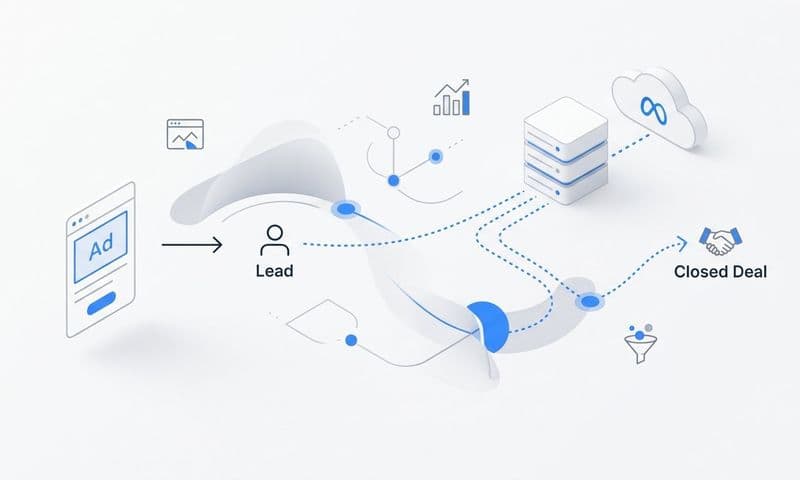
Building a single view of the customer journey means unifying these three data sources so you can track from first ad click to closed-won deal. This requires connecting your ad platforms to your website tracking and then connecting both to your CRM. When someone clicks a LinkedIn ad, views your pricing page, downloads a guide, requests a demo, and eventually closes as a customer, you need one system that captures all those events and ties them to the same person.
This is where server-side tracking becomes essential for modern B2B attribution. Traditional browser-based tracking relies on cookies and pixels that run in the user's browser. But iOS privacy changes, cookie deprecation, and ad blockers have made browser-based tracking increasingly unreliable. You might lose 30-40% of your attribution data simply because browsers block your tracking scripts.
Server-side tracking solves this by sending data directly from your server to your analytics platform, bypassing browser restrictions. When someone submits a form on your website, your server captures that event and sends it to your attribution system along with all the context about which ads they clicked, which pages they visited, and how long the journey took. This approach is more accurate, more privacy-compliant, and immune to browser-based blocking.
The technical implementation matters less than the outcome: you need a system that captures ad clicks, enriches them with website behavior data, and then connects both to CRM events. Implementing proper lead generation attribution tracking ensures that when a lead progresses to "opportunity" in your CRM, your attribution system knows exactly which marketing touchpoints influenced that progression. When a deal closes, you should see the complete journey that generated that revenue—not just the last click or the sales rep's best guess about where the lead came from.
Measuring What Matters: From MQLs to Revenue
Most B2B marketing dashboards are filled with metrics that don't actually matter. Impressions, clicks, and even form fills tell you about activity, not outcomes. The question that keeps your CEO up at night isn't "How many leads did we generate?" It's "How much pipeline and revenue did our marketing create?"
This is the shift from vanity metrics to revenue metrics. A vanity metric makes you feel good but doesn't connect to business outcomes. Generating 500 leads sounds impressive until you realize only 10 were qualified and none closed. An outcome metric connects marketing activity directly to pipeline and revenue—the numbers that actually determine whether your company grows.
Start by tracking cost-per-qualified-lead instead of just cost-per-lead. Not all leads are created equal. A form fill from someone who matches your ideal customer profile, works at a company in your target market, and has budget authority is worth 10x more than a student downloading your content for a research project. Your attribution system should distinguish between raw leads and qualified leads (MQLs, SQLs, or however you define qualification). Track how much you're spending to generate leads that your sales team actually wants to talk to.
Then push deeper: measure cost-per-opportunity. Once a qualified lead progresses to an active sales opportunity, that's a much stronger signal that your marketing is working. Some channels might generate lots of leads but few opportunities, while others generate fewer leads that convert to opportunities at higher rates. This distinction is invisible if you're only measuring at the lead level.
The ultimate metric is attributed revenue—connecting closed deals back to the specific campaigns, ads, and channels that influenced them. When a $100,000 deal closes, your attribution system should show you which LinkedIn campaign started the relationship, which webinar moved them to MQL, which retargeting ad brought them back before they requested a demo. Effective revenue attribution for B2B SaaS companies is where attribution becomes genuinely strategic: you can calculate the actual ROI of each channel based on the revenue it generates, not just the leads it captures.
Setting this up requires defining conversion events that reflect your actual sales funnel stages. Most B2B teams need at least three conversion events: lead captured (form submission), opportunity created (moved to active sales stage), and deal closed (revenue generated). Your attribution system should track all three and show you which channels excel at each stage. You might discover that LinkedIn drives expensive leads that close at high rates, while Google drives cheaper leads that rarely convert to opportunities. That insight changes everything about how you allocate budget.
The technical requirement is connecting your CRM stages to your attribution platform. When a lead status changes in Salesforce from "MQL" to "Opportunity," your attribution system needs to know immediately. When a deal closes, that revenue amount should flow back to your attribution data so you can see which marketing touchpoints contributed to it. This is why CRM integration isn't optional for serious B2B attribution—without it, you're stuck measuring activity instead of outcomes.
Turning Attribution Data Into Smarter Budget Decisions
Attribution data is worthless if it doesn't change how you spend money. The point isn't to have pretty dashboards—it's to identify which channels drive leads that actually close and reallocate budget accordingly. This is where attribution becomes a competitive advantage: while your competitors optimize for lead volume, you optimize for revenue.
Start by identifying which channels drive leads that close, not just leads that look good. Run a simple analysis: for each marketing channel, calculate what percentage of leads eventually become opportunities and what percentage of opportunities close. You'll often find surprising patterns. The channel generating the most leads might have terrible close rates, while a smaller channel generates fewer leads that convert at 3x the rate.
Let's say your LinkedIn campaigns generate 50 leads per month at $200 per lead ($10,000 spend), and 20% of those leads become opportunities with an average deal size of $50,000. Your Google campaigns generate 100 leads per month at $100 per lead ($10,000 spend), but only 5% become opportunities with the same deal size. LinkedIn is generating half the leads but twice the pipeline value. Without attribution connecting leads to opportunities, you'd think Google is winning because it delivers more leads for less cost. With attribution, you see that LinkedIn is actually more efficient at driving revenue.
This leads to the second insight: reallocate spend based on attributed pipeline value, not just lead volume. If LinkedIn is generating 10 opportunities worth $500,000 in pipeline for $10,000 in spend, while Google is generating 5 opportunities worth $250,000 for the same spend, you should shift budget toward LinkedIn. This seems obvious, but most B2B teams don't do it because they lack the attribution data to make this calculation confidently. Understanding multi-channel attribution for ROI helps you make these decisions with clarity.
The reallocation doesn't have to be dramatic. Start by moving 10-20% of budget from underperforming channels to overperforming ones, then measure the impact over the next month. Attribution gives you permission to experiment because you can see results at the pipeline level, not just the lead level. If shifting budget improves your cost-per-opportunity, keep going. If it doesn't, you've learned something valuable about channel saturation or audience overlap.
Beyond budget allocation, use attribution insights to improve ad platform targeting and optimization. Modern ad platforms (Meta, Google, LinkedIn) use machine learning to optimize toward your conversion events. But they can only optimize based on the conversion data you send them. If you're only telling Facebook about form submissions, it optimizes for people who fill out forms—not people who become customers. If you send back data about which leads became opportunities or closed deals, the algorithm learns to find more people like your actual customers.
This is called conversion sync or conversion API integration. Your attribution system captures which leads progressed to opportunity or closed, then sends that data back to your ad platforms. Over time, the ad algorithms get smarter about finding high-value prospects instead of just high-volume leads. This creates a compounding advantage: better data leads to better targeting, which leads to more qualified leads, which gives you more data to improve targeting further.
Putting Your B2B Attribution Strategy Into Action
Attribution can feel overwhelming when you're staring at months of disconnected data across multiple platforms. The key is starting with a focused foundation rather than trying to build the perfect system immediately. Here's how to get moving without getting stuck.
Start with clear conversion definitions tied to your CRM stages. Sit down with your sales team and agree on exactly what qualifies as an MQL, SQL, and opportunity in your process. Then configure your attribution system to track those specific stages. If an MQL means "filled out demo form and matches ICP criteria," make sure your system captures that. If opportunity means "sales-accepted and entered into active pipeline," track that event. Clear definitions eliminate ambiguity and ensure everyone interprets attribution data the same way.
Prioritize connecting your highest-spend channels first for immediate ROI visibility. If you're spending $30,000 per month on LinkedIn and $5,000 on display ads, start by implementing attribution for LinkedIn. Get that channel's full-funnel data flowing—from clicks to leads to opportunities to closed deals—before worrying about smaller channels. Effective attribution tracking for multiple campaigns gives you quick wins and builds confidence in the system. Once you see that LinkedIn is generating $200,000 in attributed pipeline, you'll have the momentum and buy-in to connect your other channels.
Review attribution data weekly to catch underperforming campaigns before they drain budget. Set up a recurring calendar event where you examine which campaigns drove opportunities and revenue in the past week. Look for campaigns spending significant budget but generating few qualified leads or opportunities. Pause or adjust them immediately rather than letting them run for months. Weekly reviews create a rhythm of continuous optimization that compounds over time.
Don't wait for perfect data to start making decisions. Attribution will never be 100% accurate—there will always be offline touchpoints, dark social sharing, and tracking gaps. That's fine. Even 70% visibility into what's driving revenue is transformative compared to the 20% visibility most B2B teams operate with. Start using your attribution data to inform decisions now, knowing you'll refine the system over time.
Making Attribution Work for Your Revenue Goals
Effective B2B lead generation attribution isn't about perfect data—it's about connecting marketing activities to revenue outcomes so you can make confident scaling decisions. The companies that win aren't the ones with the most sophisticated attribution models or the cleanest data. They're the ones who use attribution insights to shift budget toward what's actually working and away from what's not.
Your current attribution setup probably has blind spots. You might know which channels generate leads but not which ones generate revenue. You might track conversions but not the full journey from first touch to closed deal. You might have data in three different systems that never talk to each other. These gaps aren't just inconvenient—they're expensive. Every month you operate without clear attribution is another month of budget allocated based on incomplete information.
The path forward is clearer than you think. Define your conversion stages, connect your data sources, choose a multi-touch attribution model that reflects your sales process, and start measuring what actually matters: pipeline and revenue. When you can see which campaigns are generating $500,000 in pipeline versus which are generating leads that never close, budget decisions become obvious.
Ready to elevate your marketing game with precision and confidence? Discover how Cometly's AI-driven recommendations can transform your ad strategy—Get your free demo today and start capturing every touchpoint to maximize your conversions.