
You're spending $3,000 a day on Facebook ads, another $1,500 on Google, and testing TikTok with $800 more. Your Shopify dashboard shows sales coming in, but here's the problem: Facebook says it generated 80% of your revenue. Google claims 65%. TikTok insists it drove 40%. The math doesn't add up, and with dropshipping margins already razor-thin, you can't afford to keep guessing which platform actually deserves the credit.
This is the attribution nightmare that keeps dropshipping store owners up at night. When every dollar of ad spend needs to return at least $2.50 just to stay profitable after product costs and fees, knowing which campaigns truly drive purchases isn't optional. It's survival.
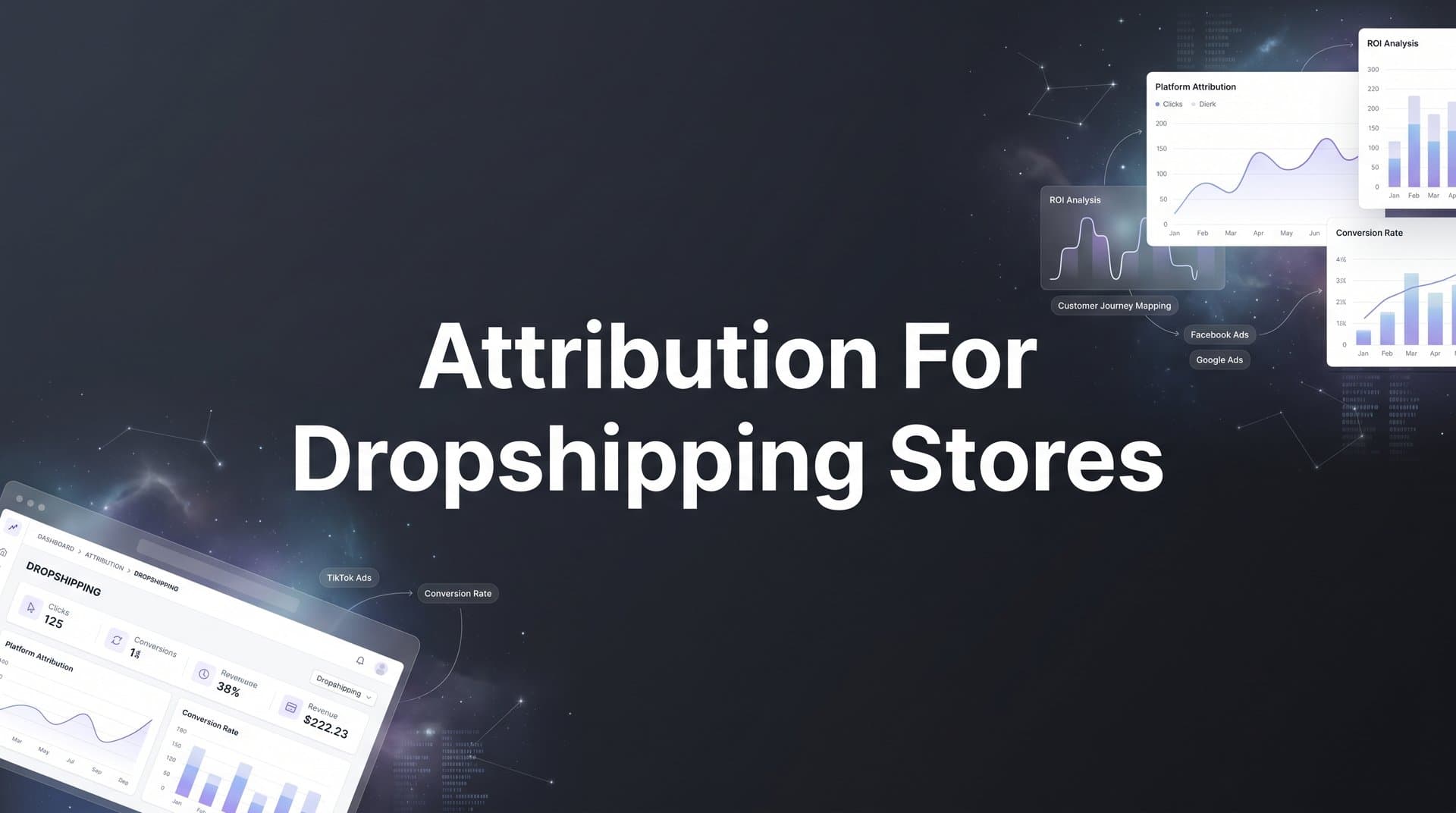
Attribution solves this by tracking the complete customer journey across every touchpoint. It shows you which ad first caught their attention, which retargeting campaign brought them back, and which final touchpoint convinced them to buy. For dropshippers running multiple campaigns simultaneously while testing products and creatives at speed, accurate attribution transforms chaos into clarity. This guide breaks down exactly how to implement attribution that reveals your real winners and scales your store profitably.
The Perfect Storm: Why Dropshipping Makes Attribution So Complex
Dropshipping creates a uniquely challenging attribution environment that most other business models don't face. The combination of tight margins, multi-platform advertising, and rapid product testing means you're essentially running dozens of mini-experiments simultaneously, all while trying to track which ones actually make money.
Multiple Platforms, Overlapping Audiences: Most successful dropshippers don't rely on a single traffic source. You're running Facebook campaigns targeting interest-based audiences, Google Shopping ads catching high-intent searchers, and TikTok ads reaching younger demographics. The problem? These audiences overlap significantly. The same potential customer sees your product on TikTok during their morning scroll, encounters it again through a Facebook retargeting ad at lunch, and finally searches for it on Google before purchasing.
Each platform's native analytics claims credit for that conversion. Facebook reports it as a Facebook sale. Google counts it as a Google conversion. Your dashboard shows three sales, but only one actually happened. This isn't just confusing—it's financially dangerous when you're calculating ROAS and deciding where to allocate tomorrow's budget. Implementing marketing attribution for multiple ad platforms solves this overlap problem by providing a unified view of performance.
The Long Journey to Purchase: Unlike impulse buys for established brands, dropshipped products often require multiple touchpoints before purchase. Customers research the product, read reviews, compare prices, and deliberate over whether they trust a store they've never heard of. This extended consideration period means the path from first ad view to checkout might span days or even weeks, crossing multiple devices and platforms.
A typical journey might look like this: Customer sees your ad on mobile while browsing Instagram, clicks through but doesn't buy. Three days later, they see a retargeting ad on desktop Facebook and visit again to read product details. A week later, they search your brand name on Google, click the ad, and finally purchase. Which touchpoint deserves credit? Without proper attribution, you're flying blind.
iOS Changes and Privacy Restrictions: Apple's iOS privacy updates fundamentally broke the tracking model that dropshippers relied on for years. When customers opt out of tracking—and most do—Facebook's pixel can't follow them across websites or attribute conversions accurately. The result is systematic under-reporting that makes profitable campaigns look unprofitable.
Cookie restrictions from browsers like Safari and Firefox compound the problem. Third-party cookies that once tracked users across the web are disappearing, creating blind spots in your customer journey data. Platform-reported metrics become increasingly unreliable, yet most dropshippers still make budget decisions based on these incomplete numbers. This gap between actual performance and reported performance is where profitable stores accidentally kill winning campaigns and scale losers.
Multi-Touch Attribution: Seeing the Complete Picture
Understanding attribution models is like choosing the right lens for your camera. Each model reveals different aspects of your customer journey, and the wrong choice can lead you to completely misread which campaigns drive real results.
First-Touch Attribution: This model gives all credit to the first interaction a customer has with your brand. If someone clicks a TikTok ad, later sees Facebook retargeting, and eventually purchases through a Google search, TikTok gets 100% of the credit. For dropshippers, first-touch attribution is valuable when you're trying to understand which platforms are best at cold traffic acquisition and initial product discovery.
This model helps answer questions like: Which platform introduces new customers to my products most cost-effectively? Where should I focus my prospecting budget? However, it completely ignores the nurturing and retargeting that often make the sale possible, potentially undervaluing your mid-funnel and bottom-funnel campaigns.
Last-Touch Attribution: The opposite approach gives all credit to the final touchpoint before purchase. If that same customer journey ends with a Google search, Google gets 100% credit even though TikTok and Facebook played crucial roles earlier. Most ad platforms use last-touch attribution by default because it makes their performance look better.
Last-touch attribution favors retargeting campaigns and branded search, which often appear highly profitable because they're capturing customers who were already warmed up by earlier touchpoints. For dropshippers, this creates a dangerous illusion: your retargeting looks incredibly efficient while your prospecting campaigns appear to lose money, even though the prospecting is what filled your retargeting audience in the first place.
Multi-Touch Attribution: This is where attribution gets real. Multi-touch attribution models distribute credit across all touchpoints in the customer journey, acknowledging that multiple interactions worked together to generate the sale. Different multi-touch models weight the touchpoints differently—some give more credit to first and last touches, others distribute credit evenly, and advanced models use data-driven weighting based on actual conversion patterns.
For dropshipping stores running multiple campaigns across multiple platforms, multi-touch attribution reveals the truth that single-touch models hide. You discover that your TikTok prospecting campaigns are actually profitable when you account for the downstream conversions they enable. You see that certain Facebook ad creatives work best for initial awareness while others excel at closing sales. You understand which combinations of touchpoints produce the highest-value customers.
For a deeper dive, see our guide to AI ad generator for dropshipping.
The Duplicate Conversion Problem: Without unified multi-touch attribution, you're likely counting the same conversion multiple times. Facebook reports a conversion. Google reports a conversion. Your email platform claims credit too. When you add up the revenue each platform claims to have generated, the total exceeds your actual revenue by 40% or more.
This duplication isn't just a reporting annoyance. It fundamentally distorts your ROAS calculations and budget allocation decisions. You think you're profitable when you're actually breaking even. You scale campaigns that appear successful but are only capturing conversions that other channels initiated. Multi-touch attribution deduplicates these conversions and shows you the single source of truth: one conversion, accurately attributed across the touchpoints that actually contributed to it.
Server-Side Tracking: Your Competitive Advantage
Browser-based tracking is dying, and dropshippers who don't adapt are leaving money on the table. Server-side tracking represents the fundamental shift in how accurate attribution happens in the privacy-first era.
How Browser Limitations Hide Your Conversions: Traditional pixel tracking relies on JavaScript code running in the customer's browser. When someone visits your store, the Facebook pixel, Google tag, and TikTok pixel all fire, dropping cookies and attempting to track behavior. This approach worked well for years, but it's increasingly broken.
Ad blockers strip out tracking pixels entirely. iOS privacy settings prevent cross-site tracking. Cookie restrictions limit how long you can follow users. The result is that 30-40% of your actual conversions go unreported by platform pixels. Your Facebook campaigns might be generating $10,000 in revenue, but Facebook only sees $6,500 because the pixel missed the rest. You look at the incomplete data and conclude the campaign is underperforming, potentially killing a winner.
Server-Side Tracking Captures What Pixels Miss: Instead of relying on browser-based tracking, server-side tracking sends conversion data directly from your server to the ad platforms. When a customer completes a purchase, your store's backend immediately notifies Facebook, Google, and TikTok about the conversion, including rich data about the purchase value, products bought, and customer information.
This approach bypasses all browser restrictions. Ad blockers can't stop it. Cookie limitations don't affect it. iOS privacy settings are irrelevant because the tracking happens server-to-server, not in the customer's browser. For dropshippers, this means capturing close to 100% of your actual conversions instead of the 60-70% that browser pixels typically catch. Proper tracking for dropshipping stores requires this server-side approach to remain competitive.
Feeding Better Data to Ad Platform Algorithms: Modern ad platforms like Facebook and Google rely heavily on machine learning to optimize your campaigns. Their algorithms need accurate conversion data to understand which audiences, creatives, and placements drive results. When pixels miss conversions, the algorithms learn from incomplete information and optimize toward the wrong signals.
Server-side tracking sends enriched conversion events that include detailed purchase information, customer lifetime value signals, and accurate attribution data. This better data helps ad platform algorithms identify your best customers and find more people like them. Your targeting improves. Your cost per acquisition drops. Your ROAS increases—not because you changed your creative or targeting, but because the platforms finally have accurate data to work with.
Setting Up Reliable Tracking: Implementing server-side tracking requires connecting your store platform directly to your attribution system, which then communicates with ad platforms through their conversion APIs. For Shopify dropshippers, this typically involves installing an attribution app that handles the server-side connection automatically, eliminating the technical complexity.
The key is ensuring that every conversion—regardless of how the customer found you or what device they used—gets captured and attributed correctly. Server-side tracking makes this possible by creating a direct pipeline from your store's transaction data to your attribution platform to your ad accounts, with no browser-based weak points where data can be lost.
Building Your Attribution System: A Practical Setup Guide
Attribution isn't theoretical. It's a specific technical implementation that connects your data sources and reveals the truth about campaign performance. Here's how to build a system that actually works for your dropshipping store.
Connect Your Ad Accounts: The foundation of attribution is linking every platform where you run ads into a unified system. This means connecting your Facebook Ads Manager, Google Ads account, TikTok Ads Manager, and any other platforms you use for traffic. The connection should be bidirectional—pulling in ad spend and impression data while pushing back accurate conversion information.
Most dropshippers use an attribution platform for dropshipping that integrates with major ad networks through official APIs. This creates a live connection where your attribution system continuously syncs campaign data, automatically updates as you launch new ads, and feeds conversion events back to platforms in real time. The key is choosing a platform that supports all your traffic sources, not just Facebook and Google.
Integrate Your Store Platform: Your Shopify, WooCommerce, or other e-commerce platform holds the ultimate truth: actual purchases and revenue. Your attribution system needs direct access to this transaction data to match conversions back to the ad touchpoints that generated them.
Integration typically happens through your store platform's API or through a dedicated app. For Shopify dropshippers, this means installing an attribution app from the Shopify App Store that automatically captures every order, extracts customer journey data, and links purchases to ad interactions. The integration should capture not just that a sale happened, but the order value, products purchased, customer information, and timestamp—all crucial for accurate attribution.
Map the Complete Customer Journey: Attribution works by connecting touchpoints into a coherent journey. When someone clicks your Facebook ad, that click gets tagged with a unique identifier. When they return later through a Google search, that interaction gets tagged and linked to the same customer profile. When they finally purchase, the attribution system looks back at all tagged touchpoints and determines which ones contributed to the conversion.
This journey mapping requires tracking parameters in your ad URLs, first-party cookies on your store, and logic that matches anonymous visitors to known customers once they purchase. Understanding cross platform attribution tracking helps you troubleshoot when something doesn't look right.
Test and Validate Your Setup: Before trusting your attribution data to make budget decisions, validate that it's capturing conversions accurately. Make test purchases using different paths—click a Facebook ad and buy immediately, click a Google ad and buy later, visit directly and purchase. Check that your attribution system captured each conversion and assigned credit correctly.
Compare your attribution platform's reported revenue to your actual Shopify revenue for a test period. They should match within a few percentage points. If there's a significant discrepancy, something in your setup needs adjustment. Common issues include tracking parameters not firing correctly, store integration missing certain order types, or timezone mismatches between systems.
Set Up Conversion Sync: The final piece is feeding your accurate conversion data back to ad platforms through their conversion APIs. This is where server-side tracking completes the loop, sending enriched conversion events that include attribution data, customer value signals, and accurate purchase information.
Conversion sync helps ad platforms optimize your campaigns based on real results instead of incomplete pixel data. For dropshippers, this means Facebook's algorithm stops optimizing toward clicks that don't convert and starts finding audiences that actually buy. Your cost per purchase drops because the platform finally knows what a real customer looks like.
Turning Attribution Data Into Profitable Scaling Decisions
Accurate attribution data is worthless if you don't act on it. The real value comes from using these insights to reallocate budget, kill losers, and scale winners with confidence.
Identify Your True Performers: With multi-touch attribution in place, you can finally see which campaigns generate positive ROAS when all touchpoints are considered. That Facebook prospecting campaign that looked unprofitable in Facebook's dashboard might actually be your best performer when you account for the downstream conversions it enables through retargeting and branded search.
Look at campaign-level ROAS across your entire attribution window, not just last-click conversions. Identify which ad creatives, audiences, and platforms consistently appear in the customer journeys of your highest-value purchasers. These are your proven winners—the campaigns that deserve more budget and the creatives worth testing variations of.
Reallocate Budget Based on Real Performance: Most dropshippers allocate budget based on platform-reported ROAS, which leads to systematic misallocation. You overspend on retargeting because it looks incredibly profitable in last-click attribution, while underfunding prospecting campaigns that actually fill your funnel.
Attribution data reveals the optimal budget split. You might discover that your TikTok prospecting campaigns deserve 40% of your budget instead of the 20% you've been giving them, because they're initiating customer journeys that convert through other channels. Using attribution data for ad optimization helps you find that certain Facebook ad sets look profitable in isolation but actually cannibalize better-performing campaigns, making them net negative for your overall ROAS.
The key is making incremental adjustments based on attributed performance, not dramatic shifts based on gut feel. Increase budget to campaigns showing strong multi-touch ROAS by 20-30%. Decrease or pause campaigns that underperform even when given credit for all touchpoints. Test new variations of winning creatives and audiences while maintaining your proven performers.
Build Smarter Audiences Using Accurate Signals: Lookalike audiences and algorithmic targeting only work when they're built from accurate conversion data. If your Facebook pixel only captured 60% of your actual purchasers, your lookalike audience is optimized toward an incomplete and potentially misleading sample.
Server-side tracking and conversion sync solve this by feeding complete purchase data back to ad platforms. Your lookalikes now include all customers who bought, not just the ones the pixel happened to catch. Your automated bidding strategies optimize toward true conversions, not partial data. The result is better targeting, lower cost per acquisition, and higher ROAS as platforms finally have accurate signals to learn from.
Optimize Your Retargeting Strategy: Attribution data reveals which customers are worth retargeting and which touchpoints drive them to convert. You might discover that customers who viewed your product page but didn't add to cart respond well to social proof ads, while cart abandoners convert best with discount offers.
Use attribution insights to segment your retargeting audiences based on where they are in the journey and what touchpoints have already influenced them. Reviewing ad analytics for dropshipping stores helps you create specific ad sequences that complement rather than repeat earlier touchpoints. If someone already engaged with your video ad explaining the product, retarget them with customer testimonials or limited-time offers, not another explainer video.
Make Product Testing Decisions Faster: Dropshipping success often comes from testing products quickly and scaling winners aggressively. Attribution data accelerates this process by showing you which products actually drive profitable sales versus which ones generate clicks but don't convert.
When testing a new product, look at the complete attributed customer journey, not just platform-reported conversions. Some products generate immediate purchases with simple ad creative. Others require multiple touchpoints and educational content before customers buy. Attribution data reveals these patterns within days instead of weeks, letting you kill losers faster and scale winners harder.
Putting It All Together
Attribution transforms dropshipping from a game of guessing which ads work into a data-driven operation where every budget decision is backed by evidence. When you know exactly which campaigns drive real purchases, which touchpoints work together to convert customers, and which platforms deserve more investment, you stop burning money on underperformers and start scaling the strategies that actually generate profit.
The dropshipping business model demands this level of precision. With tight margins and intense competition, you can't afford to make budget decisions based on incomplete platform data that over-reports conversions and hides the true customer journey. Multi-touch attribution reveals the reality behind the numbers, while server-side tracking ensures you capture every conversion that browser-based pixels miss.
The difference between profitable dropshipping stores and those that struggle often comes down to attribution. Successful stores know which ads work because they track the complete customer journey. They scale confidently because they're optimizing toward real ROAS, not inflated platform metrics. They feed better data back to ad algorithms, which improves targeting and lowers acquisition costs. They test faster and kill losers sooner because attribution data reveals true performance within days.
Setting up proper attribution isn't optional anymore. It's the foundation that makes everything else work. When your tracking is accurate, your budget allocation improves. When your conversion data is complete, your ad platform algorithms optimize better. When you understand the full customer journey, you create more effective campaigns that work together instead of competing for credit.
Ready to elevate your marketing game with precision and confidence? Discover how Cometly's AI-driven recommendations can transform your ad strategy—Get your free demo today and start capturing every touchpoint to maximize your conversions.