Your dropshipping store is bleeding money, and you don't even know it. You're pumping cash into Facebook ads, Google campaigns, and TikTok promotions, watching orders roll in—but which ads actually drove those sales? When a customer buys after seeing three different ads over two weeks, which one gets credit? Without proper tracking, you're making budget decisions based on guesswork, not data.
The dropshipping model makes this problem even worse. Your customers don't receive their products for weeks, giving them plenty of time to interact with multiple touchpoints before confirming their purchase. Add iOS privacy changes that hide conversion data, ad blockers that prevent pixels from firing, and the reality that most dropshippers run campaigns across three or four platforms simultaneously—and you've got a tracking nightmare.
Here's what's at stake: you might be scaling the wrong campaigns while killing your best performers. You could be attributing sales to the last ad a customer clicked while ignoring the awareness campaign that actually started their journey. With margins already thin in dropshipping, every misallocated dollar directly impacts your bottom line.
This guide walks you through building a tracking system that captures the complete picture. You'll set up foundational pixels, implement server-side tracking to recover lost conversions, configure multi-touch attribution that reflects your actual customer journey, and feed clean conversion data back to ad platforms to improve their optimization. By the end, you'll know exactly which campaigns drive real revenue—and you'll have the confidence to scale what works while cutting what doesn't.
Step 1: Audit Your Current Tracking Setup and Identify Gaps
Before you add new tracking, you need to understand what you already have—and more importantly, what you're missing. Most dropshipping stores have some basic tracking in place, but it's rarely comprehensive enough to support smart scaling decisions.
Start by logging into your ecommerce platform and checking which pixels are currently installed. If you're on Shopify, navigate to Settings > Customer Events to see active pixels. For WooCommerce, check your installed plugins and any tracking codes in your theme's header. Look for Meta Pixel, Google Ads tags, TikTok Pixel, and Google Analytics. Write down the pixel IDs for each one—you'll need these for verification later.
Next, open your browser's developer tools and visit your store's product pages, cart, and checkout. In the Console tab, look for tracking events firing as you navigate. You should see events like PageView, ViewContent, AddToCart, and Purchase. If you don't see these firing consistently, that's your first gap.
Now identify the blind spots specific to dropshipping. The biggest one? Fulfillment delays. When customers wait three weeks for their order, they might see five more retargeting ads before their product arrives. Your current tracking probably treats each ad click as independent, rather than connecting them to a single customer journey. Write down your average fulfillment time—this will determine your attribution window settings later.
Document every traffic source you're currently running. Create a simple spreadsheet with columns for Platform, Campaign Type, Monthly Spend, and Tracking Status. Include Meta, Google Ads, TikTok, Pinterest, Snapchat—anywhere you're investing money. For each source, note whether you have pixel tracking, UTM parameters, and click ID capture set up. Most stores discover they're tracking Meta well but have gaps in their Google or TikTok attribution.
Check your iOS attribution specifically. Open your Meta Ads Manager and compare iOS conversions to Android conversions. If your iOS conversion rate is dramatically lower despite similar traffic volume, you're experiencing the iOS 14+ attribution gap. This isn't a problem with your customers—it's a problem with browser-based tracking that pixel tracking alternatives for iOS users will solve.
Finally, verify whether your current setup connects ad clicks to actual revenue. Go to your ecommerce platform's order details and look at a recent purchase. Can you see which ad campaign drove that sale? Can you see all the ads that customer interacted with before buying? If the answer is no, you're missing the attribution layer that connects advertising to revenue.
You should now have a clear document showing what's tracked, what's missing, and where your biggest gaps are. This becomes your roadmap for the remaining steps.
Step 2: Install Platform Pixels and Configure Basic Event Tracking
With your gaps identified, it's time to install the foundational tracking that every dropshipping store needs. You'll set up pixels for your primary ad platforms and configure them to fire the standard ecommerce events that ad algorithms need for optimization.
Start with Meta Pixel since Facebook and Instagram typically drive significant dropshipping traffic. Log into Meta Events Manager and create a new pixel if you don't have one already. Copy the pixel base code, then install it on your store. For Shopify users, go to Settings > Customer Events > Add Custom Pixel and paste your Meta Pixel code. For WooCommerce, use the official Facebook for WooCommerce plugin or add the pixel code to your theme's header.php file using a child theme.
Configure your Meta Pixel to fire these standard events: ViewContent when someone views a product page, AddToCart when they add an item, InitiateCheckout when they reach checkout, and Purchase when they complete an order. Most ecommerce platforms have built-in integrations that handle this automatically, but verify each event is firing correctly using the Meta Pixel Helper browser extension.
Next, set up your Google Ads conversion tracking. In Google Ads, navigate to Tools > Conversions and create a new conversion action for purchases. Choose "Website" as the source and "Purchase" as the action. Google will generate a conversion tracking tag—install this on your order confirmation page. For Shopify, use the Google & YouTube app. For WooCommerce, install the Google Ads conversion tracking plugin or add the tag to your order confirmation template.
Configure Google Analytics 4 with enhanced ecommerce tracking. In your GA4 property, enable ecommerce events under Configure > Events. Install the GA4 measurement ID on your site using Google Tag Manager or your platform's native integration. GA4 should automatically collect events like view_item, add_to_cart, begin_checkout, and purchase. These events give you a platform-independent view of customer behavior that complements your ad platform data.
If you're running TikTok ads, install TikTok Pixel following the same pattern. In TikTok Ads Manager, go to Assets > Event and create a new pixel. Install the base code on your site and configure it to fire ViewContent, AddToCart, InitiateCheckout, and CompletePayment events. TikTok's pixel works similarly to Meta's, and most ecommerce platforms have native integrations or plugins available. For detailed guidance, check out our guide on best tools for tracking TikTok ads.
If you're evaluating vendors, our AI UGC for ecommerce breakdown can help.
For each platform, configure dynamic parameters that pass product information with your events. This includes product IDs, names, prices, and categories. Ad platforms use this data to build better audience segments and optimize for specific products. In Shopify, this happens automatically through native integrations. In WooCommerce, you'll need to map your product data fields to the pixel parameters.
We compare the leading options in our Shopify ad variation generator roundup.
Test everything before moving forward. Install browser extensions like Meta Pixel Helper, Google Tag Assistant, and TikTok Pixel Helper. Visit your store as a customer would: view a product, add it to cart, proceed to checkout, and complete a test purchase. Watch each extension to verify that events fire at the right moments with the correct data. Check your ad platform dashboards—you should see test events appearing in real time.
Open your browser's developer console and look for any JavaScript errors that might prevent pixels from loading. Common issues include conflicts between plugins, ad blockers interfering with pixel scripts, or incorrect pixel IDs. Fix any errors you find before proceeding to server-side tracking.
Your success indicator: every platform pixel fires correctly on product pages, cart, checkout, and purchase confirmation. Test events appear in each ad platform's event dashboard within minutes. You've now established the browser-based tracking foundation that most stores rely on—but as you'll see in the next step, browser-based tracking alone isn't enough.
Step 3: Implement Server-Side Tracking to Capture Lost Conversions
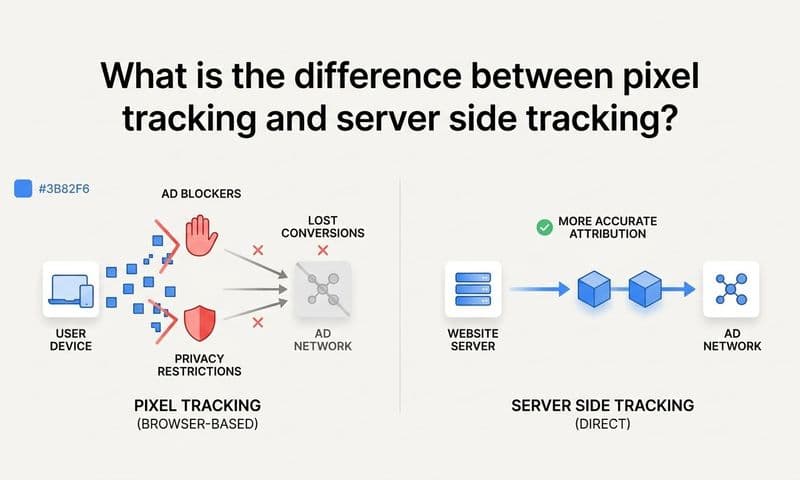
Here's the uncomfortable truth: your browser-based pixels are missing conversions. Ad blockers prevent pixels from loading. Safari's Intelligent Tracking Prevention limits cookie duration. iOS users who opted out of tracking are invisible to your Meta Pixel. For many dropshipping stores, 20-40% of actual conversions never reach ad platforms through browser pixels alone.
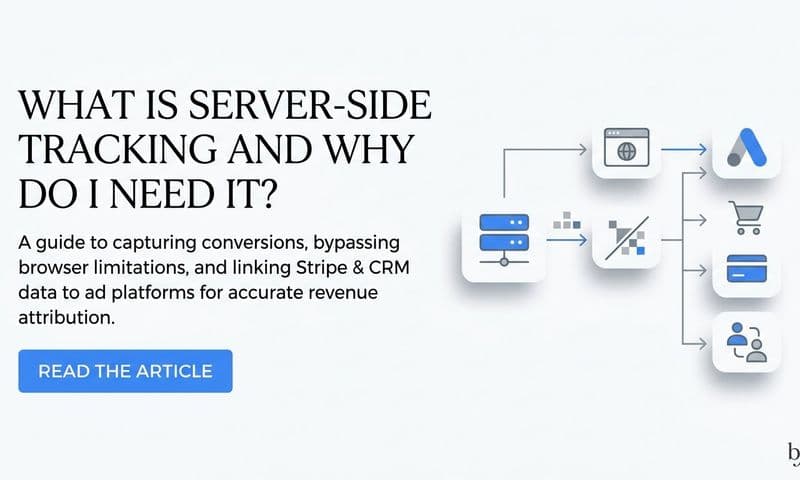
Server-side tracking solves this by sending conversion data directly from your store's backend to ad platforms, bypassing browser limitations entirely. When a customer completes a purchase, your server sends the conversion event to Meta, Google, and other platforms using their server-side APIs. No browser required, no ad blockers involved.
Start with Meta's Conversions API, which is critical for recovering iOS conversions. In Meta Events Manager, navigate to your pixel settings and find the Conversions API section. You'll need to generate an access token that allows your server to send events to Meta. Copy this token—you'll use it to authenticate your server requests.
The implementation method depends on your platform. Shopify users should install an app like Elevar or Littledata that handles Conversions API setup automatically. These apps capture order data from Shopify's backend and send it to Meta's servers in real time. For WooCommerce, use a plugin like PixelYourSite Pro or implement a custom solution using Meta's Conversions API documentation and PHP code. Our comprehensive guide on server-side tracking for WooCommerce walks through the complete setup process.
When configuring Conversions API, you'll send the same events as your browser pixel—but with additional data that improves matching. Include customer email, phone number, first name, last name, city, state, country, and zip code with each purchase event. Meta hashes this information and uses it to match conversions to user accounts, dramatically improving attribution accuracy for iOS users.
Set up event deduplication to prevent counting the same conversion twice. Both your browser pixel and Conversions API will send purchase events, so you need a way to tell Meta they're the same transaction. Use your order ID as the event_id parameter in both your browser pixel and Conversions API calls. Meta automatically deduplicates events with matching event_ids, keeping your conversion counts accurate.
For Google Ads, implement server-side conversion tracking using enhanced conversions. In Google Ads, go to Tools > Conversions and edit your purchase conversion action. Enable "Enhanced conversions" and choose server-side implementation. Like Meta, you'll send hashed customer data (email, phone, address) along with conversion events. Google uses this data to improve conversion matching, especially for users who clear cookies or switch devices.
Google's implementation typically uses Google Tag Manager Server-Side. Set up a server-side GTM container, configure it to receive events from your ecommerce platform, and forward them to Google Ads with enhanced conversion data. This requires more technical setup than Meta's Conversions API, so many stores use third-party tools or hire developers for implementation. For a deeper dive, explore our guide on the best server-side tracking platform options available.
Test your server-side tracking by placing a test order and checking the event quality score in Meta Events Manager. Navigate to your pixel's Diagnostics tab and look for the Event Match Quality score for your purchase events. A score of 6.0 or higher indicates good data quality. If your score is lower, you're missing customer information parameters that would improve matching.
Compare your browser-based conversion counts to your server-side counts. In Meta Events Manager, you can filter events by connection method to see browser pixel events versus Conversions API events. You should see server-side events capturing conversions that the browser pixel missed—this is your recovered attribution. Many stores discover that Conversions API adds 15-25% more tracked conversions compared to browser pixels alone.
Your success indicator: server-side events appear in your ad platform dashboards with high event match quality scores. You see more total conversions tracked compared to browser-only implementation. Your iOS conversion attribution improves noticeably, and your ROAS reporting becomes more complete.
Step 4: Set Up UTM Parameters and First-Party Data Collection
Platform pixels tell you what happened on your site, but UTM parameters tell you exactly where traffic came from. Without consistent UTM tagging, you can't distinguish between your Meta awareness campaign and your Google retargeting campaign when analyzing which sources drive the most profitable customers.
Create a UTM naming convention that you'll use across all campaigns. A solid structure includes five parameters: utm_source (the platform), utm_medium (the traffic type), utm_campaign (the specific campaign name), utm_term (for paid search keywords), and utm_content (for A/B testing ad variations). For example: utm_source=facebook, utm_medium=paid_social, utm_campaign=spring_sale_2026, utm_content=video_ad_v1.
Document your convention in a shared spreadsheet so everyone on your team uses the same format. Consistency matters—if one person uses "facebook" and another uses "Facebook" or "fb," you'll fragment your reporting. Use lowercase letters, underscores instead of spaces, and descriptive names that make sense six months from now when you're analyzing historical data. Our article on best practices for UTM parameter tracking covers the complete framework.
Apply UTM parameters to every external link that drives traffic to your store. In Meta Ads Manager, add UTM parameters to your ad URL parameters. In Google Ads, use the tracking template field. For email campaigns, your email platform should have a field for adding UTM parameters to links. Even organic social posts should include UTM tags so you can track their performance separately from paid campaigns.
Implement first-party cookies to track customer journeys across sessions. Most ecommerce platforms set session cookies by default, but these expire when users close their browser. First-party cookies persist longer, allowing you to connect a customer's initial visit to their eventual purchase days or weeks later. For Shopify, apps like Littledata handle this automatically. For WooCommerce, implement a custom cookie solution using JavaScript that sets a unique user ID on first visit and maintains it across sessions.
Capture click IDs from ad platforms and store them with order data. When someone clicks a Meta ad, Meta appends fbclid to the URL. Google appends gclid. TikTok appends ttclid. These click IDs allow platforms to match conversions back to specific ad clicks with perfect accuracy. Your tracking system should capture these parameters when users land on your site and pass them through to your order confirmation.
The technical implementation: use JavaScript to read URL parameters when users land on your site, store them in cookies or session storage, and include them as hidden fields in your checkout form. When someone completes a purchase, these click IDs get saved with the order in your database. Later, when you send conversion data via Conversions API or enhanced conversions, include these click IDs to improve matching accuracy.
Set up a system to preserve attribution data through your entire checkout flow. If a customer clicks a Meta ad, adds a product to cart, leaves, then returns directly to complete checkout, you need to remember that their initial source was Meta. Store the original utm_source, utm_medium, utm_campaign, and click IDs in cookies with a 30-day expiration. When they eventually purchase, pull these values from cookies and include them with the order data.
Test your UTM tracking by clicking through your own ads from different platforms. After clicking an ad, check your browser's cookies to verify that utm parameters and click IDs are stored correctly. Complete a test purchase and check your order details in your ecommerce platform's admin. You should see the complete source attribution saved with the order—utm parameters, click IDs, and any other tracking data you've configured.
Your success indicator: every order in your backend shows complete source attribution. You can look at any purchase and see exactly which campaign, ad set, and specific ad drove that sale. Your UTM data flows cleanly into your analytics platform, allowing you to segment revenue by source, medium, and campaign.
Step 5: Connect Your Attribution Platform to Ad Accounts and Store Data
You've got pixels firing, server-side tracking capturing conversions, and UTM parameters tagging traffic sources. Now you need a central system that connects all these data points into a unified view of your customer journeys. This is where a dedicated attribution platform transforms fragmented data into actionable insights.
Choose an attribution platform designed for ecommerce tracking. Your platform should integrate with your ad accounts, pull data from your store, and map customer touchpoints from first click through purchase and beyond. Solutions like Cometly specialize in this exact use case, connecting ad platforms, analytics tools, and ecommerce backends into a single attribution system.
Start by connecting your ad accounts. In your attribution platform, navigate to integrations and authenticate with Meta Ads, Google Ads, TikTok Ads, and any other platforms where you run campaigns. This allows the attribution system to pull campaign data, ad spend, and platform-reported conversions for comparison with your store's actual revenue data.
Next, connect your ecommerce platform. For Shopify, this typically involves installing an app and granting permissions to access order data. For WooCommerce, you'll either use a plugin or set up a webhook that sends order information to your attribution platform in real time. The connection should include order details, customer information, product data, and most importantly, the revenue associated with each purchase.
Configure your attribution platform to capture first-party data from your site. This usually involves installing a tracking script similar to your pixel implementations, but instead of sending data to ad platforms, it sends data to your attribution system. This script captures page views, click events, form submissions, and the complete user journey across your site.
Map the customer journey by connecting touchpoints. When someone clicks a Meta ad, visits your site, leaves, clicks a Google ad two days later, returns, and finally purchases, your attribution platform should show all four touchpoints in sequence. This mapping happens by matching user identifiers—cookies, click IDs, email addresses, and device fingerprints—across different sessions and platforms. Understanding cross platform tracking for dropshipping is essential for getting this right.
For a deeper dive, see our guide to AI ad generator for dropshipping.
Set up your conversion tracking within the attribution platform. Define what counts as a conversion: completed purchases, add-to-carts, or even newsletter signups if those are valuable actions for your store. Configure the platform to pull conversion data from your ecommerce backend rather than relying solely on pixel data, ensuring accuracy even when browser tracking fails.
Integrate your customer relationship management system if you use one. Many dropshipping stores use tools like Klaviyo for email marketing or Gorgias for customer support. Connecting these systems to your attribution platform adds additional touchpoints to customer journeys—email opens, support tickets, repeat purchases—creating a more complete picture of customer behavior.
Enable cross-device tracking if your attribution platform supports it. Customers often research products on mobile and purchase on desktop, or vice versa. Cross-device tracking uses email addresses, login data, and probabilistic matching to connect these separate sessions to the same customer, preventing you from thinking one person is actually two different prospects.
Test the integration by placing several orders through different traffic sources. Click a Meta ad and purchase immediately. Click a Google ad, leave, return directly, and purchase. Click a TikTok ad, add to cart, abandon, click a Meta retargeting ad, and complete checkout. Then check your attribution platform to verify it captured all these journeys correctly with every touchpoint visible.
Your success indicator: you can select any conversion in your attribution platform and see the complete customer journey—every ad they clicked, every page they visited, every session they started, and the exact sequence of events that led to purchase. Your ad spend data from platforms matches what your attribution system shows, and your revenue data matches your ecommerce platform's records.
Step 6: Configure Multi-Touch Attribution for Dropshipping Revenue
Now comes the crucial decision: how do you distribute credit for a sale across multiple touchpoints? If a customer saw five different ads before buying, which one deserves credit? Your answer to this question directly impacts which campaigns you scale and which you kill.
Last-click attribution gives all credit to the final touchpoint before purchase. It's simple, but it systematically undervalues awareness campaigns and overvalues retargeting. If you're running both cold traffic campaigns and retargeting, last-click will make retargeting look artificially profitable while making your awareness campaigns look like they're losing money—even though the awareness campaigns are actually starting the customer journey.
First-click attribution does the opposite, giving all credit to the initial touchpoint. This helps you understand what's bringing new customers into your funnel, but it ignores the retargeting and nurturing required to convert them. For dropshipping stores with longer consideration windows, first-click alone doesn't reflect reality.
Linear attribution distributes credit equally across all touchpoints. If someone clicked five ads before purchasing, each ad gets 20% credit. This prevents over-crediting any single touchpoint, but it treats all interactions as equally valuable—which often isn't true. The ad that introduced your brand probably matters more than the fifth retargeting impression.
Time-decay attribution gives more credit to touchpoints closer to conversion. The logic: recent interactions influenced the purchase decision more than older ones. This model works well for dropshipping because it acknowledges that the retargeting ad someone clicked yesterday probably mattered more than the awareness ad they saw three weeks ago—while still giving the awareness ad some credit.
Position-based attribution (also called U-shaped) gives 40% credit to the first touchpoint, 40% to the last touchpoint, and distributes the remaining 20% across middle interactions. This model recognizes that both introducing a customer to your brand and closing the sale are critical moments, while still accounting for nurturing touchpoints in between.
For most dropshipping stores, time-decay or position-based attribution provides the most accurate picture. Configure your attribution platform to use one of these models, then compare results across different models to see how credit distribution changes. You'll often discover that campaigns you thought were underperforming actually play a crucial role in the customer journey. For managing attribution tracking for multiple campaigns, having the right model is critical.
Set your attribution window based on your typical customer journey length. The attribution window determines how far back the system looks for touchpoints. If you set a 7-day window but your customers typically take 14 days to convert, you're missing half their journey. For dropshipping, 30-day attribution windows are common because fulfillment delays and consideration periods extend the journey.
Configure separate attribution windows for different actions. Use a 7-day click and 1-day view window for add-to-cart events, but a 30-day click and 7-day view window for purchases. This reflects reality: someone who clicked an ad last week and then purchased probably remembers that ad, but someone who only saw an ad impression three weeks ago probably doesn't.
Account for post-purchase events in your attribution. Refunds, chargebacks, and returns are common in dropshipping due to long fulfillment times and product quality issues. Configure your attribution system to subtract refunded revenue from campaign performance. If a campaign drove $10,000 in sales but $3,000 got refunded, the true revenue is $7,000—and that's what should inform your budget decisions.
Set up value-based attribution if your attribution platform supports it. Instead of treating all conversions equally, weight them by actual value. A $200 order should count more than a $30 order. Some platforms go further, allowing you to weight by profit margin rather than revenue—crucial for dropshipping where margins vary significantly by product.
Your success indicator: your attribution data aligns with your actual store revenue. When you sum attributed revenue across all campaigns, the total matches your ecommerce platform's total sales (accounting for your attribution window). Campaign performance rankings make intuitive sense based on your marketing strategy, and you can confidently identify which campaigns deserve more budget.
Step 7: Feed Optimized Conversion Data Back to Ad Platforms
Your attribution system now shows you which campaigns drive real revenue, but there's one more step: feeding this enriched data back to ad platforms to improve their optimization algorithms. When platforms receive better conversion data, they make better decisions about who to show your ads to and how much to bid.
The concept is called conversion sync or conversion enrichment. You send purchase events back to Meta, Google, and other platforms with additional context they didn't have before—like whether the order was refunded, what the actual profit was, or which products were purchased. This helps platform algorithms optimize for outcomes that actually matter to your business, not just raw conversion counts.
Start with Meta's Conversions API, which you already set up for server-side tracking. Now enhance those events with post-purchase data. When someone completes an order, send the initial purchase event immediately. Then, if that order gets refunded two weeks later, send an updated event with the refund information. Meta's algorithm learns that certain user profiles are more likely to refund, and adjusts targeting accordingly.
Exclude fraudulent transactions and test orders from your conversion data. Dropshipping stores often experience fraud attempts, and these fake orders shouldn't count as successful conversions. Configure your conversion sync to only send legitimate purchases—orders that passed fraud checks, weren't immediately canceled, and have valid tracking numbers.
Send profit-based conversion values instead of revenue-based values. If you're running value optimization campaigns, ad platforms optimize for the highest conversion value. But if you send revenue as the value, platforms might chase high-revenue orders with terrible margins. Instead, calculate your actual profit per order (revenue minus product cost, shipping, and transaction fees) and send that as the conversion value. Now platforms optimize for profitability, not just revenue. This approach to tracking conversions accurately can dramatically improve your ROAS.
For Google Ads, set up offline conversion imports to send post-purchase data. Export orders from your attribution system with their associated gclid values, then import them into Google Ads under Tools > Conversions > Uploads. Include the actual conversion value (ideally profit, not revenue) and any relevant conversion adjustments like refunds or cancellations.
Configure conversion value rules if your platform supports them. In Meta, you can set up rules that adjust conversion values based on specific conditions. For example, increase the value for orders from repeat customers, or decrease it for orders of products with high return rates. These rules help platforms optimize for the outcomes you actually care about.
Enable value-based lookalike audiences. Once platforms receive enriched conversion data showing which customers are most valuable, they can build lookalike audiences based on high-value converters rather than all converters. This targets people similar to your best customers, not just anyone who's purchased.
Set up automated feeds if your attribution platform supports them. Instead of manually syncing conversion data, configure automatic daily exports that send updated conversion information to ad platforms. This keeps your conversion data current without requiring manual intervention, and it ensures platforms receive refund and cancellation data promptly.
Monitor your ad platform ROAS reporting over time. As platforms receive better conversion data, their reported ROAS should become more accurate and align more closely with your attribution platform's data. This convergence happens because platforms are now seeing the same conversion reality you see—including refunds, fraud exclusions, and profit-based values.
Your success indicator: ad platform ROAS reporting becomes more accurate and aligns with your attribution system's data. Campaigns optimized with enriched conversion data show improved performance over time. Platform algorithms make better targeting decisions, and you see lower cost per acquisition for high-quality customers.
Putting It All Together: Your Tracking System Checklist
You've built a comprehensive tracking system that captures every touchpoint, attributes revenue accurately across your entire customer journey, and feeds clean data back to ad platforms for better optimization. This isn't just better reporting—it's a competitive advantage that helps you scale profitably while competitors waste budget on misattributed campaigns.
Use this checklist to verify your complete setup: ✓ All platform pixels installed and firing correctly on product pages, cart, checkout, and confirmation. ✓ Server-side tracking capturing conversions missed by browser-based pixels, especially iOS users. ✓ UTM parameters and click IDs stored with every order for complete source attribution. ✓ Attribution platform connected to all ad accounts and pulling real-time store data. ✓ Multi-touch attribution configured with appropriate windows for your customer journey length. ✓ Conversion sync sending enriched data to ad platforms, excluding refunds and fraud.
Review your attribution data weekly, not daily. Customer journeys in dropshipping span weeks, so daily fluctuations don't tell the full story. Look at 7-day and 30-day windows to identify consistent patterns. Focus on trends rather than individual day performance, and give campaigns time to accumulate enough data before making scaling decisions.
Use your attribution insights to reallocate budget. Identify campaigns that show strong performance in multi-touch attribution but might look weak in last-click reporting—these are often your awareness campaigns that deserve more investment. Find campaigns with high refund rates or low profit margins and either optimize them or cut them entirely.
As your store scales, this tracking foundation becomes more valuable. When you're spending $1,000 per day, a 10% improvement in attribution accuracy means finding an extra $100 of daily profit. At $10,000 per day, that's $1,000 in daily profit—$365,000 annually—just from making smarter budget allocation decisions based on accurate data.
Keep your tracking system maintained. Platforms update their APIs, ecommerce systems release new versions, and tracking technologies evolve. Set a quarterly reminder to audit your setup: verify pixels are still firing, check that server-side tracking is working, confirm your attribution platform is receiving data correctly, and test the complete flow from ad click through purchase attribution.
Remember that tracking is a means to an end, not the end itself. The goal isn't perfect attribution—it's profitable scaling. Use your tracking data to make confident decisions about where to invest your ad budget, which products to promote, and which audiences to target. Every insight should lead to action that improves your store's profitability.
Ready to elevate your marketing game with precision and confidence? Discover how Cometly's AI-driven recommendations can transform your ad strategy—Get your free demo today and start capturing every touchpoint to maximize your conversions.