
You're running campaigns on Meta, Google, and LinkedIn. Conversions are coming in. Revenue is growing. But when your CMO asks which ads are actually driving those sales, you freeze.
Was it the Facebook carousel ad they saw last week? The Google search ad they clicked yesterday? Or that LinkedIn post they engaged with two weeks ago?
Most marketers are flying blind here. They're spending thousands on paid ads while relying on incomplete data from individual platforms that each claim credit for the same conversion. It's like having three different scorekeepers at a basketball game, each reporting a different final score.
Attribution models solve this problem. They're the systematic frameworks that assign credit to the touchpoints in your customer's journey, connecting the dots between every ad interaction and the final conversion. Think of them as the referee that decides which players actually scored the points.
This guide breaks down how attribution models work, which ones fit different business scenarios, and how to implement the right model to finally answer the question: which ads are actually working?
The Building Blocks of Attribution Models
An attribution model is essentially a set of rules that determines how much credit each marketing touchpoint receives for a conversion. When someone buys your product after seeing five different ads across three platforms, the attribution model decides which ads get credit and how much.
Every attribution model operates on four core components. First, touchpoints are the individual interactions a customer has with your marketing: clicking an ad, viewing a video, engaging with a post, or visiting your website. Second, conversion events are the specific actions you're tracking as valuable outcomes, whether that's a purchase, a demo request, or a subscription signup.
Third, credit distribution rules define how the model splits credit among touchpoints. Some models give all credit to one touchpoint, while others distribute it across multiple interactions. Finally, lookback windows determine how far back in time the model considers touchpoints relevant. A seven-day lookback window only credits touchpoints from the week before conversion, while a 30-day window captures a month of interactions.
Why does attribution matter specifically for paid ads? Because every dollar you spend needs to justify itself. Organic channels like SEO or word-of-mouth are valuable, but they don't have the same direct cost-per-click pressure. With paid ads, you're making active budget decisions daily: which campaigns to scale, which to pause, where to shift spend.
Without accurate attribution, you're optimizing based on incomplete information. You might be pouring budget into bottom-funnel search ads that get last-click credit while starving the awareness campaigns that actually created the demand in the first place. Or you could be crediting conversions to branded search when the real driver was a discovery ad someone saw three weeks earlier.
The right attribution model shows you the complete picture of how your paid ads work together to drive conversions, not just which ad happened to be last.
Single-Touch vs. Multi-Touch: Two Approaches to Credit
Attribution models fall into two fundamental categories based on how they distribute credit: single-touch models that give 100% credit to one touchpoint, and multi-touch models that spread credit across multiple interactions.
First-Click Attribution: This single-touch model gives all credit to the first touchpoint that introduced a customer to your brand. If someone clicked your Facebook ad three weeks ago, then interacted with five more ads before converting, the Facebook ad gets 100% of the credit.
First-click makes sense when you're focused on top-of-funnel acquisition and want to understand which channels are best at generating new prospects. It's particularly useful for businesses with long sales cycles where the initial discovery moment is genuinely valuable, even if conversion happens weeks later.
Last-Click Attribution: The opposite approach gives all credit to the final touchpoint before conversion. If someone clicked a Google search ad and immediately purchased, that ad gets 100% credit, regardless of the awareness campaigns they saw earlier.
Last-click is the default model for most ad platforms because it's simple and favors bottom-funnel conversions. It works well for direct response campaigns with short sales cycles where the last interaction genuinely drives the decision. If you're selling impulse purchases or running time-sensitive promotions, last-click can accurately reflect what's working.
The problem with both single-touch models? They ignore the reality that most customer journeys involve multiple touchpoints. Someone might discover your brand through a Facebook ad, research on Google, compare options after seeing a retargeting ad, and finally convert through a search ad. Single-touch models credit only one of those interactions while completely ignoring the others.
Linear Attribution: This multi-touch attribution model distributes credit evenly across all touchpoints. If someone had four interactions before converting, each gets 25% credit. It's democratic but sometimes oversimplifies by treating a quick ad view the same as a detailed product page visit.
Time-Decay Attribution: This model gives more credit to touchpoints closer to conversion. The theory is that recent interactions matter more than older ones. If someone saw an ad four weeks ago and another yesterday, the recent ad gets significantly more credit. This works well for businesses where recency matters and the final touchpoints genuinely drive the decision.
Position-Based Attribution: Also called U-shaped attribution, this model gives 40% credit to the first touchpoint, 40% to the last, and splits the remaining 20% among middle interactions. It recognizes that both discovery and conversion moments matter while acknowledging the nurturing touches in between.
The trade-off is clear: single-touch models are simple to understand and implement but sacrifice accuracy. Multi-touch models provide a more complete picture but require more sophisticated tracking and can be harder to explain to stakeholders who want simple answers.
Which approach you choose depends on your business reality. If you're running direct response campaigns with one-touch conversions, last-click might genuinely reflect your customer journey. But if you're nurturing prospects through multiple touchpoints before they convert, multi-touch attribution will reveal insights that single-touch models completely miss.
Data-Driven Attribution: Letting the Numbers Decide
Rule-based attribution models like first-click or time-decay apply the same credit distribution logic to every conversion. Data-driven attribution takes a different approach: it analyzes your actual conversion data to determine which touchpoints statistically contribute most to conversions.
Here's how it works. The algorithm examines thousands of conversion paths, comparing customers who converted against those who didn't. It identifies patterns: customers who saw Ad A and then Ad B converted at 8%, while those who only saw Ad B converted at 3%. The model concludes that Ad A contributes significantly to conversions and assigns credit accordingly.
This approach reveals insights that fixed rules miss. Maybe your LinkedIn ads rarely get last-click credit, but customers who interact with them convert at twice the rate of those who don't. A last-click model would undervalue LinkedIn entirely. Data-driven attribution recognizes its contribution and allocates credit appropriately.
The power of algorithmic attribution is that it adapts to your specific customer journey. It doesn't assume that first clicks or last clicks matter most. It lets your actual conversion data determine what matters. If your business has a unique path to purchase, data-driven models will discover and account for it.
But there's a significant requirement: you need sufficient conversion volume for the algorithm to identify statistically meaningful patterns. If you're only generating 20 conversions per month, there isn't enough data to distinguish signal from noise. Most platforms recommend at least 400 conversions within the lookback window for data-driven attribution to function accurately.
AI-powered attribution takes this further by analyzing patterns across thousands of customer journeys simultaneously. While a human might spot that customers who see three specific ads tend to convert more, AI can identify complex interaction patterns across dozens of touchpoints, channels, and time intervals that would be impossible to detect manually. Understanding data science for marketing attribution helps you leverage these advanced capabilities.
Modern attribution platforms use machine learning to continuously refine their models as new conversion data arrives. They can account for cross-device journeys, adjust for seasonality, and even predict which current prospects are most likely to convert based on their touchpoint patterns so far.
The limitation is transparency. With rule-based models, you can explain exactly why each touchpoint received its credit. With data-driven models, the algorithm is making probabilistic calculations that can be harder to interpret. You're trusting the math rather than following a simple rule.
For businesses with sufficient conversion volume and complex customer journeys, data-driven attribution provides the most accurate view of what's actually driving results. For smaller businesses or those with straightforward conversion paths, simpler rule-based models might be more practical and easier to act on.
Matching Your Attribution Model to Your Ad Strategy
The right attribution model depends entirely on how your customers actually buy and how you run your ad campaigns. There's no universal best choice, just the model that best reflects your specific business reality.
Short Sales Cycles with Direct Response: If you're selling products where customers discover and purchase within days, last-click or time-decay attribution often makes sense. Someone searching for "running shoes on sale" who clicks your Google ad and buys immediately is a straightforward conversion path. The search ad genuinely drove the sale.
E-commerce businesses with impulse purchases, limited-time offers, or highly transactional products often find that last-click accurately reflects their customer journey. When the decision happens quickly and the final touchpoint truly drives action, crediting that touchpoint makes practical sense. Explore the best attribution model for ecommerce to find what works for your store.
Time-decay works well here too, especially if customers typically research for a few days before buying. It gives appropriate credit to recent touchpoints while acknowledging that earlier awareness ads might have planted the seed.
Longer B2B Sales Cycles: When your typical customer journey spans weeks or months with multiple research touchpoints, multi-touch or data-driven attribution becomes essential. A software buyer might see your LinkedIn ad, visit your website three times, download a whitepaper, attend a webinar, and finally request a demo after seeing a retargeting ad.
Last-click would credit only the retargeting ad, completely ignoring the awareness campaign, content engagement, and nurturing touches that built trust over time. Position-based attribution would recognize both the initial discovery and final conversion moment. Data-driven attribution would analyze which combination of touchpoints actually correlates with closed deals. For SaaS companies specifically, understanding attribution models for SaaS is critical for accurate pipeline measurement.
B2B companies with high-value contracts and long consideration periods need attribution models that reflect the reality of complex buyer journeys. You're not optimizing for immediate clicks; you're building pipeline over time.
Single-Platform vs. Multi-Channel Campaigns: If you're only running Google Ads, attribution is simpler because all your touchpoints exist within one platform's tracking. Google's built-in attribution reporting can show you how search, display, and YouTube ads work together.
But most businesses run campaigns across multiple platforms: Meta for awareness, Google for intent, LinkedIn for B2B targeting. Now your customer might see a Facebook ad, click a Google ad, and convert after a LinkedIn retargeting campaign. Each platform's native attribution only sees its own touchpoints.
Multi-channel advertisers need a unified attribution platform that tracks the complete cross-platform journey. Without it, you're trying to optimize based on three different incomplete stories rather than one accurate picture.
Channel Mix Considerations: The channels you use also influence your attribution choice. If you're running both branded and non-branded search campaigns, last-click will heavily favor branded search because it captures people already looking for you. But your display and social campaigns might be creating that brand awareness in the first place.
Position-based or data-driven models will reveal how your awareness channels contribute to branded search volume, helping you avoid the mistake of cutting top-funnel spend because it doesn't get last-click credit.
The key is matching your attribution model to your actual customer journey and campaign structure. Start by mapping how long your typical sales cycle runs and how many touchpoints customers usually have before converting. Then choose the model that best reflects that reality.
Common Attribution Pitfalls That Waste Ad Budget
Even with an attribution model in place, several common mistakes lead marketers to misinterpret their data and make poor budget decisions. These pitfalls waste ad spend by crediting the wrong channels or missing critical parts of the customer journey.
The Branded Search Trap: Branded search campaigns often dominate last-click attribution reports because they capture people already looking for your company. Someone searches your brand name, clicks your ad, and converts. Last-click gives the search campaign 100% credit.
But what created that brand awareness? Probably your Facebook awareness campaigns, your YouTube videos, or your display ads. These channels did the hard work of introducing prospects to your brand, but they get zero credit because they weren't the last click.
Marketers who optimize purely on last-click attribution often increase branded search spend while cutting awareness campaigns. Then they wonder why their branded search volume drops three months later. They've optimized away the channels that were creating demand.
The fix is using multi-touch attribution to see how awareness channels contribute to branded search conversions, or at minimum, monitoring branded search volume as a leading indicator of top-funnel campaign effectiveness.
Cross-Device Journey Blindness: Someone discovers your product on their phone during their commute, researches on their tablet that evening, and finally purchases on their desktop at work. Traditional cookie-based tracking sees three different anonymous users, not one customer journey.
This breaks attribution completely. The mobile awareness ad gets no credit for the desktop conversion because the tracking can't connect them. You're optimizing based on incomplete data that misses how customers actually move between devices. Proper customer journey mapping for paid ads helps you visualize these cross-device paths.
Cross-device tracking requires user identification through logins or probabilistic matching that connects devices to individuals. Without it, you're essentially blind to a huge portion of modern customer journeys, especially for products with longer consideration periods.
Platform Attribution Conflicts: Run the same campaign on Meta and Google, and you'll often see both platforms claim credit for the same conversions. Meta says it drove 100 conversions. Google says it drove 120. Your actual total? 150. The math doesn't work because each platform uses last-click attribution within its own ecosystem and can't see the other platform's touchpoints. This Google Ads and Facebook Ads attribution conflict is one of the most common issues marketers face.
Relying solely on platform-reported attribution leads to double-counting and inflated ROAS calculations. You think you're profitable across both platforms when actually you're crediting the same conversions twice.
The solution is a unified attribution platform that tracks all touchpoints across all channels in one system. This gives you a single source of truth instead of conflicting reports from each ad platform.
Ignoring Assisted Conversions: Some touchpoints rarely get last-click credit but significantly influence conversions. Display ads, social engagement, and content downloads often fall into this category. They assist conversions without being the final click.
Marketers who only look at last-click conversion reports will see these channels as underperforming and cut their budgets. But those channels might be essential for moving prospects through the funnel, even if they don't close the sale.
Most attribution platforms show assisted conversions alongside direct conversions. A channel with low direct conversions but high assisted conversions is playing a valuable supporting role in your funnel. Cutting it would hurt overall performance even if its direct attribution looks weak.
The pattern across all these pitfalls is the same: incomplete data leads to poor decisions. Accurate attribution requires seeing the complete customer journey across devices, platforms, and time. Anything less and you're optimizing based on a partial picture.
Putting Your Attribution Model Into Action
Understanding attribution models theoretically is one thing. Actually implementing them to improve your ad performance is another. Here's how to move from concept to action.
Map Your Customer Journey First: Before choosing an attribution model, understand your typical customer journey. How long does your sales cycle run? How many touchpoints do customers usually have before converting? Which channels do they interact with?
Pull your conversion path reports from your analytics platform. Look at the average number of days from first touch to conversion. Examine how many touchpoints are in the typical path. This data tells you whether you need a simple single-touch model or a more sophisticated multi-touch approach.
If most customers convert within 48 hours with one or two touchpoints, last-click might genuinely reflect your reality. If the average journey spans three weeks with seven touchpoints across four channels, you need multi-touch attribution.
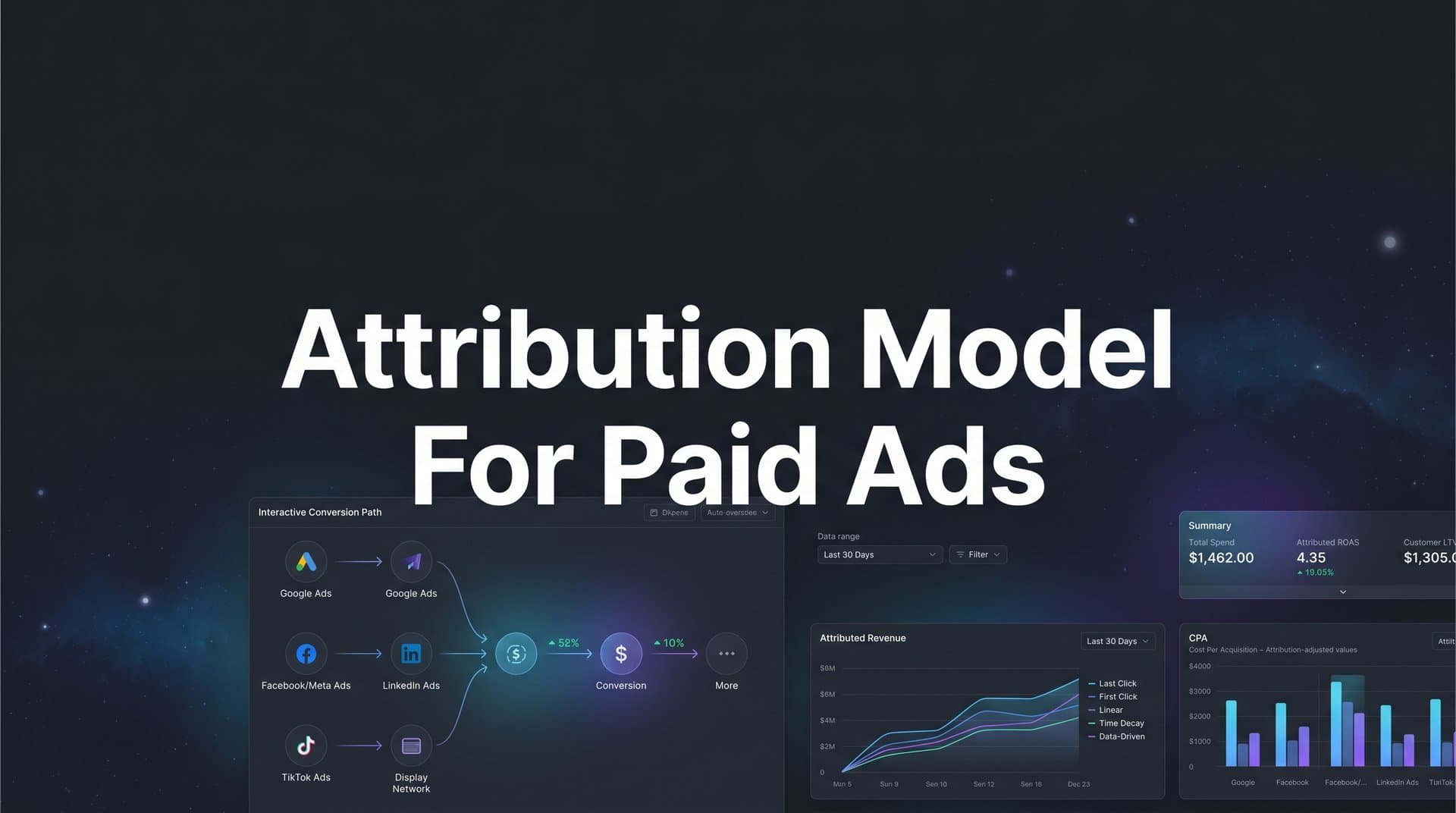
Test Multiple Models Side-by-Side: Don't commit to one attribution model immediately. Run several models in parallel on the same conversion data to see how credit shifts between channels. A thorough comparison of attribution models reveals which approach best fits your business.
You'll often discover surprising insights. A channel that looks mediocre in last-click might be a top performer in first-click, revealing its role in customer acquisition. Or time-decay might show that recent touchpoints matter more than you thought.
This comparison helps you understand which channels play which roles in your funnel. Some channels excel at awareness, others at consideration, and others at conversion. Different attribution models highlight these different strengths.
Start With Insights, Then Shift Budget: Once you've chosen an attribution model, use the insights to inform budget decisions. If multi-touch attribution shows that your LinkedIn campaigns significantly assist conversions even though they rarely get last-click credit, consider increasing LinkedIn spend.
Make changes incrementally. Shift 10-15% of budget based on attribution insights, then monitor results over several weeks. Attribution models provide better information, but they're not perfect. Test your hypotheses before making dramatic budget reallocations. Smart budget allocation for paid ads depends on accurate attribution data.
Track how changes impact overall conversion volume, not just attributed conversions. If you cut a channel that had weak attribution but overall conversions drop, the attribution model might have missed something important about that channel's role.
Unify Your Data Sources: For attribution to work accurately, you need all your touchpoint data in one place. This means connecting your ad platforms, website analytics, CRM, and any other conversion tracking into a unified system.
Modern attribution platforms can ingest data from multiple sources and build complete customer journey maps. This eliminates the platform attribution conflicts and gives you one accurate view of performance across all channels.
Making Attribution Work for Your Business
The right attribution model transforms paid advertising from educated guesswork into data-driven optimization. Instead of wondering which ads actually work, you know. Instead of debating budget allocation in meetings, you have clear data showing where to invest.
Accurate attribution isn't just about better reporting. It's about making confident decisions that scale revenue. When you know which channels drive conversions at each stage of the funnel, you can double down on what works and cut what doesn't. You can justify budget increases to stakeholders with actual data instead of intuition.
The marketing landscape continues evolving toward privacy-first tracking and cross-device journeys. Traditional pixel-based attribution becomes less reliable as browsers block cookies and platforms limit data sharing. Modern attribution platforms that combine server-side tracking with first-party data collection provide the accuracy that cookie-based tracking can no longer deliver.
As customer journeys grow more complex across devices and platforms, unified attribution becomes less optional and more essential. The businesses that win are those with clear visibility into what's actually driving their growth, not those making decisions based on incomplete platform reports.
Your attribution model should evolve with your business. As you expand into new channels, extend your sales cycle, or shift your product mix, revisit your attribution approach. What worked when you were running single-channel campaigns might not work when you're orchestrating multi-platform strategies.
The goal is simple: understand which ads drive revenue so you can spend more on what works and less on what doesn't. Attribution models are the tool that makes this possible. Choose the right model for your business, implement it properly, and use the insights to optimize with confidence.
Ready to elevate your marketing game with precision and confidence? Discover how Cometly's AI-driven recommendations can transform your ad strategy. Get your free demo today and start capturing every touchpoint to maximize your conversions.