You launch a campaign on Facebook, run Google Search ads, and maybe sprinkle in some TikTok content. Three weeks later, a customer converts. Your Facebook dashboard claims credit. Google says it was the search ad. TikTok insists its video sealed the deal. Who's actually right?
The answer depends entirely on your attribution window—the lookback period that determines which ads get credit for conversions. Set it too short, and you'll miss the full story of how customers found you. Set it too long, and you'll give credit to ads that barely influenced the decision. Either way, you're making budget decisions based on incomplete or misleading data.
Attribution windows aren't just a technical setting buried in your ad platform. They directly shape how you allocate spend, which campaigns you scale, and ultimately, your return on investment. Get them wrong, and you might kill your best-performing campaigns while doubling down on underperformers. Get them right, and you'll have a clear, accurate view of what's actually driving revenue.
Understanding How Attribution Windows Actually Work
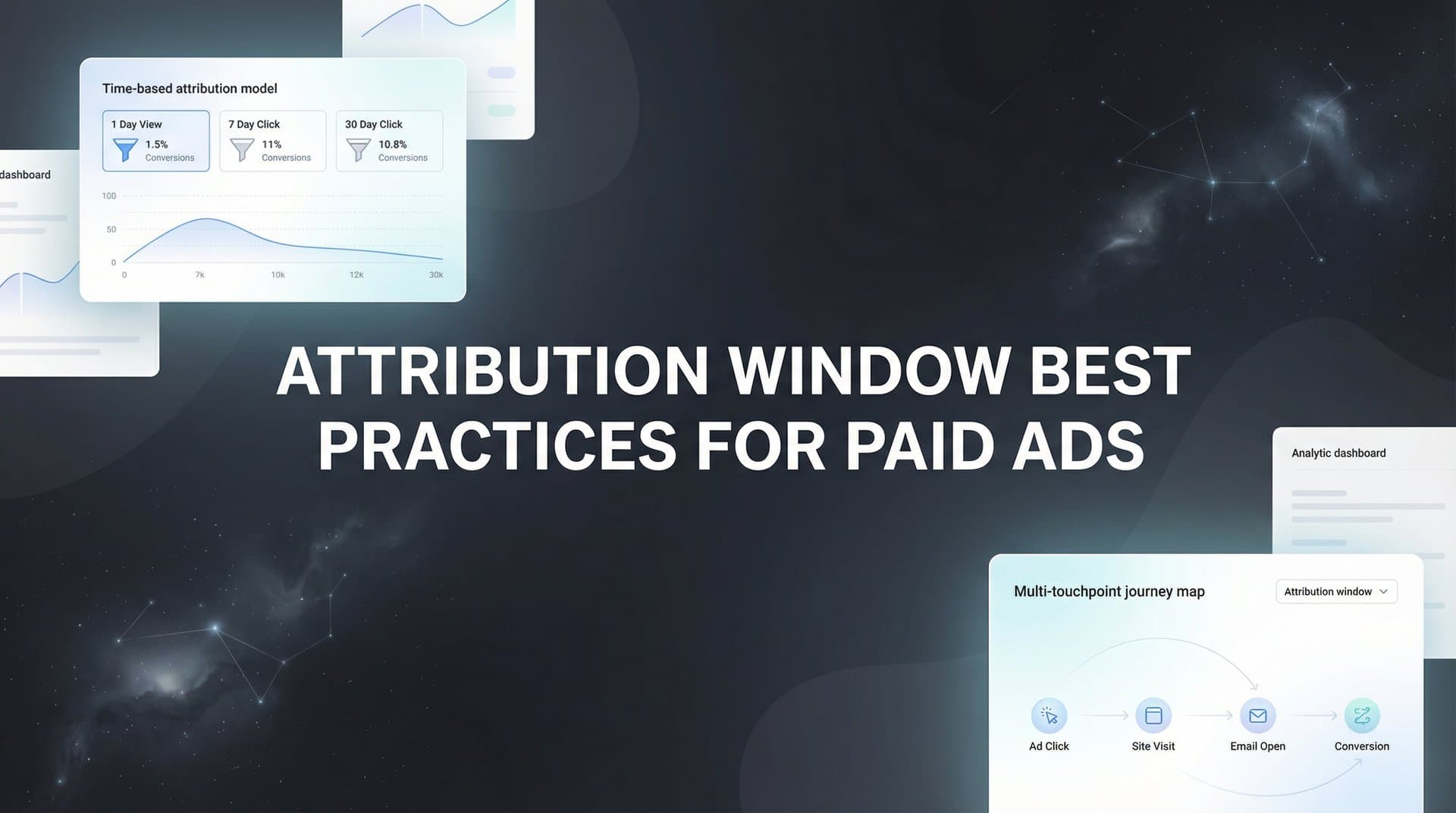
An attribution window is the timeframe during which an ad interaction—whether a click or a view—can receive credit for a conversion. Think of it as the memory span of your tracking system. If someone clicks your ad on Monday and converts on Friday, a 7-day window captures that connection. If they convert two weeks later, that same 7-day window won't give your ad any credit at all.
There are two distinct types of attribution windows you need to understand. Click-through attribution windows track the time between when someone clicks your ad and when they convert. View-through attribution windows track the time between when someone sees your ad without clicking and when they eventually convert. Most platforms treat these differently because a click represents stronger intent than a passive view.
Here's where it gets interesting: the window length you choose directly affects your reported return on ad spend. A 30-day click window will almost always show better ROAS than a 7-day window for the same campaign because it captures more conversions that happened further down the timeline. That doesn't mean your ads got better—it just means your tracking net got wider.
Platform-specific attribution operates within each ad platform's ecosystem. When you look at Facebook Ads Manager or Google Ads, you're seeing conversions attributed based on that platform's window settings. These are convenient but limited—they only show you what happened within their own walled garden. A customer might click your Facebook ad, research on Google, and convert days later. Facebook's attribution window will only tell part of that story.
Third-party attribution tools take a different approach. They track the entire customer journey across all platforms, giving you a unified view of every touchpoint. This is where you can see that the Facebook ad introduced the customer, Google Search helped them research, and a retargeting ad closed the deal. Platform attribution tells you what happened in one channel. Multi-touch marketing attribution shows you how channels work together.
The challenge most marketers face is that different platforms use different default windows, and those defaults have changed significantly over the past few years. What worked in 2023 might not reflect today's tracking reality, especially with ongoing privacy changes affecting how much data platforms can collect and attribute.
Aligning Windows With Your Actual Sales Cycle
The biggest mistake you can make with attribution windows is choosing them based on what seems reasonable rather than what your data actually shows. Your sales cycle should dictate your window length, not platform defaults or industry assumptions.
Short attribution windows—typically 1 to 7 days—work best when your customers make quick decisions. If you're selling impulse-buy products under $50, running flash sales, or promoting limited-time offers, most conversions happen fast. A customer sees your ad for a trendy phone case, clicks through, and buys within hours or days. A 7-day click window captures nearly all of these conversions without inflating your numbers with coincidental purchases.
Direct response campaigns thrive with shorter windows. When you're running ads with clear calls-to-action like "Shop Now" or "Get 20% Off Today," you're optimizing for immediate action. These campaigns aren't designed to build long-term awareness—they're built to convert right now. A shorter window keeps your attribution data tight and your optimization focused on what's actually working in real time.
Medium-length windows—typically 7 to 14 days—suit most B2C ecommerce businesses selling products that require some consideration. Think about buying a new laptop, booking a vacation, or choosing a skincare routine. Customers research, compare options, read reviews, and then decide. They might click your ad on Tuesday, think about it, and purchase that weekend.
This is where most ecommerce businesses find their sweet spot. A 7-day click window captures the majority of conversions while still maintaining reasonable accuracy. Customers who take longer than a week to decide are often influenced by factors beyond your ads—word of mouth, organic search, or simply waiting for payday. Extending your window to capture these conversions risks giving credit to ads that didn't actually drive the decision.
Longer attribution windows—14 days to 30 days or more—become essential when you're dealing with complex, high-consideration purchases. B2B marketing lives in this territory. When you're selling enterprise software, consulting services, or anything with a multi-thousand-dollar price tag, decisions take time. Multiple stakeholders get involved. Prospects attend demos, request proposals, and go through approval processes.
A 7-day window would completely miss the reality of these sales cycles. Someone might click your LinkedIn ad in early January, attend a webinar mid-month, and finally convert at the end of the month. If you're only looking at a 7-day window, you'd think your ads aren't working when they're actually initiating valuable sales conversations. For B2B companies, choosing the best marketing attribution tools for B2B SaaS becomes critical for capturing these longer journeys.
High-ticket B2C products follow similar patterns. Luxury goods, furniture, home renovations—these purchases involve research, comparison shopping, and often conversations with family members. A customer might see your ad for custom closets, spend two weeks researching options and getting quotes, then finally book a consultation. A 14-day or 30-day window captures this reality.
The key principle here is simple: your attribution window should match the typical time it takes your customers to move from awareness to purchase. Too short, and you'll undervalue the campaigns that start customer journeys. Too long, and you'll overvalue campaigns by giving them credit for conversions they didn't actually influence.
Navigating Platform-Specific Window Settings
Each advertising platform has its own attribution window defaults, and understanding these differences is critical for making accurate cross-platform comparisons. What looks like a winning campaign on one platform might just be benefiting from a longer attribution window than your other channels.
Meta Ads currently defaults to a 7-day click and 1-day view attribution window. This is a significant change from the pre-iOS 14.5 era when 28-day click windows were standard. Apple's App Tracking Transparency framework forced Meta to shorten its windows because it can no longer reliably track users across apps and websites for extended periods. The 7-day click window captures most conversions for typical ecommerce businesses, but the 1-day view window is extremely conservative.
You can adjust Meta's attribution windows in your ad account settings, but there's a catch. Even if you select a longer window for reporting purposes, Meta's algorithm optimizes based on shorter windows due to data limitations. This creates a disconnect between what you see in reporting and what Meta's actually optimizing toward. For most businesses, sticking with the 7-day click window makes sense because it aligns with what the algorithm can actually use. Understanding the nuances of the Facebook Ads attribution model helps you work within these constraints effectively.
The 1-day view-through window deserves special attention. If you're running awareness campaigns or video ads where views matter, a 1-day window severely limits the credit these campaigns receive. Someone might see your video ad on Monday, think about it, and convert on Wednesday—but that view won't get any credit. If brand awareness is part of your strategy, you need to understand that platform attribution will systematically undervalue these efforts.
Google Ads operates differently across campaign types. Search campaigns default to a 30-day click window, which makes sense given that search intent is high and the time from click to conversion is often immediate. Display and YouTube campaigns also use 30-day click windows by default, but this is where things get tricky. Display ads often serve an awareness function, and giving them credit for conversions 30 days later can inflate their apparent performance.
Many experienced Google Ads managers adjust Display and YouTube campaigns to shorter windows—often 7 or 14 days—to get a more accurate picture of their direct impact. Search campaigns can usually stay at 30 days because search behavior is fundamentally different. When someone searches for your product by name and clicks your ad, they're already deep in the buying journey. When someone sees a display ad, they're often just becoming aware of your brand.
Google also offers data-driven attribution, which uses machine learning to assign credit across touchpoints based on actual conversion patterns. This can be powerful, but it requires sufficient conversion volume—Google recommends at least 3,000 ad interactions and 300 conversions in the attribution window. Smaller accounts won't have enough data for this model to work effectively. Learning how to use GA4 for marketing attribution can help you leverage these advanced features.
TikTok Ads defaults to a 7-day click and 1-day view window, similar to Meta. Given TikTok's focus on discovery and viral content, this short window might undervalue the platform's awareness impact. Using the best tools for tracking TikTok ads can help you capture conversions that the platform's native attribution might miss. LinkedIn uses a 30-day click window for B2B campaigns, which aligns well with longer B2B sales cycles but can make direct performance comparisons with other platforms misleading.
The practical challenge is that when you're running campaigns across multiple platforms with different default windows, you're not actually comparing apples to apples. A campaign on LinkedIn with a 30-day window will naturally show more conversions than a similar campaign on Meta with a 7-day window, even if they're equally effective. This is why standardizing your windows—or at least understanding the differences—is essential for accurate budget allocation.
The Most Common Attribution Window Mistakes
Even experienced marketers fall into attribution window traps that distort their data and lead to poor optimization decisions. Understanding these pitfalls helps you avoid making expensive mistakes with your ad spend.
The over-attribution trap happens when you set windows too long for your actual sales cycle. Picture this: you're running Facebook ads for a $30 product with a 30-day attribution window. A customer sees your ad in week one but doesn't click. Three weeks later, they see an organic social post, remember your brand, search for you on Google, and buy. Your Facebook ad gets credit because it falls within the 30-day window—even though it barely influenced the purchase decision.
This inflated attribution makes your Facebook campaigns look more effective than they actually are. You might increase budget based on this data, expecting similar returns, but instead you see performance decline. The problem wasn't the campaign—it was the window setting giving credit where it wasn't really due. Long windows systematically favor early touchpoints and can make awareness campaigns appear to drive direct conversions when they're really just introducing your brand.
The under-attribution problem is equally dangerous but less obvious. You set a 3-day click window for a product that typically takes a week to research and purchase. Your ads are actually starting customer journeys, but because conversions happen outside your narrow window, you don't see the impact. You might conclude the campaigns aren't working and shut them down—killing traffic that was actually driving revenue, just on a slightly longer timeline.
This particularly affects top-of-funnel campaigns. An awareness ad that introduces someone to your brand might not drive an immediate purchase, but it plants a seed. If your attribution window is too short, these valuable brand-building efforts show zero return. You end up over-investing in bottom-funnel tactics and under-investing in the awareness campaigns that feed your entire funnel.
Inconsistent windows across platforms create perhaps the most common mistake: making budget allocation decisions based on incomparable data. You're running Meta ads with a 7-day window and Google ads with a 30-day window. Google shows a better ROAS, so you shift more budget there. But you're not comparing equivalent metrics—you're comparing a narrow view of Meta's impact with a much broader view of Google's impact. Understanding the key differences in Facebook Ads attribution vs Google Ads attribution helps you avoid this trap.
This leads to systematic misallocation. Platforms with longer windows appear more effective simply because they're capturing more of the customer journey. You might end up over-investing in channels that benefit from generous attribution while under-funding channels that are actually more efficient but use shorter windows.
Another subtle mistake is ignoring view-through attribution entirely. Some marketers only focus on click-through windows, essentially saying that if someone didn't click the ad, it didn't matter. But display ads, video ads, and social media content often work through views rather than clicks. Someone sees your video ad, doesn't click, but later searches for your brand and converts. If you're only tracking clicks, you're completely missing this impact.
The reverse problem also exists: over-relying on view-through attribution with long windows. A 28-day view-through window means any conversion within 28 days of someone scrolling past your ad counts as a success. That's an extremely loose definition of influence. Most marketers who use view-through attribution stick to 1-day or 7-day windows to maintain some reasonable connection between the view and the conversion.
Testing Your Way to Optimal Windows
Rather than guessing at the right attribution window, you can use data to find what actually matches your customer behavior. This requires some analysis and testing, but the insights are worth the effort.
Start by analyzing your time-to-conversion data. Most analytics platforms—including Google Analytics and comprehensive attribution tools—can show you how long it takes from first interaction to purchase. Pull this data for your recent conversions and look at the distribution. What percentage convert within 1 day? Within 3 days? Within 7 days? Within 14 days?
Let's say you find that 60% of conversions happen within 7 days, 80% within 14 days, and 90% within 21 days. This tells you that a 7-day window captures the majority of your conversions but misses a significant chunk. A 14-day window gets you to 80%, which might be the sweet spot between accuracy and completeness. Going to 21 or 30 days only adds another 10%, which might not be worth the risk of over-attribution.
This analysis should be product-specific if you sell multiple items with different consideration cycles. Your impulse-buy accessories might convert within 3 days, while your premium products take 14 days. Using the same attribution window for both products would either over-attribute the accessories or under-attribute the premium items.
Run controlled tests by comparing performance metrics across different window settings for the same campaigns. Most platforms let you view data with different attribution windows applied retroactively. Look at the same campaign with 7-day, 14-day, and 30-day windows. How much does the reported ROAS change? If it's relatively stable, your window choice matters less. If it swings wildly, you need to choose carefully because your optimization decisions will vary significantly based on which window you use.
Pay attention to which campaigns are most affected by window length. Bottom-funnel retargeting campaigns typically show similar performance across different windows because conversions happen quickly. Top-funnel awareness campaigns show dramatically different results with longer windows. This tells you something important: awareness campaigns need longer windows to show their true value, while direct response campaigns can use shorter windows.
Use multi-touch attribution alongside platform windows to validate your assumptions. Platform attribution shows you what happens within one channel. Multi-touch attribution shows you the complete customer journey across all channels. When you see a conversion in your multi-touch attribution tool, you can trace back all the touchpoints—the Facebook ad 12 days ago, the Google search 5 days ago, the email 2 days ago, and the retargeting ad yesterday. Implementing best practices for tracking conversions accurately ensures your data is reliable.
This complete view helps you understand whether your attribution windows are capturing reality. If your multi-touch data shows that most customer journeys span 10-14 days across multiple touchpoints, but you're using 7-day windows in your platform reporting, you're missing part of the story. Your platforms might show decent performance, but you're not seeing how channels work together to drive conversions.
Testing should be ongoing, not a one-time exercise. Customer behavior changes. New competitors enter the market. Your product mix evolves. An attribution window that worked perfectly six months ago might be too short or too long today. Set a recurring calendar reminder—quarterly or semi-annually—to review your time-to-conversion data and validate that your windows still match reality.
Creating a Unified Attribution Framework
Once you understand how attribution windows work and what settings match your business, the next step is building a consistent framework across all your marketing channels. This is where most marketers struggle—not because the concept is complex, but because it requires coordination across multiple platforms and tools.
Start by standardizing your attribution windows across ad platforms wherever possible. If your time-to-conversion data shows that 14 days captures most customer journeys, set 14-day click windows across Meta, Google, TikTok, and any other platforms you use. This creates apples-to-apples comparisons when you're evaluating channel performance and making budget allocation decisions.
There will be cases where standardization isn't possible or advisable. LinkedIn's B2B audience might genuinely need a 30-day window while your Instagram impulse-buy campaigns work best with 7 days. That's fine—just document these differences and factor them into your analysis. The goal isn't rigid uniformity but rather intentional consistency where it makes sense. Following multi-channel attribution best practices helps you navigate these complexities.
Server-side tracking has become essential for accurate attribution in the current privacy landscape. Browser-based tracking faces increasing limitations from iOS privacy settings, ad blockers, and cookie restrictions. When tracking happens entirely in the browser, you miss conversions from users who have blocked tracking or switched devices.
Server-side tracking captures conversion events on your server and sends them to ad platforms directly, bypassing browser limitations. This means you get more complete conversion data, which feeds back into platform optimization algorithms. When Facebook's algorithm has better data about what actually converts, it can find more people like your best customers. When Google knows which clicks lead to revenue, it can optimize bids more effectively.
Implementing server-side tracking requires technical setup, but the impact on attribution accuracy is significant. You'll capture conversions that browser-based tracking would miss entirely. This doesn't change your attribution window settings, but it ensures that the conversions within those windows are actually being counted. The best tracking solution for Facebook Ads combines server-side implementation with proper window configuration.
Feeding enriched conversion data back to ad platforms improves their optimization algorithms beyond just attribution accuracy. Platforms like Meta and Google use machine learning to predict which users are most likely to convert. The more accurate and detailed your conversion data, the better these predictions become. This is where the feedback loop between attribution and optimization creates compounding returns.
When you send back conversion data that includes revenue value, product categories, and customer lifetime value signals, ad platforms can optimize not just for conversions but for valuable conversions. This is particularly powerful for ecommerce businesses where not all conversions are equally valuable. The platform learns to prioritize users who are likely to make larger purchases or become repeat customers.
Your unified attribution strategy should include regular reconciliation between platform reporting and your source-of-truth analytics. Platform attribution will never match your analytics perfectly—they use different methodologies, track different things, and serve different purposes. But they should be reasonably close. If your Google Analytics shows 100 conversions while Google Ads claims 200, something is misconfigured.
Common causes of discrepancies include mismatched attribution windows, different conversion definitions, tracking implementation issues, and time zone differences. Work through these systematically. Make sure your attribution windows in platform reporting match what you're using for analysis. Verify that all platforms are tracking the same conversion events. Check that your tracking pixels are firing correctly on conversion pages.
Putting Your Attribution Strategy Into Action
Attribution windows aren't something you set once and forget. They're a living part of your marketing infrastructure that should evolve with your business, your products, and your customers' behavior. The right window today might be wrong six months from now as your market matures or your product mix changes.
The core principle to remember is simple: match your attribution window to your actual sales cycle, not to platform defaults or what seems reasonable. Let your data guide the decision. If most customers convert within a week, use a 7-day window. If your sales cycle spans three weeks, use a 21-day window. Fighting against your actual customer behavior leads to distorted data and poor decisions.
Maintain consistency across platforms wherever possible. When you're comparing Facebook to Google to TikTok, using the same attribution window creates fair comparisons. You might still see performance differences, but at least you know those differences reflect actual performance rather than measurement methodology. Choosing the right attribution model for optimizing ad campaigns works hand-in-hand with proper window settings.
Use comprehensive tracking that captures the full customer journey across all touchpoints. Platform attribution tells you what happened within each channel. Multi-touch attribution shows you how channels work together. Both perspectives are valuable, and neither tells the complete story alone.
Test and validate regularly. Customer behavior shifts. New channels emerge. Your product strategy evolves. What worked last year might be leaving money on the table today. Set up a regular review process—quarterly at minimum—to analyze your time-to-conversion data and confirm your attribution windows still match reality.
Remember that attribution accuracy directly enables confident scaling decisions. When you know which campaigns truly drive revenue, you can increase budget without fear. When your attribution is muddy, every scaling decision becomes a gamble. The difference between profitable growth and wasted spend often comes down to whether your attribution windows accurately reflect how customers actually find and buy from you.
Ready to elevate your marketing game with precision and confidence? Discover how Cometly's AI-driven recommendations can transform your ad strategy—Get your free demo today and start capturing every touchpoint to maximize your conversions.