

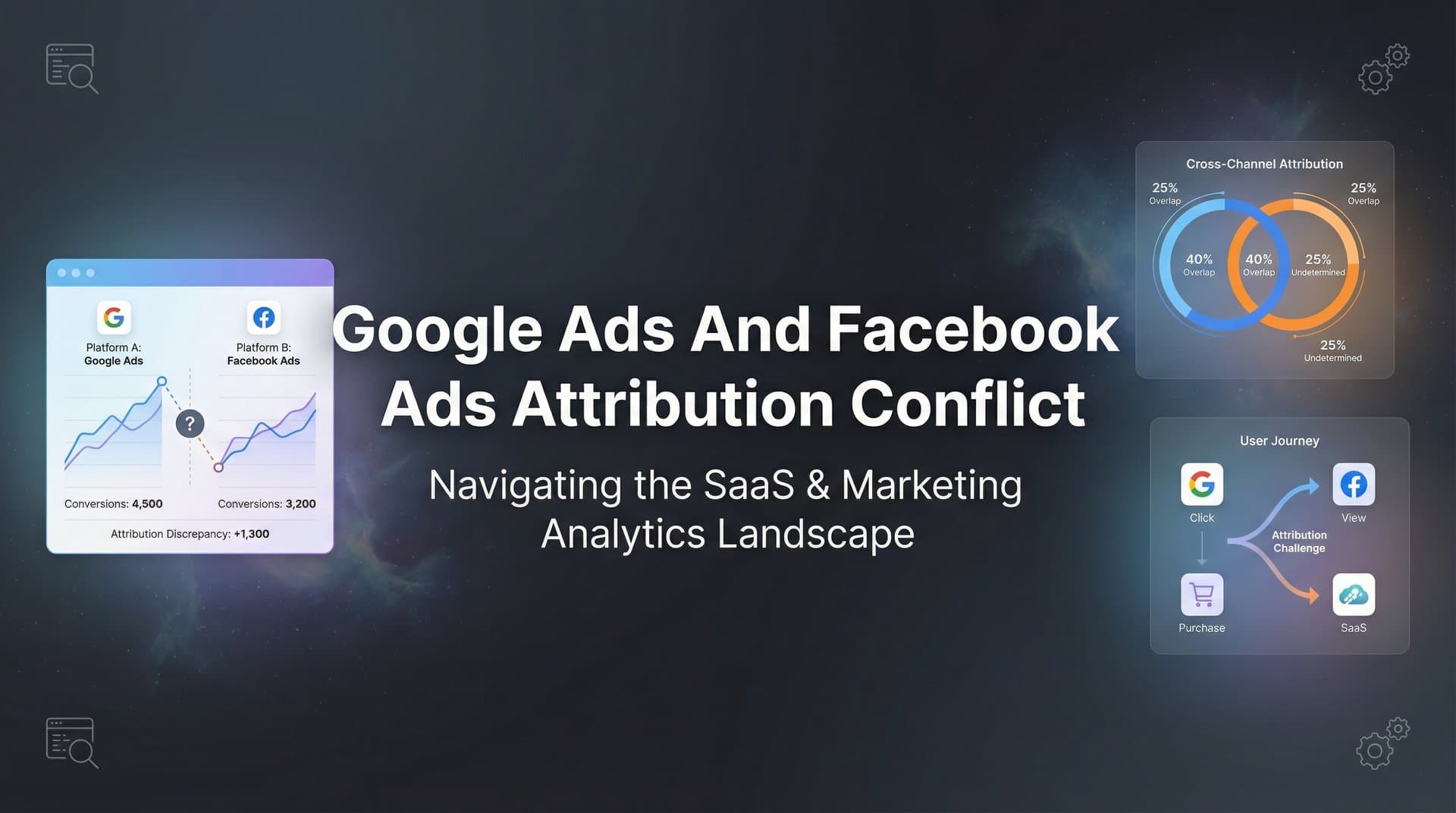
You check your Google Ads dashboard Monday morning. Fifty conversions over the weekend. Not bad. Then you open Facebook Ads Manager. Forty-five conversions from the same period. Even better—that's 95 total sales, right? But when you pull up your CRM, reality hits: only 60 actual purchases came through. Something doesn't add up.
This isn't a tracking error or a platform glitch. This is attribution conflict, and it's costing marketers clarity, confidence, and cash every single day.
Here's the uncomfortable truth: Google and Facebook both want credit for your conversions. They use different tracking methods, different attribution models, and different conversion windows. The result? Overlapping claims, inflated performance metrics, and budget decisions based on incomplete data. When both platforms take credit for the same sale, you're left wondering which channel actually drove the purchase—and whether your marketing spend is working as well as the dashboards suggest.
This guide breaks down exactly why Google Ads and Facebook Ads report conflicting conversion numbers, what technical factors drive these discrepancies, and how to build a unified attribution system that shows you what's really happening. By the end, you'll understand how to turn messy, conflicting data into clear insights that drive better ad performance.
Why Google and Facebook Count Conversions Differently
The attribution conflict starts with a fundamental reality: Google and Facebook operate in separate universes. Each platform only sees what happens within its own ecosystem. Google knows when someone clicks your search ad. Facebook knows when someone engages with your carousel post. But neither platform sees the complete journey—the search ad that introduced your brand, the Facebook retargeting ad that brought them back, the direct visit where they finally converted.
This limited visibility becomes a bigger problem when you factor in how each platform decides who gets credit for a conversion.
Google Ads defaults to last-click attribution in most standard reports. If someone clicks your Google ad and converts within 90 days, Google claims that conversion—even if the user interacted with five other marketing touchpoints before that final click. For accounts with sufficient conversion volume, Google offers data-driven attribution, which uses machine learning to distribute credit across touchpoints. But the majority of advertisers still see last-click data as their primary metric. Understanding the nuances of Google Ads attribution tracking is essential for interpreting these reports accurately.
Facebook takes a different approach entirely. As of the iOS 14.5 privacy changes in 2021, Facebook uses a default attribution window of 7 days for clicks and 1 day for views. This means if someone views your Facebook ad on Monday, doesn't click, but converts on Tuesday, Facebook counts that conversion. If someone clicks your ad on Sunday and converts the following Saturday, Facebook counts that too. This view-through attribution captures conversions that Google's click-only model would miss—but it also opens the door for both platforms to claim the same sale.
Picture this scenario: A potential customer sees your Facebook ad on Monday morning during their commute. They don't click, but they remember your brand. Tuesday afternoon, they search for your product on Google, click your search ad, and make a purchase. Facebook claims the conversion because of the 1-day view window. Google claims it because of the last click. Your reporting now shows two conversions when only one sale occurred.
The conversion window differences create timing discrepancies too. Google tracks conversions up to 90 days after a click by default, while Facebook's shorter windows mean some delayed conversions get attributed to Google even when Facebook played a role earlier in the journey. These Facebook Ads attribution window limitations contribute significantly to the data mismatch you see in your reports.
The core issue isn't that one platform is more accurate than the other. It's that each platform is measuring success using different yardsticks, and neither has visibility into what the other is doing. When you're making budget decisions based on platform-reported conversions, you're essentially flying blind, trusting incomplete pictures from sources that are financially incentivized to maximize their own reported performance.
The Technical Factors Driving Attribution Discrepancies
Beyond different attribution models, several technical factors make the conflict worse. These aren't theoretical problems—they're real limitations that affect how accurately each platform can track conversions in the modern privacy landscape.
iOS privacy changes hit Facebook particularly hard. Apple's App Tracking Transparency framework, introduced with iOS 14.5, requires apps to ask users for permission before tracking their activity across other apps and websites. Most users decline. This means Facebook's ability to track conversions through its pixel has been significantly degraded. When someone clicks a Facebook ad on their iPhone, makes a purchase, but has tracking disabled, Facebook often cannot see that conversion happen. Many advertisers have experienced firsthand why Facebook Ads stopped working after iOS 14.
Google faces similar challenges but relies less heavily on cross-app tracking for its core search advertising business. Someone searching on Google and clicking an ad typically converts in the same browser session, making that conversion easier to track even with privacy restrictions. Facebook, which depends on tracking users across apps and websites to prove ad effectiveness, lost a substantial portion of its direct tracking capability.
Both platforms responded by implementing conversion modeling—using machine learning to estimate conversions they cannot directly observe. If Facebook sees that 30% of tracked conversions came from iPhone users in a certain demographic, it might model additional conversions for similar users whose activity it cannot track. Google does similar modeling for conversions it cannot directly measure. The problem? These are estimates, not observed data, and the models each platform uses are different. This introduces variance between what Google reports and what Facebook reports, even for the same underlying customer behavior.
Cross-device journeys create another layer of complexity. Someone might click your Facebook ad on their phone during lunch, research your product on their tablet that evening, and finally purchase on their laptop the next day. Traditional cookie-based tracking struggles to connect these touchpoints because each device has different cookies. Google and Facebook both attempt cross-device tracking through logged-in user data, but gaps remain—especially when users aren't logged in or use different accounts across devices.
When attribution breaks across devices, two things happen: conversions get lost entirely, or they get double-counted. Facebook might attribute the conversion based on the mobile click. Google might attribute it based on a desktop search that happened before the final purchase. Your analytics show two conversions when one person made one purchase across three devices. These Google Ads conversion tracking issues compound the already complex attribution landscape.
Server-side tracking was supposed to solve some of these problems. Facebook's Conversions API and Google's enhanced conversions allow you to send conversion data directly from your server to the ad platforms, bypassing browser limitations like cookie blockers and privacy restrictions. This helps recover some lost conversion data. But server-side tracking introduces its own complications: it requires technical implementation, it doesn't capture all the context that browser pixels provide, and it still relies on matching conversion events back to ad clicks using identifiers that may be incomplete or hashed for privacy.
The technical reality is this: neither platform can track conversions with perfect accuracy anymore. Privacy changes, cross-device behavior, and the shift away from third-party cookies have fundamentally changed how digital advertising measurement works. Both Google and Facebook are doing their best to estimate what they cannot directly observe—but their estimates don't match, and that creates the attribution conflict you see in your reports.
How Overcounting Distorts Your Marketing Budget Decisions
Attribution conflict isn't just a reporting annoyance. It directly impacts how you allocate budget, which campaigns you scale, and whether your marketing spend is actually profitable.
When both Google and Facebook claim credit for the same conversion, your reported ROI looks better than reality. Let's say you spent $5,000 on Google Ads and $5,000 on Facebook Ads last month. Google reports 100 conversions at $50 each. Facebook reports 80 conversions at $62.50 each. Combined, that's 180 conversions from $10,000 spend—a $55.56 cost per acquisition. Not bad.
But when you check your actual sales data, you only had 120 conversions. Your real cost per acquisition is $83.33, not $55.56. That's a 50% difference between what your platforms tell you and what actually happened. If you're making budget decisions based on platform data, you might think you're hitting your target CPA when you're actually losing money on every sale. This disconnect between Google Ads attribution vs actual sales is one of the most costly blind spots in digital marketing.
This overcounting problem compounds when you try to scale. You see strong performance in both Google and Facebook, so you increase budget across both channels. But because much of that "strong performance" was the same conversions counted twice, your incremental spend doesn't generate the returns you expected. What looked like a profitable campaign at $10,000 spend becomes breakeven or negative at $20,000 because the overlapping conversions you were double-counting don't scale linearly with budget.
Budget allocation becomes pure guesswork when you cannot determine which channel actually influenced the purchase decision. Should you shift more budget to Google because it shows a lower CPA? Or is Facebook's view-through attribution capturing upper-funnel awareness that makes those Google conversions possible? Without understanding the true role each channel plays, you're essentially making budget decisions by flipping a coin.
The distortion affects campaign optimization too. If Facebook is claiming credit for conversions that really came from Google search, you might pause a Facebook campaign that's actually generating valuable brand awareness—just because its last-click conversions don't justify the spend. Or you might scale a Google search campaign that's simply harvesting demand created by other channels, leading to diminishing returns as you exhaust the pool of users already familiar with your brand.
Here's where it gets dangerous: platform-reported ROAS can turn a profitable business into an unprofitable one when used as the primary decision-making metric. Many businesses set ROAS targets—maybe 3x or 4x—and scale any campaign that hits that target. But if your platforms are overcounting conversions by 30% to 50%, a campaign showing 4x ROAS might actually be delivering 2.5x ROAS in reality. Scale that campaign aggressively, and you'll quickly find yourself spending more on ads than you're making in profit.
The financial impact extends beyond wasted ad spend. When your attribution data is unreliable, you lose confidence in your entire marketing operation. You can't accurately forecast customer acquisition costs. You can't confidently test new channels or creative approaches because you don't trust the results you're seeing. You can't prove marketing's contribution to revenue when leadership asks for data. The attribution conflict doesn't just distort individual campaign metrics—it undermines your ability to make strategic marketing decisions with confidence.
Practical Methods to Reconcile Conflicting Attribution Data
The solution to attribution conflict isn't choosing which platform to trust. It's building your own source of truth using data you control.
Start with your CRM or backend order data as the foundation. This is the only data that reflects actual business outcomes—real sales, real revenue, real customers. Every conversion that Google and Facebook claim should map back to an actual transaction in your system. When you see 50 conversions in Google, 45 in Facebook, but only 60 in your CRM, your CRM is telling you the truth. The platforms are overcounting.
The next step is connecting those actual sales back to marketing touchpoints. This is where UTM parameters become essential. UTM parameters are tags you add to your campaign URLs that identify the source, medium, campaign, and other details about where traffic came from. When implemented consistently across all your marketing channels, UTMs allow you to track traffic sources independently of platform pixels. Proper tracking for Facebook and Google Ads starts with this foundational setup.
Here's how this works in practice: Every Google ad gets a URL with UTM parameters like utm_source=google&utm_medium=cpc&utm_campaign=brand-search. Every Facebook ad gets utm_source=facebook&utm_medium=paid-social&utm_campaign=retargeting. When someone clicks these ads and converts on your site, your analytics platform captures those UTM parameters and associates them with the conversion. Now you can see in your own data which traffic source led to which sale, without relying on what Google or Facebook claim.
This approach isn't perfect—UTM parameters can be stripped by redirects, lost in cross-device journeys, or overwritten by subsequent visits. But they give you an independent tracking layer that helps reconcile platform reports with reality. When Google claims 50 conversions but your analytics only shows 35 conversions with Google UTM parameters, you know there's a 15-conversion discrepancy to investigate.
Another powerful method is incrementality testing. Instead of trying to attribute every conversion to a specific touchpoint, incrementality tests measure the true lift each channel provides. You run a holdout experiment: randomly split your audience into two groups, show ads to one group but not the other, then measure the difference in conversion rates. The difference is the incremental impact of your ads—the conversions that wouldn't have happened without your advertising.
For example, you might pause Facebook ads for a randomly selected 10% of your audience for two weeks while continuing to show ads to the other 90%. If the holdout group converts at 2% and the exposed group converts at 3%, your Facebook ads are driving a 1 percentage point lift. This tells you the real impact of your Facebook spend, regardless of what Facebook's attribution model claims. You can run similar tests for Google, comparing search ad performance in different geographic regions or at different times.
Incrementality testing requires some statistical rigor and enough conversion volume to detect meaningful differences, but it cuts through attribution model debates entirely. You're not asking "which touchpoint gets credit?" You're asking "what actually happens when we turn this channel on or off?" That's a much more valuable question for budget allocation decisions.
A simpler approach is comparing platform-reported conversions to actual revenue over time. If Google reports 500 conversions this month and Facebook reports 400, but your total sales are only 600, you know there's significant overlap. Track this ratio over time. If the overlap is consistently 30%, you can apply that correction factor when evaluating platform performance. It's not perfect attribution, but it's better than taking platform numbers at face value.
The key principle across all these methods is the same: use your own data as the anchor point. Platforms will always report metrics that make their performance look good. Your job is to connect those metrics back to business outcomes you can verify—actual sales, actual revenue, actual customers. When you build that connection, you gain the clarity needed to make confident budget decisions even when platform reports conflict.
Building a Unified Attribution System Across Platforms
Reconciling attribution data manually works for small campaigns, but it doesn't scale. As you add more channels, run more campaigns, and deal with longer customer journeys, you need a systematic approach to tracking the complete path from first touch to closed sale.
This is where third-party attribution tools become valuable. These platforms sit above your individual ad channels and connect all your marketing touchpoints to actual conversions. They integrate with Google Ads, Facebook Ads, your website analytics, and your CRM to build a unified view of each customer journey. Instead of seeing isolated snapshots from each platform, you see the complete sequence: someone clicked a Facebook ad, visited your site, left, searched on Google three days later, clicked your search ad, and converted. A dedicated attribution tool for Facebook Ads can help bridge these visibility gaps.
With this complete journey mapped, you can apply different attribution models to understand how credit should be distributed. A first-touch model gives credit to Facebook for introducing the customer. A last-touch model gives credit to Google for closing the sale. A linear model splits credit evenly between both touchpoints. A time-decay model gives more credit to interactions closer to the conversion. No single model is "correct"—different models answer different questions about your marketing performance.
The power of a unified attribution system isn't just better reporting. It's the ability to feed accurate conversion data back to your ad platforms. This is where server-side tracking becomes crucial. When you track conversions through your own system rather than relying solely on platform pixels, you capture more complete data—conversions that browser-based tracking would miss due to cookie blockers, privacy settings, or cross-device gaps. Learning how to improve Facebook Ads conversion tracking through server-side methods can dramatically increase data accuracy.
You can then send this enriched conversion data back to Google and Facebook through their server-side APIs. Facebook's Conversions API and Google's enhanced conversions allow you to pass conversion events with additional context: customer value, product categories, lifecycle stage. This gives the platforms better data to optimize their algorithms. When Facebook knows that a conversion came from a high-value customer who purchased multiple products, its algorithm can find more users like that. When Google sees that certain keywords drive conversions that lead to repeat purchases, it can bid more aggressively on those terms.
This creates a feedback loop: better tracking leads to better data, better data leads to better algorithm optimization, better optimization leads to more efficient ad spend. Many marketers see improved performance after implementing server-side tracking not because their ads changed, but because the platforms' algorithms finally have accurate conversion signals to work with.
Multi-touch attribution models are the final piece of a unified system. Instead of debating whether Google or Facebook deserves credit, multi-touch attribution distributes credit across all touchpoints based on their role in the journey. A position-based model might give 40% credit to the first touchpoint that introduced your brand, 40% to the last touchpoint that closed the sale, and 20% distributed across middle touchpoints that kept the customer engaged. This balanced view helps you understand the full value each channel provides.
The technical implementation of a unified attribution system requires some investment. You need tracking infrastructure that captures events across your website, ad platforms, and CRM. You need a data warehouse or attribution platform that can store and process this data. You need APIs and integrations that connect everything together. But the payoff is substantial: instead of conflicting reports from isolated platforms, you get a single source of truth that shows what's actually driving revenue.
For many businesses, this is the difference between marketing that scales profitably and marketing that burns cash while platforms report great numbers. When you know with confidence which channels drive real revenue, you can allocate budget intelligently, test new approaches without fear of misleading data, and scale campaigns that actually work.
Turning Accurate Attribution Into Better Ad Performance
Solving attribution conflict isn't just about clean reports. It's about using accurate data to improve your advertising results.
When you know which channels truly drive revenue, budget allocation becomes strategic rather than reactive. Maybe your analysis reveals that Facebook ads generate valuable first-touch awareness that makes your Google search campaigns more effective. Without Facebook, your Google CPAs would be higher because you'd be competing for cold traffic. This insight might lead you to maintain or increase Facebook spend even if its last-click conversions don't look impressive—because you understand its role in the broader customer journey.
Or you might discover that Google search is capturing demand created by organic content, email marketing, and word-of-mouth rather than generating new demand itself. This doesn't mean Google ads are bad—it means you should be careful about scaling them beyond a certain point, because they're harvesting a finite pool of existing demand rather than creating new customers. Accurate attribution helps you understand these dynamics and allocate budget accordingly. Leveraging marketing analytics for Google Ads can reveal these patterns in your data.
The performance improvements extend to the platforms themselves. When you feed accurate conversion data back to Google and Facebook through server-side tracking and conversion APIs, their machine learning algorithms get better training data. Facebook's algorithm learns which users are most likely to become high-value customers. Google's Smart Bidding learns which keywords and audiences drive conversions that lead to repeat purchases. This improved learning translates directly to better targeting, lower CPAs, and higher ROAS over time.
Many marketers report that implementing proper server-side tracking and conversion sync improves their ad performance by 20% to 40% within weeks—not because they changed their creative or targeting, but because the platforms finally had accurate signals to optimize against. The ads were always reaching valuable users; the platforms just couldn't see it through degraded browser-based tracking. If you're struggling with performance, understanding why Facebook Ads aren't tracking conversions is often the first step to recovery.
Accurate attribution also enables faster testing and iteration. When you trust your data, you can confidently test new creative approaches, new audience segments, new bidding strategies. You'll know within days whether a test is working, rather than waiting weeks while you try to reconcile conflicting reports and figure out what actually happened. This speed advantage compounds over time—teams that can test and learn quickly pull ahead of competitors who are stuck analyzing contradictory data.
The confidence factor matters too. When leadership asks whether marketing spend is profitable, you can answer with data you trust. When you propose scaling a channel, you can back it up with attribution analysis that shows real ROI. When you recommend pausing an underperforming campaign, you're not guessing based on platform metrics—you're making a data-driven decision based on actual business outcomes. This confidence transforms marketing from a cost center that leadership questions into a growth driver that leadership invests in.
Building Clarity From Conflicting Data
The attribution conflict between Google Ads and Facebook Ads isn't going away. These platforms are designed to maximize their reported value to advertisers, which means claiming credit for as many conversions as possible within their attribution rules. This isn't necessarily malicious—it's how their business models work. But it creates a fundamental problem for marketers who need to know what's actually driving results.
The solution isn't choosing which platform to trust or trying to force them to agree. It's building your own attribution system using your own data as the foundation. Start with actual sales and revenue in your CRM. Connect those outcomes back to marketing touchpoints using UTM parameters, server-side tracking, and attribution tools that integrate across channels. Use incrementality testing to measure true channel lift beyond what platforms report. Feed accurate conversion data back to ad platforms to improve their optimization.
This approach requires investment—in technology, in tracking infrastructure, in analytical capabilities. But the alternative is making budget decisions based on inflated, conflicting data that leads to overspending on campaigns that don't actually drive profitable growth. When you build a unified attribution system, you gain the clarity needed to scale marketing confidently and the data needed to prove marketing's contribution to revenue.
The marketers who win in the privacy-first, multi-platform advertising landscape are those who take control of their own attribution rather than relying on platform-reported metrics. They understand that every channel plays a role in the customer journey, and they use data to understand what that role is. They feed accurate signals back to ad platforms to improve algorithmic performance. They make budget decisions based on business outcomes rather than vanity metrics.
If you're tired of reconciling conflicting reports and making budget decisions based on guesswork, it's time to evaluate your attribution setup. The tools and methods exist to solve this problem—you just need to implement them systematically.
Ready to elevate your marketing game with precision and confidence? Discover how Cometly's AI-driven recommendations can transform your ad strategy. Capture every touchpoint from ad clicks to CRM events, get AI-powered insights on which campaigns truly drive revenue, and feed enriched conversion data back to your ad platforms for better targeting and optimization. Get your free demo today and start making confident budget decisions based on accurate, unified attribution data.



