
You're spending thousands on ads every month. Your conversion numbers look good. Revenue is growing. But when your CFO asks which campaigns are actually driving those sales, you freeze.
Was it the Facebook ad they saw three weeks ago? The Google search ad they clicked yesterday? The retargeting banner that followed them around? Or maybe it was that email you sent last Tuesday?
Here's the reality: your customers don't convert in a straight line. They bounce between channels, devices, and touchpoints before finally clicking "buy." And without a clear attribution model, you're essentially flying blind—making budget decisions based on guesswork rather than data.
Attribution models are the frameworks that solve this puzzle. They're the rule sets that determine how conversion credit gets distributed across every touchpoint in the customer journey. Think of them as the scoring system that tells you which players on your marketing team deserve credit for the win.
In this guide, we'll break down exactly how each attribution model works, when to use them, and how to choose the right approach for your business. By the end, you'll understand how to move from "I think this is working" to "I know exactly what's driving my results."
The Credit Assignment Problem Every Marketer Faces
Let's start with the fundamental question: what exactly is an attribution model?
An attribution model is a rule set that determines how conversion credit is distributed across the various marketing touchpoints a customer interacts with before converting. It's the framework that answers the question: "Which of my marketing efforts actually drove this sale?"
Without attribution, every channel claims victory. Your Facebook Ads dashboard shows conversions. Google Ads reports conversions. Your email platform counts conversions. But they're all counting the same customers, and the math doesn't add up.
This matters for three critical reasons. First, budget allocation. If you don't know which channels are truly driving conversions, you can't confidently shift budget toward what's working. Second, channel optimization. You need to understand which touchpoints move customers closer to conversion so you can double down on those tactics. Third, proving ROI. When leadership questions marketing spend, you need concrete data showing what's working and what's not.
Here's what makes this challenging: modern customer journeys are complex. The typical buyer interacts with six to eight touchpoints across multiple channels before converting. They might see a LinkedIn ad on their phone during their morning commute, search for your product on Google during lunch, click a retargeting ad on their laptop that evening, visit your site directly the next day, and finally convert through an email link three days later.
Every one of those touchpoints played a role. But which ones were essential? Which could you eliminate without hurting conversions? Which deserve more budget?
That's where attribution models come in. They provide a systematic way to assign value to each touchpoint based on specific rules or data-driven analysis. Some models are simple and favor specific touchpoints. Others distribute credit more evenly. And the most sophisticated models use machine learning to determine credit based on actual conversion patterns.
The key insight: there's no single "correct" attribution model. Different models answer different questions about your marketing performance. The goal isn't to find the one true answer—it's to gain clearer visibility into what's driving results so you can make smarter decisions. Understanding the importance of attribution models in marketing is the first step toward data-driven optimization.
Single-Touch Models: Simple but Limited
The simplest attribution models give 100% of the credit to a single touchpoint. They're easy to understand and implement, but they tell an incomplete story.
First-Touch Attribution: This model gives all the credit to the very first interaction a customer has with your brand. If someone first discovered you through a Facebook ad, that Facebook ad gets 100% credit for the eventual conversion—even if they interacted with five other channels before buying.
First-touch attribution excels at answering one specific question: "What's driving awareness and bringing new people into my funnel?" It helps you understand which channels are best at introducing your brand to potential customers. If you're focused on top-of-funnel performance and want to know which campaigns are most effective at generating initial interest, first-touch gives you that clarity.
The limitation? It completely ignores everything that happened after that first interaction. All the nurturing emails, retargeting ads, and consideration-stage content that actually convinced someone to buy get zero credit. It's like giving the opening act full credit for selling out the concert.
Last-Touch Attribution: This is the opposite approach. Last-touch gives 100% credit to the final touchpoint before conversion. If someone clicked an email link and immediately purchased, that email gets all the credit—regardless of the Facebook ads, Google searches, and website visits that came before.
Last-touch attribution is useful for understanding which channels are best at closing deals. It highlights the touchpoints that push people over the finish line. Many businesses default to last-touch because it's simple and aligns with how most ad platforms report conversions by default.
But here's the problem: it ignores the entire journey that led to that final click. The awareness campaigns that introduced your brand, the consideration-stage content that built trust, the retargeting that kept you top-of-mind—none of that gets recognized. It's like crediting only the closing pitcher for winning the baseball game.
When Single-Touch Models Make Sense: Despite their limitations, single-touch models have their place. They work well for businesses with short sales cycles where customers typically convert quickly after first discovering the brand. If most people buy within a day or two of their first interaction, first-touch and last-touch will often point to the same channel anyway.
They're also useful for specific campaign analysis. If you're running a time-limited promotion and want to know which channels drove the most immediate conversions, last-touch gives you that answer. If you're testing new awareness channels and want to measure their ability to attract new prospects, first-touch helps you evaluate that.
The key is understanding what question you're trying to answer. Single-touch models provide clear, simple answers to narrow questions. Just don't mistake that simplicity for completeness. For a deeper dive into all available options, explore the types of attribution models in digital marketing.
Multi-Touch Models: Seeing the Full Picture
Multi-touch attribution models recognize that conversions are rarely the result of a single interaction. They distribute credit across multiple touchpoints, acknowledging that the customer journey involves several influential moments.
These models give you a more complete picture of how your marketing channels work together to drive conversions. But they come with their own assumptions about which touchpoints matter most.
Linear Attribution: This is the most democratic model. Linear attribution divides credit equally across every touchpoint in the customer journey. If someone interacted with five touchpoints before converting, each one gets 20% of the credit.
The appeal of linear attribution is its fairness. Every interaction gets recognized. If your customer journey involves a long consideration process with many meaningful touchpoints, linear attribution ensures nothing gets ignored. It's particularly useful when you want to understand the full scope of your marketing ecosystem without making assumptions about which touchpoints matter more. Many teams rely on linear model marketing attribution software to implement this approach effectively.
The downside? It lacks nuance. Not all touchpoints are created equal. The initial awareness ad and the final conversion-driving email probably played more significant roles than the random display ad someone saw in the middle. By treating everything the same, linear attribution can dilute the signal and make it harder to identify your true performance drivers.
Time-Decay Attribution: This model acknowledges a simple truth: touchpoints closer to the conversion typically have more influence on the decision. Time-decay attribution weights recent interactions more heavily than older ones.
Think of it like a half-life decay curve. The touchpoint right before conversion might get 40% of the credit. The one before that gets 30%. The one before that gets 20%. And the earliest touchpoints split the remaining 10%. The exact decay rate varies, but the principle remains: recency matters.
Time-decay attribution reflects how human decision-making actually works. The retargeting ad you saw yesterday has more influence on today's purchase decision than the blog post you read three weeks ago. For businesses with moderate-length sales cycles where recent touchpoints tend to be more influential, time-decay provides a realistic view of channel performance.
The limitation is that it can undervalue important early-stage touchpoints. Sometimes that first interaction is what sparked genuine interest, and all the later touchpoints were just reminders. Time-decay might give too little credit to the channels that are actually driving awareness and consideration.
Position-Based (U-Shaped) Attribution: This model tries to have it both ways. Position-based attribution gives extra weight to both the first and last touchpoints while still acknowledging everything in the middle.
The typical U-shaped model allocates 40% of credit to the first touch, 40% to the last touch, and splits the remaining 20% equally among all middle touchpoints. This recognizes that both awareness and conversion moments are critical, while not completely ignoring the nurturing that happened between them.
Position-based attribution works well when you want to balance top-of-funnel and bottom-of-funnel insights. It helps you understand both which channels are best at attracting new prospects and which channels are best at closing deals. For businesses running integrated campaigns across multiple stages of the funnel, U-shaped attribution provides a balanced perspective.
The catch? The middle touchpoints still get shortchanged. If someone had ten interactions before converting, those eight middle touchpoints are sharing just 20% of the credit. If your mid-funnel nurturing is actually doing heavy lifting—building trust, answering objections, demonstrating value—position-based attribution might not give it proper recognition.
Each of these multi-touch models makes different assumptions about how customer journeys work. Linear assumes all touchpoints are equally important. Time-decay assumes recent touchpoints matter more. Position-based assumes the first and last touchpoints are most critical. None of these assumptions are universally true—they're frameworks for interpreting your data based on different perspectives. To understand how these compare to aggregate approaches, read about multi-touch attribution vs marketing mix modeling.
Data-Driven Attribution: Letting the Numbers Decide
Here's where attribution gets interesting. Instead of using predetermined rules about which touchpoints should get credit, data-driven attribution uses machine learning to analyze your actual conversion paths and determine credit based on observed patterns.
Data-driven attribution (also called algorithmic attribution) looks at all the customer journeys in your data—both those that converted and those that didn't. It identifies which touchpoints are most strongly associated with conversions and assigns credit accordingly.
The algorithm asks: "When this touchpoint is present in the journey, how much more likely is the customer to convert?" If having a particular touchpoint in the path significantly increases conversion probability, that touchpoint gets more credit. If a touchpoint appears in both converting and non-converting journeys with similar frequency, it gets less credit.
This approach removes human bias from the equation. You're not assuming that first-touch matters most or that recent interactions are more important. You're letting the actual conversion data reveal which touchpoints are truly influential. For teams ready to implement this approach, exploring marketing attribution modeling with machine learning provides a solid foundation.
The results can be surprising. Data-driven attribution often reveals that channels you thought were underperforming are actually critical to the conversion process. Or it might show that a channel you've been heavily investing in is getting credit it doesn't deserve under rule-based models.
What Data-Driven Attribution Requires: This sophisticated approach comes with requirements. First, you need sufficient conversion volume. Machine learning algorithms need enough data to identify meaningful patterns. If you're only generating a handful of conversions per month, you don't have enough data for algorithmic attribution to work reliably.
Second, you need quality tracking infrastructure. Data-driven attribution is only as good as the data it analyzes. If you're missing touchpoints because of tracking gaps, cookie restrictions, or cross-device issues, the algorithm is working with incomplete information. This is where server-side tracking becomes essential—it ensures you're capturing the full customer journey even as browser-based tracking becomes less reliable.
Third, you need cross-platform visibility. If your attribution system can only see paid ad clicks but not organic search, email, or direct traffic, the algorithm can't properly assess how channels work together. You need unified tracking across all your marketing touchpoints.
Why Data-Driven Attribution Reveals Surprising Insights: Traditional attribution models often reinforce existing assumptions. If you believe last-touch is most important, last-touch attribution will confirm that belief. But data-driven attribution can challenge those assumptions with evidence.
It might reveal that your brand awareness campaigns—which get little credit under last-touch attribution—are actually essential to conversion. Customers who interact with awareness content early in their journey convert at much higher rates, even if they don't convert immediately.
Or it might show that a particular mid-funnel touchpoint—like viewing a specific product comparison page or watching a demo video—is highly predictive of conversion. Under most rule-based models, this touchpoint gets minimal credit. But the data shows it's a critical moment in the decision process.
The power of data-driven attribution is that it reflects reality rather than assumptions. It shows you what's actually working in your specific business context, with your specific customers, across your specific channels. That makes it the most accurate approach when you have the data volume and tracking infrastructure to support it. Learn more about data science for marketing attribution to maximize these insights.
Matching Your Attribution Model to Your Marketing Goals
There's no one-size-fits-all attribution model. The right approach depends on your sales cycle, industry, and what questions you're trying to answer.
Sales Cycle Length Matters: If you have a short sales cycle where most customers convert within a day or two of first discovering you, single-touch models often provide sufficient insight. The customer journey is simple enough that first-touch and last-touch will frequently point to the same channel anyway.
But as sales cycles lengthen, multi-touch attribution becomes essential. When customers spend weeks or months researching before buying, they interact with many touchpoints. Single-touch models will systematically over-credit or under-credit channels depending on where they typically appear in the journey. You need multi-touch models to understand how channels work together over time.
For complex B2B sales with cycles measured in months, data-driven attribution often provides the clearest picture—assuming you have enough conversion volume to support it.
Industry Considerations: Different industries have different attribution needs based on how customers buy.
Ecommerce businesses often benefit from time-decay or position-based models. The first interaction introduces the brand, middle touchpoints build consideration, and recent touchpoints trigger the purchase decision. These models reflect that progression. For online retailers specifically, understanding attribution model ecommerce marketing strategies can dramatically improve ROI.
SaaS companies with trial-based models might prioritize understanding which channels drive quality trial signups versus which channels convert trials to paid customers. This often requires analyzing attribution separately for different conversion events in the funnel.
Lead generation businesses need to track attribution through multiple stages: which channels drive leads, which channels drive qualified leads, and which channels drive closed deals. Multi-touch models that recognize the full journey from awareness to sale are essential.
The Case for Comparing Multiple Models: Here's a powerful insight: you don't have to choose just one attribution model. The most sophisticated approach is comparing multiple models side-by-side to understand channel performance from different angles.
When you look at first-touch, last-touch, linear, and data-driven attribution simultaneously, patterns emerge. If a channel performs well across all models, you can be confident it's truly driving results. If a channel only looks good under last-touch but performs poorly under other models, that tells you it's getting credit for conversions it didn't really drive.
This multi-model approach also helps you answer different questions. First-touch shows you awareness drivers. Last-touch shows you conversion drivers. Linear shows you the full ecosystem. Data-driven shows you what's actually most influential. Each perspective adds value. For a comprehensive breakdown, review our guide on multi-channel attribution models explained.
The goal isn't finding the "right" model—it's developing a complete understanding of how your marketing channels work together. Multiple attribution models give you that complete picture.
Putting Attribution Insights Into Action
Attribution data is only valuable if you actually use it to make better decisions. Here's how to turn insights into action.
Reallocating Budget Toward High-Performing Channels: Once you understand which channels are truly driving conversions, you can shift budget accordingly. If data-driven attribution reveals that your LinkedIn campaigns are more influential than last-touch attribution suggested, increase LinkedIn spend and test whether that drives incremental conversions.
The key is making changes incrementally and measuring results. Attribution insights give you hypotheses about what should work. Test those hypotheses with budget adjustments, then verify whether the expected improvement materializes. Understanding channel attribution in digital marketing revenue tracking helps connect these insights directly to business outcomes.
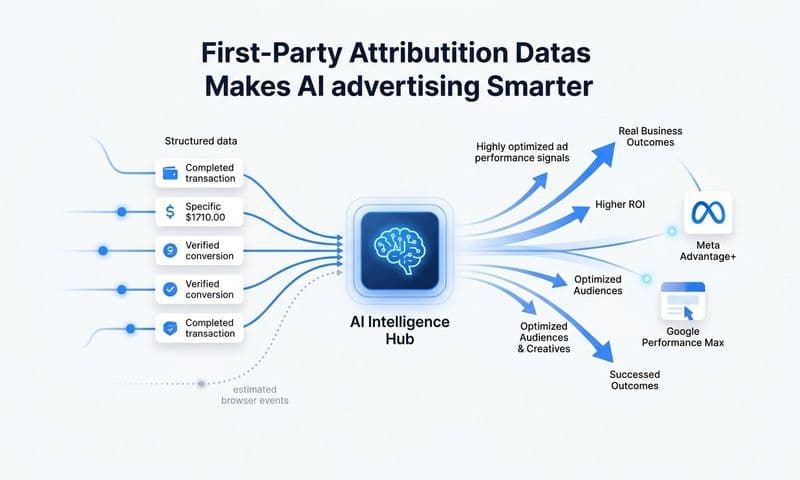
Feeding Attribution Insights Back to Ad Platforms: Modern ad platforms use machine learning to optimize delivery and targeting. But they can only optimize based on the conversion data you send them. When you use accurate attribution tracking with server-side implementation, you can feed richer conversion data back to platforms like Meta and Google.
This creates a powerful feedback loop. Better attribution data means better conversion signals sent to ad platforms. Better conversion signals mean improved algorithmic optimization. Improved optimization means better campaign performance and more conversions to analyze. The cycle compounds over time.
Building a Continuous Improvement Loop: Attribution isn't a one-time analysis. It's an ongoing process of measurement, insight, and optimization.
Start by establishing your baseline attribution data using your chosen model or models. Use those insights to make budget allocation decisions and campaign optimizations. Monitor performance to see whether the changes drive expected improvements. Refine your attribution approach based on what you learn. The right marketing attribution modeling software makes this continuous optimization process manageable.
As your business evolves, your attribution needs may change. A startup with a simple funnel might start with last-touch attribution, then graduate to position-based as the marketing mix becomes more complex, and eventually implement data-driven attribution as conversion volume increases.
The goal is creating a system where attribution data continuously informs smarter marketing decisions, which generate better results, which provide richer data for even better attribution insights.
Moving Forward with Confidence
Attribution models aren't about finding the single "correct" answer to which channels drive conversions. They're about gaining clearer visibility into what's actually working so you can make smarter budget decisions, optimize campaigns more effectively, and prove marketing ROI with confidence.
The best attribution strategy recognizes that different models answer different questions. Single-touch models help you understand specific stages of the funnel. Multi-touch models reveal how channels work together. Data-driven approaches show you what's actually most influential based on real conversion patterns.
As privacy changes and cookie restrictions continue reshaping digital marketing, accurate attribution becomes even more critical. Server-side tracking and first-party data infrastructure ensure you can still capture the full customer journey and make data-driven decisions even as browser-based tracking becomes less reliable.
The marketers who win in this environment are those who invest in proper attribution infrastructure, use multiple models to understand performance from different angles, and continuously refine their approach based on what the data reveals.
Ready to elevate your marketing game with precision and confidence? Discover how Cometly's AI-driven recommendations can transform your ad strategy—Get your free demo today and start capturing every touchpoint to maximize your conversions.