

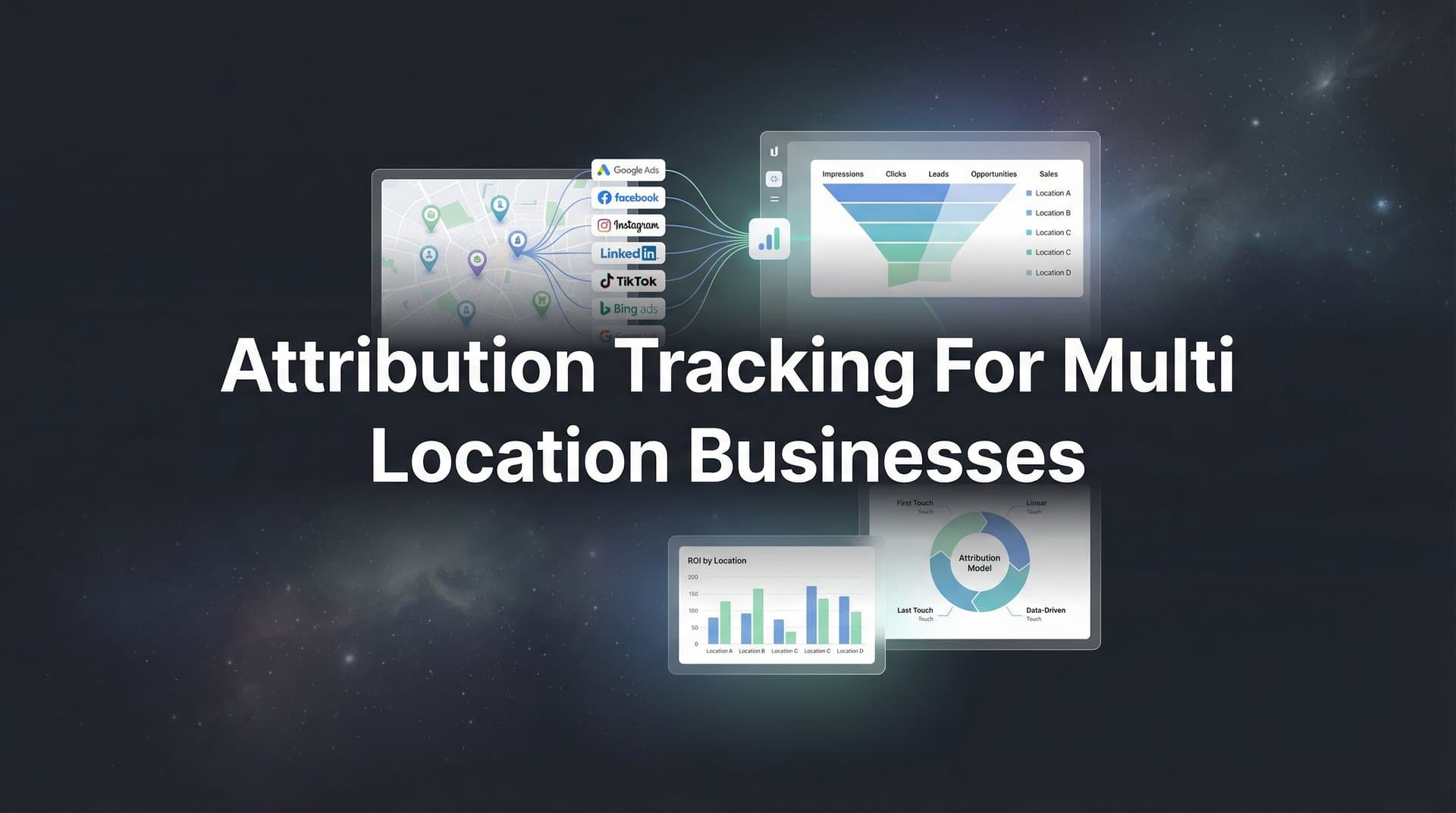
You're running ads across five cities. Your dashboard shows solid overall performance, but here's the reality: three of those locations are bleeding money while two are printing it. You just don't know which is which.
This is the hidden trap facing every multi-location business. You see aggregate numbers that look healthy, but underneath, your Chicago campaigns might be crushing it while your Miami spend disappears into a black hole. Someone clicks your ad in Seattle, calls your Phoenix location, then converts at your Dallas branch two weeks later. Traditional analytics? They have no idea how to connect those dots.
The problem gets worse as you scale. Each new location adds complexity. Each market has different customer behaviors, competitive landscapes, and conversion patterns. Without proper attribution tracking, you're essentially flying blind, making budget decisions based on incomplete data and hoping for the best.
Here's what proper attribution tracking actually does: it connects every marketing touchpoint to revenue at specific locations. It shows you which campaigns drive foot traffic to your Austin store versus your Portland branch. It reveals how awareness ads in one market contribute to conversions in another. Most importantly, it transforms your marketing from educated guessing into a data-driven growth engine where every dollar is allocated based on actual performance, not assumptions.
The Data Blindspot Costing You Revenue
Traditional analytics platforms were built for single-location businesses. They aggregate everything into one unified view, which sounds helpful until you realize it's hiding the insights you actually need.
Picture this: your overall Google Ads ROAS looks solid at 4:1. You're feeling good about the performance. But dig deeper and you discover that your San Francisco campaigns are delivering 8:1 returns while your Denver campaigns are barely breaking even at 1.5:1. The aggregate number masked a massive opportunity to reallocate budget and a significant waste problem you didn't know existed.
This aggregation problem extends beyond simple performance metrics. Customer journeys in multi-location businesses rarely follow the clean, linear path that traditional analytics expect. Someone might see your Instagram ad while visiting relatives in Boston, research your services on their phone during the flight home to Atlanta, then walk into your Nashville location a week later because it's closest to their new office.
Traditional analytics tools assign that conversion to Nashville's direct traffic. The Instagram campaign that started the journey? It gets zero credit. The research session that built confidence? Invisible. You're left making decisions based on incomplete information, potentially cutting the very campaigns that are actually driving awareness and consideration across your entire network. Understanding marketing attribution for multi location businesses is essential to solving this problem.
The budget waste compounds over time. Without location-level attribution, you cannot identify which markets respond best to which channels. Maybe Facebook crushes it in college towns but underperforms in suburban markets. Perhaps search ads drive immediate conversions in competitive metros but display ads work better in smaller cities where you have less competition. You'll never know if you're looking at aggregated data.
Even worse, you cannot spot the cross-location patterns that reveal your actual customer behavior. When someone researches locations in three different cities before choosing one, that's valuable intent data. When awareness campaigns in major metros drive conversions at suburban locations, that's a scaling opportunity. Traditional analytics miss these insights entirely because they weren't designed to track them.
Connecting the Dots Across Every Location
Accurate multi-location attribution requires connecting three critical data sources: your ad platforms, your CRM system, and your location-specific conversion data. Each piece provides part of the puzzle, but only together do they reveal the complete customer journey.
Start with your ad platforms. Every click, impression, and interaction generates data about where the customer saw your ad, what message resonated, and which market they were in. This is your awareness layer. It tells you how customers first discovered your business and which campaigns sparked their interest.
Your CRM holds the consideration layer. It tracks form submissions, phone calls, chat conversations, and email interactions. Critically, it should capture which location the customer inquired about or expressed interest in. This is where many businesses lose the thread. If your CRM doesn't tag interactions with location data, you cannot connect marketing touchpoints to location-specific outcomes.
The conversion layer comes from your point-of-sale systems, booking platforms, or e-commerce checkout. This is where the actual transaction happens, and it must include precise location information. Did they purchase online for pickup at Location A? Did they visit Location B in person? Did they call Location C to complete the sale? Each scenario requires different tracking for multi location businesses approaches.
Server-side tracking has become essential for maintaining data accuracy across this complex ecosystem. Browser-based tracking faces increasing limitations from privacy updates, ad blockers, and cookie restrictions. When you rely solely on client-side tracking, you're missing a significant portion of your conversion data, especially on mobile devices where tracking limitations are most severe.
Server-side tracking captures conversion events directly from your servers, bypassing browser limitations entirely. When a customer completes a purchase at any location, your server sends that conversion data directly to your analytics platform with complete location context, campaign attribution, and customer journey details. The data remains accurate regardless of browser settings or device restrictions.
First-party data plays a crucial role in this framework. Unlike third-party cookies that track users across the web, first-party data comes directly from your customer interactions. When someone fills out a form on your website, calls your business, or makes a purchase, you're collecting first-party data that belongs to you and isn't subject to the same privacy restrictions.
This first-party approach becomes even more powerful when you connect it across locations. A customer who requests information about your Seattle location, then later converts at your Portland branch, creates a first-party data trail that reveals their decision-making process. You can see that the Seattle inquiry represented serious consideration, even though the conversion happened elsewhere.
The technical implementation requires consistent tracking parameters across all locations. Every ad campaign needs location identifiers. Every landing page needs proper tagging. Every conversion event needs location context. This standardization ensures that when you analyze performance, you're comparing apples to apples across your entire network.
The Metrics That Actually Matter for Multi-Location Success
Location-level ROAS is your primary performance indicator. It shows you exactly how much revenue each location generates for every dollar spent on marketing. This metric reveals your stars, your steady performers, and your problem children.
But here's where it gets interesting: you need to analyze ROAS by both location and channel. Your Seattle location might deliver strong overall ROAS, but when you break it down, you discover that search ads perform brilliantly while social campaigns underperform. Meanwhile, your Portland location shows the opposite pattern. Without this granularity, you'd miss the opportunity to optimize channel mix at each location.
Cost per acquisition at the location level tells a different story than aggregate CPA. Your overall CPA might look acceptable, but location-level analysis often reveals massive disparities. One location might acquire customers for half the cost of another, signaling either a more efficient market or a more effective local strategy worth replicating.
Cross-location customer journey analysis reveals patterns that aggregate data hides completely. Track how many customers research multiple locations before converting. Measure how awareness campaigns in major metros influence conversions at suburban locations. Implementing multi touch attribution models for data analysis helps identify which locations serve as research destinations versus conversion destinations.
These journey patterns inform budget allocation in ways that simple conversion tracking cannot. If you discover that 30% of conversions at suburban locations were influenced by awareness campaigns in nearby urban markets, you know that cutting urban spend would indirectly hurt suburban performance. That's an insight you'd miss entirely with traditional last-click attribution.
Channel effectiveness by location deserves its own dashboard. Create a matrix showing how each channel performs at each location. You'll often discover that what works in one market fails in another. Search intent varies by market. Social media engagement differs by demographics. Local competition affects channel performance. Your Boston strategy should not be identical to your Phoenix strategy.
Attribution model comparison becomes particularly valuable for multi-location businesses. First-click attribution shows you which campaigns drive initial awareness across locations. Last-click attribution reveals what closes the sale. Linear attribution distributes credit across the journey. Compare these models at the location level to understand how customer behavior differs across markets.
Time to conversion by location reveals market-specific sales cycles. Some markets move fast from awareness to purchase. Others require longer consideration periods. This insight affects everything from campaign pacing to budget timing. If your Miami market converts quickly but your Denver market needs three weeks, you should structure campaigns differently in each market.
Revenue per customer by location and source helps you identify not just which campaigns drive conversions, but which drive valuable conversions. A campaign might deliver high conversion volume at one location but low average transaction values. Another campaign might generate fewer conversions but much higher revenue per customer. Both metrics matter for optimization decisions.
Building Your Location-Level Attribution System
Start with standardized naming conventions across all campaigns, ad sets, and ads. Every campaign name should include a location identifier. Use consistent formats like "LOC-SEA" for Seattle or "LOC-MIA" for Miami. This consistency ensures that when you filter reports by location, everything groups correctly without manual sorting.
Create location-specific UTM parameters for every campaign. Your UTM structure should include location data in a consistent field, typically utm_campaign or a custom parameter. This allows you to track performance by location even before someone converts, giving you visibility into which locations drive the most engaged traffic.
Set up dedicated conversion events for each location in your analytics platform. Instead of one generic "purchase" event, create "purchase_seattle", "purchase_portland", "purchase_denver" events. This granular approach makes location-level reporting straightforward and prevents the data aggregation that hides insights. Proper attribution tracking for multiple campaigns requires this level of detail.
Integrate your CRM with your attribution platform using location-tagged data. Every lead, call, or form submission should carry location information. When someone requests information about a specific branch, that location tag should flow through your entire data pipeline, from initial capture through final conversion and revenue attribution.
Your point-of-sale integration requires special attention. POS systems need to send conversion data to your attribution platform with complete location context. This means not just which location processed the sale, but ideally which campaigns and channels influenced that customer before they arrived. The connection between online marketing and offline conversions is where most attribution systems break down.
Implement a customer ID system that persists across locations. When someone interacts with multiple locations, you need to recognize them as the same person. This unified customer view prevents duplicate counting and reveals cross-location journey patterns. Hash email addresses or phone numbers to create persistent identifiers while maintaining privacy.
Build a unified reporting dashboard that shows both individual location performance and network-wide patterns. You need the ability to drill down into any location while also spotting trends across your entire network. The best dashboards allow you to switch between location-specific and aggregate views without losing context.
Create feedback loops between your attribution data and your ad platforms. Modern advertising platforms use conversion data to optimize targeting and bidding. When you send location-specific conversion data back to platforms like Meta and Google, their algorithms learn which audiences convert at which locations, improving performance over time. Solving multiple ad platforms tracking problems is critical for this feedback loop to work.
This conversion feedback becomes particularly powerful with server-side tracking. You're sending complete, accurate conversion data that isn't diminished by browser limitations. The ad platforms receive higher-quality signals, leading to better optimization and more efficient spend across all locations.
Turning Attribution Insights Into Revenue Growth
Location-level attribution data reveals your highest-performing markets and channels. Use this insight to reallocate budgets aggressively. If your Austin location delivers 6:1 ROAS while your Houston location struggles at 2:1, shift budget toward Austin until you hit diminishing returns, then investigate why Houston underperforms.
The reallocation isn't just about moving money between locations. It's about optimizing channel mix at each location based on what actually works there. Your data might show that search ads crush it in competitive metros but social ads perform better in smaller markets. Effective attribution modeling for multi channel campaigns helps you adjust your channel strategy by location rather than applying a one-size-fits-all approach.
Feed enriched conversion data back to your ad platforms to improve their targeting algorithms. When you send detailed conversion information including location, revenue value, and customer lifetime value signals, the platforms' machine learning systems get smarter about finding similar high-value customers in each market.
This creates a compounding effect. Better data leads to better targeting, which drives better results, which generates more data to further refine targeting. Multi-location businesses that implement this feedback loop consistently outperform competitors who send basic conversion signals.
Scale successful campaigns from top-performing locations to underperforming markets with location-specific adaptations. If a particular campaign creative and message crushes it in Denver, test it in similar markets. But adapt the targeting, bidding strategy, and budget based on what you've learned about how each market behaves differently.
Use cross-location journey data to optimize your full-funnel strategy. If you discover that awareness campaigns in major metros consistently influence conversions at suburban locations, you can justify increased brand spending in urban markets even if direct conversions don't justify it. You're accounting for the full impact across your network.
Identify and replicate the operational factors behind high-performing locations. Attribution data shows you which locations convert marketing traffic most efficiently, but dig deeper to understand why. Is it better local management? Superior customer service? Optimal product mix? Competitive advantages in that market? Find the transferable elements and implement them elsewhere.
Create location-specific landing pages optimized for the campaigns driving traffic to each market. Your Seattle campaigns should send traffic to Seattle-specific pages with local imagery, testimonials from Seattle customers, and Seattle location information. This localization improves conversion rates and provides clearer attribution signals.
Your Roadmap to Multi-Location Marketing Clarity
Multi-location businesses operate with a built-in competitive advantage: multiple markets, diverse customer bases, and opportunities to test and learn across different environments. But only if you can actually measure what's working in each location.
Proper attribution tracking transforms your multi-location network from a complexity challenge into a strategic asset. You stop making budget decisions based on aggregate numbers that hide the truth. You start allocating resources based on precise, location-specific performance data that reveals exactly where every dollar delivers the strongest return.
The implementation requires upfront effort. Standardizing tracking across locations, integrating data sources, and building unified reporting takes time. But the alternative is continuing to operate partially blind, missing opportunities in high-performing markets while wasting budget in underperforming ones.
Start with your highest-revenue locations. Implement complete attribution tracking there first, prove the value, then roll out to your entire network. You'll quickly discover insights that change how you think about your marketing strategy. Some locations will surprise you with hidden potential. Others will reveal problems you didn't know existed.
The businesses that win in multi-location marketing aren't necessarily the ones with the biggest budgets. They're the ones with the clearest visibility into what drives results at each location. They know which campaigns work in which markets. They understand how customer journeys span locations. They optimize based on data, not assumptions.
Your path forward is clear: implement location-level attribution tracking, connect your data sources, and start making decisions based on complete information about how marketing drives revenue across every location in your network.
Ready to elevate your marketing game with precision and confidence? Discover how Cometly's AI-driven recommendations can transform your ad strategy. Get your free demo today and start capturing every touchpoint to maximize your conversions across all your locations.



