

You just wrapped a successful campaign. Your ad platform dashboard shows strong conversion numbers, healthy ROAS, and all the green arrows pointing up. You present the results to leadership with confidence. Then someone pulls up the CRM data, and the numbers don't match. Not even close.
What happened? The answer often lies in something most marketers overlook: attribution windows. These invisible time frames determine which conversions your ad platforms can see and credit to your campaigns. When those windows close before your customers actually convert, your data tells an incomplete story.
Understanding attribution window limitations isn't just a technical detail for your analytics team. It directly affects where you allocate budget, which campaigns you scale, and how accurately you can measure what's actually driving revenue. The gap between what your platforms report and what's really happening in your business grows wider every day as privacy changes shrink tracking capabilities and customer journeys stretch across more touchpoints.
How Attribution Windows Shape Your Marketing Data
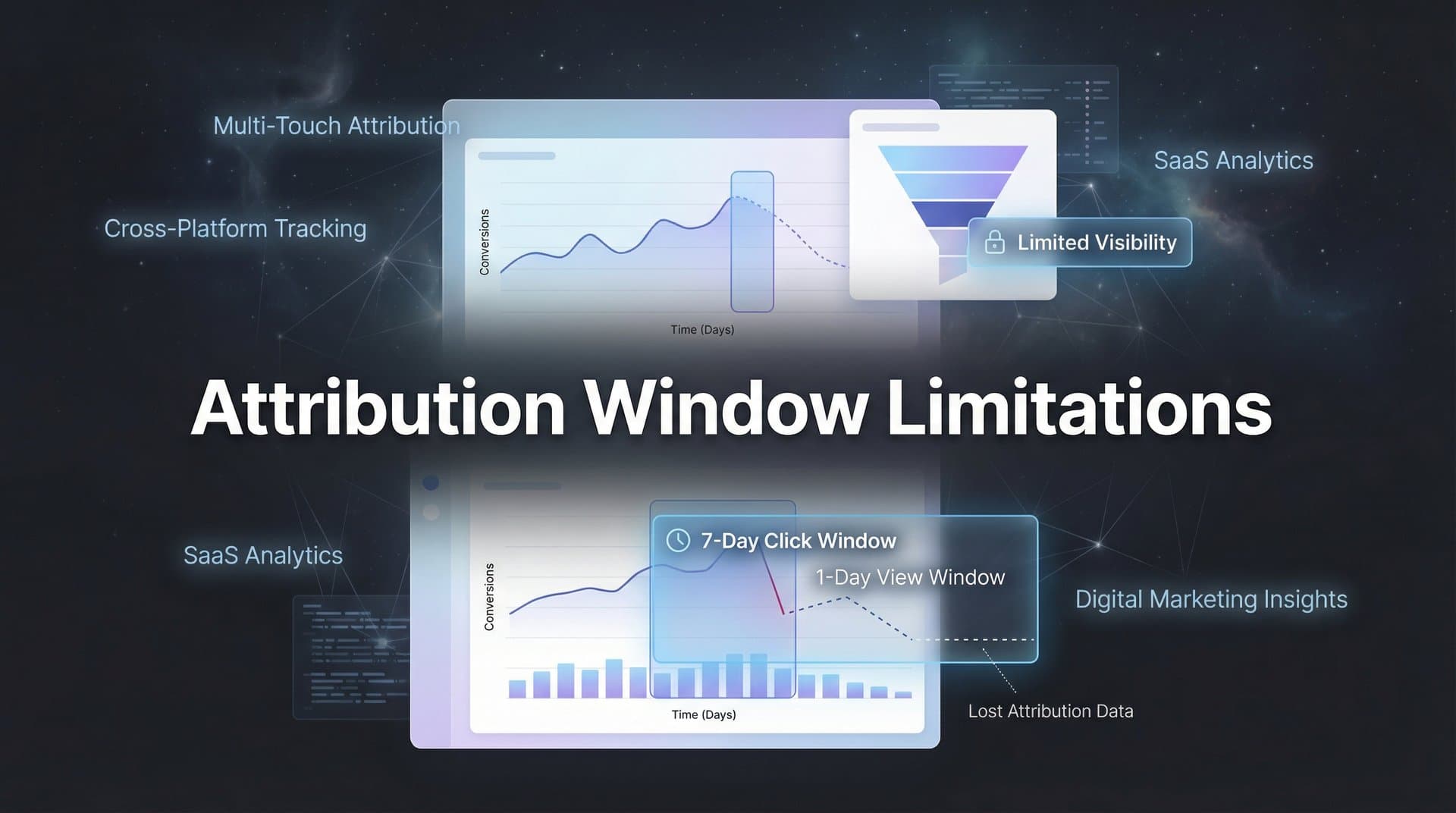
An attribution window is the specific time period during which an ad platform will credit a conversion back to an ad interaction. Think of it as a countdown timer that starts the moment someone clicks your ad or views your content. If they convert before that timer runs out, the platform counts it. If they convert after, that conversion becomes invisible to the platform's reporting.
Platforms track two distinct types of interactions, each with its own window. Click-through attribution windows measure conversions that happen after someone actively clicks your ad. View-through attribution windows track conversions from people who saw your ad but didn't click, then converted later through another path.
Here's where it gets complicated: every platform sets different default windows. Meta currently uses a 7-day click and 1-day view window as its standard. Google Ads defaults to 30 days for most conversion actions. TikTok offers 7-day or 28-day click windows depending on your setup. LinkedIn uses a 30-day click window for its conversion tracking.
These differences create real problems when you're trying to understand campaign performance. Imagine a customer clicks your Meta ad on Monday, sees your Google retargeting ad on Thursday without clicking, then converts on your website the following Tuesday—nine days after the initial Meta click. Meta's 7-day window has already closed, so they don't claim the conversion. Google's 30-day window is still active, so they take full credit.
The same conversion, counted differently across platforms based purely on window settings. Neither platform is technically wrong—they're just working within their own measurement boundaries. But when you're trying to figure out which campaigns actually drove that sale, you're left with incomplete and often conflicting information.
The mechanics get even more nuanced with view-through windows. If someone sees your video ad but doesn't click, then converts within 24 hours, Meta's 1-day view window captures it. But if they convert 36 hours later, that impression gets no credit at all, even though it might have been the critical touchpoint that introduced them to your brand.
Platform algorithms optimize based on what they can see within these windows. When conversions happen outside the window, the platform's AI doesn't learn from them. It can't identify which audiences, creatives, or placements actually drive results when those results occur beyond its measurement horizon.
The Hidden Gaps Platform Windows Create
Standard attribution windows were designed for quick consumer purchases. Someone sees an ad for shoes, clicks, buys within a few days. But most real-world buying journeys don't fit this neat timeline, especially as purchases become more complex or considered.
B2B sales cycles regularly extend weeks or months. A marketing director might click your LinkedIn ad in January, download a whitepaper, attend a webinar in February, request a demo in March, and finally sign a contract in April. That 90-day journey far exceeds any standard attribution window. The platform that introduced them to your solution gets zero credit because their window closed months before the deal closed.
High-consideration consumer purchases face the same challenge. Someone researching a new car might click your ad, visit your dealership website, think about it for two weeks, come back to compare models, then schedule a test drive three weeks after that initial click. By the time they're ready to buy, your original ad's attribution window is too short to capture the conversion.
Cross-device journeys create another layer of invisibility. A user clicks your ad on their phone during their morning commute. They research more on their work laptop during lunch. They discuss it with their partner on a shared tablet that evening, then finally convert on their personal computer two days later. Each device switch potentially breaks the attribution chain, and if the final conversion happens after the window closes, the entire journey becomes unmeasurable.
Privacy changes have dramatically shortened the effective tracking windows platforms can actually use. Apple's App Tracking Transparency framework requires users to opt in before apps can track their activity. Most users decline. This means even if a platform's attribution window is technically set to 7 or 30 days, they might only have reliable data for the first few hours after an ad interaction.
Cookie restrictions in browsers like Safari and Firefox have similar effects. Third-party cookies that once persisted for weeks now get deleted within days or blocked entirely. The technical infrastructure that made longer attribution windows possible is disappearing, making the gap between platform-visible conversions and actual customer behavior even wider.
Cross-platform journeys compound these problems. Someone might discover your brand through a TikTok ad, research you on Google, engage with your content on Instagram, then convert after clicking a Meta retargeting ad. If each of these touchpoints happens just far enough apart, multiple attribution windows expire along the way. The final retargeting ad gets all the credit, while the awareness campaigns that started the journey get none.
When Buying Cycles Exceed Measurement Capabilities
The mismatch between attribution windows and actual sales cycles creates systematic blind spots in your data. Companies selling enterprise software, consulting services, or complex products face this constantly. Their marketing teams know that awareness campaigns are essential for filling the pipeline, but platform data consistently shows these campaigns underperforming because conversions happen months after the windows close.
Even consumer brands with longer consideration periods struggle. Furniture retailers, home improvement companies, and travel businesses all see customers who research extensively before purchasing. A family planning a vacation might start looking six months in advance. By the time they book, every attribution window from their initial research phase has expired.
When Short Windows Mislead Your Budget Decisions
Attribution window limitations don't just create reporting gaps. They actively distort your understanding of what's working, leading to budget decisions that can hurt your business.
Top-of-funnel campaigns consistently appear to underperform in platform reporting because their impact happens outside measurement windows. You run a brand awareness campaign that introduces thousands of potential customers to your product. Many of them need time to consider, compare alternatives, discuss with stakeholders, or wait for the right moment to buy. When they finally convert weeks later, your awareness campaign gets no credit.
Looking at platform data alone, that awareness campaign shows poor ROAS. The temptation is to cut budget and reallocate to bottom-of-funnel campaigns that show better immediate returns. But those bottom-funnel campaigns only work because the awareness campaign filled the pipeline in the first place. Cut the top of funnel, and your entire pipeline eventually dries up.
Last-click attribution bias intensifies when windows favor recent touchpoints. If someone interacts with five different campaigns over three weeks before converting, but only the final retargeting click happens within the active attribution window, that retargeting campaign claims 100% of the credit. The four campaigns that built awareness, consideration, and intent become invisible.
This creates a dangerous feedback loop. Retargeting campaigns show excellent performance metrics because they catch users right before conversion within active windows. You increase retargeting budget. Prospecting campaigns show weak metrics because their impact happens later, outside windows. You decrease prospecting budget. Eventually, you're spending heavily on retargeting but have fewer and fewer new prospects to retarget.
Budget allocation becomes increasingly misaligned with reality. The campaigns that actually drive new customer acquisition get underfunded. The campaigns that simply capture demand created by other touchpoints get overfunded. Your overall cost per acquisition rises even as your retargeting ROAS looks strong, because you're not investing enough in the campaigns that create new opportunities.
The Prospecting Paradox
Prospecting campaigns face the harshest measurement challenges from attribution windows. By definition, they target people who don't know your brand yet. These users need time to learn about you, build trust, and decide to purchase. That time often exceeds standard attribution windows.
Meanwhile, retargeting campaigns target people who already engaged with your brand. They're closer to conversion, so they convert faster, often well within attribution windows. This makes retargeting look dramatically more efficient in platform reporting, even when prospecting campaigns are actually the ones generating the valuable new customers that retargeting later converts.
Why Platform-Reported Data Often Conflicts
Open your Meta Ads Manager, Google Ads dashboard, and TikTok analytics on the same day. Add up the conversions each platform claims. Now compare that total to what actually happened in your CRM or revenue system. The numbers rarely match, and attribution windows are a primary reason why.
Each platform operates independently with its own attribution windows and counting methods. They don't coordinate with each other. When a customer's journey includes touchpoints across multiple platforms, each platform evaluates conversions based solely on its own tracking and its own window settings.
This creates conversion duplication. A user clicks your Google ad on Monday, sees your Meta ad on Wednesday, then converts on Thursday. Google's 30-day window is active, so they claim the conversion. Meta's 7-day click window is also active from a previous interaction, so they claim it too. Your platforms report two conversions, but you only made one sale.
Privacy-focused aggregated reporting adds another layer of discrepancy. Meta's Aggregated Event Measurement delays conversion reporting and groups data to protect user privacy. You might run a campaign today, but conversions don't show up in your dashboard until days later. By the time you see the data, it's already aggregated in ways that make it hard to match to specific users or sessions in your CRM.
Google's Enhanced Conversions and other privacy-preserving measurement approaches use modeling to estimate conversions they can't directly track. These modeled conversions help fill gaps created by tracking limitations, but they're estimates, not exact counts. The modeled number your platform reports might be close to reality, but it won't match your CRM's actual conversion records perfectly.
The gap between platform metrics and CRM reality widens as customer journeys get more complex. A straightforward path—ad click to immediate purchase—usually shows reasonable alignment between platform and CRM data. But when journeys involve multiple sessions, devices, platforms, and weeks of consideration, attribution windows fail to capture the full story. Your CRM shows conversions that platforms can't see or credit correctly.
The Multi-Platform Attribution Nightmare
Companies running campaigns across Meta, Google, TikTok, LinkedIn, and other platforms face a mathematical impossibility. If you add up all the conversions each platform claims, you often get 150% or 200% of your actual conversions. Every platform wants to take credit, and their overlapping attribution windows make it technically correct for multiple platforms to claim the same conversion.
This isn't dishonesty from the platforms. It's a fundamental limitation of siloed measurement systems. Each platform only sees its own touchpoints within its own windows. They have no visibility into what happened on other platforms or what occurred before their window started or after it ended.
Strategies for Working Around Window Constraints
Attribution window limitations are real, but they're not insurmountable. Marketers who understand these constraints can implement strategies that provide more complete visibility into what's actually driving conversions.
The first step is extending measurement beyond platform defaults by connecting your ad data to systems that track the full customer lifecycle. Your CRM knows when deals close regardless of how much time has passed since the initial ad interaction. Your revenue system knows which customers generated actual value, not just which ones converted within an arbitrary window.
Connecting these systems creates a more complete picture. When a lead converts in your CRM three weeks after clicking an ad, you can trace that conversion back to the original campaign even though the platform's attribution window has closed. You're no longer limited to what platforms can see within their measurement horizons.
Multi-touch attribution models help distribute credit across touchpoints that occur outside standard windows. Instead of giving 100% credit to the last click within an active window, multi-touch approaches recognize that awareness campaigns, mid-funnel content, and retargeting all contributed to the conversion. These models can credit touchpoints that happened weeks or months ago because they're not constrained by platform attribution windows.
Server-side tracking maintains data continuity when browser-based tracking fails. Ad blockers, privacy settings, and cookie restrictions limit what platforms can track through traditional pixels and cookies. Server-side implementations send conversion data directly from your server to ad platforms, bypassing many of these limitations. This doesn't extend attribution windows per se, but it ensures the data within those windows is more complete and accurate.
Implementing conversion APIs—Meta's Conversions API, Google's Enhanced Conversions, TikTok's Events API—feeds enriched conversion data back to platforms. These server-to-server connections send conversion information that includes additional context platforms couldn't capture through browser tracking alone. Better data helps platform algorithms optimize more effectively despite the constraints of shortened attribution windows.
Custom attribution windows can be configured in most platforms, though this requires careful consideration. Extending a window from 7 days to 30 days might capture more conversions, but it also increases the likelihood of crediting conversions to ads that didn't actually influence them. The goal isn't just longer windows, but windows that align with your actual customer journey length.
Building Your Measurement Stack
Working around attribution window limitations requires more than just adjusting settings in your ad platforms. It means building a measurement infrastructure that can track customer journeys independently of platform constraints.
This typically involves UTM parameters or similar tracking codes that persist in your own analytics system regardless of platform attribution windows. When someone clicks an ad, that click gets logged with campaign details. When they convert weeks later, you can look back at all their touchpoints, not just the ones within active attribution windows.
Marketing attribution platforms specialize in this cross-platform, extended-window tracking. They collect touchpoint data from all your marketing channels, store it independently, and connect it to conversions whenever they occur. This gives you a view of the customer journey that no single ad platform can provide on its own.
Building a Complete Picture of Your Customer Journey
The solution to attribution window limitations isn't trying to fix the windows themselves. It's building systems that track customer journeys comprehensively, regardless of when or where conversions happen.
Unifying touchpoint data from ads, website interactions, email engagement, and CRM events creates a continuous thread you can follow from first awareness to final conversion. When someone clicks a Meta ad, that touchpoint gets recorded. When they visit your website directly two weeks later, that visit connects to their profile. When they convert three weeks after the initial ad click, you can see the entire journey even though Meta's attribution window closed long ago.
This unified view reveals patterns that platform-limited data can't show. You might discover that customers who engage with both paid social and paid search convert at higher rates and higher values than those who only interact with one channel. You might find that certain content pieces consistently appear in conversion paths, even though they happen too early in the journey for platforms to credit them.
Comparing attribution models side by side helps you understand how window limitations affect credit distribution. Look at the same conversion data through last-click, first-click, linear, and time-decay models. The differences reveal which campaigns are getting overcredited by platform defaults and which are being systematically undervalued.
If your last-click data shows retargeting campaigns dominating performance, but first-click data shows prospecting campaigns starting most valuable journeys, you know attribution windows are creating measurement bias. This insight lets you make budget decisions based on actual contribution rather than just what platforms can see within their limited windows.
Feeding enriched conversion data back to ad platforms helps their algorithms optimize despite window constraints. When you send conversion information through server-side integrations, you can include additional context: conversion value, product purchased, customer lifetime value predictions, whether this was a new or returning customer. This enriched data helps platforms understand which campaigns drive valuable outcomes, not just which ones get credit within attribution windows.
Platform algorithms get smarter when they receive better data. Even if they can't see conversions that happen outside their attribution windows, they can learn from the enriched data you send about conversions that do occur within windows. Over time, this improves targeting and optimization, helping campaigns perform better even as privacy changes and window limitations reduce what platforms can directly measure.
From Siloed Metrics to Unified Intelligence
The goal isn't perfect attribution. That's impossible given privacy constraints and the complexity of modern customer journeys. The goal is moving from siloed, window-limited platform metrics to a unified view that captures enough of the journey to make confident decisions.
This means accepting that you'll never have 100% visibility into every touchpoint. But you can have enough visibility to understand which campaigns are truly driving new customer acquisition, which channels work best together, and where your budget should go to maximize growth.
Companies that build this unified measurement capability gain competitive advantage. While competitors make budget decisions based on incomplete platform data, you're working with a more complete picture that shows real contribution across the full customer lifecycle.
Moving Beyond Window-Limited Measurement
Attribution window limitations aren't just technical details buried in platform settings. They directly shape how you understand campaign performance, where you allocate budget, and which strategies you scale or cut. When platforms can only see conversions within narrow time windows, your data systematically undercredits awareness campaigns, overcredits retargeting, and creates conflicts between what your dashboards show and what your CRM knows actually happened.
Privacy changes and longer customer journeys have made these limitations more severe. The attribution windows platforms use are shrinking at the same time buying cycles are stretching longer. The gap between platform-visible conversions and actual customer behavior grows wider every quarter.
Marketers who understand these constraints can work around them. By connecting ad data to CRM systems, implementing multi-touch attribution, using server-side tracking, and building unified views of customer journeys, you create measurement capabilities that extend beyond what any single platform can provide. You see conversions regardless of when they happen, credit campaigns based on actual contribution, and make budget decisions grounded in complete data rather than window-limited fragments.
The future of marketing measurement isn't about longer attribution windows. It's about systems that track customer journeys independently of platform constraints, connect touchpoints across channels and devices, and provide the complete picture you need to confidently scale what's working.
Ready to elevate your marketing game with precision and confidence? Discover how Cometly's AI-driven recommendations can transform your ad strategy. Capture every touchpoint from ad clicks to CRM events, see which sources actually convert regardless of attribution windows, and feed enriched conversion data back to ad platforms to improve their optimization. Get your free demo today and start making budget decisions based on complete customer journey data, not just what platforms can see within their limited windows.


