Picture this: a prospect clicks your Google ad in January, reads a few blog posts, disappears for six weeks, returns via a LinkedIn organic post, downloads a case study, and finally books a demo in March. They close as a customer in April. Which touchpoint gets credit? With traditional pixel-based tracking, the honest answer is: it depends on what the cookie remembered, and increasingly, that answer is nothing at all.
This is the reality B2B SaaS marketers are navigating right now. Third-party cookies, the backbone of cross-site tracking and ad attribution for decades, are being phased out across the industry. Safari has blocked them by default for years through Intelligent Tracking Prevention. Firefox followed with Enhanced Tracking Protection. Chrome has been signaling the same direction. And while timelines have shifted, the direction has not.
For B2B SaaS specifically, this is not just an inconvenience. It is a fundamental threat to marketing measurement. Long buying cycles, multiple stakeholders, cross-device journeys, and months-long gaps between first touch and closed deal make cookie-based tracking especially fragile. When cookies expire before a deal closes, or get blocked on the first visit, the entire attribution chain breaks.
B2B SaaS cookieless tracking is not a workaround or a compromise. Done right, it is actually a more accurate and reliable foundation for marketing measurement than the cookie-dependent methods it replaces. This article breaks down what cookieless tracking means for B2B SaaS, why the shift is urgent, and how to implement it in a way that connects every touchpoint to actual revenue.
Why Third-Party Cookies Are Failing B2B SaaS Marketers
Before diving into solutions, it helps to understand exactly what is being lost and why B2B SaaS teams feel the pain more acutely than most.
There are two types of cookies. First-party cookies are set by the website a user is actively visiting. They remember login sessions, preferences, and site behavior within that domain. Third-party cookies are set by external domains, typically ad networks and tracking platforms, to follow users across multiple sites. When you visit a SaaS pricing page and then see a retargeting ad on a news site later that day, that is a third-party cookie at work.
Cookieless tracking specifically addresses the loss of those third-party cookies. First-party cookies are still available and still useful. The problem is that the entire infrastructure of cross-site tracking, retargeting, and ad attribution has been built on third-party cookies that browsers are now blocking by default. For a deeper primer on the fundamentals, explore our guide on what is cookieless tracking and why it matters.
For B2B SaaS, the structural mismatch between cookie lifespans and buying cycles is severe. The average B2B SaaS sales cycle often spans weeks to months. Multiple stakeholders research independently. Decisions involve procurement reviews, security evaluations, and internal approvals. A prospect who first clicked your ad in Q1 may not sign a contract until Q3. Cookies, even when they are not blocked, have expiration windows. By the time a deal closes, the original tracking data may be long gone.
Add browser restrictions into the mix and the picture gets worse. Safari's Intelligent Tracking Prevention caps the lifespan of certain cookies at seven days and restricts cross-site tracking aggressively. Firefox's Enhanced Tracking Protection blocks known tracking scripts entirely. Even without full cookie deprecation, a significant portion of B2B traffic, particularly from privacy-conscious enterprise users, is already being tracked incompletely or not at all.
The real-world impact shows up in the numbers marketers see every day. ROAS figures that seem too high or too low. Campaigns that appear to generate no conversions but are clearly driving pipeline according to the sales team. Top-of-funnel ad spend that looks like a cost center because the conversion event happens months later through a different channel. The attribution chain breaks, and without it, budget decisions get made on incomplete information.
This is not a minor data quality issue. When you cannot connect an ad click to a closed deal, you cannot confidently scale what is working or cut what is not. For B2B SaaS teams managing significant ad budgets across Google, LinkedIn, and Meta, that ambiguity is expensive.
The Building Blocks of Cookieless Tracking
Cookieless tracking is not a single technology. It is a combination of approaches that work together to maintain accurate attribution without relying on third-party cookies. Three pillars form the foundation.
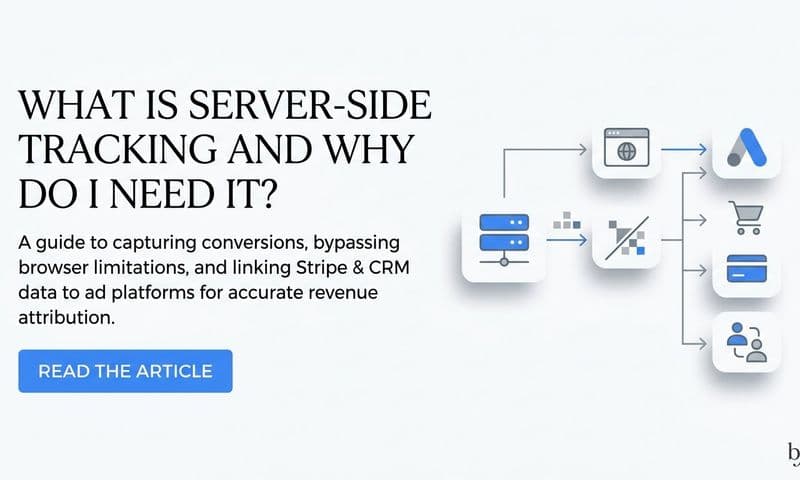
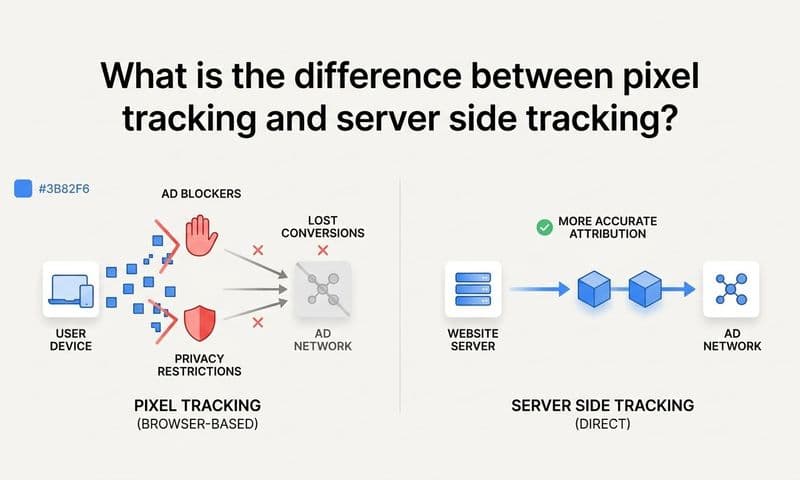
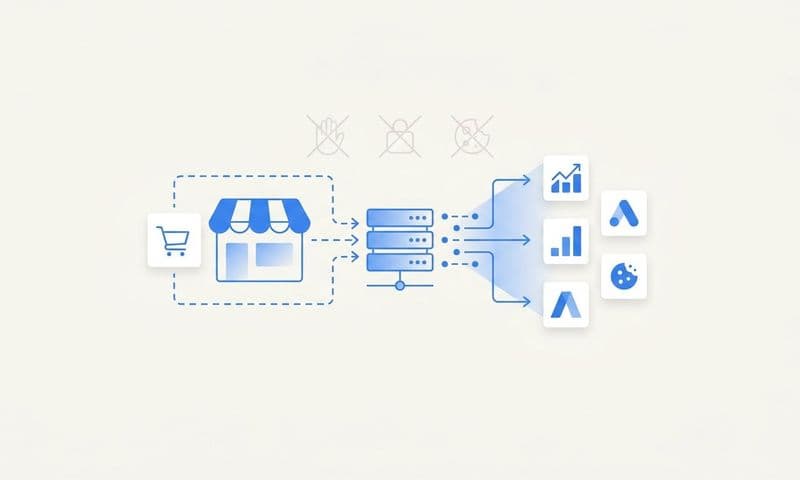
Server-Side Tracking: Traditional tracking relies on browser-based JavaScript pixels that fire when a user loads a page or completes an action. The problem is that browsers can block these pixels, ad blockers can suppress them, and browser privacy settings can strip the identifiers they rely on. Server-side tracking moves the data collection process off the browser and onto your server. When a user takes an action, your server captures that event and sends it directly to your analytics platform or ad network. Browser restrictions cannot interfere because the data never passes through the browser in the first place. To understand why this approach delivers superior results, read our breakdown of why server-side tracking is more accurate for attribution.
First-Party Data and Identity Resolution: First-party data is information collected directly from your own users through your own properties. This includes first-party cookies set by your domain, form submissions, sign-up data, CRM records, and any authenticated user information. When a prospect fills out a demo request form, you now have a known identity that can be matched across sessions, devices, and time. CRM-based identity resolution takes this further by connecting anonymous website visits to known contacts as they progress through the funnel. A prospect who visited your site anonymously in January and then submitted a form in March can have their entire journey stitched together retroactively using first-party identifiers.
Conversion APIs and Server-to-Server Integrations: Platforms like Meta and Google have built server-side data pipelines specifically to address the cookie problem. Meta's Conversions API (CAPI) and Google's Enhanced Conversions allow you to send conversion data directly from your backend systems to the ad platform, bypassing the browser entirely. Instead of relying on a pixel that fires in the browser (and might be blocked), your server sends a conversion event directly to Meta or Google when a meaningful action occurs, such as a demo booking, a trial sign-up, or a closed deal in your CRM. For a comparison of the leading tools in this space, see our roundup of top conversion API tracking tools.
These three pillars work together. Server-side tracking captures the events accurately. First-party data and identity resolution connect those events to real people across time. Conversion APIs feed that enriched data back to the platforms running your ads. The result is an attribution system that does not depend on cookies and is actually more resilient and accurate than what most teams were relying on before.
How Server-Side Tracking Changes the Attribution Game
Understanding the theory is one thing. Seeing how it plays out across a real B2B SaaS funnel makes the value concrete.
Consider a typical journey. A prospect clicks a Google Search ad and lands on your product page. They browse for a few minutes and leave without converting. Two weeks later, they return directly, read a case study, and subscribe to your newsletter with their work email. Four weeks after that, they click a LinkedIn retargeting ad and request a demo. Six weeks later, after a series of sales calls, they close as a customer.
With traditional pixel-based tracking, each of these sessions may look like a separate anonymous visitor. The first visit might be tracked, but the cookie gets cleared or expires before the return visit. The LinkedIn click fires a pixel, but it cannot connect back to the original Google ad click. The CRM records the closed deal, but there is no thread connecting it to any specific ad spend. You end up with fragmented data that makes it impossible to answer the question: which touchpoints actually drove this customer? Effective tracking SaaS customer acquisition requires maintaining that thread across every session.
Server-side tracking maintains the thread throughout that entire journey. When the prospect first clicks the Google ad, a server-side event captures that interaction with a first-party identifier tied to their session. When they return and submit their email, that identifier is now linked to a known contact. Every subsequent interaction, the LinkedIn click, the demo request, the CRM conversion, gets associated with that same identity record. The full journey is preserved, not because a cookie survived for months, but because the data was captured server-side and tied to persistent first-party identifiers.
The downstream effect on ad platform performance is significant. When you feed enriched, server-side conversion data back to Google and Meta through their respective APIs, those platforms receive a much clearer picture of which users are actually converting. Their algorithms can then optimize toward audiences that look like your real customers, not just the subset of users whose browser pixels happened to fire correctly. Better input data leads to better targeting, which typically leads to lower acquisition costs and more efficient ad spend over time.
Contrast this with the old approach, where pixel-based tracking might capture a fraction of actual conversions. Ad platforms running on incomplete data optimize toward a skewed version of your customer. You end up paying for traffic that does not convert while potentially missing the audiences that do. Server-side tracking corrects that feedback loop at the source.
Multi-Touch Attribution in a Cookieless World
If server-side tracking is the infrastructure, multi-touch attribution is what you build on top of it. And in a cookieless world, getting attribution right becomes even more critical.
Last-click attribution was already a flawed model before cookies became unreliable. Giving 100% of credit to the final touchpoint before conversion systematically undervalues everything that happened earlier in the funnel. For B2B SaaS, where a prospect might interact with ten or fifteen touchpoints over three months before booking a demo, last-click attribution tells you almost nothing useful about what is actually driving pipeline.
When cookie-based tracking degrades, last-click gets even more misleading. If the only touchpoints that get recorded are the ones that survived browser restrictions, the "last click" might simply be the last click that was tracked, not the last meaningful interaction in the actual journey. You end up crediting organic search or direct traffic for conversions that were actually driven by a paid campaign weeks earlier, simply because the paid click did not survive long enough in the cookie record. This is why many teams are moving beyond basic UTM parameters; our comparison of UTM tracking vs attribution software explains the key differences.
Cookieless attribution platforms solve this by using first-party data, server-side events, and CRM integrations to reconstruct the full customer journey. Instead of relying on cookies to maintain continuity across sessions, they use persistent first-party identifiers, matched against CRM records, to stitch together every touchpoint from first ad click to closed deal. Attribution models, whether linear, time-decay, position-based, or data-driven, can then distribute credit across the actual journey rather than just the fragment that cookies managed to capture.
The practical value for B2B SaaS marketing teams is direct. When you can see which campaigns are genuinely driving pipeline and revenue, not just clicks and form fills, you can make confident budget decisions. A LinkedIn campaign that appears to generate no direct conversions in a last-click model might be responsible for introducing a significant share of your enterprise deals when you look at the full journey. Connecting ad spend to actual closed deals is the core promise of revenue attribution for B2B SaaS companies, and cookieless infrastructure makes it possible at scale.
This is the difference between optimizing for what is easy to measure and optimizing for what actually drives revenue. For B2B SaaS teams with long cycles and high deal values, that distinction compounds over time into a significant competitive advantage.
Implementing Cookieless Tracking for Your B2B SaaS Stack
Knowing why cookieless tracking matters is the starting point. Knowing how to implement it is where most teams get stuck. Here is a practical roadmap.
Step 1: Audit your current tracking dependencies. Before you can move forward, you need to understand what you are currently relying on. Map out every tracking pixel, tag, and script on your site and in your ad platforms. Identify which ones depend on third-party cookies for cross-site tracking or identity resolution. This audit will show you where your biggest data gaps are likely to be as browser restrictions tighten further.
Step 2: Set up server-side tracking. This is the foundational infrastructure change. Rather than relying on browser-fired pixels, implement server-side event collection that captures user interactions at the server level. This typically involves setting up a server-side tag management container and routing your key conversion events through it. Evaluating the right infrastructure is easier with a detailed server-side tracking tools comparison that covers the leading options. The goal is to ensure that your most important data points, demo requests, trial sign-ups, subscription events, and CRM stage changes, are captured accurately regardless of what is happening in the user's browser.
Step 3: Connect your CRM and ad platforms. Server-side tracking becomes exponentially more powerful when it is connected to your CRM. Integrations with platforms like HubSpot or Salesforce allow you to pass CRM events, such as lead creation, opportunity stage changes, and closed deals, back into your attribution system. From there, conversion sync pushes enriched conversion data to your ad platforms through their conversion APIs. This closes the loop between ad spend and actual revenue.
Step 4: Validate data accuracy. After implementation, spend time comparing your server-side data against your previous pixel-based data and your CRM records. Look for discrepancies that might indicate gaps in your tracking setup. It is common to see an increase in reported conversions after implementing server-side tracking, simply because events that were previously being blocked or dropped are now being captured correctly.
A few implementation challenges are worth anticipating. Ensuring data consistency across platforms requires careful event naming conventions and parameter mapping. Long attribution windows, which are necessary for B2B SaaS given the length of buying cycles, need to be configured explicitly in your attribution platform. And getting internal buy-in from teams accustomed to pixel-based reporting may require some education about why the numbers look different and why the new data is more trustworthy.
Choosing the Right Cookieless Tracking Platform
Not all attribution platforms are built for the complexity of B2B SaaS. When evaluating options, there are several criteria that matter most.
Server-Side Tracking Capability: The platform must support server-side event collection natively, not as an afterthought. This is the foundation of accurate cookieless tracking, and it needs to be robust and reliable.
Multi-Touch Attribution Models: Look for platforms that offer flexible attribution models and can handle long attribution windows. B2B SaaS buying cycles do not fit neatly into 7-day or 28-day windows, and your attribution platform needs to accommodate that reality. Our overview of SaaS marketing attribution tools covers the leading platforms and their model flexibility.
CRM Integration Depth: The ability to connect CRM events, including deal stages and closed revenue, to ad touchpoints is what separates true revenue attribution from click tracking. Deep integrations with HubSpot, Salesforce, and similar platforms are essential.
Ad Platform Conversion Sync: The platform should support direct conversion sync to Meta, Google, and other ad networks through their respective APIs. This feeds better data to ad platform algorithms and improves campaign performance over time.
AI-Powered Optimization: Beyond tracking and attribution, the best platforms surface actionable recommendations based on the data they collect. AI-powered insights that identify which campaigns are driving the most efficient pipeline and revenue help marketers act on their data, not just look at it. For a broader look at the analytics landscape, explore our guide to SaaS marketing analytics and how attribution fits within it.
Cometly is built specifically to address these needs. It combines server-side tracking, multi-touch attribution across the full customer journey, and conversion sync that feeds enriched data back to Meta and Google. Its AI-powered recommendations help teams identify high-performing campaigns and scale them with confidence, rather than guessing based on incomplete data. For B2B SaaS teams where the gap between an ad click and a closed deal can span months, Cometly's focus on connecting every touchpoint to actual revenue makes it a purpose-built solution rather than a general-purpose analytics tool.
Putting It All Together
B2B SaaS cookieless tracking is not about adapting to a privacy-first world by accepting less visibility. It is about building a more accurate, more durable measurement foundation that actually reflects how your buyers behave.
The old cookie-based approach was always fragile for B2B SaaS. Buying cycles that span months, buyers who switch devices, and enterprise users who block tracking scripts were always creating gaps in the data. Cookieless tracking, built on server-side infrastructure, first-party data, CRM integration, and conversion sync, addresses those gaps directly rather than papering over them.
The marketers who invest in this infrastructure now will have a meaningful advantage. They will see their full funnel clearly. They will feed better data to ad platforms, which will improve targeting and reduce wasted spend. They will be able to attribute revenue to the campaigns and channels that actually drove it, not just the ones that happened to fire a pixel at the right moment.
The shift is already underway across the industry. The question is not whether to move to cookieless tracking but how quickly you can do it without leaving attribution gaps in the meantime.
Ready to elevate your marketing game with precision and confidence? Discover how Cometly's AI-driven recommendations can transform your ad strategy. Get your free demo today and start capturing every touchpoint to maximize your conversions.