You know the feeling. It's budget review time, and someone in the room asks the question every B2B SaaS marketer dreads: "Which of our campaigns is actually driving revenue?" You pull up your dashboards. Google Ads shows strong click-through rates. Meta reports a solid cost per lead. LinkedIn shows impressive engagement. But when you look at closed-won deals in the CRM, the connection between those numbers and actual revenue is murky at best.
This is the defining challenge of B2B SaaS marketing analytics. Unlike e-commerce, where someone sees an ad, clicks, and buys within minutes, B2B SaaS buyers move slowly and deliberately. A single deal might involve a free trial, three product demos, two rounds of procurement review, and fifteen touchpoints across six months before anyone signs a contract. Attributing that revenue to a specific campaign or channel is not a simple exercise.
The good news is that this problem is solvable. The companies pulling ahead right now are not the ones with the biggest budgets. They are the ones who have built analytics frameworks that connect marketing activity all the way through to pipeline and closed revenue. This guide will show you exactly how to do that: which metrics genuinely matter, how multi-touch attribution works in a B2B context, how to build a stack without data silos, and how to turn your analytics into smarter spend decisions.
Why B2B SaaS Demands a Different Analytics Playbook
Most marketing analytics frameworks were designed with simpler buyer journeys in mind. A consumer sees an ad, clicks, and converts. The feedback loop is tight, the data is clean, and optimizing for conversions is relatively straightforward. B2B SaaS breaks every one of those assumptions.
Think about what a typical B2B SaaS buyer journey actually looks like. A potential customer might discover your product through a Google search, read a few blog posts, download a whitepaper, attend a webinar, start a free trial, go dark for six weeks while they evaluate competitors, re-engage through a LinkedIn retargeting ad, request a demo, involve three colleagues in a procurement review, and finally close four months after that first click. Standard platform reporting is not built to handle this.
The recurring revenue model adds another layer of complexity. In B2B SaaS, a "conversion" is not a one-time purchase. It is the beginning of a relationship that could span years and generate significant lifetime value. A lead that converts quickly but churns in three months is worth far less than a lead that took six months to close but stays for three years and expands their contract. If your analytics only measure acquisition, you are missing most of the picture.
This is why so many B2B SaaS marketing teams get burned by vanity metrics. Clicks, impressions, and click-through rates feel like progress, but they tell you almost nothing about revenue. A campaign might generate thousands of cheap leads that never become qualified opportunities. Another campaign might generate a handful of expensive leads that all close into high-value accounts. Standard platform reporting from Google Ads or Meta will make the first campaign look like the winner. Your revenue data will tell the opposite story. Understanding unreliable marketing analytics data is the first step toward fixing this disconnect.
The foundation of effective B2B SaaS marketing analytics is full-funnel visibility: the ability to track a prospect from their very first ad interaction, through every content touchpoint, through CRM stages like MQL, SQL, and opportunity, all the way to closed-won revenue. Without that end-to-end view, you are making budget decisions based on incomplete information. With it, you can finally answer the question that matters: which marketing activities actually drive revenue?
The Metrics That Actually Move the Needle
Not all metrics are created equal. One of the most common mistakes in B2B SaaS marketing analytics is tracking too many numbers without understanding which ones connect to outcomes that matter to the business. A useful way to think about this is to organize your metrics into three tiers: acquisition, pipeline, and revenue.
Acquisition Metrics: These sit at the top of the funnel and measure how efficiently you are bringing new prospects into your system. Cost per lead (CPL) and cost per marketing qualified lead (cost per MQL) are the most important here. Lead velocity rate, which measures how quickly your qualified lead volume is growing month over month, is a useful leading indicator of future pipeline health. These metrics matter, but they should never be your north star.
Pipeline Metrics: This is where most B2B SaaS marketing teams need to invest more analytical attention. Marketing-sourced pipeline measures the total value of opportunities that originated from marketing activity. SQL-to-opportunity rate tells you how efficiently your qualified leads are converting into active sales conversations. Pipeline velocity measures how quickly deals move through your funnel. These metrics bridge the gap between marketing activity and revenue outcomes, and they are where you will find the most actionable insights.
Revenue Metrics: Customer acquisition cost (CAC), the ratio of customer lifetime value to CAC (LTV-to-CAC), and payback period are the metrics that CFOs and leadership teams care about most. They are also the metrics that reveal whether your marketing investments are sustainable. A healthy LTV-to-CAC ratio suggests your acquisition economics are working. A long payback period might indicate that you need to either reduce acquisition costs or improve retention.
The practical implication here is clear: over-indexing on top-of-funnel numbers leads to misallocated budgets. If you optimize purely for cost per lead, you will naturally gravitate toward channels and campaigns that produce cheap leads. But cheap leads that do not convert into pipeline are a waste of budget. The right approach is to use acquisition metrics as guardrails while optimizing toward pipeline and revenue metrics as your true north. For a deeper dive, explore this guide on revenue attribution for B2B SaaS companies.
Cohort analysis is another powerful tool that many B2B SaaS marketing teams underutilize. Instead of looking at lead volume and conversion rates in aggregate, cohort analysis tracks groups of leads acquired in the same time period and follows them through the funnel over months. This reveals something aggregate data cannot: which campaigns produce leads that actually close, and how long it takes for different lead sources to generate revenue. A campaign that looks average in week one might turn out to be your best performer by month six, once the cohort has had time to move through a full sales cycle.
Multi-Touch Attribution: Connecting Every Interaction to Revenue
Here is the thing about B2B SaaS buyer journeys: the touchpoints in the middle are often the most influential, and they are almost always the ones that get ignored.
Single-touch attribution models, specifically first-click and last-click, assign all credit for a conversion to either the very first interaction a prospect had with your brand or the very last one before they converted. Both approaches create significant blind spots. First-click attribution ignores all the nurturing, retargeting, and content engagement that moved a prospect from awareness to consideration. Last-click attribution ignores everything that brought the prospect in and nurtured them to the point where they were ready to convert. In a B2B SaaS context where the journey spans months and dozens of touchpoints, either approach will give you a distorted view of what is actually working. Understanding these SaaS marketing attribution challenges is essential before selecting a model.
Multi-touch attribution distributes credit across all the interactions in a customer's journey, giving you a much more complete picture. There are several common models, each with its own strengths.
Linear Attribution: Distributes credit equally across every touchpoint in the journey. This is a good starting point if you want to acknowledge the full funnel without making assumptions about which touchpoints matter most.
Time-Decay Attribution: Gives more credit to touchpoints that occurred closer to the conversion event. This makes intuitive sense for B2B SaaS teams who believe that later-stage interactions, like a demo request or a retargeting ad that brought someone back after a long pause, carry more weight.
Position-Based Attribution: Also called the U-shaped model, this gives the most credit to the first and last touchpoints while distributing the remaining credit across the middle. It is useful when you want to understand both what created awareness and what triggered the final conversion.
Data-Driven Attribution: Uses machine learning to assign credit based on actual patterns in your conversion data, rather than a predetermined formula. This is the most sophisticated approach and requires a meaningful volume of conversion data to work well.
Choosing the right model matters less than having any multi-touch model at all. The bigger technical challenge is actually stitching together the data needed to make attribution work: ad platform data, website behavior, CRM stages, and offline events like demo calls all need to be connected into a single customer journey view. Reviewing the best marketing attribution tools for B2B SaaS can help you find the right solution for your stack.
This is where browser-based tracking increasingly falls short. Cookie deprecation and iOS privacy restrictions, particularly Apple's App Tracking Transparency framework, have made client-side tracking less reliable. A meaningful portion of user journeys now go untracked when you rely solely on pixel-based measurement. Server-side tracking addresses this by moving the data collection process off the user's browser and onto a server, making it far more resilient to browser restrictions and privacy changes. For B2B SaaS teams running campaigns across multiple platforms, server-side tracking is no longer optional. It is the foundation of accurate attribution.
Building Your Analytics Stack Without the Data Silos
Most B2B SaaS companies already have all the data they need to do great marketing analytics. The problem is that the data lives in different places, owned by different teams, and measured in different ways. Marketing looks at platform ROAS and lead volume. Sales looks at CRM pipeline and deal velocity. Finance looks at revenue and CAC. None of the numbers agree, and no one has a clear picture of what is actually happening.
This is the data silo problem, and it is one of the most common reasons B2B SaaS marketing analytics programs fail to deliver value. When each team is working from a different data source with different definitions and different time windows, alignment becomes nearly impossible. Budget conversations turn into debates about whose numbers are right rather than discussions about what to do next. Building a unified marketing analytics platform is the most effective way to eliminate these silos.
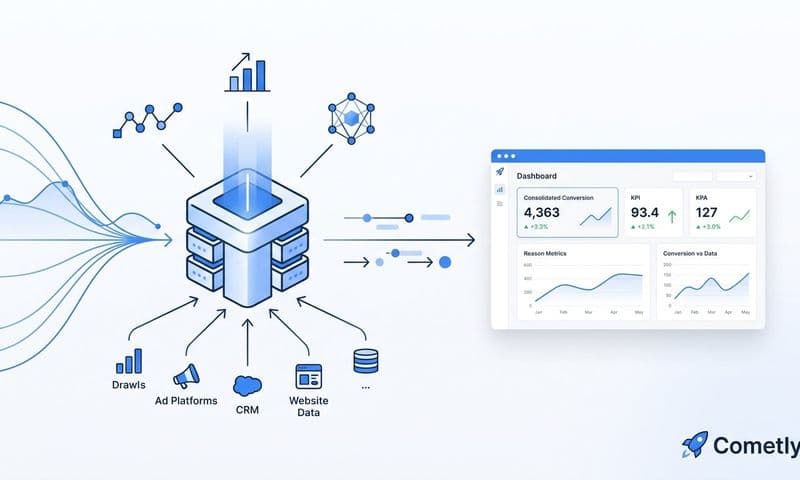
A well-structured B2B SaaS analytics stack has four core components that need to work together.
Ad Platform Data: Spend, impressions, clicks, and platform-reported conversions from Google Ads, Meta, LinkedIn, and any other paid channels you run. This is your cost data and your reach data.
Website and Product Analytics: Behavioral data from your website and product, including session data, content engagement, trial sign-ups, and feature usage. This is where you see what prospects do between ad clicks and sales conversations.
CRM Pipeline Data: Lead status, opportunity stages, deal values, close rates, and revenue data from your CRM. This is your ground truth for what marketing activity actually produces in terms of pipeline and closed business.
A Unifying Attribution Layer: The connective tissue that ties all three of the above together into a single customer journey view. Without this layer, you have three separate datasets that tell three separate stories.
This is exactly the problem that platforms like Cometly are built to solve. By connecting your ad platforms, CRM, and website tracking in one place, Cometly creates real-time visibility into which campaigns are driving actual pipeline and revenue, not just clicks and form fills. Instead of reconciling data across multiple tools at the end of each month, you get a unified view that marketing, sales, and leadership can all work from. That shared source of truth is what makes it possible to have productive conversations about budget allocation, campaign performance, and growth strategy.
Turning Analytics Into Action: Optimizing Spend and Scaling Winners
Accurate B2B SaaS marketing analytics is not an end in itself. The goal is to make better decisions faster. And the most impactful decision you can make with good analytics is where to put your budget.
Most B2B SaaS marketing teams, when they audit their spend carefully, find a similar pattern: a small number of campaigns and channels are generating the majority of their qualified pipeline, while a larger number of campaigns are generating volume without producing leads that actually close. Without full-funnel analytics, it is nearly impossible to see this clearly. With it, the answer becomes obvious: shift budget toward the campaigns that produce leads with higher close rates and higher lifetime value, even if those leads cost more to acquire. Effective tracking for B2B marketing campaigns is what makes this level of insight possible.
This is where the concept of revenue attribution, as distinct from conversion attribution, becomes critical. Conversion attribution tells you which campaigns generated leads. Revenue attribution tells you which campaigns generated leads that became paying customers and stayed. For B2B SaaS teams, this distinction can completely change how you evaluate channel performance. A channel that looks expensive on a cost-per-lead basis might look extremely efficient when you measure cost per closed-won deal or cost per dollar of ARR generated.
Feeding better conversion data back to ad platforms is another powerful lever. Most ad platforms optimize their algorithms based on the conversion signals you send them. If you are only sending form fill data, Meta and Google will optimize for form fills, many of which may never become qualified opportunities. But if you can send downstream conversion events, like SQLs, opportunities, and closed-won deals, back to the ad platforms through a conversion sync process, you enable their algorithms to optimize for the outcomes that actually matter to your business. This is one of the highest-leverage technical investments a B2B SaaS marketing team can make.
AI-powered recommendations add another dimension to this. When you are running campaigns across multiple platforms simultaneously, the volume of data and the number of optimization decisions involved quickly exceed what any human analyst can manage manually. Leveraging AI marketing analytics can surface patterns and opportunities across your entire campaign portfolio, identifying which ad creative, audience segment, or bidding strategy is most likely to drive qualified pipeline, and flagging underperforming spend before it becomes a problem. The combination of accurate data, unified attribution, and AI-powered insights is what separates teams that are guessing from teams that are scaling with confidence.
Common Pitfalls That Derail B2B SaaS Analytics Programs
Even teams with good intentions and solid tools can fall into traps that undermine the value of their analytics programs. Here are the most common ones to watch for.
Tracking Too Many Metrics Without a Clear Hierarchy: When every metric feels equally important, none of them are. Teams that try to optimize for dozens of KPIs simultaneously often end up optimizing for nothing in particular. Establish a clear hierarchy: one or two north star metrics that connect to revenue, a handful of pipeline metrics that serve as leading indicators, and acquisition metrics as guardrails rather than goals.
Misaligned Definitions Between Marketing and Sales: What counts as an MQL? What qualifies as an SQL? If marketing and sales are working from different answers to these questions, your pipeline metrics will be meaningless. Aligning on shared definitions is not a technical problem. It is a communication and process problem, and it needs to be solved before you invest in better tooling. Following SaaS marketing attribution best practices can help your team establish these shared standards from the start.
Relying Solely on Platform-Reported Conversions: Ad platforms have strong incentives to show you favorable results. Platform-reported conversion numbers are often inflated due to attribution overlap, where multiple platforms claim credit for the same conversion. Independent verification through your own attribution layer is essential for getting an accurate picture of channel performance.
Using Attribution Windows That Do Not Match Your Sales Cycle: Most ad platforms default to attribution windows of seven or twenty-eight days. If your average sales cycle is ninety days or longer, a significant portion of the revenue your campaigns generate will fall outside these windows and appear as unattributed. Your campaigns will look unprofitable when they are actually driving substantial revenue. Extending your attribution windows to reflect your actual sales cycle length is one of the most important technical adjustments a B2B SaaS marketing team can make. Learning how to properly track B2B marketing attribution across longer windows is critical for accurate measurement.
A quick checklist to avoid these pitfalls: establish shared metric definitions with your sales team before anything else, extend your attribution windows to match your real sales cycle, build an independent attribution layer rather than relying solely on platform data, and audit your data accuracy on a regular cadence rather than assuming everything is tracking correctly.
Putting It All Together
B2B SaaS marketing analytics is not about tracking everything. It is about tracking the right things and connecting them to revenue. The teams that are winning right now are not the ones with the most dashboards. They are the ones who have built a clear line of sight from every marketing dollar spent to every dollar of revenue generated.
That means moving beyond platform metrics to full-funnel attribution. It means organizing your metrics into a hierarchy that keeps revenue at the center. It means choosing attribution models that reflect the reality of long, complex B2B buyer journeys. It means building an analytics stack where ad platforms, website data, and CRM pipeline all talk to each other. And it means using that unified data to make faster, smarter decisions about where to invest and where to pull back.
The companies that build this capability gain a compounding advantage over time. Every campaign generates better data. Every optimization decision improves future performance. Every dollar of budget works harder because it is going to the channels and campaigns that have proven they can drive revenue.
If you are ready to build that kind of clarity into your marketing program, Cometly gives you the unified, full-funnel attribution view that makes it possible. From ad click to closed deal, every touchpoint is captured, every campaign is connected to revenue, and AI-powered recommendations help you scale what is working. Get your free demo today and start making marketing decisions you can actually stand behind.