Picture this: it's the end of the month, and your B2B SaaS marketing team is sitting around a conference table reviewing campaign performance. Your Google Ads dashboard shows strong conversion numbers. Meta is reporting even better results. But when you pull up the CRM, the closed-won deals tell a completely different story. Finance is asking why attributed revenue does not match what actually landed in the books. And leadership wants to know, plainly and simply, which campaigns are actually driving pipeline.
Sound familiar? This is not a reporting inconvenience. It is a fundamental data accuracy problem, and it is one of the most common and costly challenges facing B2B SaaS marketing teams today.
When your marketing data is inaccurate, every decision downstream is compromised. Budgets get shifted toward channels that look good on paper but do not actually close deals. Ad algorithms optimize toward the wrong signals. Forecasts drift further from reality. And perhaps most damaging of all, trust between marketing and leadership begins to erode.
This article breaks down what B2B SaaS marketing data accuracy actually means, why it is uniquely difficult in B2B environments, and how your team can build the systems needed to get it right. From closing tracking gaps to connecting your CRM to your ad platforms, there is a clear path forward. Let's walk through it.
The Hidden Cost of Dirty Data in B2B SaaS
Marketing data accuracy, in the B2B SaaS context, means something more specific than just having clean spreadsheets. It refers to the degree to which your marketing analytics actually reflect real customer journeys, true channel performance, and genuine revenue impact across long, multi-touch sales cycles.
That last part is important. In B2B SaaS, a "conversion" is rarely a single event. It is a sequence of interactions that unfolds over weeks or months, involves multiple stakeholders, and often includes touchpoints that are difficult or impossible to track with standard pixel-based tools. A prospect might click a LinkedIn ad, read your blog, attend a webinar, get passed to a sales rep, go through a demo, and then have three more internal conversations before the deal closes. Standard analytics tools were not built to stitch all of that together cleanly.
When data is inaccurate, the damage compounds over time. Wrong conversion signals get fed back to ad platforms, which then optimize toward the wrong audiences. Budgets gradually migrate toward channels that appear to perform well based on platform-reported metrics, but do not actually contribute to closed-won revenue. Understanding unreliable marketing analytics data is the first step toward fixing these systemic issues. Teams spend increasing amounts of time reconciling conflicting dashboards instead of making decisions.
This is fundamentally different from the data challenges faced by B2C or ecommerce businesses. In ecommerce, a customer sees an ad, clicks it, and buys a product within minutes or days. The attribution window is short, the transaction is one-time, and the conversion signal is clean and immediate. B2B SaaS operates in a different universe entirely.
Longer sales cycles: Deals in B2B SaaS commonly take weeks to months to close. Attribution models that look back only 7 or 28 days miss a significant portion of the journey.
Multiple decision-makers: A single deal might involve an end user, a manager, a finance stakeholder, and an IT reviewer, each interacting with your marketing content independently and at different times.
Offline touchpoints: Demos, discovery calls, and sales conversations are critical parts of the B2B buying process. None of these are captured by a browser pixel.
Recurring revenue: Unlike a one-time purchase, SaaS revenue is measured in subscriptions, expansions, and lifetime value. Attribution models that treat a trial signup the same as a closed-won deal are measuring the wrong thing entirely.
The result is a situation where marketing teams are making budget and strategy decisions based on data that does not accurately represent what is actually happening. Tracking the right SaaS marketing metrics is essential to avoiding this trap. That is not a minor inconvenience. It is a strategic liability.
Five Root Causes of Inaccurate Marketing Data
Before you can fix a data accuracy problem, you need to understand where the breakdowns are happening. In B2B SaaS environments, inaccurate marketing data typically traces back to a handful of recurring root causes.
Fragmented tracking across ad platforms: Every major ad network, whether Meta, Google, or LinkedIn, uses its own attribution model and claims credit for conversions using its own logic. When you run campaigns across multiple platforms simultaneously, each platform reports its own version of the truth. The totals often add up to far more conversions than your CRM actually shows, because each platform is counting the same deal multiple times. This over-attribution creates a false sense of performance and makes it nearly impossible to understand true channel contribution.
Client-side tracking degradation: The browser-based pixels and cookies that marketers have relied on for years are increasingly unreliable. Apple's App Tracking Transparency changes, introduced with iOS 14.5, significantly limited the ability to track user behavior across apps and websites on Apple devices. Browser-level restrictions on third-party cookies have further reduced tracking coverage. Ad blockers, used by a growing portion of internet users, prevent pixels from firing altogether. The practical result is that a meaningful portion of the customer journey simply goes unrecorded, leaving gaps between the click and the conversion.
CRM and ad platform disconnection: This is perhaps the most consequential gap in B2B SaaS marketing data. Your CRM is where deals actually close. Your ad platforms are where your spend happens. When these two systems are not connected, marketing teams are forced to rely on proxy metrics like leads, MQLs, or form fills to evaluate campaign performance. These metrics can look strong even when the underlying quality is poor. A campaign that generates hundreds of leads but zero closed deals looks great in the ad platform and terrible in the CRM. Implementing proper tracking for B2B marketing campaigns bridges this critical gap. Without a connection between the two, you cannot see the full picture.
Attribution window mismatches: Most ad platforms default to short attribution windows, often 7 or 28 days. In B2B SaaS, where sales cycles regularly extend beyond these windows, conversions get missed entirely. A deal that started with a paid ad click three months ago will not be credited to that campaign if your attribution window closed weeks before the deal was won. Understanding these SaaS marketing attribution challenges is critical to building a more accurate measurement system.
Inconsistent UTM practices: UTM parameters are the foundation of campaign tracking in most analytics setups. But when different team members, agencies, or platforms apply UTM tags inconsistently, or when links are shared without tags at all, traffic gets misattributed or falls into "direct" or "unknown" buckets. Over time, this erodes your ability to understand which sources are actually driving traffic and engagement.
Each of these issues on its own creates noise in your data. Together, they create a reporting environment where confidence in any single number becomes difficult to justify.
Server-Side Tracking: Closing the Data Gap
One of the most impactful solutions to client-side tracking degradation is server-side tracking, and it has become an industry best practice for teams serious about B2B SaaS marketing data accuracy.
Here is the core idea. Traditional tracking relies on browser-based pixels: small pieces of JavaScript that fire in a user's browser when they take an action on your site. The problem is that browsers, privacy settings, and ad blockers can all interfere with these pixels before they ever send data back to your analytics or ad platforms. The result is incomplete data.
Server-side tracking works differently. Instead of relying on the browser to capture and send the conversion event, the event is captured at the server level, directly from your own infrastructure. This means the data collection happens before it ever touches the browser environment where it can be blocked or lost. The result is significantly more complete and reliable data collection.
For B2B SaaS teams, this matters in several specific ways. First, it captures conversions that client-side pixels miss. When a user has an ad blocker installed or is browsing on a restricted browser, server-side tracking still records the event. Second, because server-side tracking is not dependent on cookie-based identification in the same way, it maintains better continuity across the longer sales cycles typical in B2B. Third, it provides a more accurate foundation for attribution because the underlying data is more complete.
The downstream impact on ad platform performance is significant. Ad platforms like Meta and Google use conversion data to train their algorithms. When you feed these platforms accurate, complete conversion data, their algorithms can optimize toward the right audiences and behaviors. Leveraging the right performance marketing tracking software ensures this data pipeline stays intact. When you feed them incomplete or noisy data, they optimize toward the wrong signals, and performance suffers accordingly.
Think of it this way: if your ad platform only sees half of your actual conversions because the other half were blocked at the browser level, it is essentially working with a distorted map of what your best customers look like. Server-side tracking gives the algorithm a more complete and accurate map, which leads to better targeting, less wasted spend, and campaigns that actually reach the people most likely to become customers.
For B2B SaaS teams dealing with long sales cycles and multiple touchpoints, getting the foundational data collection right is not optional. It is the prerequisite for everything else.
Multi-Touch Attribution for Complex B2B Journeys
If server-side tracking is about capturing data more completely, multi-touch attribution is about interpreting that data more accurately. And in B2B SaaS, the interpretation challenge is significant.
Single-touch attribution models, specifically first-click and last-click, assign all credit for a conversion to a single touchpoint. First-click gives all the credit to whatever channel introduced the prospect. Last-click gives all the credit to whatever channel was last before the conversion. Both models are simple to understand and easy to implement. They are also deeply misleading in B2B contexts.
Consider a realistic B2B SaaS buyer journey. A prospect sees a LinkedIn ad and clicks through to a blog post. A week later, they return directly to read more content. They sign up for a webinar, attend it, and then get a follow-up email. They request a demo, go through two calls with a sales rep, and then the deal closes six weeks after that first ad click. Under a last-click model, the demo request or the final email gets all the credit. Under a first-click model, the LinkedIn ad gets it all. Neither model reflects the reality that multiple touchpoints contributed meaningfully to that outcome.
Multi-touch attribution distributes credit across the full journey based on defined rules or data-driven models. Linear attribution gives equal credit to every touchpoint. Time-decay models give more credit to touchpoints closer to the conversion. Position-based models weight the first and last touch more heavily while still crediting the middle. Developing a clear SaaS marketing attribution strategy helps teams choose the right model for their specific sales cycle.
For B2B SaaS teams, the real power of multi-touch attribution comes when you connect it to CRM data. Tracking a prospect all the way from the first ad click through pipeline stages to a closed-won deal transforms your reporting from a collection of proxy metrics into actual business outcomes. Effective revenue attribution for B2B SaaS companies makes this connection possible. You can see which campaigns are generating pipeline, which are contributing to late-stage acceleration, and which are driving closed revenue. That is a fundamentally different and more useful view than tracking form fills or MQL volume.
When attribution data is tied to CRM events like opportunity creation, pipeline stage progression, and closed-won status, marketing can finally speak the same language as sales and finance. Revenue-backed reporting builds credibility with leadership and enables smarter decisions about where to invest.
Building a Data Accuracy Framework for Your Team
Understanding the problems is one thing. Building a systematic approach to solving them is another. Here is a practical framework for improving B2B SaaS marketing data accuracy across your organization.
Step 1: Audit your current data stack. Before you can fix anything, you need to understand where the breaks are. Map every touchpoint from the first ad click to the closed deal and identify where data goes missing or gets distorted. Compare platform-reported conversions to CRM records for the same time period. Look for significant discrepancies. Check your UTM coverage to understand how much traffic is arriving without proper tagging. Identify which stages of the funnel have no tracking at all, such as demo calls or sales conversations. This audit gives you a clear picture of your current data quality and the gaps that need to be addressed.
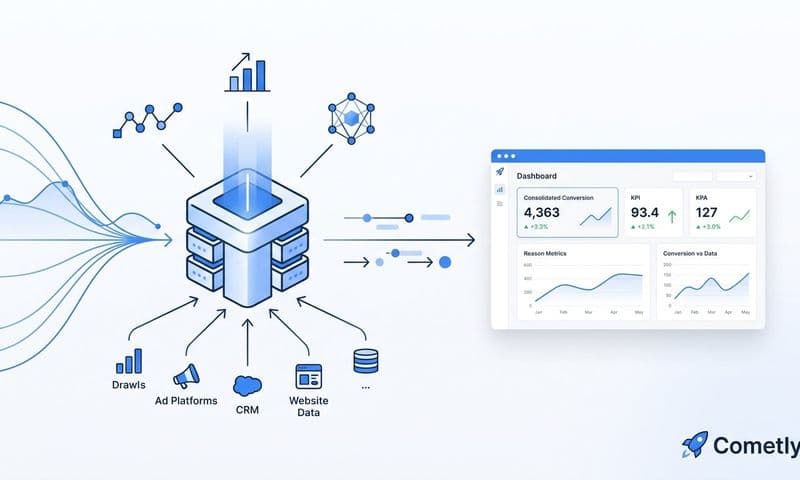
Step 2: Unify your data sources. Siloed dashboards are the enemy of data accuracy. When your ad platforms, website analytics, and CRM each live in their own ecosystem, you are always working with an incomplete picture. The goal is to connect these sources into a single attribution system where every touchpoint feeds into one source of truth. Reviewing the ultimate guide to B2B marketing analytics can help teams understand how to structure this unified approach. This means integrating your CRM with your ad platforms, ensuring your website tracking feeds into the same system, and establishing a consistent data model that can connect an ad click to a closed deal even when weeks or months separate the two events.
Step 3: Establish a conversion feedback loop. This is where data accuracy starts to pay dividends beyond just better reporting. When enriched conversion data, meaning actual revenue events from your CRM rather than just form fills or trial signups, flows back to your ad platforms through conversion sync or API integrations, those platforms can optimize their algorithms toward your real business outcomes. Instead of optimizing for the cheapest lead, Meta and Google start optimizing for the signals that actually correlate with closed deals. This feedback loop improves targeting quality over time and reduces spend on audiences that generate activity but not revenue.
Step 4: Standardize your measurement practices. Implement consistent UTM naming conventions across every campaign, every team member, and every agency partner. Document your attribution model choices and the reasoning behind them. Following proven SaaS marketing attribution best practices ensures your team maintains consistency over time. Establish regular data reconciliation reviews where platform metrics are compared against CRM outcomes. Build these practices into your team's workflow so that data hygiene is maintained as a habit rather than addressed reactively when something looks off.
This framework is not a one-time project. It is an ongoing operational discipline. The payoff is a marketing function that can speak to leadership with confidence, make budget decisions backed by revenue data, and continuously improve based on accurate feedback.
From Accurate Data to Decisions That Actually Scale
Here is what changes when your data is accurate. You stop debating which dashboard to trust and start making decisions. Budget reallocation conversations shift from "I think this channel is working" to "here is the revenue data that shows it." Campaigns that look strong on surface metrics but do not contribute to pipeline get cut. Campaigns that consistently appear in closed-won customer journeys get scaled. The entire decision-making process becomes faster, cleaner, and more defensible.
Accurate data also unlocks the real potential of AI-powered marketing tools. AI recommendations are only as good as the data they are trained on. When you feed an AI system noisy, incomplete, or fragmented data, its recommendations reflect those flaws. But when the underlying data accurately captures the full customer journey and connects it to revenue outcomes, AI can surface genuinely useful insights: which ad creative is driving high-quality pipeline, which audiences are converting at the best rates, and where budget reallocation would have the greatest impact.
This is where platforms like Cometly create real leverage for B2B SaaS teams. By capturing every touchpoint from ad click to CRM event, connecting that data across platforms, and surfacing AI-driven recommendations on top of accurate attribution, Cometly helps marketing teams move from reactive reporting to proactive optimization. You can identify which ads and campaigns are performing across every channel, get actionable recommendations, and scale with confidence rather than guesswork.
Beyond the operational benefits, accurate marketing data changes the relationship between marketing and leadership. When marketing can show a clear line from spend to pipeline to closed revenue, the conversation shifts from defending budgets to planning growth. Understanding why marketing data accuracy matters for ROI helps teams articulate this value to stakeholders. That credibility is hard to build and easy to lose when data is unreliable. Getting the data right is not just a technical improvement. It is a strategic investment in the team's ability to operate at the highest level.
The Bottom Line on B2B SaaS Marketing Data Accuracy
B2B SaaS marketing data accuracy is not a nice-to-have feature of a mature analytics setup. It is a foundational requirement for effective growth. Without it, every budget decision, every optimization, and every forecast is built on uncertain ground.
The path to better data accuracy runs through several interconnected improvements: closing tracking gaps with server-side solutions that capture what browser pixels miss, adopting multi-touch attribution models that reflect the complexity of real B2B buyer journeys, connecting ad platform data to CRM outcomes so that performance is measured in revenue rather than proxy metrics, and feeding enriched conversion data back to ad algorithms so they optimize toward what actually matters.
None of these steps are simple, but each one meaningfully improves the quality of the signals your team is working with. And better signals lead to better decisions, which compound into better results over time.
If you are ready to stop guessing and start making marketing decisions backed by accurate, complete revenue data, Cometly is built for exactly this. From server-side tracking to multi-touch attribution to AI-powered optimization recommendations, Cometly gives B2B SaaS teams the tools to capture every touchpoint, connect it to revenue, and act with confidence. Get your free demo today and see what your marketing data looks like when it actually tells the truth.