You've spent months building a pipeline. A prospect clicked your LinkedIn ad back in January, showed up to your webinar in February, downloaded your whitepaper in March, and finally closed in April after a product demo and three sales calls. Your last-click attribution model? It's giving all the credit to the demo request page.
This is the quiet frustration running through most B2B SaaS marketing teams. The sales cycle is long, the buyer journey is complex, and the tools most teams rely on to measure success were built for a fundamentally different kind of purchase. When a deal takes three to six months and involves multiple decision-makers, paid ads, organic content, email sequences, webinars, and live sales conversations, a single-touch model doesn't just underreport your impact. It actively misleads your budget decisions.
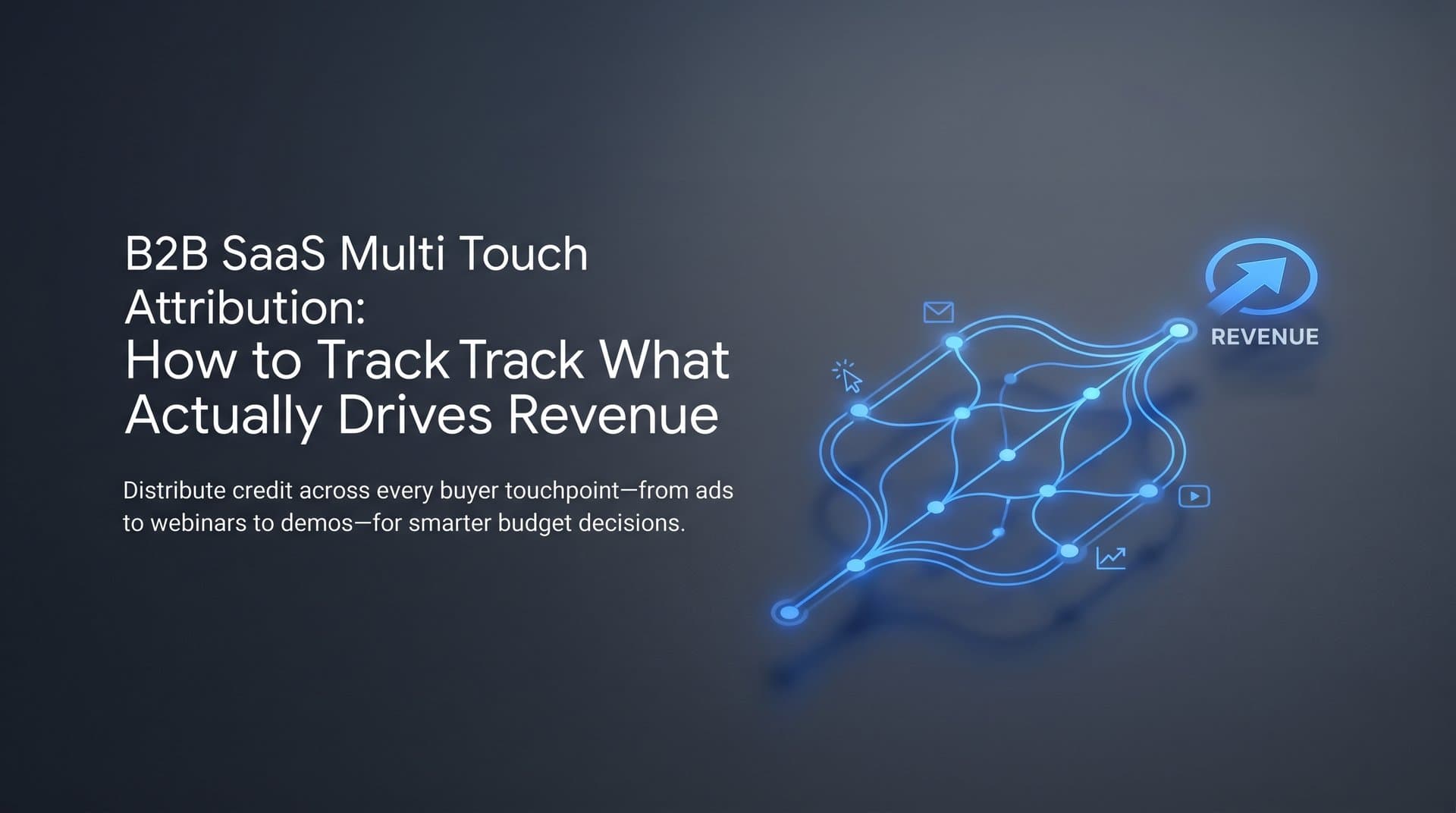
Multi-touch attribution is the framework designed to solve this. Instead of handing credit to one arbitrary interaction, it distributes recognition across every touchpoint that shaped the buyer's journey. Done well, it gives marketing teams a clear view of which channels, campaigns, and content pieces are genuinely moving deals forward, and which ones are consuming budget without contributing to pipeline.
This article breaks down how B2B SaaS multi-touch attribution works, which models are most relevant to your buying cycle, what data infrastructure you actually need to make it function, and how to turn attribution insights into smarter spending decisions. Let's get into it.
Why B2B SaaS Buying Journeys Break Traditional Attribution
B2B SaaS deals are not impulse purchases. They involve procurement teams, technical evaluators, finance sign-offs, and executive stakeholders, all moving at different speeds and consuming different types of content along the way. A single deal might touch your brand dozens of times across LinkedIn, Google Search, your blog, a third-party review site, a webinar, a sales email sequence, and a live demo before a contract is signed.
This is fundamentally different from e-commerce or B2C attribution, where a customer might discover a product, consider it briefly, and purchase within hours or days. In those contexts, first-click or last-click attribution is imperfect but workable. The journey is short enough that one interaction often does carry disproportionate weight.
In B2B SaaS, that logic collapses completely. First-click attribution rewards whatever channel introduced the prospect, which is often a broad awareness campaign that never would have closed the deal alone. Last-click attribution rewards whatever happened right before the conversion event, which is frequently a branded search or a direct visit that reflects intent already built up over months of prior engagement. Understanding the difference between single source and multi-touch attribution is critical for teams ready to move beyond these limitations.
The consequences of relying on these models are real. Teams cut budget from channels that consistently influence deals in the middle of the funnel because those channels never "get credit" in a single-touch world. They over-invest in channels that appear at the end of journeys simply because they're visible at conversion time. Over time, this creates a compounding misallocation problem where the budget drifts away from what works and toward what looks good in a flawed report.
There's also the stakeholder complexity to consider. In many B2B SaaS deals, different people within the same buying organization interact with your brand in different ways. The end user might discover you through a LinkedIn post. The IT lead might find you through a Google search. The CFO might read a case study forwarded by the sales rep. Single-touch models can't capture this organizational dimension at all. They track one person's journey, not the full account-level picture.
This is why multi-touch attribution isn't a nice-to-have for B2B SaaS teams. It's the minimum viable framework for understanding how marketing actually contributes to revenue in an environment where the path from awareness to closed deal is long, nonlinear, and involves many hands.
How Attribution Models Distribute Credit Across the Buyer Journey
Not all multi-touch attribution models work the same way, and choosing the right one depends on what strategic question you're trying to answer. Here's a clear breakdown of the models most relevant to B2B SaaS and when each one makes sense.
Linear Attribution: Every touchpoint in the journey receives equal credit. If a deal had ten interactions, each one gets ten percent of the revenue credit. This model is simple, fair in a broad sense, and easy to explain to stakeholders. It's a good starting point if you're moving away from single-touch models and want to understand the full range of channels involved in your deals. The downside is that it treats a casual blog visit the same as a demo request, which doesn't reflect how buyers actually behave.
Time-Decay Attribution: Touchpoints closer to the conversion event receive more credit, with earlier interactions receiving progressively less. This model reflects the intuition that a prospect who requested a demo yesterday was more "ready to buy" than someone who clicked an ad four months ago. It's useful when you want to optimize for closing velocity and understand what's accelerating deals in their final stages. The risk is that it systematically undervalues awareness-stage marketing, which can lead to under-investment in top-of-funnel channels over time.
U-Shaped (Position-Based) Attribution: This model assigns heavier credit to the first touch and the lead creation event, typically splitting around forty percent each, with the remaining twenty percent distributed across middle-of-funnel interactions. For a deeper dive into how these frameworks compare, explore our guide on multi-touch attribution models and when each one applies.
W-Shaped Attribution: W-shaped models add a third major credit point: opportunity creation. This is particularly meaningful in B2B SaaS, where moving a lead to a sales-qualified opportunity is a critical and distinct milestone. The model typically distributes significant credit to first touch, lead creation, and opportunity creation, with the remainder spread across other interactions. For teams managing pipeline and working closely with sales, W-shaped attribution provides a more complete view of marketing's influence across the funnel.
Full-Path Attribution: This model extends W-shaped attribution by adding a fourth credit point at the customer close stage. It's the most comprehensive model and the most demanding in terms of data requirements. Full-path attribution is ideal for mature SaaS marketing teams with clean CRM data and a clear view of their entire pipeline. It gives you the most complete picture of which touchpoints influenced deals from first contact to closed revenue.
The trade-off across all of these models is consistent: simpler models are easier to implement and explain but sacrifice nuance. More sophisticated models reveal deeper insights about pipeline influence but require better data infrastructure and more organizational alignment to act on. The right starting point is usually the model that answers your most pressing strategic question, not the most complex one available.
The Data Foundation You Need Before Anything Else
Here's the uncomfortable truth about multi-touch attribution: the model itself is almost secondary to the quality of your data. A sophisticated W-shaped model built on incomplete or fragmented data will produce misleading results. A simpler linear model built on clean, connected data will outperform it every time.
For B2B SaaS attribution to work, you need to connect several distinct data sources into a unified tracking layer. Your ad platforms (Google, Meta, LinkedIn, and others) need to be integrated so that campaign-level and ad-level data flows into your attribution system. Your CRM needs to be connected so that lead records, opportunity stages, and closed deals can be tied back to the marketing touchpoints that preceded them. Teams that need help with tracking conversions across multiple ad platforms should prioritize this integration early in their setup process.
Without this integration, you end up with attribution that's based on whatever data happens to be available, which is rarely the full picture. The most common gap is the disconnect between ad platform data and CRM pipeline data. Many teams can see which ads drove clicks and form fills, but they can't trace which of those form fills became qualified opportunities, and which opportunities became revenue. That gap makes it impossible to understand true marketing ROI.
Server-side tracking has become an increasingly critical part of solving this problem. Browser privacy changes, iOS App Tracking Transparency restrictions, and the gradual deprecation of third-party cookies have significantly degraded the accuracy of client-side tracking. When a pixel fires in a user's browser, it's subject to ad blockers, browser restrictions, and privacy settings that can prevent the data from being captured at all. Server-side tracking moves that data collection to your own server environment, where it's far less susceptible to these limitations and produces more complete, accurate conversion data.
Conversion syncing is the other piece of the puzzle. Once you have clean, enriched conversion data, you can send it back to the ad platforms so their machine learning algorithms can optimize toward the outcomes that actually matter to your business. When Meta or Google receives better quality conversion signals, they can improve targeting, reduce wasted impressions, and surface your ads to prospects who are more likely to convert into real pipeline. This creates a compounding benefit over time: better data leads to better algorithmic optimization, which leads to better results, which generates better data.
Platforms like Cometly are built specifically to address this data foundation challenge. By connecting ad platforms, CRMs, and websites into a single attribution layer with server-side tracking and conversion syncing built in, Cometly gives B2B SaaS teams the data infrastructure they need to make multi-touch attribution actually work, rather than just theoretically sound.
Mapping the Full B2B SaaS Customer Journey
To make multi-touch attribution concrete, it helps to walk through what a realistic B2B SaaS buyer journey actually looks like and how attribution captures it.
Imagine a prospect at a mid-sized software company. In week one, they click a LinkedIn ad promoting a thought leadership article about scaling engineering teams. They read the article, spend four minutes on the page, and leave. No conversion. Two weeks later, they see a retargeting ad for an upcoming webinar on the same topic and register. They attend the webinar, which is tracked as an event in your marketing automation system. A week after that, they download a whitepaper from your resource library using their work email address. That download creates a lead record in your CRM.
Over the next three weeks, they receive a nurture email sequence. They open two emails and click through to a product comparison page. Then they request a demo. The demo happens, a sales opportunity is created, and after two follow-up calls and a security review, the deal closes two months later.
In a last-click model, the demo request page gets all the credit. In a first-click model, the LinkedIn ad gets all the credit. In a W-shaped multi-touch model, meaningful credit flows to the LinkedIn ad (first touch), the whitepaper download (lead creation), and the demo request (opportunity creation), with the remaining credit distributed across the webinar, email clicks, and product page visits.
This matters because it tells you something different about each channel's role. The LinkedIn ad was essential for awareness. The webinar built credibility and kept the prospect engaged. The whitepaper converted an anonymous visitor into a known lead. The email nurture maintained momentum. Effective tracking customers across multiple touchpoints is what makes this level of insight possible.
Touchpoint categorization helps formalize this thinking. Awareness-stage touches introduce your brand and generate initial interest. Consideration-stage touches educate, build trust, and move the prospect toward evaluation. Decision-stage touches facilitate the final steps toward purchase. Weighting attribution credit by stage helps ensure that your model reflects the strategic value of each phase of marketing, not just its proximity to the conversion event.
One of the hardest technical challenges in mapping these journeys is identity resolution across devices and sessions. A prospect might click your LinkedIn ad on their phone, attend your webinar on their laptop, and fill out a demo request form on their work desktop. Without a way to stitch those sessions together, they look like three separate users. CRM integration and email-based identity matching are the most reliable ways to connect fragmented touchpoints into a single customer record, which is why CRM connectivity is non-negotiable in a serious B2B SaaS attribution setup.
Turning Attribution Insights Into Smarter Budget Decisions
Attribution data is only valuable if it changes how you allocate resources. The goal isn't to produce a more sophisticated report. It's to make better decisions about where to invest your marketing budget.
Once you have multi-touch attribution running across your full funnel, you can start asking questions that were previously unanswerable. Which channels consistently appear in deals that close fastest? Which content types show up most often in the consideration stage of high-value opportunities? Are there specific ad-to-content sequences that reliably move prospects from awareness to lead creation? These patterns exist in your data, but they're invisible without attribution that spans the entire journey. Investing in the right revenue attribution for B2B SaaS setup is what unlocks these answers.
This is where AI-powered analysis becomes genuinely useful. Manual reporting can surface broad trends, but it struggles to identify the nuanced sequences and combinations that drive deal velocity. AI can analyze patterns across hundreds or thousands of customer journeys simultaneously, surfacing insights like "prospects who attend a webinar within two weeks of their first ad click convert to opportunities at a significantly higher rate" or "LinkedIn-sourced leads that engage with three or more blog posts before requesting a demo have a higher average contract value." These are the kinds of insights that reshape budget strategy in meaningful ways.
The feedback loop is the final piece. When attribution data reveals which campaigns and channels are generating real pipeline influence, you can use that information to send better conversion signals back to your ad platforms. Instead of optimizing toward form fills or page views, you're optimizing toward the conversion events that actually predict revenue. This improves ad platform targeting over time, reduces wasted spend on low-intent audiences, and compounds the effectiveness of your campaigns as the algorithms learn from higher-quality signals.
Budget reallocation based on attribution insights should be iterative, not reactive. Small, deliberate shifts based on consistent patterns are more reliable than dramatic pivots based on a single month of data. The goal is to build a feedback loop where attribution data continuously informs spending decisions, which generates better data, which improves future decisions.
Common Pitfalls That Undermine B2B SaaS Attribution
Even teams that invest in multi-touch attribution often undermine their own results by making a handful of predictable mistakes. Knowing what these are upfront can save months of frustration.
Trusting platform-reported data without cross-referencing: Every major ad platform has an incentive to claim as much credit as possible for conversions. Meta, Google, and LinkedIn each apply their own attribution windows and counting methodologies, which means if you add up the conversions each platform reports, the total will almost certainly exceed your actual conversion count. Understanding why attribution data doesn't match across platforms is essential for building trust in your numbers.
Ignoring offline and CRM-based touchpoints: Multi-touch attribution that only captures digital interactions is still incomplete for most B2B SaaS deals. Sales calls, demos, in-person events, and direct outreach from SDRs all influence buying decisions. If these touchpoints aren't logged in your CRM and connected to your attribution layer, you're building a model with significant blind spots.
Choosing a model without a clear strategic question: Attribution models are tools, not answers. Before selecting a model, define what you're trying to understand. Are you trying to optimize lead generation? Pipeline creation? Deal velocity? Close rates? Different questions call for different models, and using the wrong one will produce insights that are technically accurate but strategically irrelevant.
Treating attribution as a one-time setup: Buyer behavior changes. New channels emerge. Campaign strategies evolve. An attribution model that was well-calibrated twelve months ago may no longer reflect how your buyers actually move through the funnel today. Reviewing common SaaS marketing attribution challenges periodically helps teams stay ahead of these shifts and recalibrate accordingly.
Letting perfect be the enemy of good: Many teams delay implementing attribution because they're waiting for perfect data, perfect CRM hygiene, or a perfect technical setup. A good attribution model that's implemented and acted on will generate far more value than a theoretically perfect model that's still being designed six months from now. Start with the data you have, identify the gaps, and improve incrementally.
Putting It All Together: Attribution as a Revenue Strategy
B2B SaaS multi-touch attribution isn't a reporting upgrade. It's a fundamental shift in how your marketing team understands and communicates its impact on revenue. When you can see every touchpoint that shaped a deal, you stop guessing about what works and start making decisions grounded in actual buyer behavior.
The combination of connected data, the right attribution model, and AI-powered analysis gives SaaS marketing teams the clarity to scale with confidence. You know which channels to invest in at each stage of the funnel. You know which content sequences accelerate deal velocity. You know how to feed better signals to your ad platforms so their algorithms work harder for you. And you know how to have credible conversations with leadership about marketing's contribution to pipeline and revenue.
This is exactly the challenge Cometly is built to solve. Cometly connects your ad platforms, CRM, and website into a unified attribution layer with server-side tracking, multi-touch attribution modeling, and conversion syncing built in. It captures every touchpoint from the first ad click to the closed deal, surfaces AI-powered insights about what's driving revenue, and feeds enriched conversion data back to Meta, Google, and other platforms to improve algorithmic targeting over time.
If your team is running complex B2B campaigns and you're ready to move beyond single-touch models and platform-reported data, Cometly gives you the infrastructure to do it right. Get your free demo today and start capturing every touchpoint to maximize your conversions.