You've spent thousands on paid ads across Google, Meta, and LinkedIn. Leads are coming in, campaigns are running, and the dashboards look busy. But then your VP of Sales asks a simple question: "Which campaigns are actually driving closed deals?" And suddenly, the data falls apart.
This is the defining frustration of B2B SaaS marketing. Unlike ecommerce, where someone clicks an ad and buys within minutes, B2B SaaS deals unfold over weeks or months. They involve multiple stakeholders, a dozen touchpoints, and a buyer journey that weaves through paid ads, organic search, sales calls, webinars, and word of mouth before anyone signs a contract. Traditional ad tracking was never built for this.
The result? Marketers are forced to make budget decisions based on incomplete, conflicting, or outright misleading data. They optimize for metrics that feel meaningful but don't connect to revenue. They scale campaigns that generate leads but not pipeline. And they struggle to prove ROI to leadership in any credible way.
This article is a practical guide to understanding B2B SaaS paid ads attribution: why it breaks down, which models actually work, what technical infrastructure you need, and how to build a system that connects your ad spend to real revenue outcomes. Let's get into it.
Why B2B SaaS Sales Cycles Break Traditional Ad Tracking
Ad platforms like Google and Meta were designed with a specific buyer in mind: someone who sees an ad, clicks, and converts within a short window. Their default attribution windows reflect this assumption. But B2B SaaS buyers don't behave this way, and the mismatch creates serious problems for marketers trying to measure what's working.
Think about a typical B2B SaaS buyer journey. A VP of Operations sees a LinkedIn ad for your product, clicks through, reads a blog post, and leaves. Two weeks later, they Google your brand name, watch a demo video, and download a case study. A month after that, they attend your webinar and finally request a demo. At that point, three or four people from their company are involved in the evaluation. The deal closes four months after that first ad click.
Which channel gets credit? According to LinkedIn's attribution, it's LinkedIn. According to Google's last-click attribution, it's the branded search. According to your form fill data, it's the webinar. Each platform tells a different story, and none of them are fully right. Understanding these SaaS marketing attribution challenges is the first step toward solving them.
This is the "dark funnel" problem. A significant portion of the B2B buyer journey happens in spaces that are difficult or impossible to track directly: private Slack communities, peer conversations, review sites, and offline touchpoints. Prospects research your product long before they ever raise their hand, and by the time they convert, the ad that first introduced them to your brand is buried under months of other interactions.
Self-reported attribution, the classic "how did you hear about us?" question on your demo request form, adds another layer of confusion. Buyers often don't remember which specific ad or channel first reached them. They might say "Google" when they mean they searched your brand name after seeing a LinkedIn ad. Or they say "a colleague recommended you" without mentioning that the colleague first heard about you through a retargeting campaign.
The result is that platform-reported data and self-reported data almost always tell different stories. Marketers end up with multiple competing versions of the truth and no reliable way to reconcile them. Building a real attribution system starts with acknowledging this gap and designing infrastructure that can bridge it.
Attribution Models That Actually Work for B2B SaaS Paid Ads
Not all attribution models are created equal, and in B2B SaaS, the model you choose has a direct impact on which campaigns you scale and which ones you cut. Understanding the trade-offs is essential before you build any attribution system.
First-Touch Attribution: Gives 100% of the credit to the first interaction a prospect had with your brand. This is useful for understanding which channels are best at generating awareness and bringing new prospects into your funnel. The limitation is that it completely ignores everything that happened between that first touch and the eventual conversion, which in a long B2B sales cycle is a lot.
Last-Touch Attribution: Gives all the credit to the final touchpoint before conversion. This tends to favor bottom-of-funnel channels like branded search or direct traffic, since those are often the last stop before a prospect fills out a demo form. It's easy to implement but systematically undervalues the awareness and nurture channels that moved the prospect through the funnel in the first place.
Linear Attribution: Distributes credit equally across every touchpoint in the buyer journey. This is more balanced than single-touch models and gives marketers a clearer picture of which channels are consistently present throughout the journey. The downside is that it treats a quick homepage visit the same as a 30-minute product demo, which doesn't reflect the actual influence of each interaction.
Time-Decay Attribution: Gives more credit to touchpoints that happened closer to the conversion event. This makes intuitive sense in some contexts, but in B2B SaaS it can undervalue the awareness campaigns that first brought a prospect into your ecosystem, even if those campaigns happened months before the deal closed.
Position-Based (U-Shaped) Attribution: Assigns more credit to the first and last touchpoints and distributes the remainder across the middle interactions. This is a popular choice for B2B SaaS because it acknowledges both the channel that generated awareness and the channel that drove the final conversion, while still giving some credit to the nurture touchpoints in between. For a deeper dive into how these models compare, explore which attribution model approach is mainly used in modern marketing.
Multi-touch attribution (MTA) is generally the most valuable approach for B2B SaaS paid ads attribution because it captures the complexity of long buyer journeys rather than forcing the entire credit onto a single interaction. By distributing credit across the full journey, MTA gives marketers visibility into how paid ads contribute at every stage, from initial awareness through to closed-won revenue.
The practical trade-off is real: simpler models are easier to set up and explain to stakeholders, but they hide critical insights about which channels are actually influencing pipeline. Multi-touch models require more data infrastructure, specifically CRM integration and cross-channel tracking, but they reveal the true contribution of each paid channel in a way that single-touch models simply cannot.
Connecting Paid Ad Clicks to CRM Revenue: The Technical Foundation
Understanding attribution models is one thing. Actually implementing a system that connects ad clicks to closed deals is where most B2B SaaS teams run into trouble. The technical foundation matters enormously, and cutting corners here means your attribution data will always be incomplete.
The starting point is server-side tracking. Traditional pixel-based tracking, where a JavaScript snippet fires in the browser when someone takes an action, has become increasingly unreliable. Browser privacy settings, ad blockers, and the ripple effects of Apple's App Tracking Transparency changes have all degraded the accuracy of client-side data collection. Understanding how to handle tracking paid ads after the iOS update is essential for maintaining data accuracy in this environment.
UTM parameter discipline is equally critical. Every paid ad campaign, ad set, and individual ad needs consistent, structured UTM parameters so you can trace clicks back to their source across your CRM and analytics tools. Without this, you end up with a flood of traffic labeled "direct" or "unknown" in your data, and there's no way to connect those sessions to the ad that drove them. Understanding the difference between UTM tracking vs attribution software helps you decide what level of infrastructure your team needs.
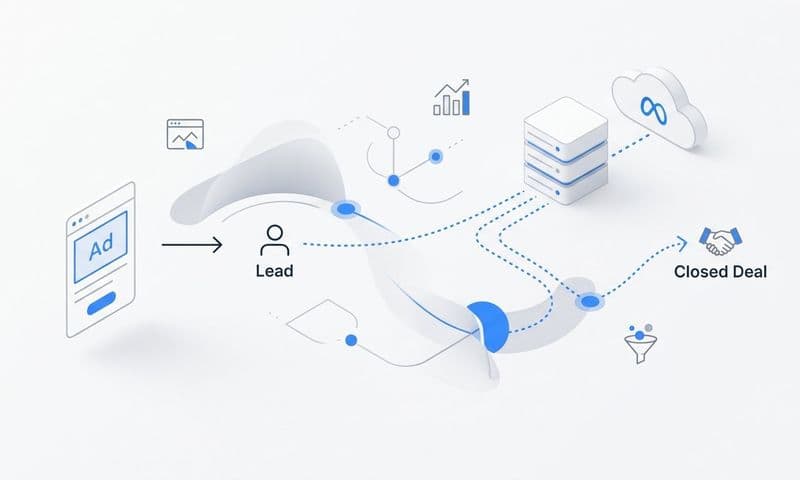
CRM integration is the backbone of the whole system. Connecting your ad platform data to your CRM is what allows you to move beyond top-of-funnel metrics and see how paid ad clicks translate into pipeline stages, deal values, and closed revenue. When a prospect who clicked your LinkedIn ad eventually becomes a qualified opportunity and then a closed deal, that connection needs to be traceable all the way back to the original ad interaction.
Conversion sync takes this a step further. Rather than just using CRM data internally, conversion sync sends enriched conversion events back to ad platforms like Meta and Google. This is valuable for two reasons. First, it gives the platforms more accurate signal about which clicks actually led to meaningful business outcomes, not just form fills. Second, it allows their algorithms to optimize toward the prospects who look like your actual buyers, improving targeting quality over time. Many B2B SaaS marketers find that feeding better conversion data back to ad platforms noticeably improves the quality of traffic those platforms deliver.
The goal of this technical layer is to create an unbroken chain of data from the first ad impression through to closed revenue. Without it, you're making budget decisions based on the top of the funnel and hoping the rest works out. With it, you can see exactly which campaigns are generating pipeline and which ones are generating noise.
Common Attribution Pitfalls That Waste B2B SaaS Ad Budgets
Even marketers who understand attribution conceptually often fall into traps that quietly drain their budgets. These are the most common mistakes that B2B SaaS teams make when trying to measure paid ad performance.
Trusting Platform-Reported Conversions at Face Value: Google, Meta, and LinkedIn each use their own attribution windows and counting methodologies. When you look at each platform's reported conversions individually and add them up, the total almost always exceeds your actual number of conversions. This happens because all three platforms may claim credit for the same deal, using overlapping attribution windows. Relying on platform-reported ROAS without a unified view leads to inflated performance numbers and poor budget decisions.
Optimizing for the Wrong Metrics: Cost per lead is a seductive metric because it's easy to measure and easy to reduce. But in B2B SaaS, a low cost per lead often signals that you're attracting the wrong audience. Many teams discover, once they connect their ad data to CRM outcomes, that their highest-volume lead sources are generating the lowest-quality pipeline. Optimizing for cost per qualified opportunity or cost per closed deal tells a completely different story about which campaigns deserve more budget. Investing in proper tracking paid ads performance helps you move beyond vanity metrics to revenue-focused measurement.
Living With Data Silos: This is perhaps the most pervasive problem in B2B SaaS marketing operations. Ad performance data lives in the ad platforms. Website analytics sits in a separate tool. Sales data stays locked in the CRM. Marketing automation data is in yet another system. When these data sources don't talk to each other, it's impossible to build a unified picture of how paid ads contribute to revenue. Marketers end up making decisions based on fragments of the story rather than the whole.
The common thread across all of these pitfalls is a lack of connected data. Each mistake becomes easier to avoid when you have a system that pulls ad spend, conversion events, pipeline data, and revenue into a single, coherent view. Without that foundation, even experienced marketers are flying partially blind.
Building a Paid Ads Attribution System That Scales With Your SaaS
Knowing what you need is one thing. Building it in a way that actually scales with your business is another. Here's a practical approach to standing up a B2B SaaS paid ads attribution system that grows with you.
Step 1: Start with UTM tracking and CRM integration. Before you add any complexity, make sure the basics are airtight. Every paid campaign should have consistent UTM parameters, and those parameters should flow into your CRM so that every lead and deal has a traceable source. This alone gives you more visibility than most B2B SaaS teams have. It's the foundation everything else is built on. For a comprehensive overview of how to approach this, review SaaS marketing attribution best practices before you begin implementation.
Step 2: Layer in server-side tracking. Once your UTM and CRM foundation is solid, implement server-side tracking to capture the conversion events that browser-based pixels miss. This is especially important if you're running significant spend on Meta, where iOS privacy changes have had the most impact on pixel accuracy. Server-side tracking ensures that your conversion data is as complete as possible before you start making attribution decisions based on it.
Step 3: Implement multi-touch attribution. With clean data flowing from your ad platforms through your website and into your CRM, you can now implement a multi-touch attribution model that distributes credit across the full buyer journey. This is where you start to see the real story: which channels are generating awareness, which are driving consideration, and which are closing deals.
Step 4: Use AI to surface insights at scale. As your data set grows, manually analyzing attribution data across multiple channels and campaigns becomes impractical. AI-powered tools can analyze attribution data at scale, identifying high-performing ads and campaigns across channels and surfacing optimization recommendations that would take hours to find manually. Rather than spending time in spreadsheets, marketers can focus on acting on insights rather than generating them.
Step 5: Feed better data back to the ad platforms. Set up conversion sync to send enriched conversion events back to Google, Meta, and LinkedIn. This creates a compounding advantage over time. As the platforms receive better signal about which clicks lead to actual revenue, their algorithms improve at targeting prospects who match your best customers. The longer this loop runs, the more efficient your paid acquisition becomes.
The key insight here is that attribution is not a one-time project. It's an ongoing system that gets more valuable as your data accumulates and your campaigns scale. Teams that invest in this infrastructure early build a durable competitive advantage in how efficiently they can acquire and retain customers.
Measuring What Matters: KPIs for B2B SaaS Ad Attribution
Once your attribution system is in place, the question becomes: what should you actually be measuring? The answer for B2B SaaS is very different from the metrics most ad platforms push you toward by default.
Attributed Pipeline Value: The total value of open opportunities that can be traced back to paid ad touchpoints. This tells you how much potential revenue your paid ads are generating, even before deals close. It's a leading indicator that connects marketing activity to sales outcomes.
Attributed Revenue: The closed-won revenue that can be traced back to paid ad touchpoints across the buyer journey. This is the ultimate measure of whether your paid ads are generating real business value, not just traffic or leads. Teams focused on revenue attribution for B2B SaaS companies consistently make better budget allocation decisions than those relying on top-of-funnel metrics alone.
Customer Acquisition Cost by Channel: How much you're spending in total, including ad spend and associated costs, to acquire a paying customer through each channel. This is more meaningful than cost per lead because it accounts for the quality and conversion rate of leads from each source. Understanding SaaS customer acquisition attribution helps you pinpoint exactly where your most profitable customers originate.
Payback Period by Campaign: How long it takes to recover the acquisition cost of customers brought in through specific campaigns. In B2B SaaS, where customer lifetime value is often high but upfront revenue is limited, understanding payback period helps you make smarter decisions about which campaigns to scale.
Blended vs. Isolated ROAS: Blended ROAS looks at total revenue divided by total ad spend across all channels, while isolated ROAS looks at each channel individually. Both are useful. Blended ROAS gives you a business-level health check, while isolated ROAS helps you compare channel efficiency.
Using attribution data to make budget allocation decisions is where this all comes together. When you can see which channels are driving the highest quality pipeline rather than just the highest volume of leads, you can shift spend with confidence rather than guesswork.
One often-overlooked practice is reviewing attribution data over longer time windows: 30, 60, and 90 days. Because B2B SaaS sales cycles are long, a campaign that looks underperforming at 30 days might be generating significant pipeline at 90 days. Real-time dashboards help you stay on top of trends without waiting for monthly reports, but you need to be intentional about the time windows you're analyzing to avoid drawing premature conclusions.
Putting It All Together
B2B SaaS paid ads attribution is not just a tracking exercise. It's a strategic capability that separates marketers who can scale with confidence from those who are guessing at what's working.
When you can connect ad spend to pipeline and closed revenue, everything changes. You stop optimizing for vanity metrics and start optimizing for outcomes that actually matter to the business. You can walk into budget conversations with data that leadership trusts. You can scale the campaigns that are generating real revenue and cut the ones that only look good on a dashboard.
The path to getting there is clear: start with clean UTM tracking and CRM integration, layer in server-side tracking for data accuracy, implement multi-touch attribution to see the full buyer journey, and use AI to surface insights and feed better data back to your ad platforms. None of these steps are trivial, but each one compounds the value of the others.
If you're evaluating your current attribution setup and wondering whether you have the visibility you need to make smart budget decisions, that's exactly the problem Cometly was built to solve. Cometly connects your ad platforms, CRM, and website data to track the full customer journey in real time. It provides multi-touch attribution across every channel, server-side tracking for data accuracy, conversion sync to improve your ad platform algorithms, and AI-powered optimization recommendations that help you scale what's working.
The marketers who invest in attribution infrastructure now will have a compounding advantage over those who don't. Your next dollar of ad spend should be informed by your last thousand. Get your free demo today and start connecting every touchpoint to the revenue that matters.