You run paid ads, publish content, send nurture emails, host webinars, and have your sales team following up with prospects for weeks. Then a deal finally closes, and your last-click attribution model hands all the credit to a single Google search ad the buyer clicked the day they booked a demo. Sound familiar?
This is the daily reality for B2B SaaS marketing teams. A prospect sees your LinkedIn ad on a Tuesday, reads a blog post that weekend, registers for a webinar two weeks later, gets a sales email on a Thursday, and finally books a demo a month after that first impression. The deal closes six weeks after the demo. So which touchpoint actually drove the revenue? The honest answer is: probably all of them, in different ways, at different moments.
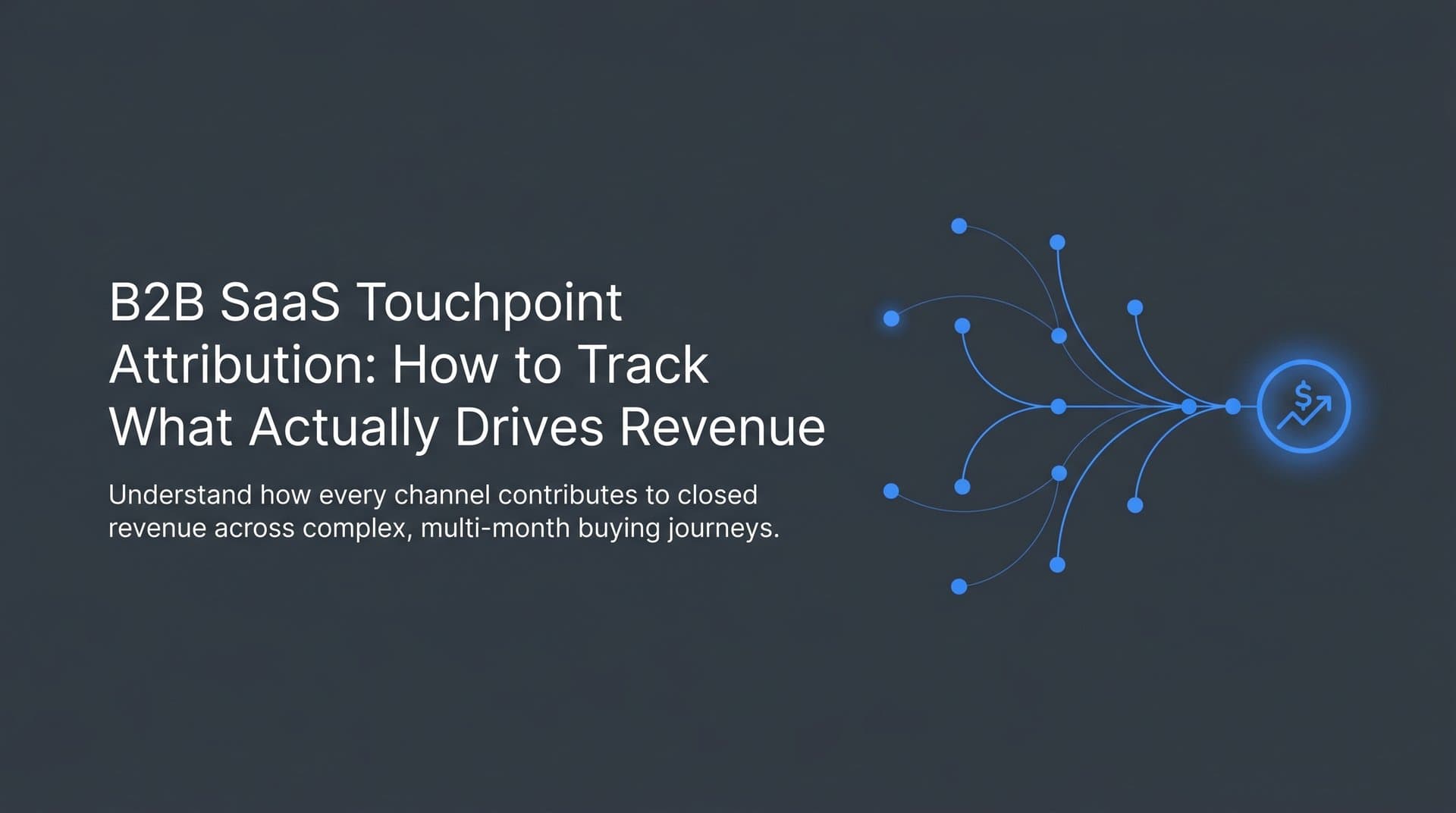
That question is exactly what B2B SaaS touchpoint attribution is designed to answer. It is the methodology that moves you beyond single-interaction credit and gives you a complete, accurate picture of how every channel and every interaction contributes to pipeline and closed revenue. Without it, you are making budget decisions based on incomplete data, often overfunding the last thing a buyer clicked and starving the channels that actually built the relationship.
This article walks through why traditional tracking breaks down for B2B SaaS, how to choose the right attribution model, how to map every touchpoint from first click to closed deal, how to feed better data back to your ad platforms, and how to avoid the common mistakes that undermine even well-intentioned attribution setups. By the end, you will have a clear framework for building an attribution practice that actually reflects how your buyers buy.
Why B2B SaaS Buyer Journeys Break Traditional Tracking
Traditional attribution was built for simple, fast transactions. Someone sees an ad, clicks it, buys a product. The journey is short, linear, and easy to track. B2B SaaS is none of those things.
Sales cycles in B2B SaaS often span weeks or months. Enterprise deals can take even longer. During that time, multiple stakeholders from the same company are researching your product independently, each interacting with different content across different channels. The marketing manager reads your blog. The VP of Engineering watches a product demo video. The CFO clicks a retargeting ad. A single-touch model cannot capture any of that complexity, which means it will inevitably mislead you about what is actually driving pipeline.
The typical B2B SaaS buyer journey weaves across paid ads, organic search, email nurture sequences, product trial experiences, sales calls, and direct outreach. Each of these channels plays a distinct role in moving a prospect forward. Awareness channels introduce your brand. Content channels build credibility and educate. Sales touchpoints convert interest into commitment. Treating any one of these as the sole driver of a deal misses the entire point of how B2B buying actually works.
Tracking gaps compound this problem in ways that are easy to overlook. When a prospect first discovers you on their phone during a commute and later converts on their work laptop, that is two separate device sessions that most tracking setups treat as two separate people. Teams that understand these SaaS marketing attribution challenges are better positioned to solve them before they corrupt their data.
These are not edge cases. They are the norm in B2B SaaS, and they are precisely why single-touch models are not just imperfect but fundamentally inadequate for understanding what drives your revenue. The solution is not to find a better single touchpoint to credit. It is to build a system that captures and connects every touchpoint across the entire journey.
Single-Touch vs. Multi-Touch: Choosing the Right Attribution Model
Before you can choose the right attribution model, it helps to understand why the popular defaults fall short and what the alternatives actually offer.
First-touch attribution gives 100% of the credit to the first interaction a prospect had with your brand. It is useful for understanding awareness and top-of-funnel performance, but it completely ignores everything that happened between that first impression and the eventual conversion. In a long B2B SaaS sales cycle, that is a lot of ignored work.
Last-touch attribution does the opposite: it credits the final interaction before conversion. This is the most common default in ad platforms, and it tends to make bottom-of-funnel channels look like heroes while everything that nurtured the prospect into a sales-ready state gets zero credit. For a deeper look at how these approaches compare, explore the difference between single source and multi-touch attribution models.
Multi-touch models distribute credit across multiple interactions, and each has a different logic that fits different business contexts.
Linear attribution splits credit equally across every touchpoint in the journey. It is simple and democratic, but it treats a casual blog visit the same as a demo booking, which may not reflect actual influence on the deal.
Time-decay attribution gives more credit to touchpoints that happened closer to the conversion. This makes intuitive sense for short sales cycles, but in a six-month B2B deal, it can undervalue the awareness and education touchpoints that built the foundation for the sale.
U-shaped attribution (also called position-based) heavily weights the first touch and the lead creation event, distributing the remaining credit across middle touchpoints. This is a strong fit for inbound-led SaaS businesses where the first impression and the moment someone raises their hand both carry significant weight.
W-shaped attribution adds a third heavily weighted point: the opportunity creation event. For sales-led SaaS teams where a qualified opportunity is a distinct and meaningful milestone, this model better reflects the journey from awareness to pipeline.
Data-driven attribution uses algorithms to assign credit based on actual patterns in your conversion data. It is the most sophisticated option and, when you have enough data, the most accurate. The tradeoff is that it requires significant conversion volume to produce reliable outputs and can be harder to explain to stakeholders.
Here is the practical insight that gets overlooked: you do not have to pick one model and commit to it forever. The most valuable approach is often to run multiple models side by side and look for channels that appear consistently across all of them. Dedicated multi-touch attribution tools make this kind of side-by-side comparison much easier to manage at scale.
For freemium SaaS businesses with high trial volume, data-driven or linear models often work well because there are enough conversion events to find patterns. For enterprise sales-led motions with longer cycles and fewer deals, W-shaped or custom models that weight specific milestones tend to give a more meaningful picture.
Mapping Every Touchpoint From First Click to Closed Deal
Knowing which models to use only matters if you are actually capturing the touchpoints those models will analyze. This is where most B2B SaaS teams have the biggest gaps, and it is where the real infrastructure work happens.
Think of your funnel in four stages, each with its own category of touchpoints. At the awareness stage, you have paid search ads, paid social ads, organic search visits, podcast mentions, and social media posts. At the consideration stage, prospects are engaging with webinars, case studies, product comparison pages, G2 reviews, and email nurture sequences. At the decision stage, they are booking demos, starting trials, attending sales calls, visiting pricing pages, and interacting with your sales team directly. Post-sale, you have onboarding interactions, customer success touchpoints, and expansion conversations that matter for understanding lifetime value.
Defining these categories is step one. Capturing them reliably is step two, and it requires getting a few technical foundations right.
UTM parameter discipline is non-negotiable. Every link in every campaign across every channel needs consistently structured UTM parameters so you can aggregate data cleanly. One team using "utm_source=linkedin" and another using "utm_source=LinkedIn" or "utm_source=li" creates fragmentation that makes your attribution data unreliable at the aggregate level. Understanding the nuances of UTM tracking vs attribution software can help you decide where manual tagging ends and automated tracking should begin.
Server-side tracking has become increasingly important as browser-based tracking faces limitations from ad blockers, iOS privacy changes, and the ongoing deprecation of third-party cookies. Server-side tracking sends event data directly from your server to ad platforms, bypassing browser-level restrictions that would otherwise drop that data. For B2B SaaS teams running significant ad spend, server-side tracking is no longer optional if you want accurate attribution.
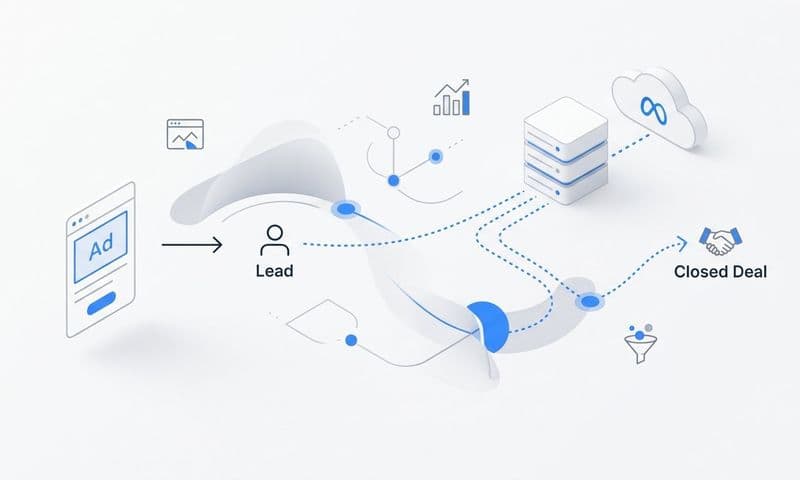
CRM integration is the bridge between your marketing data and your revenue data. When a prospect fills out a demo request form, that event needs to connect back to every marketing touchpoint they had before that moment. When a deal closes in your CRM, that closed-won event needs to flow back to your attribution system so you can trace it all the way to the original source. Without this integration, you are attributing to leads, not to revenue.
Event-based tracking that connects anonymous website visits to known contacts is what allows you to stitch together the pre-and-post-identification journey. A robust touchpoint attribution system handles this identity resolution automatically, turning fragmented data into a complete customer journey.
Offline touchpoints deserve attention too. A sales call, a conference conversation, or an event attendance should be logged in your CRM with enough context to connect it back to the original marketing touchpoint that started the journey. Without this, your attribution model will have a blind spot for some of the most influential moments in an enterprise deal.
Feeding Better Data Back to Your Ad Platforms
Here is where touchpoint attribution stops being just a reporting exercise and becomes an active growth lever.
Ad platforms like Meta and Google run on machine learning algorithms that optimize toward the conversion signals you give them. If you are only sending them form fill events or page view data, their algorithms will optimize for finding people who fill out forms or visit pages. That sounds reasonable until you realize that not everyone who fills out a form becomes a qualified lead, and not every qualified lead closes into revenue.
When you send enriched, downstream conversion data back to these platforms, specifically events like qualified lead created, opportunity opened, or deal closed, you are teaching their algorithms what your actual buyers look like. This is the foundation of effective revenue attribution for B2B SaaS companies, connecting marketing spend directly to closed deals rather than vanity metrics.
This is the concept behind conversion syncing, and it is one of the highest-leverage things a B2B SaaS marketing team can do with their attribution data. Instead of letting Meta optimize for "lead form submitted," you sync back a "qualified opportunity" event that only fires when a prospect meets your actual ICP criteria. The algorithm then starts finding more prospects who match that profile rather than just anyone willing to click a button.
Server-side event data makes this even more powerful. Because server-side tracking captures more complete data than browser-based tracking, the conversion signals you send back to ad platforms are richer and more accurate. Platforms receive better match rates, which means they can connect your conversion events to specific users more reliably, improving the quality of the optimization signal.
The feedback loop compounds over time in a meaningful way. Better conversion data leads to better algorithmic targeting. Better targeting brings in higher-quality leads. Higher-quality leads generate stronger, more reliable conversion signals to send back to the platform. Each cycle makes the next one more effective. Teams that invest in this feedback loop early tend to see their cost per qualified lead improve steadily as the algorithm learns, while teams that keep sending surface-level conversion data stay stuck optimizing for metrics that do not directly correlate with revenue.
This is why attribution is not just a finance or analytics function. It is a core part of your paid media strategy, and the quality of your SaaS marketing attribution tracking directly affects the efficiency of every dollar you spend on ads.
Common Attribution Pitfalls (and How to Avoid Them)
Even teams that understand attribution well often stumble in predictable ways. Here are the mistakes worth watching for.
Over-engineering your model too early. It is tempting to want a perfect, custom data-driven model from day one. In practice, building a sophisticated model before you have clean, consistent data is like building a house on sand. Start with a solid multi-touch foundation, such as U-shaped or W-shaped, get your tracking infrastructure right, and iterate from there. A simple model with clean data will outperform a complex model with messy data every time.
Neglecting data hygiene. Inconsistent UTM parameters are the most common culprit, but broken tracking pixels, disconnected CRM fields, and ad platform integrations that fall out of sync are equally damaging. Understanding why attribution data doesn't match across platforms is the first step toward fixing these discrepancies before they undermine your decision-making.
Treating attribution as a set-it-and-forget-it project. Your attribution setup is not a piece of infrastructure you configure once and then ignore. Buyer journeys evolve. New channels emerge. Your sales process changes. A webinar that was a major touchpoint in your funnel two years ago may now be irrelevant, while a new community channel might be driving significant awareness that your current setup is not capturing. Following established SaaS marketing attribution best practices includes building a quarterly review cadence into your team's workflow to audit your setup and update your model.
Siloing attribution from budget decisions. Attribution data is only valuable if it informs how you allocate spend. If your attribution model shows that organic content consistently appears in the journeys of your highest-value customers, but your budget planning still treats content as a cost center with no measurable return, you have an organizational problem, not just a data problem. Make sure your attribution outputs are connected to the people and processes that control budget.
Avoiding these pitfalls is less about having perfect technology and more about building disciplined habits around how your team collects, maintains, and acts on attribution data.
Putting Touchpoint Attribution Into Action for Your SaaS Team
Let's bring this together into a practical path forward.
The core principles are straightforward: connect all your data sources so your attribution system has a complete view of the customer journey. Use multi-touch models instead of single-touch defaults. Compare multiple models side by side to identify channels with consistent impact across different attribution lenses. And feed enriched conversion data back to your ad platforms so their algorithms can optimize for the outcomes that actually matter to your business.
The practical starting point is an audit. Before you choose a model or build a dashboard, take stock of where your data actually stands. Are your UTM parameters consistent across all campaigns? Is your CRM receiving marketing touchpoint data and passing conversion events back out? Is your website tracking capturing the full funnel, or are there gaps between anonymous visits and known contacts? Identifying your biggest data gaps before you build your attribution setup will save you significant rework later.
Once your tracking foundation is solid, choose an attribution model that fits your current sales motion. If you are sales-led with a defined opportunity stage, start with W-shaped. If you are product-led with high trial volume, start with linear or data-driven. Run it alongside first-touch and last-touch for comparison. Look for channels that consistently show up across models. Build a quarterly review into your team calendar.
This is exactly what Cometly is built to support. Cometly connects your ad platforms, CRM, and website data to track the full customer journey in real time, giving you a complete view of every touchpoint from first click to closed deal. Its multi-touch attribution capabilities let you compare models side by side so you can identify what is genuinely driving revenue rather than what happens to get the last click. Server-side tracking ensures your data is accurate even as browser-based tracking faces increasing limitations. And conversion syncing sends enriched event data back to Meta, Google, and other platforms so their algorithms can optimize for your actual buyers.
Beyond reporting, Cometly's AI surfaces recommendations based on your attribution data, helping you identify high-performing campaigns and scale what works with confidence rather than guesswork.
If your team is ready to move beyond last-click attribution and build a system that actually reflects how your buyers buy, the next step is seeing it in action. Get your free demo today and start capturing every touchpoint to maximize your conversions.