You're running ads on Meta, Google, TikTok, and maybe a few other platforms. Your dashboards show thousands of clicks, hundreds of conversions, and what looks like decent engagement. But when you sit down with your finance team to justify the marketing budget, something doesn't add up. The platforms say you're crushing it, but your actual revenue growth tells a different story. Which campaigns are actually generating customers? Which channels deserve more budget? You're spending confidently, but you're not entirely sure what's working.
This disconnect between ad platform metrics and real business outcomes is one of the most frustrating challenges modern marketers face. Campaign performance tracking—the systematic measurement of how your marketing efforts contribute to actual revenue across the entire customer journey—is the bridge between ad spend and business growth. It's not just about knowing how many people clicked your ad. It's about understanding which specific campaigns, ads, and touchpoints influence real customers to open their wallets.
By the end of this guide, you'll understand not just what metrics to track, but how to connect those data points to revenue outcomes. You'll learn how to build a tracking system that follows prospects from their first interaction with your brand all the way to closed deals, giving you the confidence to scale what works and cut what doesn't. Let's dig in.
Beyond Vanity Metrics: What Campaign Performance Tracking Really Means
Campaign performance tracking is the systematic measurement of how your marketing campaigns contribute to business outcomes across the entire customer journey. Notice the emphasis on "business outcomes" and "entire journey"—those distinctions matter more than most marketers realize.
Too many marketing teams celebrate metrics that look impressive but don't correlate with revenue. A thousand impressions sounds great until you realize none of those people visited your website. A hundred clicks feels like progress until you discover that zero of them converted. These surface-level metrics—impressions, reach, clicks, even engagement rates—are what we call vanity metrics. They measure activity, but they don't tell you whether that activity generated customers or revenue.
Real campaign performance tracking goes deeper. It connects your ad platforms to your website analytics and your CRM data to create a complete picture of what happens after someone sees your ad. Did they click? Did they visit multiple pages? Did they fill out a form? Did they become a customer? How much did they spend? Which other marketing touchpoints did they interact with before converting?
This is where modern tracking diverges from the old approach. Traditional marketing campaign tracking might tell you that your Facebook ad generated 50 conversions this week. But without connecting that data to your CRM, you don't know if those conversions became paying customers, how much revenue they generated, or whether they're worth the cost you paid to acquire them.
Modern campaign performance tracking requires three layers of integration. First, your ad platforms need to send data about who clicked your ads and when. Second, your website tracking needs to capture what those visitors do after they arrive—which pages they view, which forms they complete, which actions they take. Third, your CRM needs to feed back information about which leads became customers and how much revenue they generated.
When these three layers connect, you stop guessing and start knowing. You can trace a customer's journey from the first ad they saw, through every touchpoint they encountered, all the way to the revenue they generated for your business. That's the difference between tracking activity and tracking performance.
The Metrics That Actually Matter for Revenue Attribution
Not all metrics deserve equal attention. Understanding the hierarchy of campaign performance metrics helps you focus on what actually drives business decisions.
At the bottom of the hierarchy sit awareness metrics—impressions, reach, and frequency. These tell you how many people saw your ads and how often. They're useful for understanding the top of your funnel, but they don't tell you anything about business outcomes. You can reach a million people and generate zero revenue if your message doesn't resonate.
One level up are engagement metrics—clicks, click-through rates, video views, and post interactions. These indicate that people noticed your ads and took some action. They're more meaningful than awareness metrics, but they still don't connect to revenue. Someone can click your ad, watch your video, and never become a customer.
Conversion metrics sit higher in the hierarchy—form submissions, sign-ups, downloads, add-to-carts, and purchases. These represent actions that move prospects closer to becoming customers. But even here, you need to be careful. Not all conversions are created equal. A newsletter sign-up is a conversion, but it's not the same as a purchase.
At the top of the hierarchy are revenue metrics—the numbers that actually matter to your business. These are the metrics that connect your marketing spend directly to business growth.
Customer Acquisition Cost (CAC) tells you how much you spent to acquire each customer. Calculate it by dividing your total marketing spend by the number of customers acquired. If you spent $10,000 on ads this month and acquired 50 customers, your CAC is $200. This metric reveals whether your campaigns are efficient or whether you're overpaying for customers.
Return on Ad Spend (ROAS) measures how much revenue you generate for every dollar you spend on advertising. If you spend $1,000 on a campaign and it generates $5,000 in revenue, your ROAS is 5:1 or 500%. This metric shows whether your campaigns are profitable. A ROAS below your break-even point means you're losing money on every customer you acquire.
Customer Lifetime Value (LTV) estimates the total revenue a customer will generate over their entire relationship with your business. For subscription businesses, this might be monthly recurring revenue multiplied by average customer lifespan. For e-commerce, it might be average order value multiplied by average number of purchases. LTV matters because it tells you how much you can afford to spend to acquire a customer while remaining profitable.
The relationship between these three metrics determines your growth potential. If your LTV is $1,000 and your CAC is $200, you have $800 of margin to work with. You can afford to scale aggressively. But if your LTV is $300 and your CAC is $250, you're barely profitable. Scaling those campaigns would be risky.
Here's where tracking at the touchpoint level becomes crucial. Platform-level metrics tell you that Facebook generated 100 customers this month, but they don't tell you which specific campaigns, ad sets, or individual ads drove those conversions. Touchpoint-level tracking reveals that Campaign A generated 70 of those customers while Campaign B only generated 30. It shows that one specific ad creative outperformed all your others by 3x. It identifies which audiences convert at the highest rates and which placements waste your budget.
This granular insight changes how you optimize. Instead of making broad decisions like "increase Facebook budget by 20%," you make surgical decisions like "shift budget from Campaign B to Campaign A" or "pause the underperforming ad creative and scale the winner." That level of precision only comes from tracking performance at the individual touchpoint level and connecting those touchpoints to revenue outcomes.
Multi-Touch Attribution: Seeing the Full Customer Journey
Single-touch attribution is like watching only the first or last five minutes of a movie and trying to understand the plot. You're missing most of the story.
First-click attribution gives all the credit to whichever campaign first introduced someone to your brand. Last-click attribution gives all the credit to the final touchpoint before conversion. Both approaches drastically misrepresent how your campaigns actually contribute to conversions.
Think about how you actually buy things. You probably don't see one ad and immediately purchase. You see an ad, visit the website, leave, see another ad a few days later, read some reviews, come back through a Google search, sign up for an email list, receive a few emails, and eventually make a purchase. Which touchpoint "caused" the conversion? All of them played a role.
Multi-touch attribution distributes credit across all the touchpoints that influenced a conversion. Different attribution models distribute that credit in different ways, and understanding these models helps you interpret your campaign performance more accurately. For a deeper dive into this topic, explore our guide on campaign attribution tracking.
Linear attribution gives equal credit to every touchpoint in the customer journey. If someone interacted with five different campaigns before converting, each campaign receives 20% of the credit. This model recognizes that every touchpoint matters, but it doesn't account for the fact that some touchpoints might be more influential than others.
Time-decay attribution gives more credit to touchpoints closer to the conversion. The logic here is that recent interactions have more influence on the decision to buy than interactions from weeks ago. If someone saw your Facebook ad a month ago but converted after clicking a Google ad yesterday, the Google ad receives more credit. This model makes sense for products with shorter consideration periods.
Position-based attribution (also called U-shaped attribution) gives the most credit to the first and last touchpoints, with the remaining credit distributed among the middle touchpoints. Typically, 40% goes to the first touch, 40% to the last touch, and 20% is split among everything in between. The reasoning is that the first touchpoint creates awareness and the last touchpoint drives the decision, while middle touchpoints play a supporting role.
Data-driven attribution uses machine learning to analyze which touchpoints actually correlate with conversions in your specific business. Instead of applying a predetermined rule, it looks at your historical conversion data and identifies patterns. Maybe your Facebook ads are great at introducing new prospects but rarely drive direct conversions. Maybe your email campaigns consistently appear in the journeys of your highest-value customers. Data-driven attribution reveals these patterns.
Why does comparing attribution models matter? Because each model tells a different story about your campaign performance, and the truth usually lies somewhere in the middle.
Let's say you're running both top-of-funnel awareness campaigns and bottom-of-funnel conversion campaigns. Under last-click attribution, your conversion campaigns look incredibly effective while your awareness campaigns look worthless. But switch to first-click attribution, and suddenly your awareness campaigns look brilliant while your conversion campaigns appear to contribute nothing. Neither view is accurate.
By comparing multiple attribution models, you get a more nuanced understanding. You might discover that your Facebook campaigns excel at introducing new prospects (high first-click attribution) while your Google Search campaigns excel at capturing ready-to-buy prospects (high last-click attribution). Both are valuable, but they serve different purposes in your funnel. Without multi-touch attribution, you might cut the Facebook budget because it doesn't show strong last-click performance, even though it's essential for filling your pipeline.
The most sophisticated marketers don't rely on a single attribution model. They compare multiple models to understand how different campaigns contribute at different stages of the customer journey. This insight helps them build balanced marketing strategies that address every stage of the funnel, not just the final conversion moment.
Overcoming Modern Tracking Challenges
Campaign performance tracking would be straightforward if everyone used a single device, never cleared their cookies, and willingly shared their data with advertisers. Unfortunately, that's not the world we live in.
Modern marketers face a fragmented tracking landscape filled with blind spots. iOS privacy changes, cookie deprecation, cross-device behavior, and ad blockers all create gaps in your campaign data. Understanding these attribution challenges in marketing analytics helps you build more resilient tracking systems.
Apple's App Tracking Transparency framework, introduced with iOS 14.5, fundamentally changed how mobile tracking works. Now, apps must ask users for permission to track their activity across other apps and websites. Most users decline. This means that a significant portion of your iOS traffic is invisible to traditional pixel-based tracking. You might be running successful campaigns that drive conversions, but your ad platforms can't see those conversions because the users opted out of tracking.
Cookie deprecation compounds the problem. Third-party cookies—the technology that allowed advertisers to track users across different websites—are being phased out across major browsers. Chrome, the last major holdout, has committed to eliminating third-party cookies. This makes it harder to track users who visit your website, leave, and return later through a different channel.
Cross-device tracking adds another layer of complexity. Someone might see your ad on their phone during their morning commute, research your product on their work computer during lunch, and make a purchase on their tablet that evening. Traditional tracking treats these as three different people, not one customer journey. Without cross-device tracking, you're missing connections between touchpoints.
Server-side tracking offers a more reliable alternative to browser-based pixels. Instead of relying on cookies and pixels that users can block or delete, server-side tracking sends conversion data directly from your server to your analytics platform and ad platforms. This approach captures conversion events more accurately because it doesn't depend on the user's browser or device settings.
Think of it this way: browser-based tracking is like asking someone to carry a note from your website to your ad platform. They might lose the note, refuse to carry it, or forget to deliver it. Server-side tracking is like making a direct phone call—the message gets delivered regardless of what the user does.
Server-side tracking also enables conversion sync—the practice of sending enriched conversion data back to your ad platforms. This matters more than most marketers realize. Ad platforms use machine learning to optimize campaign delivery, but their algorithms are only as good as the data they receive. When you send back detailed conversion data—not just "someone converted" but "someone converted and generated $500 in revenue within 30 days"—the platform can optimize toward high-value conversions, not just any conversion.
Feeding better data back to ad platforms creates a virtuous cycle. The platform's algorithms learn which users are most likely to become valuable customers. They adjust delivery to show your ads to more people who match that profile. Your conversion rates improve. Your ROAS increases. You can scale more confidently because the platform is actively helping you find better customers.
This approach becomes especially powerful when you're running campaigns across multiple platforms. Each platform receives enriched conversion data that helps its algorithms optimize. Your Meta campaigns learn to target users who become high-LTV customers. Your Google campaigns learn to bid more aggressively on searches from users who convert at higher rates. Your TikTok campaigns learn which creative formats drive the most revenue.
The marketers who thrive in this privacy-first, cookie-less future are the ones who build tracking systems that don't rely on outdated methods. They implement server-side tracking, they sync conversion data back to ad platforms, and they focus on first-party data collection strategies that give them direct relationships with their customers.
Building Your Campaign Performance Tracking System
Effective campaign performance tracking isn't a single tool or tactic—it's a system of connected components that work together to give you a complete view of your customer journey.
Start with ad platform connections. Your tracking system needs to pull data from every platform where you run campaigns—Meta, Google, TikTok, LinkedIn, Twitter, Pinterest, or wherever you advertise. This creates a unified view of your ad spend and platform-reported metrics. Without these connections, you're stuck manually exporting data from each platform and combining it in spreadsheets, which is time-consuming and error-prone.
Layer in website tracking that captures what happens after someone clicks your ad. This goes beyond basic page view tracking. You need to track form submissions, button clicks, video plays, time on page, scroll depth, and any other actions that indicate interest or intent. Understanding event tracking in Google Analytics can help you capture this behavioral data, revealing which campaigns drive engaged visitors versus which campaigns drive traffic that immediately bounces.
Integrate your CRM to close the loop between marketing activity and revenue outcomes. Your CRM holds the information about which leads became customers, how much revenue they generated, and how long they remained customers. Without this integration, you're tracking conversions but not revenue. You might think a campaign is performing well because it generates lots of leads, but if none of those leads close, the campaign is actually failing.
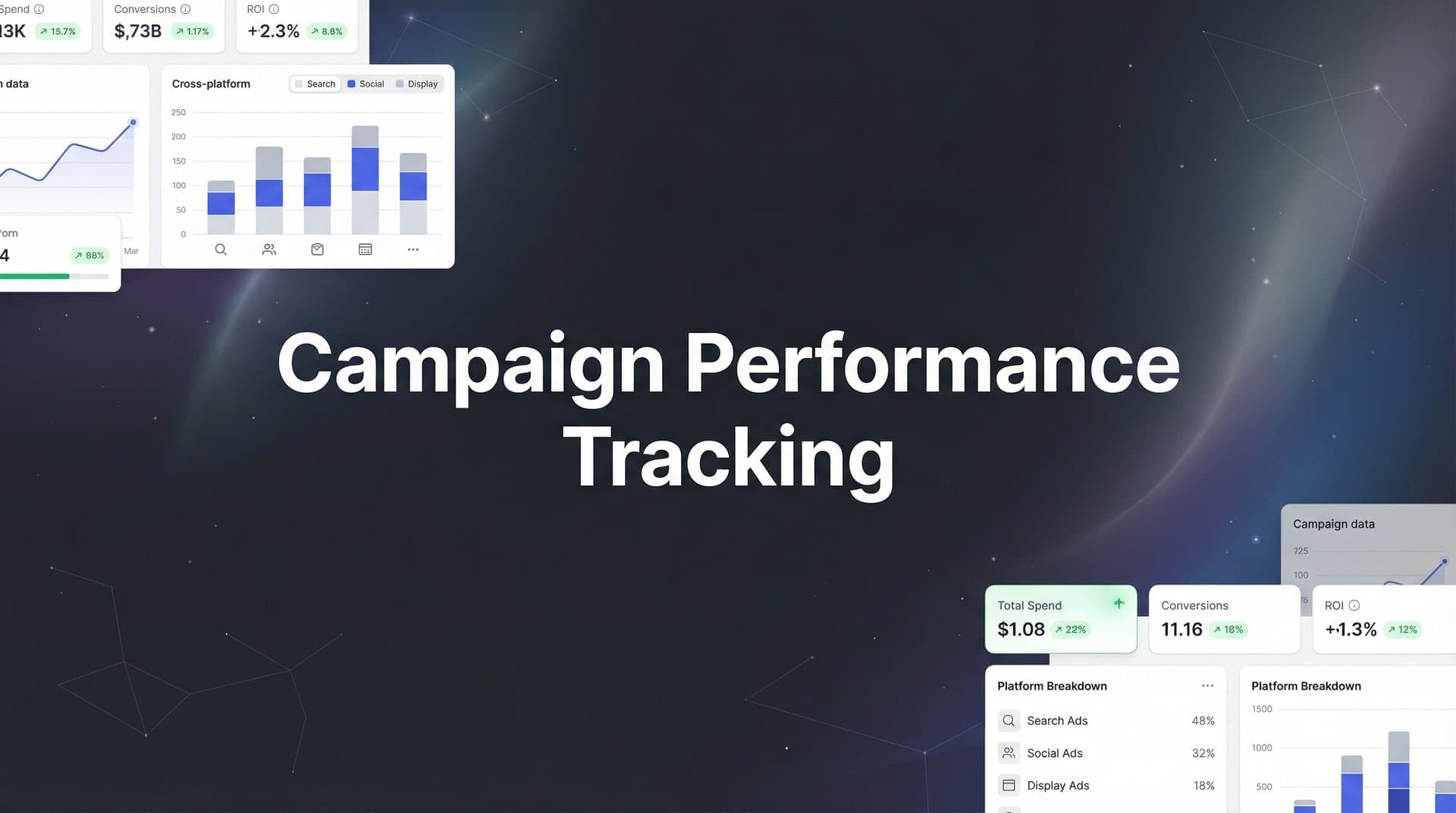
Bring all this data together in a unified analytics dashboard where you can analyze performance across channels, compare attribution models, and identify optimization opportunities. Scattered data across multiple platforms forces you to piece together the story manually. Investing in the right campaign performance analytics solution shows you the complete picture in one place.
Real-time tracking capabilities transform how quickly you can optimize. Traditional reporting cycles—waiting for end-of-week or end-of-month reports—mean you're making decisions based on old data. By the time you realize a campaign isn't working, you've already spent budget on it for days or weeks. Real-time tracking lets you spot problems and opportunities immediately.
Picture this scenario: You launch a new campaign on Monday morning. By Tuesday afternoon, you can see that it's generating clicks but zero conversions. With real-time tracking, you pause it immediately and save the rest of the week's budget. Without real-time tracking, you wouldn't discover the problem until Friday or the following Monday, after wasting several days of spend.
The same principle applies to winning campaigns. Real-time tracking lets you identify high performers quickly and shift budget toward them while they're hot. You don't wait until next month to scale what's working—you scale it today.
Here's a practical framework for setting up tracking that follows the complete journey from ad click to revenue. First, ensure every ad campaign uses properly tagged URLs so you can identify which specific campaigns, ad sets, and ads drive traffic. Understanding UTM tracking is essential for this step. Second, implement website tracking that captures key conversion events—form submissions, purchases, sign-ups, or whatever actions matter for your business. Third, connect your CRM so conversion data flows back into your analytics system. Fourth, set up conversion sync so enriched conversion data flows back to your ad platforms.
This framework creates a closed loop. You can see which campaigns drive clicks, which clicks become website visitors, which visitors complete conversion actions, which conversions become customers, and which customers generate revenue. That complete visibility is what enables confident optimization decisions.
From Data to Decisions: Acting on Campaign Insights
Collecting campaign performance data is pointless if you don't use it to make better decisions. The goal isn't to have more dashboards—it's to identify what's working and do more of it while cutting what's not working.
Start by identifying your high-performing campaigns. Look beyond surface metrics like click-through rates and focus on revenue metrics. Which campaigns have the lowest CAC? Which campaigns generate the highest ROAS? Which campaigns attract customers with the highest LTV? These are the campaigns worth scaling.
But don't just look at campaign-level performance. Drill down into ad sets, individual ads, audiences, and placements. You might find that a campaign overall performs moderately well, but one specific ad set within that campaign is crushing it while others drag down the average. Identifying these pockets of excellence lets you make surgical optimizations instead of broad, imprecise changes. Mastering ad campaign performance analysis methods helps you uncover these insights consistently.
Budget reallocation becomes straightforward when you have accurate revenue attribution. Instead of spreading your budget evenly across all campaigns or all platforms, concentrate spend where you're seeing the best returns. If your data shows that Facebook campaigns generate a 6:1 ROAS while Google campaigns only generate 3:1, shift more budget to Facebook. If one specific campaign consistently outperforms others, give it more fuel.
This approach requires courage because it often contradicts what ad platforms tell you. Meta's dashboard might show that all your campaigns are performing well, but when you connect that data to actual revenue, you might discover that only two of your five campaigns are profitable. Cutting the underperformers feels risky because the platform says they're working, but your revenue data tells the truth.
The most sophisticated marketers use AI-powered recommendations to surface optimization opportunities they might otherwise miss. When you're running campaigns across multiple platforms with dozens of ad sets and hundreds of individual ads, manually analyzing all that data becomes overwhelming. AI can identify patterns that aren't obvious to human analysts.
For example, AI might notice that your campaigns consistently perform better on Tuesdays and Wednesdays, suggesting you should adjust your budget schedule to concentrate spend on those days. It might identify that video ads under 15 seconds dramatically outperform longer videos in your account, suggesting you should shift creative resources toward shorter formats. It might discover that campaigns targeting specific geographic regions generate 2x higher ROAS than others, suggesting you should expand in those markets.
These insights emerge from analyzing large volumes of data across multiple dimensions. AI excels at this kind of pattern recognition in ways that manual analysis can't match. Instead of spending hours digging through reports, you receive actionable recommendations: "Increase budget for Campaign X by 30%," "Pause Ad Set Y—it's generating clicks but zero conversions," "Test expanding Audience Z to similar demographics."
The key is acting on insights quickly. Campaign performance changes constantly. Creative fatigues, audiences saturate, competitors adjust their strategies, and market conditions shift. The campaigns that worked brilliantly last month might underperform this month. Regular optimization isn't optional—it's essential for maintaining strong performance.
Build a rhythm of optimization into your workflow. Weekly reviews of campaign performance help you catch problems early and capitalize on opportunities while they're hot. Monthly deep dives help you identify longer-term trends and make strategic adjustments to your overall approach. Quarterly planning sessions help you evaluate whether your marketing strategy as a whole is delivering the business outcomes you need.
Throughout all of this, let revenue metrics guide your decisions. Engagement metrics, click-through rates, and conversion rates are interesting, but they're not the goal. The goal is profitable customer acquisition. Every optimization decision should move you closer to lower CAC, higher ROAS, and better LTV. When you stay focused on those outcomes, your campaign performance naturally improves.
Putting It All Together
Effective campaign performance tracking isn't about collecting more data—it's about connecting the right data to revenue outcomes. The marketers who win in today's complex digital landscape are the ones who can trace their campaigns from first impression to final dollar generated.
The shift from vanity metrics to revenue-focused tracking changes everything. You stop celebrating clicks that don't convert and start optimizing for the metrics that actually matter. You stop guessing which campaigns work and start knowing with confidence. You stop wasting budget on underperformers and start scaling winners.
This requires building a tracking system that captures every touchpoint across the customer journey, connects your ad platforms to your CRM, and uses multi-touch attribution to understand how different campaigns contribute at different stages. It requires overcoming modern tracking challenges with server-side tracking and conversion sync. And it requires acting on insights quickly to optimize performance before opportunities disappear.
Take a moment to evaluate your current tracking setup. Can you confidently say which campaigns are driving revenue, or are you relying on platform-reported metrics that might not tell the whole story? Can you trace a customer's journey from their first ad interaction to their final purchase? Do you know your true CAC, ROAS, and LTV for each campaign? If the answer to any of these questions is no, you have blind spots that are costing you money.
Ready to elevate your marketing game with precision and confidence? Discover how Cometly's AI-driven recommendations can transform your ad strategy—Get your free demo today and start capturing every touchpoint to maximize your conversions.