You check your dashboard after a strong sales week. The CRM shows ten new customers. Google Ads claims credit for eight conversions. Meta says it drove seven. TikTok chimes in with three more. Add those up and you have got eighteen reported conversions for ten actual customers. Something is clearly wrong, but you are not sure what to cut, what to scale, or what to trust.
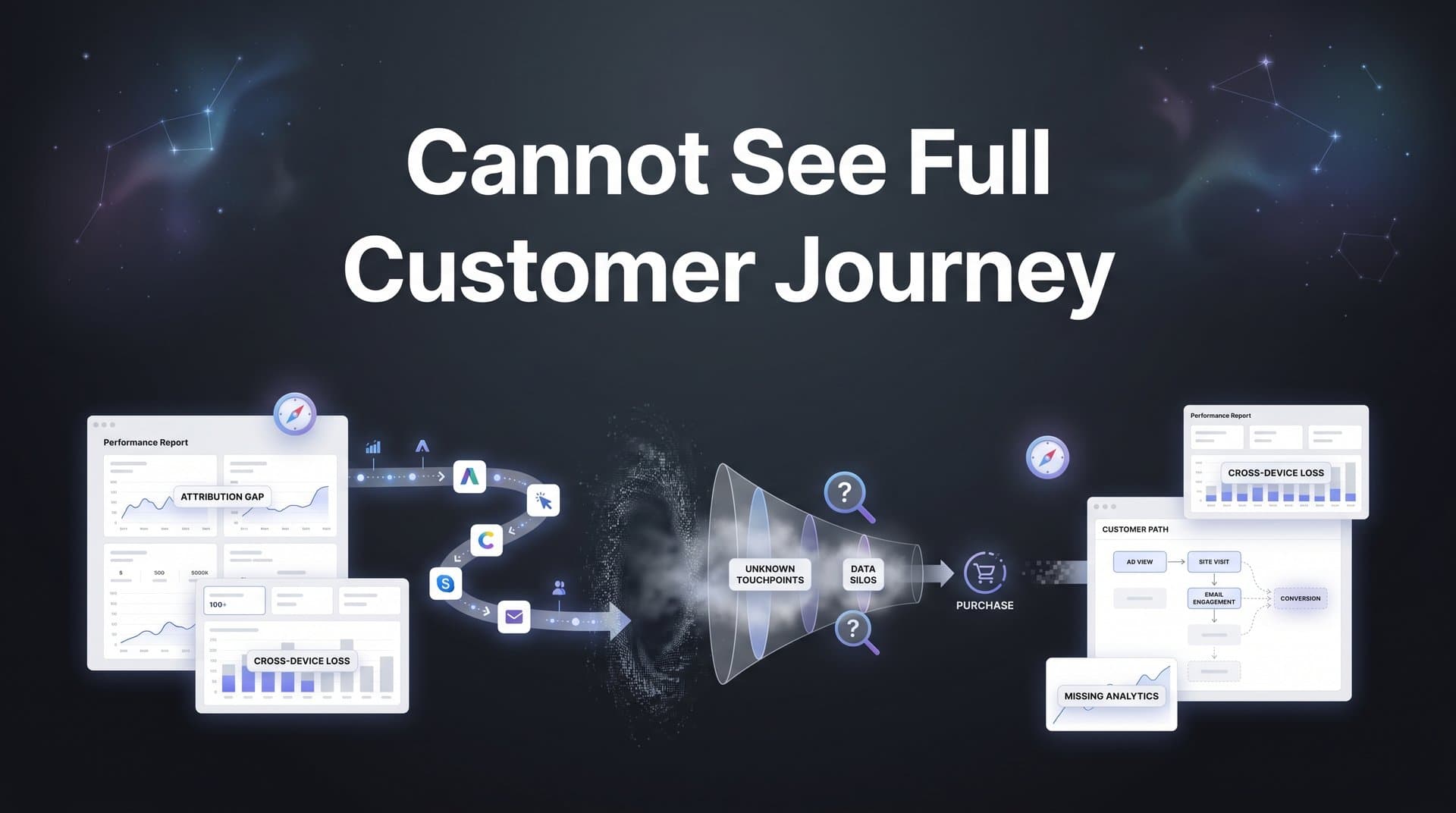
This is not a rare edge case. It is the everyday reality for marketers running campaigns across multiple platforms without a unified view of how customers actually move from first impression to final purchase. When you cannot see the full customer journey, every budget decision is essentially a guess dressed up in dashboard data.
The problem is not that you lack data. You probably have more data than you can process. The problem is that the data is fragmented, siloed, and often contradictory. Each platform tells its own version of the story, and none of them shows you the complete picture. This article breaks down exactly why those blind spots exist, what they are costing you, and the practical steps you can take to close them for good.
The Hidden Cost of Missing Touchpoints
At first glance, missing a few touchpoints in your reporting might seem like a minor data quality issue. In practice, it is a budget allocation problem that compounds over time. When you cannot see the full customer journey, you systematically over-invest in channels that are loudest about claiming credit and under-invest in the channels that are quietly doing the heavy lifting.
Think about what that means in real terms. An email nurture sequence might be the final nudge that moves a prospect to buy, but if your attribution model gives all credit to the last paid click, email looks like it contributes nothing. You cut the email budget. Conversions quietly drop. You assume the paid campaign needs more spend to compensate, so you increase it. The cycle continues, and the root cause stays invisible.
Fragmented data also creates a trust problem inside your organization. When the marketing team pulls a report from Google Analytics, the paid social team pulls from Meta Ads Manager, and the sales team pulls from the CRM, and none of those numbers agree, you end up spending meeting time debating whose data is right instead of deciding what to do next. Confidence in marketing data erodes, and decision-making slows down across the entire team. This is a common symptom of incomplete customer journey data that plagues organizations of all sizes.
The compounding effect is what makes this genuinely dangerous. Bad data does not just produce one bad decision. It produces a pattern of bad decisions, each one feeding the next. You optimize campaigns based on flawed signals, which trains ad platform algorithms on flawed inputs, which generates worse audience targeting, which produces weaker results, which makes your data even harder to interpret. The longer this cycle runs, the harder it becomes to untangle.
The business impact is real and measurable in ways that go beyond wasted ad spend. Misallocated budgets mean you are not scaling what actually works. You cannot identify your most valuable customer acquisition channels. You cannot accurately forecast return on ad spend. And you cannot build the kind of repeatable, scalable growth that comes from genuinely understanding how your customers find you and decide to buy.
Five Reasons Your Customer Journey Has Blind Spots
Understanding why visibility gaps exist is the first step toward closing them. The causes are not random. They are structural, and they have been getting worse as the digital advertising landscape has evolved.
Privacy changes and cookie deprecation: The shift that fundamentally changed tracking for most marketers was Apple's iOS 14.5 App Tracking Transparency rollout, which gave users the ability to opt out of cross-app tracking. A large portion of mobile users chose to opt out, dramatically reducing the data that platforms like Meta could collect from their mobile audience. Browser-level cookie blocking has followed a similar trajectory, with Firefox and Safari blocking third-party cookies by default, and Google continuing to evolve its approach to cookies in Chrome. The result is that client-side tracking, which relies on pixels and cookies in the browser, is capturing a shrinking share of actual customer interactions.
Siloed platforms and disconnected data: Meta tracks within its ecosystem. Google tracks within its ecosystem. Your CRM tracks what gets entered manually or synced through integrations. Your email platform tracks opens and clicks. None of these systems were designed to talk to each other natively, and each one uses its own attribution model with its own lookback windows and credit assignment logic. The gap between a click on an ad and a closed deal in your CRM is often completely invisible to every individual platform involved. This is why seeing the full customer journey across channels remains one of the biggest challenges in modern marketing.
Cross-device and cross-channel complexity: A customer might see your Instagram ad on their phone during their commute, search for your brand on their laptop that evening, read a blog post you published, sign up for a webinar, and then convert through a retargeting ad three weeks later. Without a system that stitches those interactions together across devices and channels, you are seeing fragments of a journey rather than the journey itself. Many attribution systems simply cannot connect the mobile impression to the desktop conversion, so entire segments of the path go unrecorded.
Ad blockers and browser restrictions: A meaningful portion of internet users run ad blockers or privacy-focused browsers that prevent pixels from firing at all. When a pixel does not fire, the touchpoint does not get recorded. For audiences that skew technical or privacy-conscious, such as developers, IT professionals, or early adopters, this can mean a significant share of your actual traffic and conversions never appear in your platform data.
Delayed and offline conversions: Not every conversion happens immediately after a click. B2B buyers in particular often take weeks or months to convert, involving multiple stakeholders and many touchpoints along the way. When attribution windows are too short, or when conversions happen offline through a sales call or contract signing, those conversions either get attributed to the wrong touchpoint or disappear from your data entirely. This is a well-documented example of when the customer journey is longer than attribution windows allow.
What Each Ad Platform Gets Wrong About Attribution
Here is something worth sitting with: every major ad platform has a financial incentive to show you that its ads are working. Meta wants you to believe Meta drove the conversion. Google wants credit for the same conversion. This is not a conspiracy. It is just the natural result of self-reported attribution, and it leads to numbers that consistently flatter the platform doing the reporting.
The mechanism is straightforward. Each platform sets its own attribution window and its own rules for what counts as a conversion. Meta might claim a conversion if a user saw an ad within seven days of converting, even if they never clicked it. Google might claim the same conversion because the user clicked a search ad the day before converting. Your email platform might count it because the user opened a promotional email that week. All three platforms are technically reporting accurately within their own rules. But when you add up their reported conversions, the total far exceeds your actual revenue, sometimes by a wide margin. These are classic customer journey attribution problems that affect nearly every multi-channel advertiser.
This overlap is not just a reporting nuisance. It actively distorts your optimization decisions. If you believe Meta drove eight conversions and Google drove seven when you only had ten total, you are going to make very different budget decisions than if you understood how those ten customers actually moved through your funnel.
Default attribution models compound the problem. Last-click attribution, which remains a common default, gives all credit to the final touchpoint before conversion. It is simple and easy to implement, but it is deeply misleading about how customers actually buy. The awareness ad that introduced your brand, the blog post that built trust, the webinar that answered the key objection: none of these get any credit in a last-click model. You end up optimizing for the last step of the funnel while systematically starving the top and middle of the funnel that feed it.
First-click attribution has the opposite problem. It credits the initial touchpoint while ignoring everything that came after. Position-based models split credit between first and last touch, which is an improvement but still ignores the middle. The core issue is that relying on any single platform's default reporting means you are looking at one platform's interpretation of a story that spans many platforms, devices, and time periods. A deeper understanding of customer journey attribution is essential for making sense of these conflicting reports.
Server-Side Tracking: Reclaiming the Data You Are Losing
Traditional tracking works by placing a pixel or JavaScript tag in the browser. When a user takes an action on your website, the browser fires a request to the ad platform's servers to record the event. This approach has worked reasonably well for years, but it has a fundamental vulnerability: it depends entirely on what the browser allows.
Ad blockers block the request. Safari's Intelligent Tracking Prevention limits the data that can be passed. iOS restrictions prevent cross-app tracking. The result is that a growing share of your actual conversions simply never get recorded by your pixels. You are not just missing attribution data. You are missing conversion events entirely, which means the ad platforms' algorithms are being trained on an incomplete picture of who your actual customers are.
Server-side tracking solves this by moving the data collection off the browser entirely. Instead of relying on a pixel in the user's browser to fire a request, your own server receives the conversion event and sends it directly to the ad platform's server. This approach bypasses browser restrictions, ad blockers, and cookie limitations because the communication happens server-to-server, not browser-to-server. This is a critical component of tracking the customer journey effectively in today's privacy-first landscape.
The practical benefits are significant. More conversion events get recorded accurately. The data that flows back to Meta, Google, and other platforms is richer and more complete, which means their algorithms have better inputs for audience targeting and bid optimization. You are not just improving your reporting. You are improving the actual performance of your campaigns by feeding the ad platform AI better data.
This is the concept behind conversion sync technology. Rather than letting each platform's pixel capture whatever fragments it can, you build a first-party data pipeline that connects ad clicks to real outcomes in your CRM and sends that enriched conversion data back to the platforms in real time. The result is a system where your data flows from first click to closed deal without the gaps that browser-based tracking inevitably introduces.
For marketers dealing with the aftermath of iOS privacy changes and ongoing cookie deprecation, server-side tracking is not a nice-to-have. It is the foundation of any serious attribution strategy in the current landscape.
Multi-Touch Attribution: Seeing the Complete Picture
Even with accurate tracking in place, you still need a framework for making sense of what you are seeing. That is where multi-touch attribution comes in. Rather than assigning all credit for a conversion to a single touchpoint, multi-touch attribution distributes credit proportionally across every interaction a customer had before converting.
To make this concrete, consider a B2B SaaS buyer. They click a LinkedIn ad that introduces them to your product. A week later, they search your brand name and read a blog post on your site. They register for a webinar, attend it, and ask questions. Two weeks after the webinar, they see a retargeting ad and click through to request a demo. They convert during the demo call. Understanding how to track the customer journey across touchpoints like these is what separates guesswork from genuine insight.
In a last-click model, the retargeting ad gets all the credit. The LinkedIn ad, the blog post, and the webinar appear to contribute nothing. In a first-click model, LinkedIn gets everything. In reality, every one of those touchpoints played a role in building the awareness, trust, and intent that led to the conversion.
Multi-touch attribution makes each of those contributions visible. Depending on the model you use, the credit is distributed differently. Linear attribution gives equal credit to every touchpoint. Time-decay models give more credit to touchpoints closer to the conversion, reflecting the idea that recent interactions had more influence. Position-based models give more weight to the first and last touch while distributing the remainder across the middle.
None of these models is definitively correct for every business. The real value comes from being able to compare them. When you can look at your funnel through multiple attribution lenses, you start to see which channels are driving awareness, which are nurturing consideration, and which are closing deals. That understanding gives you the confidence to allocate budget across the full funnel rather than just doubling down on whatever the last-click model happens to favor.
For B2B marketers especially, where buying cycles are long and involve multiple stakeholders, multi-touch attribution is often the difference between understanding your pipeline and guessing at it. Learn more about how customer journey software can help B2B SaaS companies scale with this approach.
Building a System Where No Touchpoint Goes Untracked
Understanding the problem is one thing. Building the infrastructure to solve it is another. The good news is that the path forward is clear, even if it requires some deliberate setup.
The starting point is connecting all of your data sources into a single attribution system. That means linking your ad platforms (Meta, Google, TikTok, LinkedIn), your website, and your CRM so that data flows continuously from the first ad impression to the closed deal. When these systems operate in isolation, you will always have gaps. When they are unified, you can trace the complete journey for every customer. This is the foundation of end-to-end customer journey tracking that eliminates blind spots.
The next layer is implementing server-side tracking so that the data flowing through that system is as complete and accurate as possible. This addresses the tracking gaps created by privacy changes, ad blockers, and browser restrictions. It also means the conversion data you send back to ad platforms is richer, which improves their targeting and optimization algorithms in ways that directly benefit your campaign performance.
On top of that foundation, multi-touch attribution gives you the analytical framework to understand what that complete data is telling you. You can see which channels are driving top-of-funnel awareness, which are nurturing mid-funnel consideration, and which are closing conversions. You can compare attribution models to stress-test your assumptions and make budget decisions with genuine confidence rather than platform-reported guesswork.
AI-powered analytics add another dimension. When you have complete, unified data flowing through your system, AI can surface patterns that manual analysis would miss. It can identify which ads and campaigns are performing across every channel, flag underperforming spend, and generate recommendations for where to scale and where to pull back. Investing in the right customer journey analytics tools is what makes this level of intelligence possible.
Cometly brings all of these capabilities together in a single platform built specifically for marketers who need clear, accurate data across every channel. With server-side tracking, multi-touch attribution, conversion sync to feed better data back to Meta and Google, and AI-driven recommendations, Cometly gives you a complete view of the customer journey from first click to closed revenue. It connects your ad platforms, CRM, and website so that every touchpoint is captured and every budget decision is grounded in real data.
The Bottom Line
The inability to see the full customer journey is not just a tracking inconvenience. It is a growth problem that touches every part of your marketing operation. Every invisible touchpoint is a missed insight. Every missed insight is a potential budget mistake. And every budget mistake, repeated over time, compounds into a significant drag on your ability to scale.
The path forward involves three interconnected moves: adopting server-side tracking to capture the data that browser-based pixels miss, implementing multi-touch attribution to understand how credit should be distributed across your funnel, and unifying all of your data in a single platform so you are working from one source of truth instead of a collection of conflicting dashboards.
When you close these visibility gaps, something meaningful shifts. You stop optimizing based on which platform shouts the loudest and start optimizing based on what actually drives revenue. You can scale with confidence because you know what is working and why. And you can build the kind of repeatable, data-driven growth that compounds in your favor over time.
Ready to elevate your marketing game with precision and confidence? Discover how Cometly's AI-driven recommendations can transform your ad strategy. Get your free demo today and start capturing every touchpoint to maximize your conversions.