
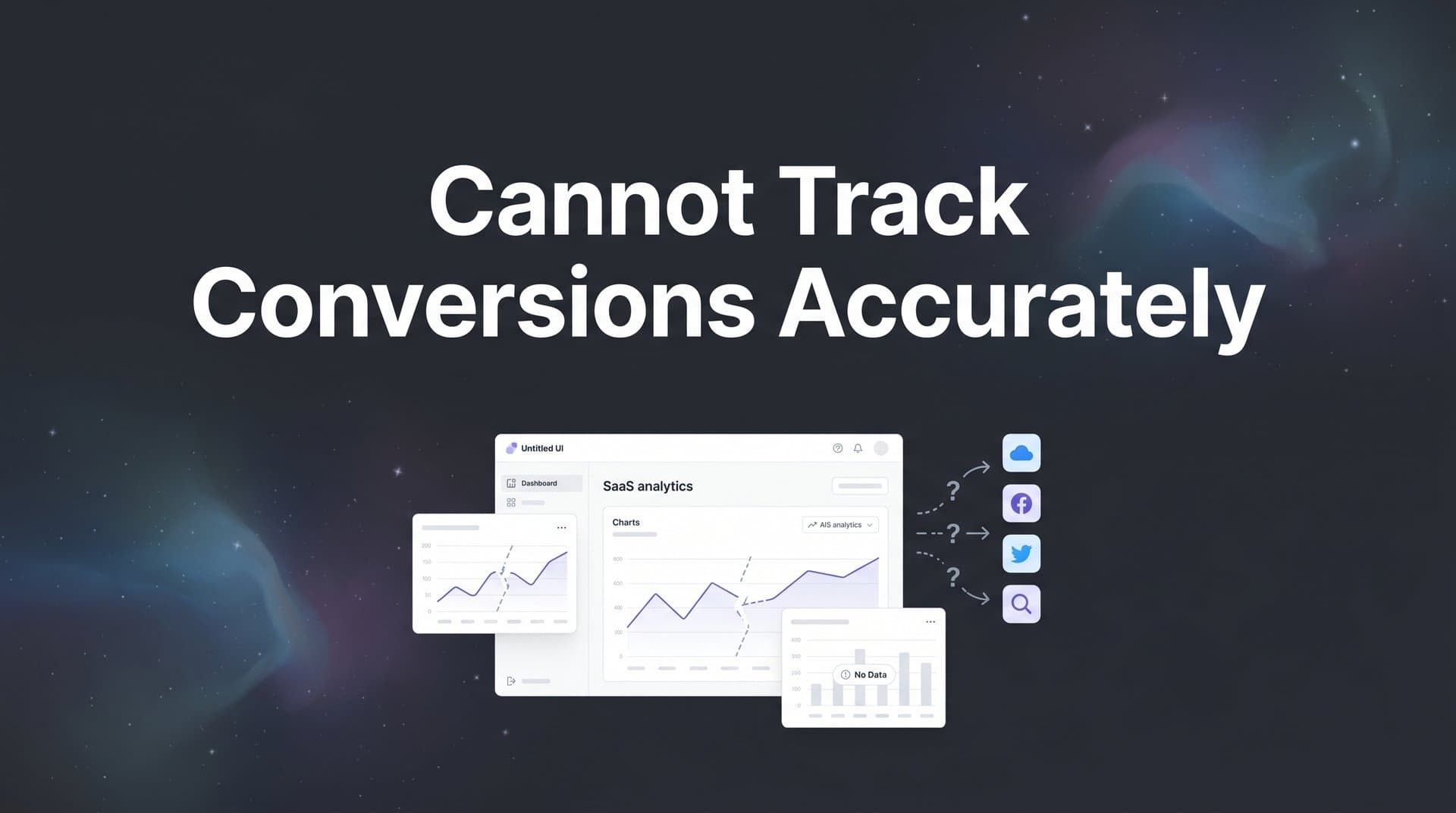
You check your Meta Ads dashboard and see 50 conversions from yesterday's campaign. You open your CRM, scroll through the actual sales records, and count only 30 new customers. The numbers don't match. Again.
This isn't a small discrepancy you can ignore. That 20-conversion gap represents thousands in misallocated ad spend, campaigns you're scaling based on phantom results, and optimization decisions built on unreliable data. When you cannot track conversions accurately, every strategic choice becomes a gamble.
The frustrating part? This data disconnect isn't your fault. The tracking infrastructure that powered digital advertising for years has fundamentally broken. Privacy changes, browser restrictions, and cross-device behavior have created blind spots in your conversion data that no amount of pixel tweaking can fix.
This article breaks down exactly why your conversion tracking has become unreliable and, more importantly, shows you how to rebuild it with infrastructure that works in today's privacy-first landscape. You'll understand the forces breaking your data, recognize the hidden costs of flying blind, and learn the practical steps to reclaim accurate attribution.
The Hidden Forces Breaking Your Conversion Data
When iOS 14.5 launched App Tracking Transparency in 2021, it fundamentally changed how user data flows between websites and ad platforms. Apple required apps to ask permission before tracking users across other apps and websites. The result? Industry data shows that the majority of iOS users opted out of tracking, creating immediate blind spots in conversion data for advertisers.
This wasn't just an Apple problem. Safari and Firefox had already blocked third-party cookies by default. Google Chrome announced plans to phase out third-party cookies entirely, though timelines have shifted multiple times. The common thread? Browser makers prioritized user privacy over advertiser tracking capabilities.
Think of cookies as breadcrumbs that follow users from your ad to your website to your checkout page. When those breadcrumbs disappear, ad platforms lose the ability to connect the dots. You run an ad, someone clicks it, they convert three days later, but the platform has no way to attribute that sale back to your campaign. Understanding why conversions break after cookie changes is essential for modern marketers.
Cookie deprecation creates another problem: shortened attribution windows. Traditional tracking relied on cookies that could last 30, 60, or even 90 days. Now, many tracking mechanisms expire within 7 days or less. For businesses with longer sales cycles, this means conversions that happen after the cookie expires simply vanish from your attribution data.
Here's where it gets even more complex. Your customers don't live in a single-device world. They see your ad on their iPhone during their morning commute, research your product on their work laptop during lunch, and finally purchase on their home desktop that evening. Each device switch creates a potential break in the tracking chain.
Cross-device behavior has always challenged attribution, but privacy restrictions have made it nearly impossible to stitch these journeys together accurately. When you cannot track conversions accurately across devices, you're essentially viewing your customer journey through a fragmented mirror. You see pieces of the path, but never the complete picture. Learning how to track cross device conversions becomes critical for accurate attribution.
The technical reality is stark: the tracking methods that worked reliably until 2020 now capture only a fraction of actual conversion activity. Ad platforms receive incomplete signals, your analytics show partial data, and the gap between what your tools report and what actually happened continues to widen.
How Ad Platforms Fill Data Gaps (And Why It Hurts You)
When ad platforms cannot track conversions accurately through traditional methods, they don't simply report zeros. Instead, they use modeled conversions and statistical estimates to fill the gaps. Meta, Google, and other platforms employ machine learning algorithms that predict conversions based on patterns from users who can be tracked.
The logic seems reasonable: if the platform can track 40% of users and sees certain patterns leading to conversions, it uses those patterns to estimate conversions from the 60% it cannot track. The problem? These are educated guesses, not actual measurements. You're making budget decisions based on projections, not facts.
Modeled conversions can swing in either direction. Sometimes platforms overestimate, showing you more conversions than actually occurred. This leads to false confidence and scaling campaigns that aren't truly performing. Other times, platforms underestimate, causing you to pause or reduce spend on campaigns that are actually driving real revenue. If you're experiencing this with Meta, understanding why Facebook Pixel isn't tracking all conversions can help diagnose the issue.
The inconsistency gets worse when you compare platforms. Meta uses a 7-day click and 1-day view attribution window by default. Google Ads defaults to 30-day click attribution. TikTok has its own methodology. Each platform measures conversions differently, making cross-platform comparison nearly impossible.
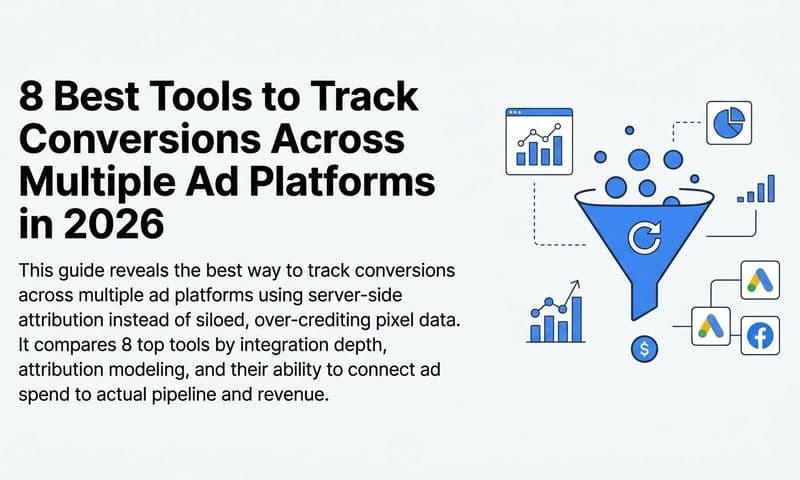
Let's say a customer clicks your Meta ad, then clicks your Google ad two days later, and converts. Which platform gets credit? Both will likely claim the conversion in their respective dashboards. Now multiply this scenario across hundreds of conversions, and you end up with total reported conversions far exceeding your actual sales. This is why tracking conversions across multiple ad platforms requires a unified approach.
There's an inherent bias problem too. Ad platforms are businesses that need to demonstrate value to keep advertisers spending. When they control both the delivery of ads and the measurement of results, there's a natural incentive to report favorable numbers. This doesn't mean platforms are being dishonest, but it does mean their self-reported data should be validated against ground truth from your CRM.
The attribution methodology differences create strategic confusion. You might see Meta reporting a $30 cost per acquisition while Google reports $50 for the same campaign period. Without accurate, unified tracking, you cannot determine which platform truly delivers better efficiency. You're comparing apples to oranges, and neither number reflects reality.
The Real Cost of Flying Blind on Conversions
Budget misallocation is the most immediate consequence when you cannot track conversions accurately. Imagine scaling a campaign from $1,000 to $5,000 daily because your ad platform shows strong conversion numbers. You're confident in the data, so you increase spend aggressively. Then you check your actual revenue and realize those phantom conversions never translated to real sales.
You've just burned through an extra $4,000 daily based on misleading signals. Multiply this across multiple campaigns and several weeks, and the wasted spend becomes substantial. Worse, you've simultaneously underfunded campaigns that were actually working but appeared less successful in platform reporting. Many marketers struggle because they can't track ROAS accurately enough to make confident decisions.
Algorithm degradation presents a more insidious problem. Ad platforms like Meta and Google use machine learning to optimize delivery toward users most likely to convert. These algorithms need accurate conversion signals to learn and improve. When the platforms receive incomplete or incorrect conversion data, they optimize toward the wrong patterns.
Think of it like teaching someone to cook by only telling them about half the ingredients. They'll develop techniques based on incomplete information, and the results will never match what's possible with the full recipe. Your ad platform's AI is trying to find your best customers, but it's working with partial data about who actually converts.
The algorithm learns to target users who look like the conversions it can track, not necessarily the users who actually drive the most revenue. This creates a feedback loop where targeting gets progressively less effective because the optimization signals are fundamentally flawed.
Strategic decisions become guesswork when you lack confidence in your conversion data. Should you expand to new platforms? Double down on existing channels? Shift budget from prospecting to retargeting? Every major decision requires reliable data about what's working and what's not. When you can't track customer journey accurately, these decisions become shots in the dark.
When you cannot track conversions accurately, you're essentially making these calls based on gut feeling rather than evidence. Some marketers respond by becoming overly conservative, missing growth opportunities because they don't trust their data enough to scale. Others become reckless, throwing money at channels without real proof of performance.
The competitive disadvantage compounds over time. While you're making decisions in the dark, competitors who have solved their tracking problems are confidently allocating budget to their highest-performing channels, feeding their algorithms accurate signals, and pulling away in efficiency and scale.
Server-Side Tracking: Reclaiming Your Conversion Data
Server-side tracking fundamentally changes how conversion data flows from your business to ad platforms. Instead of relying on browser-based pixels and cookies that privacy restrictions can block, server-side tracking sends conversion data directly from your server to ad platforms through their conversion APIs.
Here's the key difference: browser-based tracking depends on the user's device and browser allowing the connection. Ad blockers can stop it. Cookie restrictions can break it. Cross-device journeys fragment it. Server-side tracking bypasses all of these limitations because the data transmission happens between servers, not through the user's browser. This is why learning to track conversions without cookies has become essential.
When a conversion occurs on your website or in your CRM, your server captures that event and sends it directly to Meta's Conversions API, Google's Enhanced Conversions, or similar endpoints on other platforms. The user's browser settings become irrelevant because the tracking doesn't depend on client-side technology.
This approach gives you ownership and control over your conversion data. You're collecting first-party data directly from interactions with your own properties—your website, your checkout process, your CRM. This data isn't subject to the same restrictions as third-party cookies because you're not tracking users across other websites. You're simply measuring activity on your own platform.
The accuracy improvement is substantial. Server-side tracking can capture conversions that browser-based pixels miss entirely. Users who have ad blockers installed, Safari users with intelligent tracking prevention enabled, and cross-device converters all become visible in your attribution data when you implement server-side tracking properly.
Implementation requires connecting three core components into a unified system: your website, your CRM, and your ad platforms. Your website needs to send conversion events to your server. Your CRM needs to pass back completed sales and revenue data. Your server needs to format this data correctly and transmit it to each ad platform's conversion API.
The technical setup involves more than just installing a pixel. You need server infrastructure to receive and process conversion events, proper data mapping to ensure the information matches what ad platforms expect, and ongoing maintenance to handle API updates and troubleshoot transmission issues.
Many businesses implement server-side tracking through specialized attribution platforms that handle the technical complexity. These tools sit between your data sources and your ad platforms, receiving conversion data from your website and CRM, then distributing it accurately to Meta, Google, TikTok, and other platforms through their respective APIs.
Building an Attribution System You Can Trust
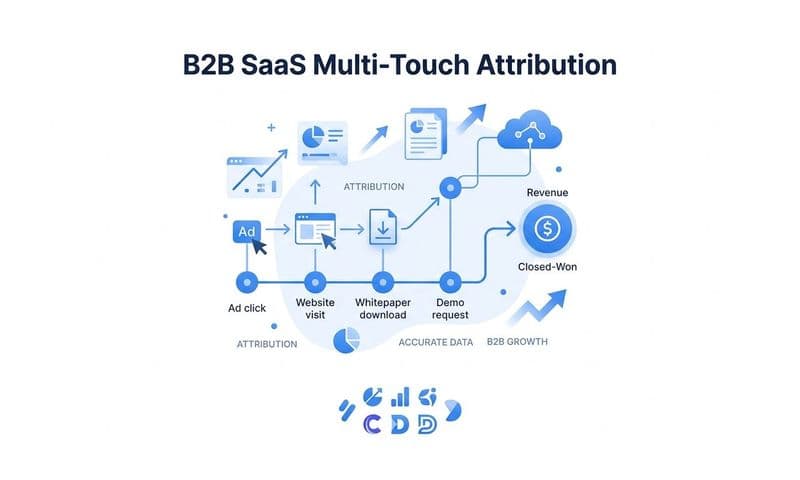
Multi-touch attribution reveals the full customer journey instead of giving all credit to the last click before conversion. In reality, customers interact with multiple touchpoints before purchasing. They might see your Meta ad, click a Google search ad, visit directly, and then convert through an email link. Last-click attribution would credit only the email, ignoring the ads that created awareness and consideration. Mastering tracking conversions across multiple touchpoints gives you the complete picture.
Multi-touch models distribute credit across all touchpoints in the customer journey. Linear attribution gives equal credit to each interaction. Time-decay attribution gives more credit to touchpoints closer to conversion. Position-based attribution emphasizes the first and last touchpoints. Each model provides different insights into how your channels work together.
The value isn't in picking the perfect model but in seeing the complete picture. When you understand that your Meta ads drive initial awareness, Google search captures high-intent users, and email closes the deal, you can optimize each channel for its actual role rather than judging everything by last-click conversions.
Connecting offline conversions and CRM data closes the critical loop between ad clicks and actual revenue. A form submission isn't a conversion if the lead never becomes a customer. A checkout isn't valuable if the order gets canceled. Your CRM holds the ground truth about which interactions actually generated revenue. Implementing proper offline conversion tracking from online ads bridges this gap.
Integrating CRM data into your attribution system means sending back not just that a conversion occurred, but the actual revenue value, whether the customer remained active, their lifetime value, and which initial touchpoint started their journey. This transforms attribution from counting clicks to measuring real business outcomes.
For businesses with sales teams, offline conversion tracking becomes essential. A lead might click your ad, fill out a form, then convert through a phone call three weeks later. Without connecting your CRM back to your ad platforms, that conversion appears to have happened in a vacuum, with no attribution to the campaign that generated the lead.
Real-time data synchronization ensures ad platform algorithms receive accurate conversion signals quickly enough to optimize effectively. Machine learning models need fresh data to adapt and improve. If conversions take days or weeks to flow back to your ad platforms, the algorithms are optimizing based on outdated patterns.
Modern attribution platforms sync conversion data back to ad platforms within minutes or hours of the actual conversion. When Meta's algorithm sees that users matching certain characteristics are converting, it can immediately shift delivery toward similar users. This creates a tight feedback loop that improves targeting continuously.
The synchronization works both ways. Your attribution platform receives click and impression data from ad platforms, matches it with conversion data from your website and CRM, then sends enriched conversion events back to the platforms. This bidirectional flow ensures everyone is working with the same, accurate information.
Putting Accurate Tracking Into Action
Start by auditing your current tracking setup to identify exactly where data breaks down. Check your ad platform dashboards against your website analytics and CRM records. Document the gaps. If Meta reports 100 conversions but your CRM shows 70 sales, you have a 30% data loss that needs investigation. Understanding why your conversions aren't tracking is the first step toward fixing the problem.
Look for common failure points: Do you see traffic in analytics that doesn't appear in ad platform reports? Are there conversions in your CRM without corresponding attribution data? Do your ad platforms show wildly different conversion counts for the same campaign period? Each discrepancy points to a specific tracking problem you need to solve.
Prioritize server-side implementation and CRM integration as the foundation for reliable attribution. Browser-based tracking alone cannot deliver the accuracy you need in today's privacy-focused environment. Server-side tracking through conversion APIs should be your core infrastructure, with browser pixels serving as a supplementary data source.
CRM integration is equally critical because it connects your tracking to actual business outcomes. Without it, you're measuring activity rather than results. Your attribution system needs to know not just that someone filled out a form, but that they became a paying customer and generated specific revenue. Following best practices for tracking conversions accurately ensures you capture this complete picture.
Use accurate conversion data to feed ad platform AI and unlock better targeting and optimization. Once your tracking infrastructure captures reliable conversion signals, ensure those signals flow back to your ad platforms in real time. Meta's algorithm, Google's smart bidding, and other automated optimization features perform dramatically better when they receive complete, accurate data.
The platforms' machine learning models are powerful, but they're only as good as the data they receive. When you feed them accurate conversion signals that include actual revenue, customer quality, and complete attribution, they optimize toward real business value rather than vanity metrics. This is where accurate tracking translates directly into better ad performance and lower acquisition costs.
Moving Forward with Confidence
Inaccurate conversion tracking isn't a permanent problem you have to accept. The infrastructure exists right now to capture complete, reliable attribution data even in today's privacy-first landscape. Server-side tracking, proper CRM integration, and multi-touch attribution aren't experimental technologies. They're proven solutions that forward-thinking marketers are already using to gain competitive advantage.
The marketers who invest in this infrastructure make decisions with confidence. They know which channels drive real revenue, not just reported conversions. They scale campaigns based on actual performance data, not modeled estimates. They feed their ad platform algorithms accurate signals that improve targeting and optimization continuously.
This confidence translates directly into better results. When you cannot track conversions accurately, every decision carries unnecessary risk. When you can trust your data, you move faster, scale smarter, and outperform competitors who are still flying blind.
The gap between your ad platform reports and your actual revenue doesn't have to persist. With the right tracking foundation, you close that gap and build a marketing operation that runs on facts rather than guesses. The question isn't whether accurate attribution is possible. It's whether you're willing to implement the infrastructure that makes it work.
Ready to elevate your marketing game with precision and confidence? Discover how Cometly's AI-driven recommendations can transform your ad strategy. Get your free demo today and start capturing every touchpoint to maximize your conversions.