You are spending money across Meta, Google, TikTok, and maybe a handful of other platforms. The campaigns are running. The budget is flowing. But when someone asks which ads are actually driving revenue, you draw a blank.
You can see clicks and impressions, sure. But connecting those surface-level metrics to real conversions, pipeline, and closed deals? That is where things fall apart.
If you can't see which ads are working, you are not alone. Most marketing teams face a growing gap between ad platform reporting and actual business results. Privacy changes, cross-platform customer journeys, and siloed data sources have made it harder than ever to get a clear picture of ad performance.
The result is wasted budget on underperforming campaigns, missed opportunities to scale winners, and a constant feeling of guessing instead of knowing. Since Apple's iOS 14.5 App Tracking Transparency update, the problem has only intensified. Platforms like Meta receive far less data from mobile users than they once did, and browser-based tracking continues to face pressure from cookie restrictions and ad blockers.
Add to that the fact that most ad platforms report conversions using their own models, often taking credit for the same conversion across multiple platforms, and you end up with numbers that simply do not add up.
This guide walks you through six concrete steps to fix your ad tracking, connect the dots across your marketing stack, and finally see which ads are driving real results. Whether you are a solo marketer managing a few campaigns or part of a team running ads across multiple platforms, these steps will help you move from confusion to clarity.
Step 1: Audit Your Current Tracking Setup for Gaps
Before you can fix anything, you need to know exactly what is broken. Most marketers assume their tracking is working because campaigns are reporting data. But reporting data and accurate data are two very different things.
Start by pulling up each ad platform you are running: Meta, Google, TikTok, LinkedIn, or wherever your budget is going. For each one, ask a simple question: what conversion events are actually firing, and are they firing correctly?
Here is what to check in each platform:
Pixel and tag status: Is the pixel installed and active on every relevant page? Expired or incorrectly placed pixels are one of the most common causes of missing conversion data.
Conversion event configuration: Are your events set up to track the right actions? A purchase event that only fires on a thank-you page will miss conversions if that page has a broken trigger or a redirect that skips it entirely.
UTM parameters: Are your ad URLs consistently tagged with UTM source, medium, campaign, and content parameters? Missing UTMs mean you lose the ability to trace traffic back to its origin in any analytics tool. Learn more about what UTMs are and how marketers use them to ensure your tagging is consistent.
Post-click vs. post-view tracking: Is your tracking set up to capture what happens after someone clicks an ad, or is it only counting impressions and surface-level engagement? Many setups stop at the click and never connect to what actually happened on the site or downstream.
As you work through each platform, document everything you find. Create a simple spreadsheet with columns for platform, what is being tracked, where tracking fires, and where data drops off. This audit document becomes your roadmap for the steps that follow.
A common pitfall here is stopping the audit at the ad platform level. Make sure you also check your website analytics tool (typically Google Analytics 4) and confirm that the events you expect to see there match what your ad platforms are reporting. A large discrepancy between the two is a clear signal that conversions are being underreported in Ads Manager.
Success indicator: You have a complete audit document listing every platform, every tracked event, and every identified gap. You know exactly where your tracking is working and where it is not before you make a single change.
Step 2: Map Your Full Customer Journey from Click to Revenue
Here is the thing most tracking setups miss entirely: the customer journey does not end at the form fill. For many businesses, especially those with a sales team or a longer consideration cycle, the real conversion happens days or weeks after the first ad click.
Mapping your full customer journey means tracing every touchpoint a prospect interacts with from the very first ad impression to the moment they become a paying customer.
A typical journey might look like this: a prospect sees a Meta ad, clicks through to a landing page, fills out a form, enters an email nurture sequence, joins a sales call, and eventually closes as a deal in your CRM. Each of those stages is a potential data handoff point, and each handoff is a potential place where tracking breaks.
Start by writing out every stage in your customer journey. Be specific about what happens at each stage and what data exists there. Then identify the handoffs, particularly the transition between marketing systems and your CRM or sales process. This is where tracking most commonly goes dark.
A few things to map clearly:
Where does marketing data live? Ad platforms, your website analytics tool, your email platform. These are your marketing-side data sources.
Where does sales data live? Your CRM, your deal pipeline, your revenue reporting. These are your revenue-side data sources.
Where is the connection between the two? This is the gap most teams cannot answer. When a lead converts to a customer, does that revenue event flow back to the original ad that drove the first click? For most teams, it does not. The ability to track leads to revenue is what separates teams that optimize effectively from those that guess.
Also recognize that most customers touch multiple ads and channels before converting. A prospect might see a Google search ad, then a retargeting ad on Meta, then click a LinkedIn post before finally converting. Single-touch reporting, which is what most ad platforms default to, only tells part of that story.
Your journey map does not need to be a complex diagram. A simple written outline or a basic flowchart showing each stage, the data source at that stage, and whether those sources are currently connected is enough to give you clarity.
Success indicator: You have a written or visual map showing every stage from first ad interaction to revenue, with data sources noted at each stage and gaps clearly identified.
Step 3: Connect Your Ad Platforms, Website, and CRM into One Data Source
Siloed data is the core reason most marketers can't see which ads are working. When your Meta data lives in Meta, your Google data lives in Google, your website data lives in GA4, and your revenue data lives in your CRM, you are looking at four separate partial pictures instead of one complete one.
The fix is to connect all of those sources into a central place where you can trace a conversion all the way back to its original source. Here is how to approach it practically.
Connect your ad accounts: Link your Meta, Google, TikTok, and any other ad accounts to a central attribution platform. This gives you a unified view of spend, clicks, and reported conversions across every channel without having to toggle between dashboards. A unified marketing dashboard eliminates the need to manually reconcile data across platforms.
Integrate your CRM: This is the step most teams skip, and it is the most important one. When you integrate your CRM (HubSpot, Salesforce, or whichever tool you use), downstream revenue events like deals won, subscriptions started, or purchases completed can flow back and be matched to the original ad interaction that started the journey.
Without this connection, you are always flying blind on the revenue side. You might know an ad drove a lead, but you have no way to know whether that lead ever became a customer.
Connect your website or landing page builder: On-site behavior, form submissions, page views, and conversion events on your website need to be captured and connected to your ad data. This means ensuring your tracking scripts are properly installed and that events fire correctly across your site.
Cometly is built specifically to unify these data sources. It connects your ad platforms, your website, and your CRM into a single analytics environment, so you can see the full customer journey in one place rather than piecing it together manually across multiple tools. The platform is designed for marketers who need accurate, cross-platform attribution without building a custom data pipeline.
Once your data sources are connected, you stop relying on each platform's self-reported numbers and start working from a single source of truth. That shift alone changes how you make budget decisions, helping you identify which marketing channel drives revenue with confidence.
Success indicator: All major data sources are feeding into a single dashboard where you can select any conversion and trace it back to the original ad, channel, and campaign that drove it.
Step 4: Implement Server-Side Tracking to Recover Lost Data
Even with your pixels installed correctly and your platforms connected, you are likely still missing a meaningful portion of your conversion data. The reason is that browser-based tracking has become increasingly unreliable.
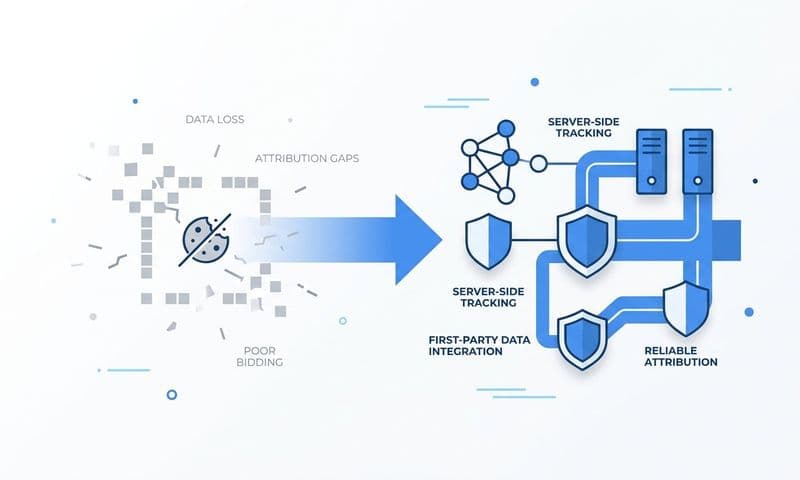
Here is why. When a user visits your website, your pixel fires from their browser and sends data back to the ad platform. But that process depends on the browser allowing it. iOS privacy updates have significantly restricted the data that gets passed from mobile Safari users. Ad blockers prevent pixels from loading entirely. Third-party cookie restrictions in Chrome and other browsers add another layer of data loss. If you are running Meta campaigns, understanding why Facebook ads stopped working after iOS 14 provides essential context for these challenges.
The result is that a portion of your actual conversions never get reported back to your ad platforms. You are making budget decisions based on incomplete data, and you may not even realize it.
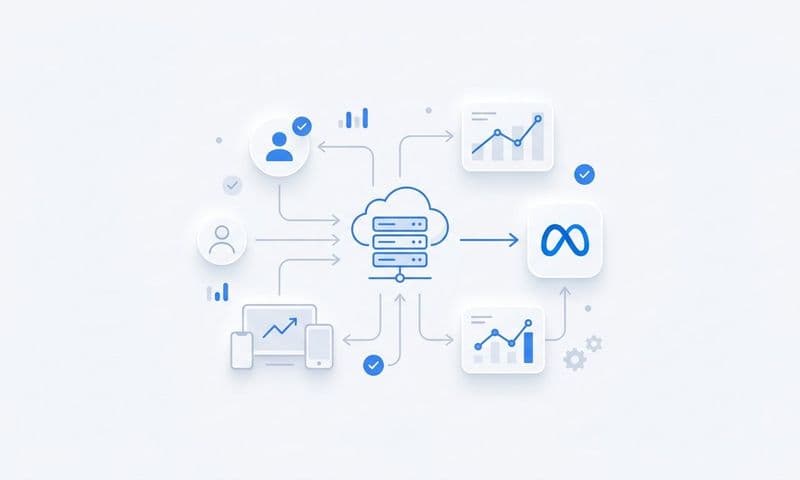
Server-side tracking solves this problem by changing where the data originates. Instead of relying on the user's browser to send conversion data, server-side tracking sends that data directly from your server to the ad platform. Browser restrictions, ad blockers, and cookie limitations do not apply because the data never passes through the browser at all.
The practical difference is significant. Many marketers who implement server-side tracking alongside their existing pixel setup discover conversions that were previously going untracked. The pixel continues to capture what it can, and the server-side layer fills in the gaps.
Cometly offers server-side tracking that works alongside your existing pixels. Rather than replacing your current setup, it layers on top to recover the data your pixel is missing. This is especially important for businesses running ads to mobile audiences, where iOS restrictions have the greatest impact.
A common mistake at this stage is assuming your pixel is capturing everything simply because it is installed and reporting data. Pixels report what they can see. Server-side tracking reveals what they cannot.
Success indicator: After implementing server-side tracking, you see a noticeable increase in tracked conversions compared to what your pixel-only setup was reporting. Your conversion data becomes more complete, and your cost-per-conversion metrics reflect a more accurate picture of actual performance.
Step 5: Choose the Right Attribution Model for Your Business
Once your tracking is solid and your data sources are connected, you face a new question: how do you assign credit for a conversion that involved five different touchpoints across three different channels?
This is where attribution models come in, and where most ad platforms quietly mislead you.
By default, most ad platforms use last-click attribution. That means 100% of the conversion credit goes to the final ad a user clicked before converting. If someone saw your Google search ad, then a Meta retargeting ad, then clicked a YouTube ad right before purchasing, YouTube gets all the credit. Google and Meta get none, even though they played a role in moving that prospect toward the decision.
Last-click attribution systematically undervalues upper-funnel and mid-funnel touchpoints. It makes awareness campaigns look like they are not working when they are actually doing exactly what they should. This is one reason many teams end up wasting money on ads by cutting campaigns that were quietly driving results.
Here is a quick breakdown of the main attribution models:
First-touch attribution: All credit goes to the first interaction. Useful for understanding what channels are best at generating awareness and bringing new prospects into the funnel.
Last-touch attribution: All credit goes to the final interaction before conversion. Useful for understanding what closes deals, but misses everything that happened before.
Linear attribution: Credit is distributed equally across every touchpoint in the journey. Gives a more balanced view but does not differentiate between high-impact and low-impact interactions.
Data-driven multi-touch attribution: Credit is distributed based on the actual influence each touchpoint had on the conversion, using algorithmic analysis of your conversion data. This is the most accurate model for most businesses, particularly those with longer sales cycles or multiple channels. Explore the top marketing attribution software options in 2026 to find the right fit for your needs.
The right model depends on your business. If you have a short sales cycle with few touchpoints, last-click may be sufficient. If you are running a B2B operation where prospects research for weeks before converting, multi-touch attribution will give you a far more accurate read on what is working.
Cometly's multi-touch attribution allows you to compare models side by side within a single dashboard. You can look at the same set of conversions through a first-touch lens, a last-touch lens, and a multi-touch lens simultaneously, which makes budget decisions much clearer.
Success indicator: You can view the same conversion data through multiple attribution models and use those different perspectives to make informed decisions about where to allocate budget across the funnel.
Step 6: Feed Better Conversion Data Back to Ad Platforms
Here is a step that many marketers overlook even after they have done the hard work of fixing their internal reporting: the ad platforms themselves need your better data.
Meta, Google, and other ad platforms use machine learning to optimize their targeting and bidding. Their algorithms decide who to show your ads to, how much to bid for each impression, and how to allocate your budget across ad sets. But those algorithms are only as good as the conversion signals they receive.
If your pixel is only capturing a fraction of your actual conversions due to iOS restrictions or ad blockers, the algorithm is optimizing based on incomplete information. It thinks certain audiences or placements are not converting when they actually are. The result is suboptimal targeting, inflated costs, and lower returns than you should be getting. This is often the root cause when ads show conversions but no sales in your actual business results.
Fixing your internal attribution is only half the job. The other half is sending that enriched, accurate conversion data back to the platforms so their algorithms can use it.
This process is called conversion syncing. You take the complete, server-side conversion data you have collected and send it back to Meta via the Conversions API, to Google via enhanced conversions, and to other platforms through their respective server-side integrations. The platforms receive a fuller picture of which ads are actually driving results, and their algorithms adjust accordingly.
Over time, this improved feedback loop leads to better lookalike audience quality, smarter automated bidding, and generally improved campaign performance. You are not just reporting better internally; you are actively making the ad platforms smarter about who to target on your behalf. This is the key to scaling ads without losing money as you increase budgets.
Cometly's Conversion Sync feature automates this process. Rather than manually configuring server-side event sending for each platform, Conversion Sync routes your enriched conversion data back to Meta, Google, and other platforms automatically. This keeps the feedback loop running without ongoing manual intervention.
The common pitfall here is stopping at internal reporting. Many teams do the work of fixing their attribution dashboard but never close the loop by feeding that better data back to the platforms. That leaves significant performance gains on the table.
Success indicator: Your ad platforms are receiving richer, more complete conversion signals. Over time, you see improved targeting efficiency, stronger lookalike audience performance, and better returns from automated bidding strategies as the algorithms work from cleaner data.
Your Six-Step Tracking Fix: A Quick-Reference Checklist
If you have made it this far, you now have a clear path from tracking confusion to attribution clarity. Here is a quick summary of all six steps to keep as a reference:
Step 1: Audit your tracking setup. Check every platform for expired pixels, misconfigured events, missing UTMs, and broken conversion triggers. Document every gap before making changes.
Step 2: Map your full customer journey. Trace every touchpoint from first ad click to closed revenue. Identify where data exists and where it goes dark, especially at the marketing-to-sales handoff.
Step 3: Connect your data sources. Unify your ad platforms, website, and CRM into a single attribution environment so you can trace any conversion back to its original source.
Step 4: Implement server-side tracking. Layer server-side tracking on top of your existing pixels to recover conversions that browser restrictions and ad blockers are causing you to miss.
Step 5: Choose the right attribution model. Move beyond default last-click attribution and use multi-touch models that reflect how your customers actually make decisions.
Step 6: Feed better data back to ad platforms. Close the loop by syncing your enriched conversion data back to Meta, Google, and other platforms so their algorithms optimize from accurate signals.
The inability to see which ads are working is not a permanent condition. It is a solvable problem rooted in tracking gaps, siloed data, and attribution models that do not reflect reality. Start with the audit in Step 1 and work through each step progressively. Each one builds on the last.
Steps 3 through 6, connecting your data sources, implementing server-side tracking, choosing the right attribution model, and syncing conversion data back to platforms, are exactly what Cometly is built to handle in a unified solution. Ready to stop guessing and start knowing? Get your free demo and see how Cometly brings every touchpoint, every channel, and every conversion into one clear picture.