You're running campaigns across Meta, Google, TikTok, and three other platforms. Your CRM is full of leads. Your analytics dashboard shows thousands of data points. But when your CEO asks which marketing channels actually drive revenue, you freeze. The data is everywhere, but the answer isn't clear.
This is the paradox of modern marketing: we've never had more customer data, yet many teams still can't confidently answer what's working. Consumer marketing analytics solves this problem by transforming scattered touchpoints into a clear picture of what drives purchases.
For marketers managing multi-platform campaigns, consumer marketing analytics is the bridge between raw data and revenue-generating decisions. It connects every ad click, email open, and website visit to actual conversions, showing you which interactions matter most. When done right, it's the difference between guessing where to allocate budget and knowing exactly which channels deserve more investment.
Breaking Down the Data: What Consumer Marketing Analytics Actually Measures
Consumer marketing analytics tracks the complete story of how people discover, evaluate, and buy from you. At its core, it measures customer behavior patterns across every touchpoint—from the first ad impression to the final purchase and beyond.
The foundational metrics include channel interactions (which platforms drive traffic), engagement patterns (how consumers interact with your content), conversion events (what actions lead to revenue), and customer journey paths (the sequence of touchpoints before purchase). But here's what separates effective analytics from data noise: the ability to connect these metrics to outcomes.
Vanity Metrics vs. Actionable Insights: Many marketers track metrics that feel impressive but don't inform decisions. Page views look good in reports, but they don't tell you if those visitors convert. Social media followers grow your audience count, but follower growth doesn't automatically translate to revenue.
Actionable consumer insights answer questions that change how you spend money. Which ad campaigns generate customers with the highest lifetime value? What sequence of touchpoints leads to faster purchase decisions? Which channels assist conversions even if they're not the final click? These insights directly inform budget allocation, creative strategy, and targeting decisions.
Cross-Device and Cross-Platform Tracking: Modern consumers don't follow linear paths. They see your Instagram ad on mobile during lunch, research your product on desktop that evening, and convert three days later after reading a review on their tablet.
Effective consumer marketing analytics captures this fragmented journey by tracking the same person across devices and platforms. This requires sophisticated identity resolution—connecting anonymous website visitors to known users through email, phone numbers, or customer IDs. Without this capability, you're essentially watching disconnected scenes from different movies and trying to understand the plot.
The challenge is that traditional browser-based tracking struggles with this. iOS updates, cookie restrictions, and privacy changes have created blind spots in consumer journeys. This is why modern analytics platforms use server-side tracking and direct integrations with CRMs to maintain accuracy even as browser-based methods become less reliable.
What you're ultimately measuring is influence. Not just which touchpoint happened last, but which interactions actually influenced the decision to buy. That distinction changes everything about how you interpret your data.
From Clicks to Revenue: How Consumer Data Becomes Strategic Insight
Raw data is just noise until you connect it to outcomes. The transformation from clicks to strategic insight happens through a systematic process: capturing touchpoints, linking them to revenue events, and identifying patterns that predict success.
First, every interaction gets logged—ad clicks, email opens, website visits, content downloads, chat conversations, and CRM events. Each touchpoint is timestamped and tagged with source information. This creates a chronological record of every consumer's journey with your brand.
Next comes the critical connection: linking these touchpoints to conversion events. When someone makes a purchase, requests a demo, or becomes a qualified lead, the analytics system traces backward through their entire journey. This is where consumer marketing analytics becomes powerful—you're not just seeing what happened, you're seeing what led to revenue.
Why Attribution Matters: Not all touchpoints contribute equally to conversions. Your first-touch ad might create awareness, your educational blog post might build consideration, your retargeting campaign might drive urgency, and your email sequence might close the deal. Attribution modeling reveals which interactions deserve credit for the conversion.
Last-click attribution gives all credit to the final touchpoint before purchase. It's simple but dangerously misleading—it ignores everything that built awareness and consideration. First-click attribution credits only the initial interaction, missing the nurturing that converted interest into action.
Multi-touch attribution distributes credit across the journey based on each touchpoint's influence. Linear models give equal weight to every interaction. Time-decay models give more credit to recent touchpoints. Position-based models emphasize first and last touches while acknowledging middle interactions. The right model depends on your sales cycle and customer journey complexity.
Real-Time vs. Historical Analysis: Both approaches serve distinct purposes in consumer marketing analytics. Real-time analysis shows what's happening now—which campaigns are driving traffic this hour, which ads are converting today, which landing pages are performing right now. This powers immediate optimizations: pausing underperforming ads, increasing budgets on winning campaigns, and responding to sudden changes.
Historical analysis reveals patterns over weeks and months. It shows how seasonal trends affect performance, which customer segments have the highest lifetime value, and how changes in your marketing strategy impact results over time. This informs strategic decisions: annual budget planning, market expansion priorities, and long-term channel investment. Understanding the real-time marketing analytics benefits helps teams respond faster to market changes.
The most effective marketing teams use both. Real-time data keeps campaigns optimized day-to-day. Historical data ensures those optimizations align with broader strategic goals. Together, they create a feedback loop where tactical adjustments compound into strategic advantages.
The Technology Stack Behind Effective Consumer Analytics
Consumer marketing analytics requires more than just installing a tracking pixel. The technology stack includes several interconnected components that work together to capture, process, and visualize consumer data.
Tracking Infrastructure: This is the foundation—the code that captures consumer interactions across your digital properties. Website tracking monitors page views, button clicks, form submissions, and time on page. Ad platform pixels track impressions, clicks, and post-click behavior. Mobile SDKs capture in-app events and user actions.
The challenge with browser-based tracking is accuracy. Ad blockers prevent pixels from firing. Cookie restrictions limit cross-domain tracking. iOS privacy features block third-party cookies entirely. This creates gaps in your consumer journey data—you might see the first click and the final conversion, but miss everything in between.
Server-Side Tracking: This approach solves accuracy problems by processing events on your server rather than in the consumer's browser. When someone clicks an ad, your server receives the event directly from the ad platform. When they convert, your server sends that data back to ad networks and your analytics platform.
Because server-side tracking doesn't rely on browser cookies or client-side JavaScript, it's immune to ad blockers and privacy restrictions. You get complete, accurate data even as browser-based methods become less reliable. This is increasingly essential for maintaining data quality in consumer marketing analytics.
Data Integration and CRM Connections: Consumer marketing analytics becomes truly powerful when it connects marketing touchpoints to customer outcomes stored in your CRM. This integration shows not just who clicked your ad, but whether that person became a customer, their purchase value, and their lifetime revenue contribution.
Modern analytics platforms integrate directly with CRMs like Salesforce, HubSpot, and Pipedrive, syncing lead and customer data automatically. This creates a closed-loop system where marketing actions connect directly to revenue outcomes. You can finally answer questions like "Which ad campaign generated the most high-value customers?" instead of just "Which campaign got the most clicks?"
AI and Machine Learning Enhancement: Manual analysis of consumer behavior data becomes impossible at scale. When you're tracking thousands of customer journeys across dozens of touchpoints, patterns that drive success become invisible to human analysis.
AI-powered analytics identifies these hidden patterns automatically. Machine learning algorithms detect which combinations of touchpoints lead to higher conversion rates, which customer segments respond best to specific messaging, and which times of day drive the most valuable traffic. These insights enable predictive capabilities—forecasting which leads are most likely to convert and recommending budget allocations before you manually analyze the data.
Turning Insights Into Action: Practical Applications for Marketing Teams
Consumer marketing analytics only creates value when it changes decisions. The goal isn't to generate more reports—it's to allocate budgets smarter, target audiences better, and optimize campaigns faster. Here's how marketing teams apply these insights in practice.
Budget Allocation Based on Proven Impact: Most marketing teams distribute budgets based on intuition, past habits, or which channels feel like they're working. Consumer marketing analytics replaces guesswork with evidence.
When you can see which channels contribute to conversions across the entire customer journey, budget decisions become clear. If your data shows that LinkedIn ads consistently assist high-value conversions even though they're rarely the last click, you know that cutting LinkedIn budget would hurt revenue even if last-click reports suggest it's underperforming.
Similarly, if your analytics reveal that email sequences convert 3x better when preceded by educational blog content, you know to invest more in content creation. The key is connecting budget allocation to multi-touch attribution data rather than single-touchpoint metrics. Learning how to leverage analytics for marketing strategy transforms how teams approach spending decisions.
Audience Segmentation Driven by Behavioral Data: Not all customers are equally valuable, and not all prospects respond to the same messaging. Consumer marketing analytics reveals which customer profiles drive the most revenue and which behavioral patterns indicate purchase intent.
You might discover that customers who engage with three specific pages on your website convert at 5x the rate of those who don't. This insight lets you create lookalike audiences targeting people with similar characteristics. Or you might find that customers who interact with your brand across multiple channels have 2x higher lifetime value than single-channel customers, informing your cross-channel marketing strategy.
Behavioral segmentation goes beyond demographics. Instead of targeting "marketing managers in tech companies," you target "people who visited pricing pages twice, downloaded a guide, and engaged with retargeting ads"—a segment defined by actions that correlate with purchase intent.
Campaign Optimization Through Continuous Testing: Consumer marketing analytics creates a feedback loop for improvement. You launch campaigns, measure how different audience segments respond, identify what's working, and refine your approach based on data.
This applies to every campaign element. If analytics show that ads featuring customer testimonials drive 40% more conversions than product feature ads, you shift creative strategy. If data reveals that campaigns perform better on weekday mornings than weekend evenings, you adjust scheduling. If certain landing page variations convert visitors at higher rates, you direct more traffic there.
The difference between good and great marketing teams is often the speed of this optimization cycle. Teams with robust consumer marketing analytics can identify winning approaches in days rather than months, compounding small improvements into significant competitive advantages.
AI-powered recommendations accelerate this process further by automatically identifying optimization opportunities. Instead of manually analyzing campaign data to find improvements, you receive specific suggestions: increase budget on this ad set, adjust targeting for this audience, test this messaging variation.
Common Pitfalls and How to Avoid Them
Even with sophisticated analytics tools, many marketing teams fall into traps that undermine data quality and decision-making. Understanding these pitfalls helps you avoid them.
Data Silos and Fragmented Customer Views: When your ad platforms, website analytics, email system, and CRM don't communicate, you're seeing fragments of customer journeys rather than complete stories. Someone might click your Facebook ad, visit your site three times, engage with two emails, and convert—but if these systems don't connect, you see five disconnected events instead of one customer journey.
The cost of data silos is misattribution and missed insights. You might think your email campaigns aren't working because you don't see them driving conversions, when in reality they're assisting conversions that get credited to other channels. Or you might over-invest in channels that get last-click credit while under-funding channels that create awareness and consideration.
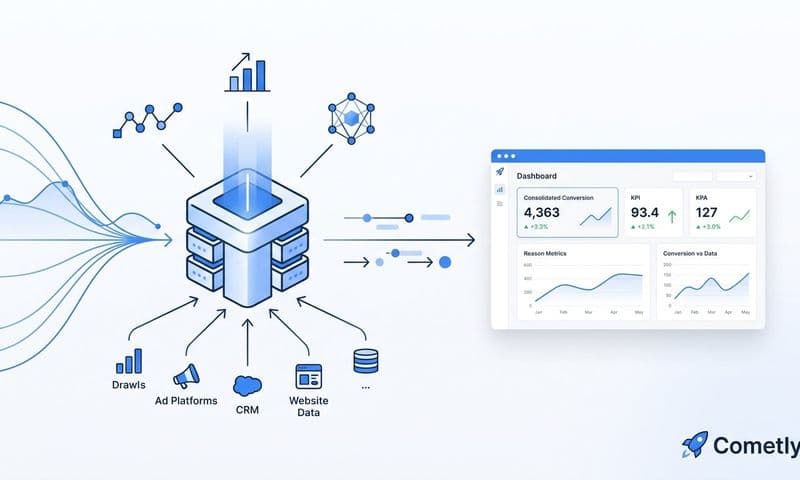
The solution is unified tracking that connects all touchpoints to individual customers. This requires a central analytics platform that integrates with every marketing tool you use, creating a single source of truth for customer journey data. A multi-channel marketing analytics dashboard consolidates this fragmented data into actionable views.
Over-Reliance on Last-Click Attribution: Last-click attribution is seductive because it's simple and definitive. Someone clicked this ad and converted, so this ad gets full credit. But this approach systematically undervalues every touchpoint except the final one.
Consider a customer who discovers your brand through a podcast ad, visits your site and reads three blog posts, engages with your social content, clicks a retargeting ad, and then searches your brand name on Google before converting. Last-click attribution gives all credit to that branded search—ignoring the podcast ad that created awareness, the content that built trust, and the retargeting that maintained consideration.
This leads to destructive budget decisions. You cut spending on awareness channels because they don't get last-click credit, then watch your overall conversions decline because you've stopped filling the top of your funnel. Understanding the common attribution challenges in marketing analytics helps teams avoid these costly mistakes.
Analysis Paralysis: When you can track everything, the temptation is to track everything. Marketing teams drown in dashboards showing hundreds of metrics, none of which clearly indicate whether marketing is succeeding or failing.
The antidote is focusing on metrics that directly connect to revenue outcomes. Track customer acquisition cost, conversion rate by channel, average order value by traffic source, and customer lifetime value by first-touch channel. These metrics inform budget allocation and strategic decisions. Secondary metrics like bounce rate and time on site only matter if they correlate with these primary outcomes.
Effective consumer marketing analytics isn't about having the most data—it's about having the right data organized around clear questions: What's driving revenue? Where should we invest more? What's not working?
Building Your Consumer Analytics Foundation
Implementing comprehensive consumer marketing analytics doesn't require starting from scratch. Most marketing teams already have pieces of the infrastructure—they just need to connect them properly and fill the gaps.
Step 1: Audit Your Current Tracking Capabilities: Start by mapping what you're currently measuring. List every platform where you run campaigns, every tool that captures customer data, and every system that stores conversion information. Then identify the gaps: Where do you lose visibility into customer journeys? Which touchpoints aren't being tracked? Where do data silos prevent you from seeing complete customer paths?
Step 2: Establish Unified Tracking Infrastructure: The goal is creating a single source of truth for customer journey data. This typically means implementing a consumer marketing analytics platform that integrates with your ad platforms, website, email system, and CRM. Look for solutions that offer server-side tracking to maintain accuracy despite browser limitations and privacy changes.
Proper implementation requires consistent tracking across all properties. Every ad campaign should use UTM parameters or platform-specific tracking. Your website should capture key events like page views, button clicks, and form submissions. Your CRM should receive updates when tracked visitors become known leads or customers. Understanding what data analytics in marketing encompasses helps teams build comprehensive tracking strategies.
Step 3: Define Your Attribution Model: Choose an attribution approach that matches your sales cycle complexity. If you have a simple, single-touch sales process, first-click or last-click might suffice. If customers typically interact with your brand multiple times before converting, multi-touch attribution is essential.
Most marketing teams benefit from comparing multiple attribution models side-by-side. This reveals how different perspectives on the customer journey lead to different conclusions about channel performance. The model you use for reporting doesn't have to be the same one you use for budget decisions—understanding multiple viewpoints creates better strategic thinking.
Key Questions When Evaluating Analytics Solutions: Not all consumer marketing analytics platforms serve the same purpose. When evaluating options, ask: Does it integrate with all the platforms we currently use? Can it track customers across devices and sessions? Does it offer server-side tracking for data accuracy? How does it handle attribution modeling? Can it sync conversion data back to ad platforms to improve their algorithms? Our guide on choosing a marketing analytics platform covers these considerations in depth.
Also consider: Does it provide AI-powered insights and recommendations, or just raw data? How quickly can we implement it without disrupting current campaigns? What level of technical expertise does it require to maintain? These practical considerations often matter more than feature lists.
Measuring Success: You'll know your consumer marketing analytics is working when it changes decisions. The right KPIs to track are: increased confidence in budget allocation decisions, improved return on ad spend across channels, reduced customer acquisition cost, and faster identification of winning campaigns and audiences.
Also watch for: decreased time spent manually analyzing data, increased alignment between marketing and sales teams around lead quality, and improved ability to forecast campaign performance. These indicators show that analytics is moving from a reporting function to a strategic advantage. Effective marketing analytics and reporting transforms raw data into revenue-driving decisions.
Moving Forward with Clarity and Confidence
Consumer marketing analytics isn't about collecting more data—it's about connecting the right data to revenue outcomes. The competitive advantage goes to marketing teams who understand the complete customer journey, not just the final click.
When you can see which touchpoints actually influence purchase decisions, budget allocation becomes evidence-based rather than intuition-driven. When you can track customers across devices and platforms despite browser limitations, you maintain accuracy while competitors lose visibility. When AI identifies patterns across thousands of customer journeys, you optimize faster than manual analysis allows.
The marketers winning today aren't the ones with the biggest budgets—they're the ones who know exactly what's working and can prove it. They're feeding better conversion data back to ad platforms, improving targeting algorithms. They're identifying high-value customer segments based on behavioral patterns. They're scaling campaigns with confidence because their analytics show clear cause-and-effect relationships between marketing actions and revenue outcomes.
The question isn't whether to invest in consumer marketing analytics—it's whether you can afford to make decisions without it. Every day you operate with incomplete customer journey data is a day competitors with better insights gain ground.
Ready to elevate your marketing game with precision and confidence? Discover how Cometly's AI-driven recommendations can transform your ad strategy—Get your free demo today and start capturing every touchpoint to maximize your conversions.