

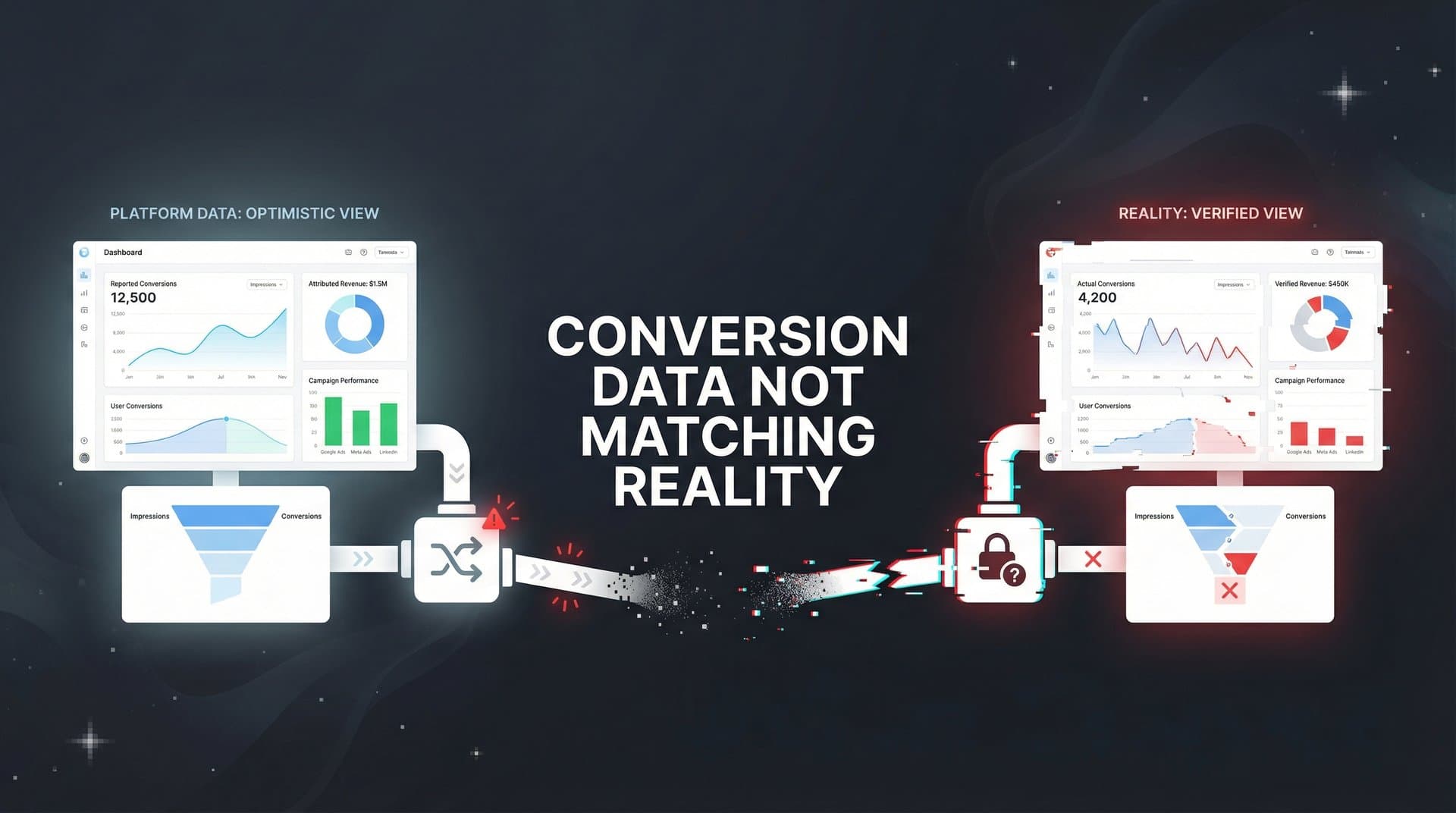
You check your Meta Ads dashboard and see 50 conversions from yesterday's campaign. Feeling confident, you pull up your CRM to follow up with the new leads. Only 30 are there. Confused, you ask your finance team how many actual customers came through. They count 20.
This isn't a rare glitch. It's the daily reality for most marketers running multi-channel campaigns. Your conversion data isn't matching reality, and the gap between what your ad platforms report and what actually happens in your business is costing you more than you realize.
The problem goes beyond frustrating discrepancies in your reports. When your data doesn't align, you make decisions based on fiction. You scale campaigns that aren't actually working. You cut budgets from channels that are driving real revenue. And worst of all, you feed inaccurate data back to ad platform algorithms, which then optimize toward the wrong outcomes.
Understanding why this happens and how to fix it isn't just about cleaner reporting. It's about making confident, profitable decisions with your marketing budget.
The Hidden Culprits Behind Your Data Discrepancies
The conversion data mismatch problem didn't appear overnight. It's the result of fundamental changes in how the internet tracks user behavior, combined with technical limitations that have always existed but are now impossible to ignore.
Browser Privacy Changes Have Broken Traditional Tracking: Since Apple introduced iOS 14.5 in 2021, the digital advertising landscape transformed completely. Users can now opt out of cross-app tracking with a single tap, and most do. Safari blocks third-party cookies by default. Firefox follows suit. Even Chrome is phasing out third-party cookies, though they've delayed the timeline multiple times. Understanding the full impact of lost conversion data from iOS privacy changes is essential for modern marketers.
What does this mean for your conversion tracking? When someone clicks your ad on their iPhone, browses your site, but doesn't convert until later, that connection often gets lost. The cookie that would have linked their initial click to their eventual purchase simply doesn't exist anymore. Your ad platform sees the click but never sees the conversion, while your website analytics shows a conversion with no clear source.
Cross-Device Journeys Create Invisible Gaps: Picture this common scenario. A potential customer sees your Instagram ad on their phone during their morning commute. They're interested but not ready to buy. That evening, they search for your brand on their laptop and convert. Which touchpoint gets credit?
Most ad platforms can't connect these dots. Meta knows about the mobile click. Google knows about the desktop search and conversion. Neither platform sees the complete journey. Your data shows two separate, unrelated events when it's actually one customer journey split across devices.
The scale of this problem is significant. People regularly switch between phones, tablets, and computers throughout their day. Each device switch creates a potential blind spot in your tracking.
Attribution Windows Create Timing Mismatches: Here's where it gets technical but important. Meta Ads uses a 7-day click and 1-day view attribution window by default. Google Ads uses a 30-day click window. Your CRM records conversions the moment they happen, regardless of when the ad click occurred.
Let's say someone clicks your Facebook ad on Monday but doesn't convert until the following Tuesday, nine days later. Facebook won't count this conversion because it falls outside their attribution window. But your CRM shows a new lead, and you might see it attributed to a different source entirely.
These timing differences compound when you're running campaigns across multiple platforms. Each platform has its own rules for what counts and when, creating a situation where the sum of all platform-reported conversions exceeds your actual total conversions by a significant margin.
How Ad Platforms Count Conversions (And Why It Differs From Your CRM)
Ad platforms aren't trying to deceive you with inflated numbers. They're operating within their own limited view of the customer journey, using attribution models that serve their business interests as much as yours.
Platform-Specific Attribution Models Have Built-In Biases: Most ad platforms use last-click attribution by default. This means they give full credit to the last ad interaction before a conversion. If someone clicked five different ads across three platforms before converting, each platform that got a click might claim 100% credit for that same conversion.
Your CRM, on the other hand, doesn't care about attribution models. It simply records when a lead enters the system and where they came from based on the most recent source. This creates an immediate discrepancy. The ad platforms are counting conversions based on their interaction history, while your CRM is recording actual leads based on direct form submissions or purchases. These conversion data discrepancies are a fundamental challenge in modern marketing.
Think of it like this: if three different salespeople each claim they closed the same deal, your revenue doesn't triple. But in digital advertising, that's essentially what's happening across your reporting dashboards.
Duplicate Counting Across Channels Is Inevitable: When you run campaigns on Meta, Google, TikTok, and LinkedIn simultaneously, you're creating multiple opportunities for the same conversion to be counted multiple times. A customer might see your LinkedIn ad, click a Google search ad, engage with a Meta retargeting ad, and then convert.
Each platform sees their piece of the puzzle and claims credit. LinkedIn reports a conversion from their ad. Google reports a conversion from search. Meta reports a conversion from retargeting. Your total reported conversions across all platforms might show 150, but your actual conversions are only 50. This is why ad platform reporting not matching your actual results is such a common frustration.
This isn't a minor accounting error. It fundamentally distorts your understanding of campaign performance and return on ad spend.
Every Platform Wants to Prove Its Value: Let's be direct about the incentive structure. Ad platforms make money when you spend more on advertising. They have a vested interest in showing you positive results that justify continued and increased spending.
This doesn't mean they're fabricating data, but it does mean their attribution methodologies tend to be generous in claiming credit. View-through conversions, where someone sees but doesn't click your ad and later converts, are a perfect example. The platform counts it as a conversion influenced by their ad, even though the person never actually engaged with it.
Your CRM has no such incentive. It simply records what actually happened in your business, making it a more reliable source of truth for actual conversion volume, even if it can't tell you which marketing touchpoints influenced those conversions.
The Real Cost of Trusting Inaccurate Data
Data discrepancies aren't just an annoying reporting problem. They directly impact your profitability and growth trajectory in ways that compound over time.
Budget Misallocation Drains Your Marketing ROI: When your conversion data is inflated or inaccurate, you make budget decisions based on false signals. You see a campaign reporting a strong return on ad spend in the platform dashboard and decide to scale it aggressively. Meanwhile, your actual revenue from that channel doesn't justify the increased spend.
The opposite problem is equally damaging. Channels that are genuinely driving revenue might appear underperforming in platform reporting due to attribution gaps. You cut budgets or pause campaigns that are actually working, shifting resources to channels that only look good on paper. Learning how to fix attribution data gaps is critical for accurate budget allocation.
This misallocation doesn't just waste money on a single campaign. It creates a pattern of poor decision-making that affects your entire marketing strategy. Over months and quarters, you systematically invest in the wrong channels while starving the ones that actually drive business results.
Scaling Campaigns That Aren't Actually Working: Here's a scenario that plays out constantly in marketing teams. A campaign shows promising conversion numbers in the ad platform. The cost per conversion looks great. The reported ROAS is strong. You get approval to triple the budget.
Two months later, your finance team asks why revenue hasn't increased proportionally to your ad spend. You investigate and discover that many of those reported conversions were duplicates, fell outside your actual customer profile, or never actually converted in your CRM. You've just spent a significant portion of your quarterly budget scaling a campaign that wasn't delivering real results.
The confidence to scale is essential for growth, but it must be based on accurate data. When your conversion tracking doesn't match reality, you lose the ability to identify genuine winners worth scaling versus campaigns that only appear successful due to tracking discrepancies.
Bad Data Creates a Negative Feedback Loop: This is where the problem becomes truly insidious. Modern ad platforms use machine learning algorithms that optimize based on the conversion data you send them. When that data is inaccurate, incomplete, or misattributed, you're teaching the algorithm to optimize toward the wrong outcomes.
Let's say your conversion tracking is missing 30% of actual conversions due to browser restrictions and cross-device gaps. The ad platform's algorithm doesn't know about those missing conversions. It's making optimization decisions based on an incomplete picture, potentially overlooking audience segments and creative approaches that are actually driving results. If you're experiencing missing conversion data from ads, your optimization suffers significantly.
Even worse, if you're feeding duplicate or false conversion data back to the platform, you're actively training it to target people who aren't actually converting. The algorithm learns the wrong patterns and doubles down on ineffective strategies, all while reporting metrics that look acceptable in the dashboard.
Building a Single Source of Truth for Your Marketing Data
The solution to conversion data mismatches isn't trying to reconcile multiple conflicting reports. It's creating a unified tracking infrastructure that captures the complete customer journey regardless of browser restrictions, device switches, or platform limitations.
Server-Side Tracking Bypasses Browser-Level Restrictions: Traditional client-side tracking relies on cookies and browser-based pixels that are increasingly blocked by privacy features and ad blockers. Server-side tracking takes a fundamentally different approach by recording conversion events on your server before sending them to ad platforms.
When someone converts on your website, instead of relying on a browser pixel to fire and hopefully reach the ad platform, your server directly sends the conversion data. This bypasses cookie restrictions, ad blockers, and browser privacy features that break traditional tracking. Implementing first-party data tracking solutions is essential for maintaining accurate conversion data.
The difference in data accuracy is substantial. While client-side tracking might capture 60-70% of actual conversions due to various blocking mechanisms, server-side tracking can achieve near-complete capture of conversion events. You're finally seeing the full picture of what's actually happening in your business.
Unified Tracking Connects Every Touchpoint: The power of server-side tracking multiplies when you connect it across all your marketing systems. Your ad platforms, website analytics, CRM, and even offline conversion data all feed into a single source of truth.
This unified view solves the cross-device and cross-platform attribution problem. When someone clicks your Meta ad on mobile, searches your brand on desktop, and converts via a phone call tracked in your CRM, you can see the complete journey. Each touchpoint is connected to the same customer record, giving you accurate multi-touch attribution instead of fragmented, conflicting reports. Don't forget that offline conversions not tracked represent a significant blind spot for many businesses.
The practical impact is transformative. Instead of trying to reconcile why Meta reports 50 conversions and Google reports 45 when you only had 30 actual customers, you have one accurate number that matches your business reality and shows exactly which touchpoints contributed to each conversion.
Multi-Touch Attribution Reveals the Complete Customer Journey: Single-touch attribution models used by most ad platforms are fundamentally limited. They assign 100% credit to one touchpoint, whether that's the first click, last click, or last ad interaction. This oversimplifies the reality of how people make purchase decisions.
Multi-touch attribution recognizes that conversions typically result from multiple touchpoints across different channels and time periods. Someone might discover your brand through a Meta ad, research you via Google search, engage with your content, see a retargeting ad, and finally convert.
With proper multi-touch attribution, you can see the value contribution of each touchpoint in the journey. You understand which channels work best for awareness versus conversion. You identify which combinations of touchpoints lead to the highest-value customers. This insight is impossible to gain from platform-specific reporting that only sees its own piece of the puzzle.
Building this single source of truth requires the right infrastructure, but the competitive advantage it provides is substantial. You make decisions based on complete, accurate data while your competitors are still guessing based on fragmented platform reports.
Practical Steps to Align Your Conversion Data Today
You don't need to rebuild your entire marketing infrastructure overnight. Start with these concrete steps to immediately improve your conversion data accuracy and alignment.
Audit Your Current Tracking Setup: Begin by mapping every conversion tracking mechanism you currently have in place. List all the pixels, tags, and tracking codes across your website. Document which ad platforms are receiving conversion data and how. Check your CRM integration to understand what conversion information flows in and from where.
Look for gaps where conversions might be lost. Are you tracking conversions that happen over the phone? What about customers who start on one device and finish on another? Do you have proper tracking for all your landing pages, or are some missing key pixels? If you're wondering why your conversions are not tracking, a thorough audit is your first step.
Also identify redundancies where multiple tracking methods might be counting the same conversion. If you have both a Meta pixel and a conversion API implementation, are they properly deduplicated? Are you accidentally double-counting conversions that flow through both your website tracking and your CRM integration?
This audit reveals the specific weak points in your current setup and helps you prioritize what to fix first.
Implement Consistent UTM Parameters and Naming Conventions: One of the simplest yet most impactful improvements you can make is standardizing how you tag and track your marketing campaigns. Create a clear UTM parameter structure and stick to it religiously across all channels.
Your UTM parameters should include campaign source, medium, campaign name, and any other relevant identifiers that help you track performance consistently. The key is consistency. If you use "facebook" as a source in some campaigns and "meta" in others, you're fragmenting your data and making accurate analysis impossible.
Document your naming conventions and make sure everyone on your marketing team follows them. When you launch a new campaign, the UTM structure should be immediately clear and consistent with all your other campaigns. This simple discipline dramatically improves your ability to track which specific campaigns and channels are driving real results.
Feed Enriched Conversion Data Back to Ad Platforms: Here's where you close the loop and improve not just your reporting accuracy but also your campaign performance. Once you have accurate conversion data from your unified tracking system, send that enriched data back to your ad platforms. Understanding how to feed conversion data back to ad platforms is crucial for optimization.
Instead of relying on basic browser-based pixel tracking that misses conversions and lacks context, you can send complete conversion events that include customer value, product information, and other relevant data points. This gives ad platform algorithms much better information to optimize against.
When Meta's algorithm knows which ad clicks led to high-value customers versus low-value ones, it can optimize toward better outcomes. When Google understands the complete conversion picture including conversions that happened outside the browser, it can find more customers like your best ones.
This enriched data feedback creates a positive cycle. Better data leads to better optimization, which leads to better results, which generates more accurate data to feed back into the system. You're finally working with the ad platforms instead of fighting against their limited view of your customer journey.
Turning Data Accuracy Into Competitive Advantage
The conversion data mismatch problem isn't inevitable. It's solvable with the right tracking infrastructure and a commitment to building a single source of truth for your marketing data.
When your conversion data matches reality, everything changes. You make budget decisions with confidence instead of guesswork. You scale campaigns that are genuinely working instead of ones that just look good in platform dashboards. You feed accurate data back to ad algorithms, improving their optimization and your results.
Most importantly, you stop wasting money on the invisible tax of inaccurate data. The budget misallocation, the failed scaling attempts, the negative feedback loops, they all disappear when you can see clearly what's actually driving revenue in your business.
Your competitors are likely still struggling with fragmented data and conflicting reports. They're making decisions based on incomplete information and wondering why their marketing performance is inconsistent. This is your opportunity to build a sustainable competitive advantage through superior data infrastructure.
The marketers who win in the current privacy-focused, multi-platform advertising landscape are the ones who invest in accurate, unified attribution. They're not the ones with the biggest budgets. They're the ones who know exactly what's working and can confidently invest behind real results.
Ready to elevate your marketing game with precision and confidence? Discover how Cometly's AI-driven recommendations can transform your ad strategy. Get your free demo today and start capturing every touchpoint to maximize your conversions.


