

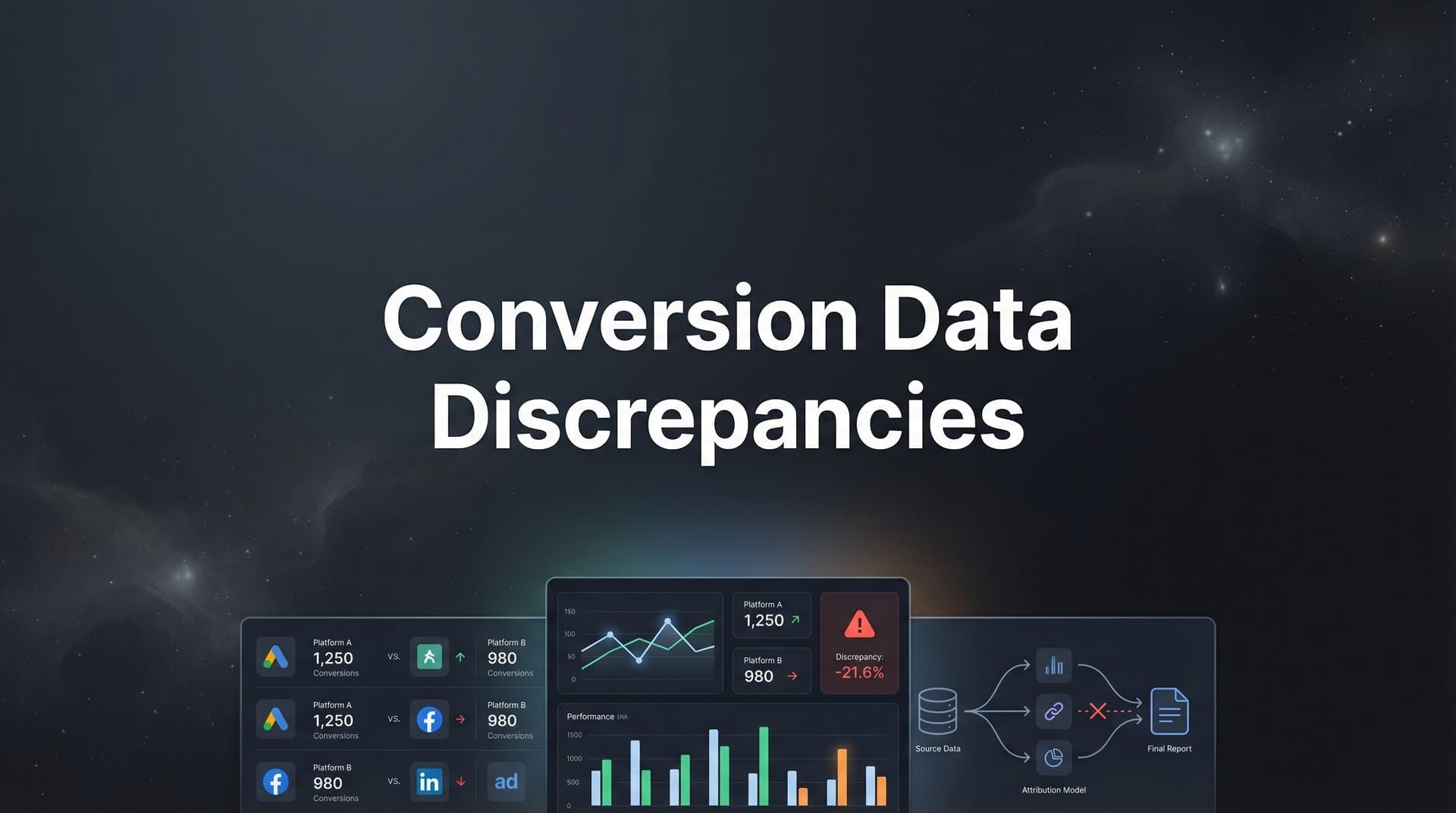
You refresh your dashboard for the third time this morning. Google Ads shows 50 conversions. Meta Ads claims 38. Your CRM logged 42. Your analytics platform? Another number entirely. They're all tracking the same campaign, the same time period, the same business—yet none of them agree.
If you've ever felt that sinking feeling of not knowing which number to trust, you're not alone. Conversion data discrepancies are one of the most frustrating realities of modern digital marketing. These mismatches aren't just annoying—they directly impact budget allocation, campaign optimization, and strategic decisions that affect your bottom line.
The good news? These discrepancies follow predictable patterns. Once you understand why they happen and how to diagnose them systematically, you can make confident marketing decisions even when your numbers don't perfectly align. This guide will walk you through the root causes of conversion data mismatches and give you a practical framework for identifying and resolving them.
The Anatomy of a Conversion Data Mismatch
Conversion data discrepancies happen when different platforms report different conversion counts for the same marketing activity. These aren't simple rounding errors or minor statistical variations—they represent fundamental differences in how platforms track, attribute, and report customer actions.
Understanding how conversion data flows helps explain why mismatches occur. When someone clicks your ad and completes a purchase, here's what happens: the user takes an action (clicking, viewing), a tracking mechanism fires (pixel, tag, SDK), the platform records the event according to its attribution rules, and finally the conversion appears in reporting dashboards. Each step in this chain introduces potential points of divergence.
Think of it like multiple witnesses describing the same event. Each platform sees the customer journey from a different vantage point, with different visibility into what happened before and after the interaction they tracked.
Conversion data discrepancies typically fall into three main categories. Timing discrepancies occur when platforms record conversions at different moments or aggregate data across different time windows. Attribution conflicts happen when multiple platforms claim credit for the same conversion using different attribution models. Tracking failures represent actual data loss—when conversions occur but aren't captured by one or more platforms.
The distinction matters because each category requires a different diagnostic approach. A timing issue might resolve itself with patience and proper date range selection. An attribution conflict requires understanding each platform's rules and choosing a consistent framework. A tracking failure demands immediate technical investigation and fixes.
Many marketers initially treat all discrepancies as technical failures requiring urgent fixes. This creates unnecessary panic and wasted effort. The reality is more nuanced: some variance between platforms is normal and expected, while certain discrepancies signal genuine problems that need addressing.
The key is learning to distinguish between acceptable variance and critical tracking issues. A 10-15% difference between platforms often falls within expected range given different attribution methodologies. A 50% gap or sudden dramatic changes in discrepancy patterns typically indicate something broken that needs investigation. For a deeper dive into identifying these issues, explore our guide on solving attribution data discrepancies.
Why Your Ad Platforms and CRM Never Agree
Ad platforms and CRMs approach conversion tracking with fundamentally different perspectives and priorities. Understanding these differences explains why perfect alignment is virtually impossible.
Attribution windows create one of the most significant sources of discrepancy. Meta Ads defaults to a 7-day click and 1-day view attribution window, meaning it claims credit for conversions that happen within 7 days of a click or 1 day of an ad impression. Google Ads uses a 30-day click attribution window by default. Your CRM doesn't use attribution windows at all—it simply records when transactions occur.
This creates scenarios where the same conversion gets counted differently across platforms. Imagine someone clicks a Meta ad on Monday, clicks a Google ad on Thursday, then converts on Friday. Meta claims the conversion because it falls within its 7-day window. Google also claims it because it falls within its 30-day window. Your CRM records one conversion on Friday. Result: three different reported conversion counts for what was actually a single customer action.
Each platform also applies different attribution models to determine which touchpoint deserves credit. Last-click attribution gives 100% credit to the final ad clicked before conversion. First-click gives credit to the initial touchpoint. Multi-touch distributes credit across multiple interactions. When platforms use different models, they inevitably report different conversion counts even when tracking the same customer journeys.
The challenge intensifies with cross-device customer journeys. Someone might see your ad on their phone during their morning commute, research on their work laptop during lunch, and finally purchase on their tablet at home. Most ad platforms struggle to connect these dots across devices, leading to incomplete visibility into the full customer journey.
Browser and device limitations further fragment the picture. When someone switches from the Facebook app to a mobile browser, then later uses a desktop computer, platforms lose the thread. Each environment has different tracking capabilities and privacy restrictions, creating natural blind spots in the data.
Time zone differences also contribute to apparent discrepancies. If your Google Ads account uses Pacific Time but your CRM operates in Eastern Time, conversions near midnight might be attributed to different dates across systems. This creates day-to-day variances that resolve when you look at longer time periods but cause confusion in daily reporting.
Platform reporting delays add another layer of complexity. Some platforms update conversion data in near real-time, while others batch process conversions every few hours or even days. Comparing reports pulled at different times can show different numbers simply because one platform hadn't finished processing recent conversions. If you're experiencing issues with inaccurate conversion data in Google Ads, these delays are often a contributing factor.
The Hidden Culprits: Privacy Changes and Tracking Gaps
The tracking landscape has fundamentally changed over the past few years, creating new sources of conversion data discrepancies that didn't exist in the era of unrestricted third-party cookies.
Apple's App Tracking Transparency framework, introduced with iOS 14.5, represents the most significant shift. When users opt out of tracking—and many do—apps can no longer access the device identifier that previously enabled cross-app conversion tracking. This means Meta, Google, and other platforms lose visibility into conversions that happen after someone clicks an ad in their mobile app. Understanding the full impact of lost conversion data from iOS privacy changes is essential for modern marketers.
The impact shows up as a gap between what platforms report and what actually happened. Your backend systems record the conversion because the customer completed the purchase. But the ad platform never receives the signal that their ad led to that conversion, creating an apparent discrepancy.
Browser privacy features compound the challenge. Safari's Intelligent Tracking Prevention and Firefox's Enhanced Tracking Protection actively block or limit third-party cookies and tracking scripts. When someone clicks your ad in Safari, the tracking pixel might be prevented from firing or have its data significantly restricted.
These privacy protections create systematic undercounting in ad platform reports. The conversions still happen—customers still buy your products—but the connection between ad exposure and conversion gets severed at the browser level. Your CRM sees the revenue; your ad platforms don't see the conversion.
Cookie deprecation continues to evolve as a challenge. While Google has delayed its third-party cookie phase-out in Chrome multiple times, the direction is clear: the cookie-based tracking that powered digital advertising for two decades is ending. As more browsers restrict cookies, conversion tracking gaps will widen for marketers who haven't implemented alternative tracking methods. Learn more about losing tracking data from cookies and how to prepare.
Ad blockers create another blind spot. Users who run ad blocking extensions often block analytics and conversion tracking scripts as well. These customers interact with your marketing, potentially convert, but remain invisible to your tracking systems. The discrepancy appears as a gap between backend revenue data and platform-reported conversions.
Consent management platforms add complexity in regulated markets. When users decline tracking cookies through GDPR or CCPA consent banners, your tracking pixels can't fire. This creates a known population of conversions that your ad platforms can't see, even though the customers arrived through your ads.
The cumulative effect of these privacy changes means conversion data discrepancies have grown larger and more common since 2021. What used to be a 5-10% variance between platforms can now reach 20-30% or more, depending on your audience's device mix and privacy preferences.
A Practical Framework for Diagnosing Discrepancies
When faced with conflicting conversion numbers, most marketers jump straight to troubleshooting pixels and tags. But effective diagnosis starts with establishing a clear baseline and working systematically through potential causes.
Step one is establishing your single source of truth. This should be your most complete and accurate record of actual business outcomes—typically your CRM, order management system, or backend transaction database. These systems record what actually happened in your business, regardless of whether tracking pixels fired or attribution windows aligned.
Your source of truth becomes the benchmark against which you measure all other platforms. If your CRM shows 100 conversions but Google Ads reports 85, you have a 15% discrepancy to investigate. The CRM number is reality; the Google Ads number reflects what that platform could see and attribute.
Step two involves mapping the complete data journey for a conversion. Start from the customer action and trace forward: Did the tracking pixel fire? Did it send data to the right platform? Did the platform receive and process the data? Did the conversion fall within the platform's attribution window? Was it credited to the right campaign?
This mapping exercise often reveals exactly where data gets lost or miscategorized. You might discover that your checkout page doesn't load the conversion pixel until after customers close the browser. Or that timezone settings cause midnight conversions to be attributed to the wrong day. Or that your attribution window is too short to capture your typical conversion timeline. For detailed guidance on this process, review our article on how to fix attribution discrepancies in data.
Use browser developer tools to verify pixel fires in real-time. Complete a test conversion yourself while watching the network tab to confirm that tracking events are being sent. Check that the data payload includes all necessary information like conversion value, order ID, and customer identifier.
Step three is categorizing each discrepancy as either acceptable variance or a critical tracking issue. This requires understanding what level of difference is normal given your specific setup and traffic sources.
Acceptable variance typically includes small percentage differences caused by attribution model differences, attribution window mismatches, timezone variations, and reporting delays. If Google Ads and Meta Ads show slightly different conversion counts but both are within 15% of your CRM total, this often represents normal variance rather than a tracking problem.
Critical tracking issues reveal themselves through specific patterns. Sudden changes in discrepancy percentage suggest something broke. One platform showing dramatically fewer conversions than others points to a tracking implementation problem. Discrepancies that grow larger over time indicate a systematic issue that's getting worse.
Create a simple diagnostic checklist to work through systematically. Check attribution window settings across platforms. Verify that all conversion tracking codes are properly installed and firing. Confirm that platform integrations are active and syncing data. Review recent changes to your website, checkout flow, or tracking implementation that might have broken something.
Document your findings in a tracking audit spreadsheet. List each platform, its reported conversion count, the discrepancy percentage versus your source of truth, and the likely cause category. This creates a clear picture of where your biggest data gaps exist and which issues deserve immediate attention versus which represent acceptable variance.
Strategies That Actually Reduce Data Gaps
Understanding why discrepancies happen is valuable, but reducing them requires implementing specific technical solutions and tracking strategies.
Server-side tracking has emerged as the most effective solution for bypassing browser-based tracking limitations. Instead of relying on pixels and cookies that browsers can block, server-side tracking sends conversion data directly from your server to ad platforms. When a customer completes a purchase, your backend system sends the conversion event to Meta, Google, and other platforms through their server-side APIs.
This approach eliminates many common sources of data loss. Ad blockers can't block server-to-server communication. Safari's Intelligent Tracking Prevention doesn't apply. iOS App Tracking Transparency restrictions don't affect server-side data transmission. The result is significantly more complete conversion data reaching your ad platforms.
Implementing server-side tracking requires technical setup but delivers substantial improvements in data accuracy. You'll need to configure your server to send conversion events with proper identifiers, match customers across sessions, and ensure data reaches platforms in the correct format. If you're struggling with conversion data not syncing, server-side implementation often resolves these issues.
UTM parameters provide a simpler but still effective strategy for improving attribution accuracy. By consistently tagging all marketing links with source, medium, campaign, and content parameters, you create a paper trail that survives across sessions and devices. When someone converts, you can trace back to the specific campaign that drove them, even if platform pixels didn't fire properly.
The key is consistency. Establish UTM naming conventions and apply them rigorously across all channels. Use a URL builder to ensure parameters are formatted correctly. Store UTM values in your CRM so you can compare your own attribution against what platforms report.
First-party data capture strengthens your tracking foundation. Collect email addresses early in the customer journey—through newsletter signups, lead magnets, or account creation. This gives you a persistent identifier that works across devices and sessions, enabling better matching when someone eventually converts. Our comprehensive guide on first-party data tracking setup walks you through the implementation process.
Many platforms now support enhanced conversion tracking that uses hashed email addresses or phone numbers to improve match rates. When you send this first-party data alongside conversion events, platforms can more accurately connect conversions to ad exposures, reducing apparent discrepancies.
Conversion sync capabilities let you send your CRM conversion data back to ad platforms, feeding their optimization algorithms with more complete information. Instead of platforms only knowing about conversions their pixels captured, they receive data about all conversions, including those lost to tracking limitations. Learn how to effectively feed conversion data back to ad platforms for improved campaign performance.
This doesn't eliminate discrepancies in reporting—your CRM will still show more conversions than platforms claim credit for—but it improves campaign performance by giving platform algorithms better data to optimize against. The ad platforms can learn from the complete conversion set rather than just the subset they could track.
Regular tracking audits should become part of your standard operating procedure. Monthly or quarterly, systematically verify that all tracking codes are firing, integrations are syncing, and discrepancy patterns remain within expected ranges. Catching tracking breaks quickly minimizes data loss and maintains the reliability of your marketing measurement.
Making Confident Decisions Despite Imperfect Data
Perfect conversion tracking is increasingly impossible in today's privacy-focused landscape. The goal isn't eliminating all discrepancies—it's building a decision-making framework that accounts for known data gaps while still enabling confident optimization.
Start by establishing acceptable discrepancy thresholds for your specific business. What percentage difference between your source of truth and platform reports represents normal variance versus a red flag? This varies based on your traffic sources, device mix, and typical customer journey length.
Many businesses find that 10-15% discrepancies between platforms and CRM data fall within acceptable range, given attribution differences and tracking limitations. Anything beyond 20% warrants investigation. Sudden changes in discrepancy patterns—even if the absolute percentage remains acceptable—often signal tracking issues that need attention.
Document these thresholds and review them with your team. When someone panics about numbers not matching perfectly, you can reference your established standards and focus energy on genuine problems rather than expected variance.
Multi-touch attribution helps you see beyond the limitations of any single platform's view. By tracking all touchpoints in the customer journey and distributing credit across them, you gain a more complete picture of what's actually driving conversions. This approach acknowledges that customers rarely convert from a single ad exposure and that different platforms play different roles in the conversion path. Dive deeper into attribution data analysis to master this approach.
Implement attribution modeling that reflects your actual customer behavior. If your typical customer journey spans multiple sessions and devices over several days, a last-click model will systematically undervalue upper-funnel touchpoints. Position-based or time-decay models might better represent how different channels contribute to eventual conversions.
Build reporting dashboards that explicitly account for known data gaps. Rather than showing raw platform numbers that you know are incomplete, create calculated metrics that adjust for typical discrepancy patterns. If your CRM consistently shows 20% more conversions than ad platforms report, factor this into your ROI calculations and performance targets.
This doesn't mean manipulating data to show what you want to see. It means being transparent about measurement limitations and making decisions based on adjusted numbers that better reflect reality. Your dashboard might show both the platform-reported conversions and your adjusted estimate based on historical CRM reconciliation.
Focus on trends and relative performance rather than absolute numbers when platform data is incomplete. Even if your conversion counts are understated, the directional insights remain valuable. If Campaign A shows 50 conversions and Campaign B shows 25, Campaign A is likely performing better even if the true numbers are higher for both.
Use your source of truth data for business decisions and platform data for optimization decisions. When calculating actual ROI or deciding overall budget levels, rely on your CRM numbers. When deciding which ad creative to scale or which audience to expand, platform data provides sufficient signal for optimization even if it's not perfectly complete.
Create feedback loops between your complete data and platform optimization. Regularly analyze which platform-reported conversions correspond to high-value customers in your CRM. This helps you optimize toward the conversions that actually matter to your business, even when platforms can't see the complete picture.
Moving Forward with Clarity
Conversion data discrepancies are a permanent feature of modern digital marketing. Privacy protections, cross-device journeys, and platform attribution differences ensure that your numbers will never perfectly align across all systems. This isn't a problem to solve—it's a reality to manage intelligently.
The marketers who succeed in this environment are those who understand why discrepancies happen, diagnose them systematically, and build decision-making frameworks that work despite imperfect data. They establish a single source of truth, typically in their CRM or backend systems, and use it as a benchmark for evaluating platform reports.
They implement technical solutions like server-side tracking to minimize data loss where possible. They use UTM parameters and first-party data capture to maintain visibility into customer journeys across devices and sessions. They sync conversion data back to ad platforms to improve algorithmic optimization even when reporting remains imperfect.
Most importantly, they make confident decisions based on directional insights and relative performance rather than waiting for perfect data that will never arrive. They establish acceptable discrepancy thresholds, focus on trends rather than absolute numbers, and build reporting that explicitly accounts for known measurement gaps.
The path forward isn't about achieving perfect attribution—it's about building a measurement foundation that gives you enough clarity to optimize effectively while acknowledging the inherent limitations of modern tracking. With the right framework and tools, you can navigate conversion data discrepancies without letting them paralyze your marketing decisions.
Ready to elevate your marketing game with precision and confidence? Cometly connects your ad platforms, CRM, and website tracking to capture every touchpoint in the customer journey, providing AI-driven recommendations that help you see which sources actually convert and make data-driven decisions to scale your campaigns. Get your free demo today and start capturing every touchpoint to maximize your conversions.


