

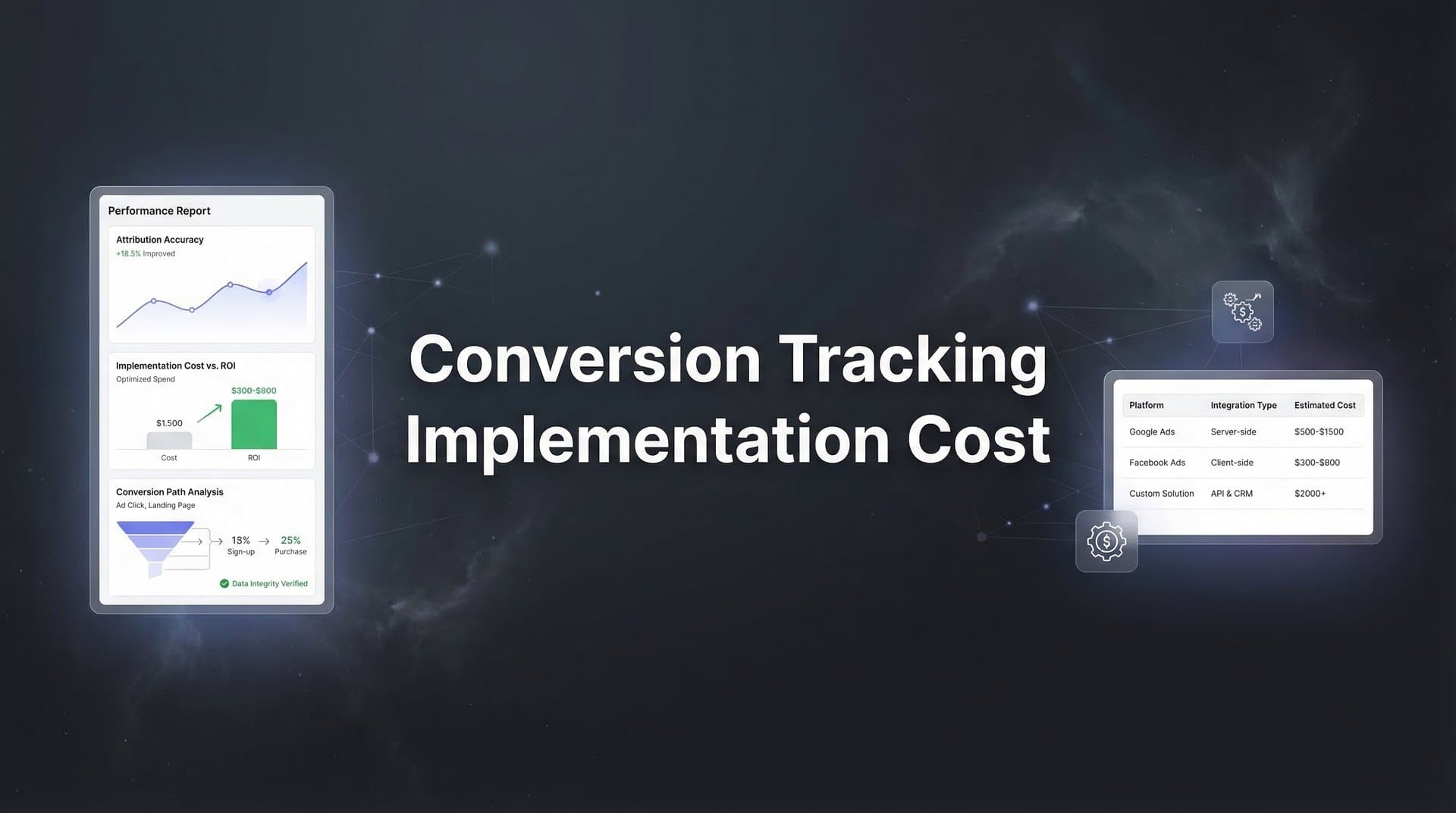
You're spending thousands on ads every month, but here's the uncomfortable truth: you probably don't know which ones are actually working. You know you need better conversion tracking—your gut tells you money is being wasted somewhere—but every time you research solutions, you hit the same wall. What does this actually cost?
The answer frustrates most marketers because it's genuinely complicated. Free platform pixels promise easy setup. Mid-tier analytics tools offer dashboards full of data. Enterprise attribution platforms tout AI-powered insights. And somewhere in between, there's the technical implementation nobody mentions until you're already committed.
Here's what makes this decision harder: the cost of getting it wrong compounds daily. Every misattributed conversion pushes budget toward underperforming channels. Every tracking gap hides your best customers. Every platform update breaks something you thought was working.
This guide cuts through the confusion. We'll break down what conversion tracking actually costs in 2026—from software fees to hidden technical debt—and more importantly, help you understand when better attribution pays for itself. Because the real question isn't what tracking costs. It's what you're losing by not having it.
The Three Cost Layers Most Marketers Underestimate
When marketers budget for conversion tracking, they typically think about software costs. That's like buying a car and forgetting about gas, insurance, and maintenance. Let's break down what you're actually paying for.
Software and Platform Fees: This is the visible part of the iceberg. Free platform pixels from Meta and Google cost nothing upfront, but they only track what happens on their own platforms. The moment you need to understand cross-channel attribution or server-side tracking, you're looking at paid solutions.
Mid-tier analytics platforms typically range from $100 to $500 monthly. These tools aggregate data from multiple sources and provide basic attribution modeling. They work well for businesses with straightforward customer journeys and modest ad spend.
Specialized attribution platforms built for serious advertisers usually start around $500 to $1,000 monthly and scale based on your ad spend or tracked events. These platforms offer server-side tracking, AI-powered insights, and the ability to feed enriched conversion data back to ad platforms. For businesses spending $50,000+ monthly on ads, this tier becomes essential rather than optional. Understanding the full conversion tracking platform cost structure helps you budget appropriately from the start.
Technical Implementation Labor: This is where budgets get blindsided. Even "easy setup" solutions require developer time to implement properly. Installing a basic pixel might take an hour. Configuring server-side tracking with proper event mapping, CRM integration, and cross-domain tracking? That's 20 to 40 hours of specialized development work.
In-house developer time costs vary, but figure $75 to $150 per hour for qualified developers who understand both marketing analytics and technical implementation. Agency or consultant fees typically run $150 to $250 per hour. For complex implementations involving multiple platforms, custom e-commerce setups, or legacy systems, you're looking at $3,000 to $10,000 in implementation labor alone.
The technical complexity escalates quickly. Connecting your ad platforms to your CRM requires API integrations. Setting up server-side tracking means configuring cloud infrastructure. Ensuring accurate user identification across devices demands sophisticated identity resolution. Each layer adds cost.
Ongoing Maintenance and Updates: This is the cost component that surprises marketers six months after implementation. Conversion tracking isn't set-it-and-forget-it infrastructure.
Ad platforms update their APIs regularly. Meta changes its Conversions API requirements. Google modifies how enhanced conversions work. Each update potentially breaks your existing tracking setup. Budget 5 to 10 hours monthly for monitoring, troubleshooting, and maintenance—that's $500 to $1,500 monthly in ongoing technical support.
Privacy regulations add another maintenance layer. GDPR compliance requires consent management. CCPA demands opt-out mechanisms. Cookie policies need updating. Each regulatory change triggers tracking adjustments, legal review, and technical implementation. Companies often underestimate this at $2,000 to $5,000 annually in compliance-related tracking updates.
Website redesigns, new product launches, and marketing campaign changes all require tracking updates. Launch a new landing page? Update your tracking. Add a new conversion funnel? Configure new events. Expand to a new ad platform? Integrate it into your attribution system. These ongoing adjustments accumulate quickly.
Why Free Tracking Solutions Cost More Than You Think
Free sounds appealing, especially when you're testing a new channel or working with a limited budget. But free platform pixels come with trade-offs that often cost more in lost opportunities than paid solutions would have cost upfront.
The Platform Pixel Limitation: Meta's pixel tracks what happens on Meta. Google's tag tracks what happens on Google. Each platform sees only its own contribution to conversions, which creates a fundamental attribution problem.
When someone clicks your Meta ad, then later searches your brand on Google and converts, both platforms claim credit for that conversion. You're not getting a complete picture—you're getting two incomplete, overlapping pictures that make your total conversions add up to 150% of reality.
Post-iOS privacy changes made this worse. Apple's App Tracking Transparency framework limited how platforms track users across apps and websites. Suddenly, platform pixels lost visibility into significant portions of the customer journey. Many marketers saw their tracked conversions drop 20% to 30% overnight—not because conversions actually decreased, but because tracking became less accurate. Modern solutions that go beyond traditional pixels address these limitations directly.
The invisible cost here is decision-making based on incomplete data. When you can't see which touchpoints actually drive conversions, you optimize toward what's visible rather than what's effective. You might cut budget from channels that are actually working but not getting proper attribution credit.
Mid-Tier Solutions and Their Sweet Spot: Analytics platforms in the $100 to $500 monthly range offer a middle ground. Tools like Google Analytics 4 (free) or paid platforms like Segment provide cross-platform data aggregation and basic attribution modeling.
These solutions work well for businesses with relatively straightforward customer journeys. If most of your customers convert within a single session or primarily use one or two channels, mid-tier analytics give you enough visibility to make informed decisions.
The limitations emerge as your marketing gets more sophisticated. Mid-tier platforms often struggle with accurate user identification across devices. They typically use last-click or simple multi-touch attribution models that don't reflect actual customer behavior. And they rarely offer the ability to send enriched conversion data back to ad platforms, which means you're not improving your ad targeting algorithms.
For businesses spending $10,000 to $50,000 monthly on ads, mid-tier solutions provide decent visibility at reasonable cost. You'll understand general performance trends and can make directional budget decisions. But you won't have the precision needed to optimize aggressively or the confidence to scale quickly.
When Specialized Attribution Justifies Higher Investment: Enterprise and specialized attribution platforms cost more because they solve problems that mid-tier solutions can't address. Server-side tracking maintains accuracy despite browser restrictions. AI-powered attribution models reveal which touchpoints actually influence conversions. Conversion sync feeds better data back to ad platforms, improving their optimization algorithms.
These platforms become essential when your customer journeys span multiple touchpoints, devices, and channels. If someone sees your Meta ad on mobile, researches on desktop, and converts via phone call, free pixels miss most of that journey. Implementing cross-device conversion tracking solutions connects these dots and reveals the complete customer path.
The investment makes sense when improved attribution accuracy directly impacts budget allocation. For a business spending $100,000 monthly on ads, even a 10% improvement in budget efficiency—redirecting $10,000 from underperforming channels to high-performers—generates $120,000 in annual value. That easily justifies a $12,000 to $18,000 annual platform investment.
The Hidden Costs That Inflate Every Implementation
Beyond software fees and technical setup, several cost categories catch marketers off guard. These aren't line items on vendor quotes, but they're real expenses that accumulate throughout implementation and beyond.
The Data Accuracy Gap Tax: Incomplete or inaccurate conversion data doesn't show up as a cost in your budget spreadsheet, but it's one of the most expensive problems in digital marketing. When you can't accurately attribute conversions, you make suboptimal decisions that compound over time.
Consider a common scenario: your attribution shows Meta driving 60% of conversions at $50 cost per acquisition, while Google drives 40% at $75 CPA. You increase Meta budget and decrease Google spend. But what if your tracking missed that most Meta conversions actually started with a Google search? You've just cut budget from your top-of-funnel driver while scaling a bottom-funnel channel that depends on it. Learning how to fix conversion tracking gaps prevents these costly misallocations.
Many businesses discover they've been underfunding their best channels for months or years. The opportunity cost—revenue you could have generated with better attribution—often dwarfs the cost of implementing proper tracking. For a business generating $1 million in annual revenue from paid ads, even a 5% improvement in channel allocation could mean $50,000 in additional revenue.
Integration Complexity Nobody Mentions Upfront: Every additional system you need to connect multiplies implementation complexity. Connecting two ad platforms might be straightforward. Connecting five ad platforms, your CRM, your e-commerce platform, your email marketing tool, and your phone tracking system? That's an integration challenge that requires custom development.
Most attribution platforms offer pre-built integrations for major platforms, but these rarely work perfectly out of the box. Your CRM might use custom fields that don't map to standard conversion events. Your e-commerce platform might require specialized tracking for subscription products. Your call tracking system might need custom API work to connect properly.
Each custom integration adds development time. Budget an additional 10 to 20 hours per non-standard integration, which translates to $1,500 to $4,000 per system. For businesses with complex tech stacks, integration costs can exceed the platform subscription cost in the first year.
Data quality issues add another hidden cost. When systems don't communicate properly, you get duplicate conversions, missing data, or mismatched user identities. Troubleshooting these problems requires both technical expertise and marketing analytics knowledge—a rare combination that's expensive to hire or contract.
Compliance and Privacy Overhead: Privacy regulations aren't going away—they're getting stricter. Every tracking implementation now requires careful attention to consent management, data retention policies, and user privacy rights.
GDPR compliance means implementing proper consent mechanisms before tracking European visitors. CCPA requires opt-out capabilities for California residents. Cookie policies need legal review and technical implementation. Each regulation adds both one-time setup costs and ongoing compliance monitoring. Following privacy-compliant conversion tracking methods from the start reduces costly retrofitting later.
Many businesses underestimate this at $3,000 to $8,000 in initial legal and technical setup, plus $1,000 to $2,000 annually in ongoing compliance updates. Larger businesses operating in multiple jurisdictions face significantly higher compliance costs.
The risk of non-compliance adds another hidden cost. GDPR fines can reach 4% of annual revenue. CCPA penalties start at $2,500 per violation. Beyond financial penalties, privacy violations damage brand reputation and customer trust. Proper compliance isn't optional—it's insurance against much larger potential losses.
When Better Tracking Actually Pays for Itself
Understanding costs matters, but the real question is ROI. At what point does investing in better conversion tracking generate more value than it costs? Let's break down the math that makes this decision clear.
The Attribution Gap Problem: Most businesses running multi-channel campaigns have an attribution gap—a disconnect between what's actually driving conversions and what their tracking shows. This gap directly translates to wasted ad spend.
Think about it this way: if your tracking shows Channel A delivering conversions at $60 CPA and Channel B at $90 CPA, you naturally shift budget toward Channel A. But what if your tracking is missing 30% of Channel B's conversions because they happen cross-device or after multiple touchpoints? You're now underfunding a channel that actually performs at $63 CPA while scaling one that's really at $75 CPA.
The financial impact compounds quickly. A business spending $50,000 monthly on ads with a 20% attribution gap is making budget decisions based on incomplete data. Even conservative estimates suggest this leads to 10% to 15% inefficiency in budget allocation—that's $5,000 to $7,500 in monthly wasted spend, or $60,000 to $90,000 annually. Implementing an accurate conversion tracking solution eliminates this hidden waste.
ROI Framework That Works: Calculate your tracking investment ROI by comparing the cost of better attribution against the value of improved budget allocation. Here's a practical framework that applies to most businesses.
Start with your monthly ad spend. For a business spending $75,000 monthly, that's $900,000 annually. Research your current attribution accuracy—most businesses with basic tracking capture 70% to 80% of actual conversion paths. That 20% to 30% gap represents decisions made without complete information.
Better attribution doesn't just show you what's working—it reveals what's not. When you can accurately see which channels, campaigns, and audiences drive real conversions, you can reallocate budget from underperformers to high-performers. Even a modest 8% to 12% improvement in overall efficiency through better budget allocation generates significant value.
For our $75,000 monthly spend example, a 10% efficiency improvement means $7,500 monthly in better results from the same budget—that's $90,000 annually. If your attribution platform costs $15,000 annually (software plus implementation and maintenance), you're generating 6x ROI in year one. The investment pays for itself in less than two months.
Time-to-Value Considerations: ROI isn't just about total value—it's about how quickly that value materializes. Different attribution solutions have different time-to-value profiles.
Basic platform pixels provide immediate data but limited insight. You'll see conversions within days, but you won't gain the deeper understanding needed for meaningful optimization. Mid-tier analytics platforms typically require 30 to 60 days to accumulate enough data for confident decision-making. Specialized attribution platforms often need 60 to 90 days to train AI models and establish baseline performance.
The faster you gain actionable insights, the sooner you can optimize and the more value you capture. A solution that costs more but provides actionable insights in 30 days often delivers better total ROI than a cheaper solution that takes 90 days to become useful. During those extra 60 days, you're still making decisions based on incomplete data.
Consider your business velocity. Fast-growing companies scaling ad spend quickly need attribution insights immediately. Waiting three months for data means making critical scaling decisions blind. For these businesses, faster time-to-value justifies higher implementation investment.
Building Your Budget: A Decision Framework That Works
Now that you understand the cost components and ROI dynamics, how do you actually build a realistic implementation budget? This framework helps you match investment to your specific situation.
Assessment Checklist for Right-Sizing Investment: Start by honestly evaluating your current tracking gaps and business needs. Your answers determine appropriate investment level.
First, audit your current tracking setup. Can you accurately attribute conversions across all your active channels? Do you know which touchpoints influence purchases versus which just happen to be present? Can you track users across devices? If you're answering no to these questions, you have significant tracking gaps that justify investment.
Second, evaluate your ad spend volume. Businesses spending under $10,000 monthly can often manage with free platform pixels plus Google Analytics 4. The efficiency gains from better attribution don't yet justify significant platform investment, though proper technical setup remains important.
Businesses spending $10,000 to $50,000 monthly hit the sweet spot for mid-tier solutions. Attribution gaps at this spend level create meaningful waste, but you don't yet need enterprise-grade platforms. Budget $2,000 to $5,000 for initial setup plus $100 to $500 monthly for platform fees.
Businesses spending $50,000+ monthly should seriously evaluate specialized attribution platforms. At this spend level, even small efficiency improvements generate substantial value. Reviewing enterprise conversion tracking pricing helps you understand what to expect at higher spend levels. Budget $5,000 to $12,000 for initial implementation plus $500 to $2,000+ monthly for platform fees and maintenance.
Third, count your active platforms and integration complexity. Running ads on just Meta and Google? Implementation is straightforward. Running Meta, Google, LinkedIn, TikTok, plus email, plus CRM, plus call tracking? Each additional integration adds cost. Budget an extra $1,000 to $3,000 per platform beyond the first three.
Phased Implementation Approach: You don't need to implement everything at once. Start with high-impact tracking and expand as ROI proves out.
Phase one focuses on accurate tracking for your highest-spend channels. If Meta represents 60% of your ad spend, get Meta tracking bulletproof first. Implement server-side tracking, ensure proper event mapping, and verify data accuracy. A comprehensive server-side tracking implementation guide walks you through this critical foundation. This typically requires 15 to 25 hours of implementation work—budget $2,500 to $5,000 depending on complexity.
Phase two adds cross-channel attribution. Once individual channels track accurately, implement attribution modeling that shows how channels work together. This phase typically adds another 10 to 20 hours of work for integration and model configuration.
Phase three optimizes advanced features like AI recommendations, automated budget suggestions, and conversion sync back to ad platforms. These features deliver incremental value once your foundational tracking is solid.
Phasing implementation spreads costs over time and lets you validate ROI before committing to full investment. Many businesses implement phase one, see immediate value in better data, then accelerate phases two and three.
Questions to Ask Before Committing: Whether you're evaluating attribution platforms or hiring implementation help, these questions reveal what you're actually getting.
Ask vendors what's included in base pricing versus what costs extra. Some platforms charge per tracked event or per connected platform. Others include everything in base pricing but charge for premium features or support. Understanding the full cost structure prevents surprise bills six months in.
Ask about implementation support. Does the platform provide dedicated onboarding? Do they handle technical setup or just provide documentation? How much of the implementation burden falls on your team? Platforms with white-glove onboarding cost more upfront but often reduce total implementation time and cost.
Ask about ongoing support and maintenance. What happens when tracking breaks? How quickly do they respond to support requests? Do they proactively monitor your tracking and alert you to issues? Ongoing support quality dramatically affects long-term cost of ownership.
Ask about scalability. What happens to pricing as your ad spend grows? Do they charge per conversion, per platform, or flat monthly fees? Understanding pricing structure helps you forecast costs as your business scales.
Making the Investment Decision With Confidence
Conversion tracking implementation costs vary dramatically based on your business complexity, ad spend, and accuracy requirements. But here's the perspective that matters: the cost of not having accurate attribution almost always exceeds the cost of implementing it properly.
Every day you operate with incomplete tracking, you're making budget decisions based on partial information. You're scaling channels that might not deserve it. You're cutting budget from channels that might be your best performers. You're leaving revenue on the table because you can't see the complete customer journey.
The businesses winning in 2026 aren't necessarily spending more on ads—they're spending smarter because they can see what's actually working. They've invested in tracking infrastructure that captures every touchpoint, attributes conversions accurately, and feeds better data back to ad platforms. That investment pays for itself through reduced waste and improved efficiency.
Start by honestly assessing your current tracking gaps. If you're spending meaningful money on ads but can't confidently attribute conversions across channels and devices, you have a problem worth solving. Calculate the potential value of even modest efficiency improvements at your spend level. For most businesses, the ROI case becomes obvious quickly.
The right attribution solution isn't the cheapest or the most expensive—it's the one that matches your business complexity and delivers actionable insights fast enough to impact decisions. Proper implementation requires upfront investment in both software and technical setup, but that investment compounds in value as you make better decisions month after month.
Ready to elevate your marketing game with precision and confidence? Discover how Cometly's AI-driven recommendations can transform your ad strategy—Get your free demo today and start capturing every touchpoint to maximize your conversions.



