

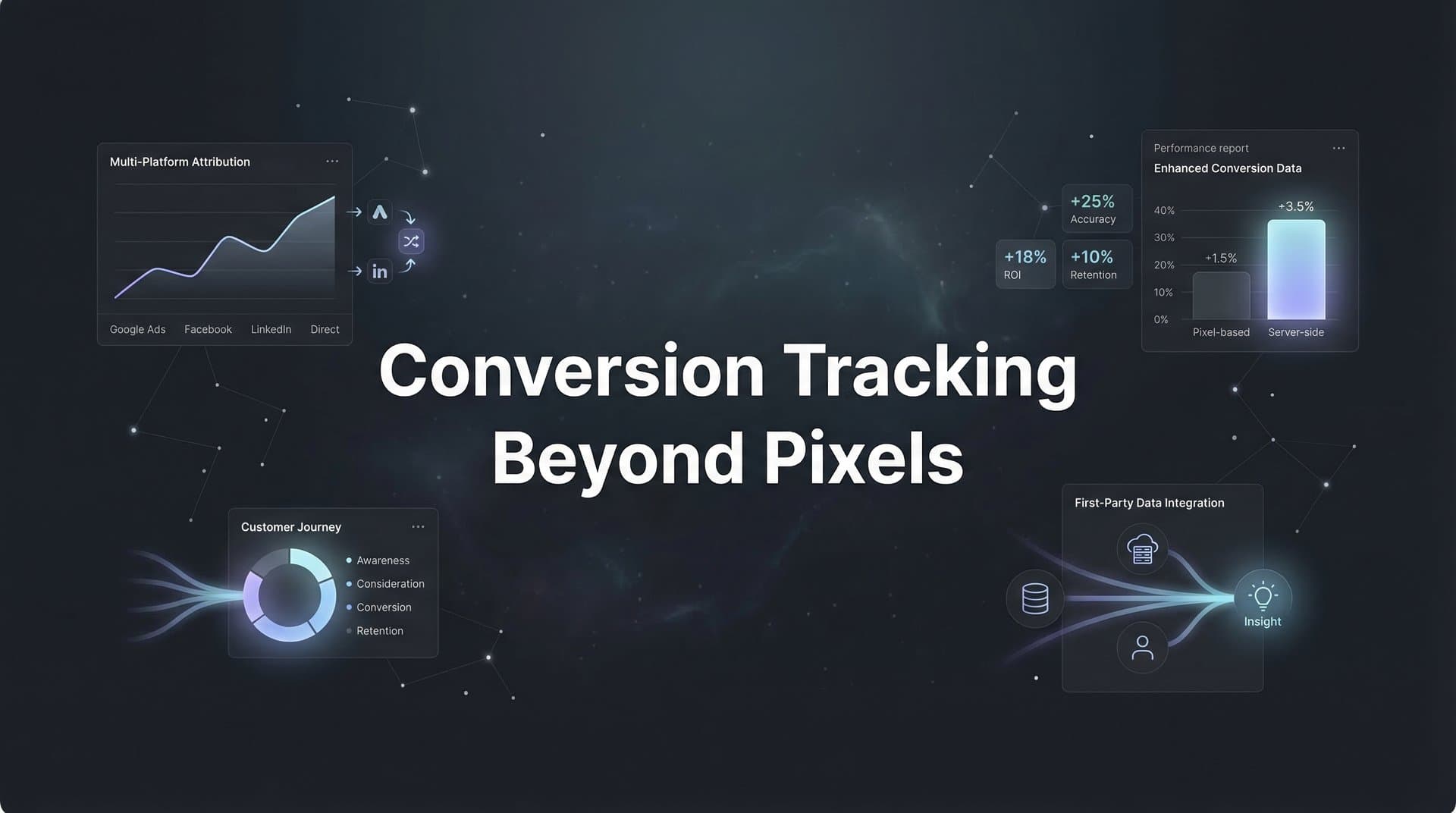
You're running ads across Meta, Google, TikTok—maybe a few other platforms. Your dashboard shows conversions. Your CRM shows revenue. The numbers don't match. Not even close.
This isn't a glitch. It's the new reality of digital marketing in 2026.
Traditional pixel-based tracking—the foundation of digital advertising for over a decade—is crumbling. iOS privacy updates have blocked tracking for millions of users. Browser restrictions have created massive blind spots in your data. Ad blockers are more prevalent than ever. The result? You're making six-figure budget decisions based on incomplete, often misleading information.
The marketers who thrive in this new landscape aren't clinging to pixels alone. They've built multi-layered tracking systems that capture the full customer journey—from first click to final purchase and everything in between. They're using server-side tracking to bypass browser limitations. They're connecting their CRM to see which ads actually drive revenue. They're feeding enriched conversion data back to ad platforms to improve targeting and optimization.
This is conversion tracking beyond pixels. And if you're still relying solely on client-side tracking, you're flying blind—no matter what your ad platform dashboards tell you.
The Pixel Problem: Why Your Tracking Data Is Incomplete
Let's start with what's actually broken. Traditional pixel tracking works by dropping a small piece of code on someone's browser when they visit your site. When they convert, that pixel fires and tells your ad platform "this person bought something." Simple, elegant, and increasingly unreliable.
Safari's Intelligent Tracking Prevention (ITP) kicked things off back in 2017, but the real disruption came with Apple's iOS 14.5 update in 2021. App Tracking Transparency gave users a simple choice: allow apps to track them or don't. Most chose "don't." Suddenly, marketers lost visibility into huge portions of their iOS traffic—and that's not a small segment. iOS users represent a significant share of mobile traffic and often skew toward higher-income demographics.
Browser restrictions have only intensified since then. Chrome, which once seemed like a safe haven for marketers, has been gradually phasing out third-party cookies. Firefox blocks them by default. Even users who aren't actively trying to avoid tracking are increasingly invisible to traditional pixels. Understanding how ad blockers affect conversion tracking is essential for diagnosing these data gaps.
The impact shows up in your data as a growing gap between what your ad platforms report and what actually happens in your business. Your Meta Ads Manager might show 100 conversions this month. Your CRM shows 147 actual sales. Which number do you trust? Which one do you use to calculate your true ROAS?
This discrepancy isn't just annoying—it's dangerous. When you can't accurately measure which campaigns drive revenue, you end up scaling the wrong ads, cutting budget from profitable channels, and making decisions based on fiction rather than facts. You might be sitting on a goldmine campaign that looks mediocre in your dashboard because half the conversions never get tracked.
Here's the thing: pixels aren't going away entirely, but they're no longer sufficient on their own. The marketers who recognize this early—who build tracking systems that don't rely solely on browser-based pixels—are the ones who'll maintain their competitive edge while others struggle with incomplete data.
Server-Side Tracking: Your New Foundation for Accurate Data
Server-side tracking flips the traditional model on its head. Instead of relying on code that runs in someone's browser (where it can be blocked, restricted, or deleted), server-side tracking sends conversion data directly from your server to ad platforms. No browser restrictions. No cookie limitations. No ad blocker interference.
Think of it like this: client-side pixels are like asking someone to deliver a message for you—they might forget, get distracted, or refuse to help. Server-side tracking is like making the phone call yourself. You control the message, the timing, and the delivery.
When a conversion happens on your site or in your CRM, your server captures that event and sends it directly to Meta, Google, or whichever platforms you're using. The data flows through a secure server-to-server connection, completely bypassing the browser and all its modern restrictions. This represents a fundamental ad tracking alternative to pixels that many marketers are now adopting.
The benefits compound quickly. First, you capture significantly more conversion events—often 20-30% more than pixel-only setups, sometimes even higher for businesses with lots of iOS traffic. Second, the data you send is more accurate because it's based on actual server records rather than browser signals that might be incomplete or delayed. Third, you can enrich that data with information from your backend systems—things like customer lifetime value, product categories, or subscription tier—that pixels alone could never access.
Server-side tracking makes the biggest difference for businesses with complex customer journeys. If you're a SaaS company where someone might click an ad today but not convert until they've attended a demo, talked to sales, and gotten internal approval two weeks later, traditional pixels often lose that connection. Server-side tracking maintains it because you're matching conversion events to user identifiers stored on your server, not relying on browser cookies that might have expired.
Implementation does require some technical work. You'll need to set up a server that can receive conversion events and forward them to ad platforms using their conversion APIs. Many attribution platforms handle this infrastructure for you, but you can also build it yourself if you have the engineering resources. The key is ensuring you're sending high-quality data—accurate user identifiers, proper event matching, and timely event delivery.
One critical detail: server-side tracking works best when combined with client-side pixels, not as a replacement. Use pixels to capture immediate browser-based events and server-side tracking to fill in the gaps, capture delayed conversions, and send enriched data that pixels can't access. This hybrid approach gives you the most complete picture of your conversion data.
CRM Integration: Tracking Revenue, Not Just Leads
Here's a question that should make every marketer uncomfortable: which matters more—the number of leads you generate or the revenue those leads produce?
Obviously revenue. But most attribution setups only track the lead. Someone fills out a form, the pixel fires, your ad platform counts a conversion. What happens next—whether that lead becomes a $500 customer or a $50,000 enterprise deal—remains invisible to your tracking system.
This is where CRM integration transforms your attribution from guesswork into precision. By connecting your CRM to your attribution platform, you close the loop between marketing activity and actual business outcomes. You stop optimizing for form fills and start optimizing for revenue. Businesses focused on conversion tracking for lead generation see the biggest improvements when they implement this approach.
The mechanics are straightforward but powerful. When someone converts on your site, you capture their information and create a lead record in your CRM. As that lead moves through your sales process—demo scheduled, proposal sent, deal closed—your CRM tracks each stage. A proper attribution system connects those CRM events back to the original marketing touchpoint that started the journey.
Suddenly, you're not just seeing "Campaign A generated 50 leads." You're seeing "Campaign A generated 50 leads, 12 became opportunities, 5 closed for $73,000 in total revenue." That's the difference between surface-level metrics and business intelligence you can actually use.
This visibility changes how you allocate budget. Maybe you've been scaling a campaign because it generates tons of cheap leads. But when you connect your CRM data, you discover those leads rarely convert to customers. Meanwhile, a smaller campaign with fewer but higher-quality leads is actually driving more revenue. Without CRM integration, you'd never know to shift budget from the first campaign to the second.
The enriched conversion data you get from CRM integration also improves how ad platforms optimize your campaigns. When you send conversion events back to Meta or Google that include revenue values and customer quality indicators, their algorithms learn to target people more likely to become high-value customers, not just people likely to fill out a form. This feedback loop compounds over time—better data leads to better targeting leads to better customers leads to even better data. Companies selling premium products benefit especially from conversion tracking for high ticket sales.
For businesses with longer sales cycles, CRM integration is especially critical. If your average time from lead to customer is 30, 60, or 90 days, you need a system that can attribute that eventual revenue back to the marketing touchpoint that happened months earlier. Traditional pixels can't maintain that connection across such long timeframes, but a proper CRM integration can.
Multi-Touch Attribution: Understanding How Channels Work Together
Last-click attribution is a lie. Not because it's inaccurate—it correctly identifies the last thing someone clicked before converting—but because it tells an incomplete story that leads to bad decisions.
Here's what actually happens: someone sees your brand in a Facebook ad. They don't click, but they remember the name. Two days later, they Google your company, read some blog posts, and leave. A week after that, they see a retargeting ad, click through, and still don't convert. Finally, they search your brand name directly, click a Google ad, and make a purchase.
Last-click attribution gives 100% of the credit to that final Google brand search. Facebook, which introduced your brand? Zero credit. The blog content that educated them? Zero credit. The retargeting ad that brought them back? Zero credit. You'd look at this data and conclude that only Google brand campaigns drive revenue, completely missing the role every other touchpoint played. This is one of the most common conversion tracking accuracy issues marketers face.
Multi-touch attribution solves this by distributing credit across all the touchpoints in the customer journey. Different models distribute that credit differently, and understanding when to use each is key to interpreting your data correctly.
First-touch attribution gives all credit to the initial touchpoint. This model helps you understand which channels are best at introducing new people to your brand. If you're focused on top-of-funnel awareness and want to know which campaigns are bringing new audiences into your ecosystem, first-touch provides valuable insights.
Linear attribution distributes credit evenly across all touchpoints. If someone had five interactions before converting, each gets 20% of the credit. This model works well when you want a balanced view and believe every touchpoint contributes equally to the final decision.
Time-decay attribution gives more credit to touchpoints closer to the conversion. The logic: recent interactions had more influence on the purchase decision than things that happened weeks ago. This model is useful when you're focused on understanding what finally pushes people over the conversion line.
Position-based attribution (also called U-shaped) gives the most credit to the first and last touchpoints—typically 40% each—with the remaining 20% distributed among middle interactions. This recognizes that introducing someone to your brand and closing the deal are both critical moments, while middle touches still matter but less so.
Which model should you use? The honest answer: multiple. Different attribution models answer different questions. First-touch tells you what's working for awareness. Last-touch shows what's closing deals. Time-decay reveals what's most influential near the decision point. Position-based balances introduction and conversion. A comprehensive conversion funnel tracking guide can help you implement these models effectively.
The real power comes from comparing models side by side. When you see how credit distribution changes across different attribution frameworks, you start to understand the true role each channel plays. Maybe your LinkedIn ads never get last-click credit but show up in first-touch attribution constantly—they're introducing high-quality prospects who convert through other channels later. That's valuable information you'd miss with last-click alone.
Use these insights to allocate budget more effectively. Channels that excel at first-touch deserve investment for awareness and prospecting. Channels that dominate last-touch need budget for conversion and retargeting. Channels that show up consistently across all models—those are your workhorses that deserve stable, ongoing investment.
Conversion Sync: Teaching Ad Platforms What Success Really Looks Like
Ad platform algorithms are incredibly sophisticated. They can predict who's likely to click, who's likely to convert, and optimize your campaigns accordingly. But they can only work with the data you give them.
When you rely solely on basic pixel tracking, you're teaching these algorithms to optimize for surface-level signals. Someone filled out a form? That's a conversion. Someone bought a $10 product? That's a conversion. Someone signed a $50,000 annual contract? Also a conversion. The algorithm treats them all the same because it doesn't know any better.
Conversion sync—also called offline conversion tracking or enhanced conversions—changes this by sending enriched conversion data back to ad platforms. You're not just saying "a conversion happened." You're saying "a conversion happened, here's the revenue value, here's the customer quality score, here's whether they're still a customer 90 days later." This approach is central to best practices for tracking conversions accurately.
This enriched data transforms how platforms optimize your campaigns. When Meta's algorithm knows that conversions from certain demographics or interests tend to have 3x higher lifetime value, it can proactively target similar audiences. When Google's smart bidding knows that conversions from specific keywords lead to larger deal sizes, it can bid more aggressively on those terms.
The effect compounds over time. Better data leads to better targeting. Better targeting leads to higher-quality conversions. Higher-quality conversions generate more enriched data. This feedback loop is why marketers who implement proper conversion sync often see performance improvements that continue accelerating months after initial setup.
Setting up conversion sync requires connecting your backend systems—your CRM, your database, your payment processor—to your ad platforms' conversion APIs. When someone becomes a customer, your system sends that event data to Meta, Google, and other platforms you're using. When they make a repeat purchase, upgrade their subscription, or hit other valuable milestones, those events get sent too. For teams managing multiple channels, conversion tracking for multiple ad platforms becomes essential.
The technical implementation varies by platform, but the principles remain consistent. You need accurate user matching—connecting the person in your CRM to the person who clicked your ad. You need timely event delivery—sending conversion data quickly enough that platforms can use it for optimization. And you need proper event structure—formatting your data according to each platform's specifications.
Many marketers overlook the importance of sending negative signals too. If someone cancels their subscription, refunds their purchase, or churns after 30 days, that's valuable information. Platforms can use these signals to avoid targeting similar audiences in the future, improving the overall quality of your conversions.
The businesses that benefit most from conversion sync are those with significant variance in customer value. If you're an e-commerce store where every purchase is roughly the same value, basic conversion tracking might suffice. But if you're a B2B SaaS company where customers range from $100/month to $10,000/month, or a service business where project sizes vary dramatically, conversion sync is essential for teaching platforms to optimize for high-value outcomes rather than just volume.
Building Your Complete Tracking System
Conversion tracking beyond pixels isn't a single tool or tactic—it's a comprehensive system that captures the full customer journey and feeds that intelligence back into your marketing decisions.
The foundation is server-side tracking. This bypasses browser restrictions and ensures you're capturing the maximum number of conversion events with the highest possible accuracy. It's not optional anymore—it's table stakes for marketers who want reliable data in 2026.
Layer on CRM integration to connect marketing activity to actual revenue. Stop optimizing for vanity metrics like form fills and start optimizing for the business outcomes that actually matter. When you can see which campaigns drive high-value customers versus low-value leads, budget allocation becomes strategic rather than guesswork.
Implement multi-touch attribution to understand how your channels work together. Last-click attribution creates blind spots that lead to bad decisions. When you can see the full journey—from first awareness to final conversion—you allocate budget based on reality rather than oversimplified models.
Close the loop with conversion sync, sending enriched conversion data back to ad platforms. This teaches their algorithms what success really looks like for your business, creating a compounding feedback loop that improves targeting and optimization over time.
The marketers who build these systems now—while competitors still rely on pixel-only tracking and wonder why their data doesn't match reality—are the ones who'll dominate their markets. They'll make better decisions because they have better data. They'll scale more efficiently because they know what actually drives revenue. They'll outperform because they're playing a different game entirely.
Your current tracking setup probably has gaps. Most do. The question is whether you're going to address them proactively or wait until the data discrepancies become so obvious you can't ignore them anymore. By then, your competitors who moved early will have months or years of compounding advantages from better attribution and optimization.
Ready to elevate your marketing game with precision and confidence? Discover how Cometly's AI-driven recommendations can transform your ad strategy—Get your free demo today and start capturing every touchpoint to maximize your conversions.



