

You've just wrapped up a campaign that looked perfect in your Facebook Ads Manager. Strong click-through rates, healthy engagement, costs trending down. Then you check your actual revenue dashboard and find something unsettling: the conversions Facebook claims to have driven don't match what your analytics show. Not even close.
This isn't a tracking error on your end. It's the new reality of digital advertising in 2026.
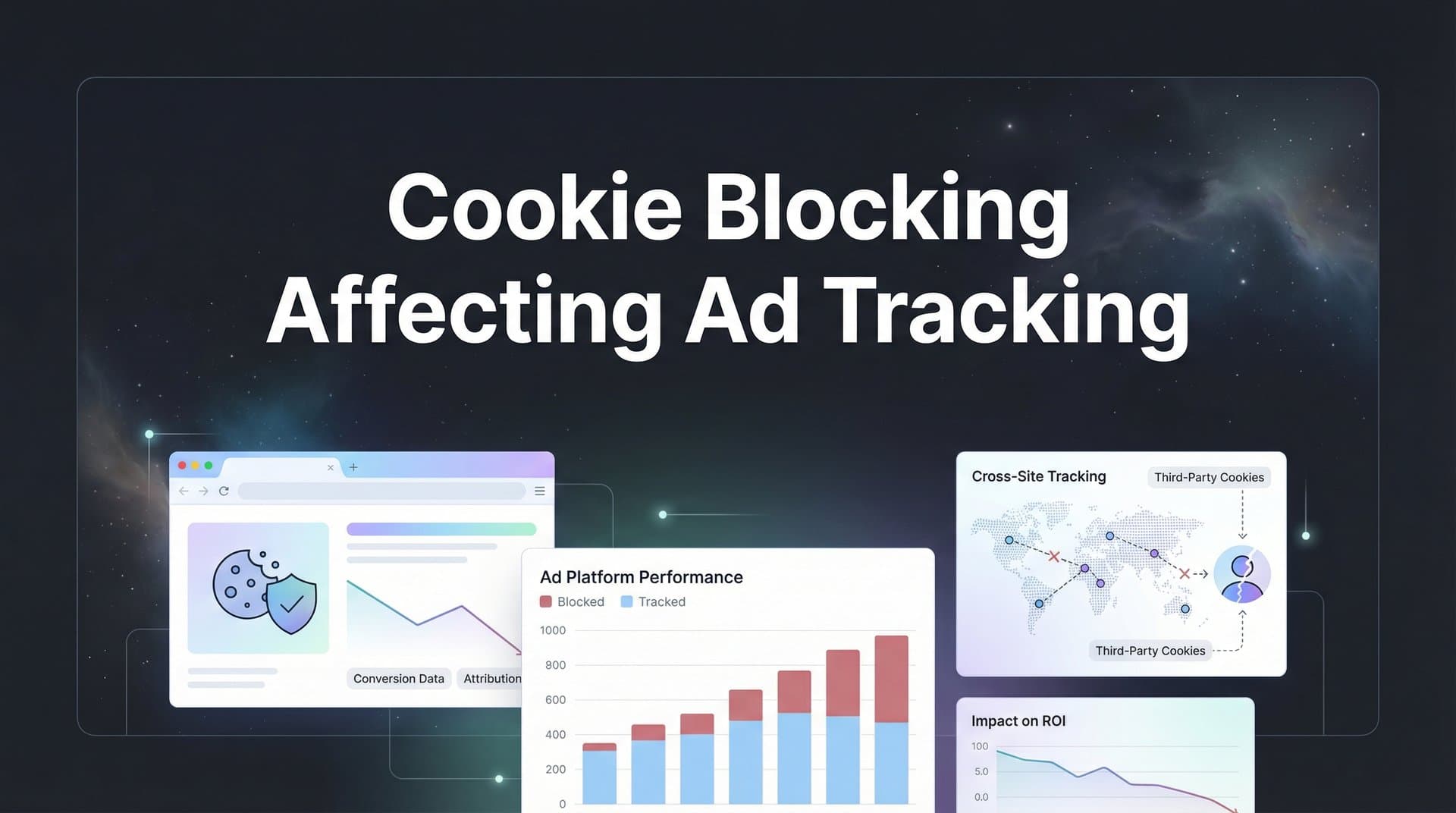
Cookie blocking has fundamentally reshaped how digital ads work, creating a widening gap between what ad platforms report and what actually converts into revenue. Browsers have systematically dismantled the cookie-based tracking infrastructure that powered advertising for two decades. The result? Marketers are making budget decisions based on incomplete data, ad algorithms are optimizing toward phantom conversions, and attribution has become more guesswork than science.
This guide breaks down exactly how cookie restrictions broke modern ad tracking and what you can do to restore accuracy. Because understanding the problem is the first step toward building a tracking system that actually works.
The Mechanics Behind Modern Cookie Restrictions
Third-party cookies were the backbone of digital advertising for years. When someone clicked your ad and later converted on your site, a cookie dropped by the ad platform would connect those two events. Simple, reliable, and now mostly dead.
Here's what changed. Apple launched Intelligent Tracking Prevention (ITP) in Safari back in 2017, drastically limiting how long third-party cookies could persist. What started as a 24-hour restriction evolved into something far more aggressive. By 2026, Safari treats most third-party cookies as if they expire almost immediately, making cross-site tracking virtually impossible through traditional methods.
Firefox followed with Enhanced Tracking Protection, which blocks third-party cookies by default. Then came the biggest shift: Google Chrome, which commands the majority of browser market share, began phasing out third-party cookies entirely through its Privacy Sandbox initiative. Chrome now restricts third-party cookie access for most users, completing the industry-wide transition away from cookie-based tracking.
The technical mechanism is straightforward but devastating for advertisers. When someone clicks your Facebook ad in Safari, the cookie Facebook tries to drop gets severely restricted. If that person doesn't convert within a narrow window, the connection between the click and eventual conversion disappears entirely. The ad platform never receives confirmation that the conversion happened, so it can't attribute the sale back to your campaign.
It gets worse on mobile. Apple's App Tracking Transparency framework, introduced with iOS 14.5, requires apps to ask permission before tracking users across other apps and websites. Most users decline. When someone sees your ad in Instagram, clicks through to your mobile site, and converts days later, the entire journey becomes invisible to the ad platform.
These aren't minor technical adjustments. They represent a complete architectural shift in how browsers handle cross-site data. The cookie-based attribution model that powered digital advertising since the early 2000s simply doesn't function anymore in this environment. Browsers now actively prevent the very tracking mechanisms that ad platforms depend on to measure performance.
The impact compounds across the customer journey. Someone might see your ad on their iPhone using Safari, research your product later on their desktop using Chrome, and finally convert days afterward on a different device entirely. Each step leaves behind fragmented data that never connects into a complete picture. What used to be a clear attribution path now looks like scattered puzzle pieces with half of them missing.
How Cookie Blocking Breaks Your Attribution Data
The most immediate casualty of cookie restrictions is the cross-device customer journey. Think about your own behavior: you discover a product on Instagram during your morning commute, research it on your laptop during lunch, and purchase it on your tablet that evening. That's three devices, three browsers, three separate cookie environments that never connect.
Without third-party cookies bridging those touchpoints, ad platforms see three different anonymous users instead of one continuous journey. Your Facebook campaign gets credit for the initial click, but when the conversion happens on a different device hours or days later, Facebook has no way to connect them. The conversion appears as "direct" traffic in your analytics, and Facebook's reporting shows the campaign underperforming.
Conversion windows have collapsed alongside cookie lifespans. Traditional attribution models used 28-day click windows and 7-day view windows because cookies persisted that long. Now, with ITP restricting cookies to much shorter periods, conversions that happen outside these compressed windows simply vanish from platform reporting. Your actual customer might take a week to decide, but your attribution data only captures decisions made within 24-48 hours.
This creates a perverse reporting dynamic where ad platforms simultaneously over-report and under-report conversions depending on the scenario. Platforms use probabilistic modeling to fill in gaps where cookie data is missing, sometimes attributing conversions to campaigns that didn't actually influence them. Other times, legitimate conversions fall outside the shortened attribution window and disappear entirely from reporting.
Retargeting audiences suffer catastrophic shrinkage. When you can't drop persistent cookies on site visitors, you can't build reliable retargeting pools. A visitor who browses your product pages in Safari might never make it into your retargeting audience because the cookie expires before your retargeting campaign can reach them. Your audience sizes shrink, your retargeting becomes less effective, and your cost per acquisition climbs.
Multi-touch attribution becomes nearly impossible with fragmented cookie data. Understanding which channels work together to drive conversions requires tracking the complete customer journey across all touchpoints. When cookie blocking severs the connections between touchpoints, you lose visibility into how your channels interact. Did your Facebook ad prime the customer for that Google search? Did your display campaign support the email that drove the conversion? You'll never know with broken attribution.
The data quality issues cascade through every marketing decision. Budget allocation becomes guesswork when you can't trust conversion data. Creative testing loses statistical validity when half your conversions go untracked. Campaign optimization happens in the dark when the feedback loop between ad spend and actual results breaks down.
Even first-click and last-click attribution models, once considered simple and reliable, fail in this environment. First-click attribution can't work when the first click happened in a browser that blocked the cookie. Last-click attribution misses conversions that occurred outside the shortened cookie window. The fundamental building blocks of attribution have crumbled.
The Real Cost to Your Ad Campaigns
Poor data quality doesn't just create reporting headaches. It actively destroys campaign performance by feeding ad platform algorithms incomplete information about what's actually working.
Ad platforms use machine learning to optimize delivery toward people most likely to convert. When cookie blocking prevents platforms from seeing which users actually converted, the algorithms optimize toward the wrong signals. Facebook's algorithm might think your campaign performs best with a certain demographic because those are the only conversions it can track, while your actual best-performing audience remains invisible in the data gaps.
Wasted ad spend becomes inevitable when you can't accurately measure what drives revenue. You might be pouring budget into campaigns that look successful in platform reporting but fail to generate actual sales. Meanwhile, genuinely effective campaigns might appear to underperform because their conversions happen outside trackable windows, leading you to cut budget from your best performers.
Lookalike audiences degrade rapidly with incomplete conversion data. When you build a lookalike audience based on converters, you're essentially asking the platform to find more people similar to your best customers. But if cookie blocking means the platform only sees a fraction of your actual converters, the lookalike becomes based on an incomplete and potentially skewed sample. You're scaling toward a lookalike of the customers the platform can track, not the customers who actually drive your revenue.
Automated bidding strategies suffer the same fate. Platforms like Meta and Google offer sophisticated automated bidding that adjusts bids in real-time based on conversion likelihood. These systems depend on receiving complete, accurate conversion signals to learn and optimize. When pixel tracking cookie limitations create gaps in conversion reporting, automated bidding optimizes toward phantom patterns in incomplete data. Your bids might increase for audiences that aren't actually converting or decrease for audiences that are.
The competitive disadvantage compounds over time. Marketers who solve the attribution problem gain an enormous edge because their ad algorithms receive better training data. Their campaigns optimize toward real revenue while competitors optimize toward whatever fragments cookie-based tracking can still capture. The gap in campaign efficiency widens with every optimization cycle.
Testing velocity collapses when you can't trust your data. How do you run meaningful creative tests when you're missing half your conversions? How do you evaluate new channels when attribution is broken? Marketers become paralyzed by data uncertainty, afraid to make moves because they can't confidently measure results. Growth stalls not from lack of opportunity but from inability to identify what's working.
Server-Side Tracking: The Foundation of Accurate Attribution
Server-side tracking represents a fundamental architectural shift in how conversion data flows from your properties to ad platforms. Instead of relying on browser-based cookies and pixels that can be blocked, server-side tracking sends conversion data directly from your server to ad platforms through secure server-to-server connections.
Here's how it works in practice. When someone converts on your site, instead of a client-side pixel firing in their browser and hoping the cookie hasn't been blocked, your server captures the conversion event and sends it directly to the ad platform's API. This happens entirely outside the browser environment, bypassing cookie restrictions, ad blockers, and privacy tools that interfere with traditional tracking.
The technical difference matters enormously. Client-side tracking depends on JavaScript pixels executing in the user's browser, which means browser privacy features can block them. Server-side tracking happens on infrastructure you control, sending authenticated requests directly to platform APIs. Ad platforms receive the conversion data regardless of what privacy settings or extensions the user has enabled.
First-party data collection becomes the foundation of this approach. You're tracking user interactions on your own properties using your own identifiers, then sharing that information with ad platforms through official APIs. This aligns with privacy regulations because you're handling data you legitimately collected from customers who interacted with your business, not tracking them across the web with third-party cookies.
The data quality improvement is substantial. Server-side events can include rich information that client-side pixels often miss: customer lifetime value, subscription tier, product categories, offline conversions, CRM status updates. You're sending complete, accurate conversion data that reflects actual business outcomes rather than just page views and button clicks.
Ad platforms themselves now recommend server-side implementations. Meta's Conversions API and Google's Enhanced Conversions exist specifically to receive server-side conversion data. These platforms recognize that cookie-based tracking is dying and have built infrastructure to support more reliable data collection methods. Their algorithms perform better when they receive complete conversion signals through server-side channels.
Implementation requires technical infrastructure but solves attribution challenges that are otherwise unsolvable. You need a system that captures conversion events, matches them to the correct user journey, and sends them to ad platform APIs with proper authentication. This typically involves connecting your CRM, analytics platform, or dedicated cookieless attribution tracking tool to ad platform APIs through secure server-side integrations.
The conversion data flows differently but more reliably. A user clicks your ad, lands on your site, and later converts. Your server captures that conversion, matches it back to the original ad click using first-party identifiers, and sends a conversion event to the ad platform's API with all relevant details. The ad platform receives confirmation of the conversion regardless of cookie status, browser privacy settings, or device switching.
Building a Cookie-Resilient Tracking Stack
A modern tracking infrastructure that survives cookie restrictions requires several interconnected components working together to capture, connect, and transmit conversion data accurately.
Start with comprehensive first-party data collection across all customer touchpoints. Your website, mobile app, CRM, email platform, and any other property where customers interact with your brand should feed into a unified customer data system. This creates a complete view of customer behavior that doesn't depend on third-party cookies to connect the dots.
CRM integration becomes essential rather than optional. When someone fills out a lead form, makes a purchase, or updates their account, those events need to flow into your attribution system immediately. CRM data provides the ground truth about what actually happened in your business, anchoring your attribution to real outcomes rather than proxy metrics like clicks and page views.
Server-side event implementation connects your first-party data to ad platform algorithms. This means setting up Meta Conversions API, Google Enhanced Conversions, and similar server-side integrations for every platform you advertise on. Each conversion that happens in your business should trigger a corresponding server-side event sent to the relevant ad platforms.
The technical architecture looks like this: conversion happens, your system captures it with first-party identifiers, matches it to the customer's advertising journey, enriches it with business context from your CRM, and sends detailed conversion events to ad platforms through their APIs. All of this happens server-side, immune to cookie blocking.
Feeding enriched data back to ad platforms dramatically improves their optimization algorithms. Instead of just telling Facebook that a conversion happened, you can send the actual purchase value, customer lifetime value prediction, product category, and whether this is a new or returning customer. Ad platforms use this enriched data to find more valuable customers and optimize toward revenue rather than just conversion volume.
Unified customer journey tracking ties everything together. You need a system that can follow a customer from their first ad click through multiple sessions, devices, and channels all the way to conversion and beyond. This requires persistent first-party identifiers that survive cookie deletion and device switching, typically achieved through authenticated user IDs or probabilistic matching based on multiple signals.
The competitive advantage comes from data completeness. While competitors struggle with fragmented cookie-based attribution that misses most conversions, your tracking stack captures the full customer journey. Your ad algorithms receive complete training data, your budget decisions are based on actual performance, and your attribution shows which channels genuinely drive revenue.
Implementation doesn't have to happen all at once. Start by adding server-side tracking for your most important conversion events. Connect your CRM to close the loop on lead quality and customer value. Gradually build out the infrastructure until every meaningful customer interaction feeds into your unified tracking system. Each improvement compounds, progressively restoring the attribution accuracy that cookie blocking destroyed. For a detailed roadmap, explore our cookieless tracking implementation guide.
Putting It All Together: Your Path Forward
The shift from cookie-dependent tracking to first-party data strategies represents a permanent change in digital advertising infrastructure. Cookie blocking will only intensify as privacy regulations expand and browser restrictions tighten. Marketers who adapt their tracking systems now gain a lasting competitive advantage over those who cling to dying attribution methods.
Accurate attribution has become essential for scaling campaigns confidently in this privacy-first landscape. Without reliable data connecting ad spend to actual revenue, every budget decision becomes speculation. You can't optimize what you can't measure, and you can't measure what cookie blocking has made invisible.
The solution path is clear: transition to server-side tracking, build first-party data infrastructure, integrate your CRM with your advertising platforms, and feed complete conversion signals back to ad algorithms. This isn't a temporary workaround. It's the foundation of effective digital advertising going forward.
The marketers who solve attribution first will dominate their markets. While competitors waste budget on campaigns they can't accurately measure, you'll be scaling the channels that actually drive revenue. While their ad algorithms optimize toward incomplete data, yours will be learning from complete conversion signals. The performance gap compounds with every campaign cycle.
Cookie blocking has fundamentally changed the rules of digital advertising. The question isn't whether to adapt your tracking infrastructure, but how quickly you can implement the systems that restore attribution accuracy. Your ability to scale profitably depends on knowing what's really driving your results.
The Bottom Line
Cookie blocking isn't a temporary disruption that will eventually resolve itself. It's the new permanent reality of digital advertising. Browsers will continue restricting tracking capabilities, privacy regulations will expand, and the gap between platform reporting and actual results will keep widening for marketers who rely on outdated attribution methods.
The solution exists, and it's already being implemented by growth-focused marketing teams who refuse to make budget decisions based on incomplete data. Server-side tracking, first-party data strategies, and proper CRM integration restore the attribution accuracy that cookie restrictions destroyed. These aren't experimental approaches. They're proven systems that major ad platforms actively recommend because they improve algorithm performance.
Every day you operate with broken attribution is a day you're wasting budget on campaigns you can't accurately measure and missing opportunities in channels that appear to underperform only because conversions go untracked. The competitive disadvantage grows with each optimization cycle as your ad algorithms learn from incomplete data while competitors feed theirs complete conversion signals.
Building a cookie-resilient tracking stack requires technical implementation, but the alternative is making marketing decisions in the dark. You need visibility into what's actually driving revenue, and that visibility only comes from attribution infrastructure designed for the privacy-first advertising landscape we're operating in now.
Ready to elevate your marketing game with precision and confidence? Discover how Cometly's AI-driven recommendations can transform your ad strategy. Get your free demo today and start capturing every touchpoint to maximize your conversions.


