You've just launched a new campaign. The ads are running, clicks are coming in, and you're watching the dashboard like it's the final quarter of a championship game. Then someone converts. Great! But here's the question that keeps marketers up at night: was it really that last ad click that closed the deal, or did something else happen weeks ago that actually started this journey?
Most customers don't see your ad and immediately pull out their credit card. They stumble across your brand on Instagram, forget about you, see a retargeting ad three days later, Google your company name, read a few blog posts, sign up for your email list, ignore five emails, and then—maybe—convert after clicking a Facebook ad. That's seven touchpoints, three devices, and two weeks of consideration.
Without understanding these customer journey stages, you're essentially managing a multi-million dollar marketing budget with a blindfold on. You can't accurately attribute revenue, you can't identify which channels actually drive conversions, and you definitely can't optimize campaigns with confidence. The solution isn't more data—it's understanding how customers actually move through each stage of their journey and tracking every touchpoint that influences their decision.
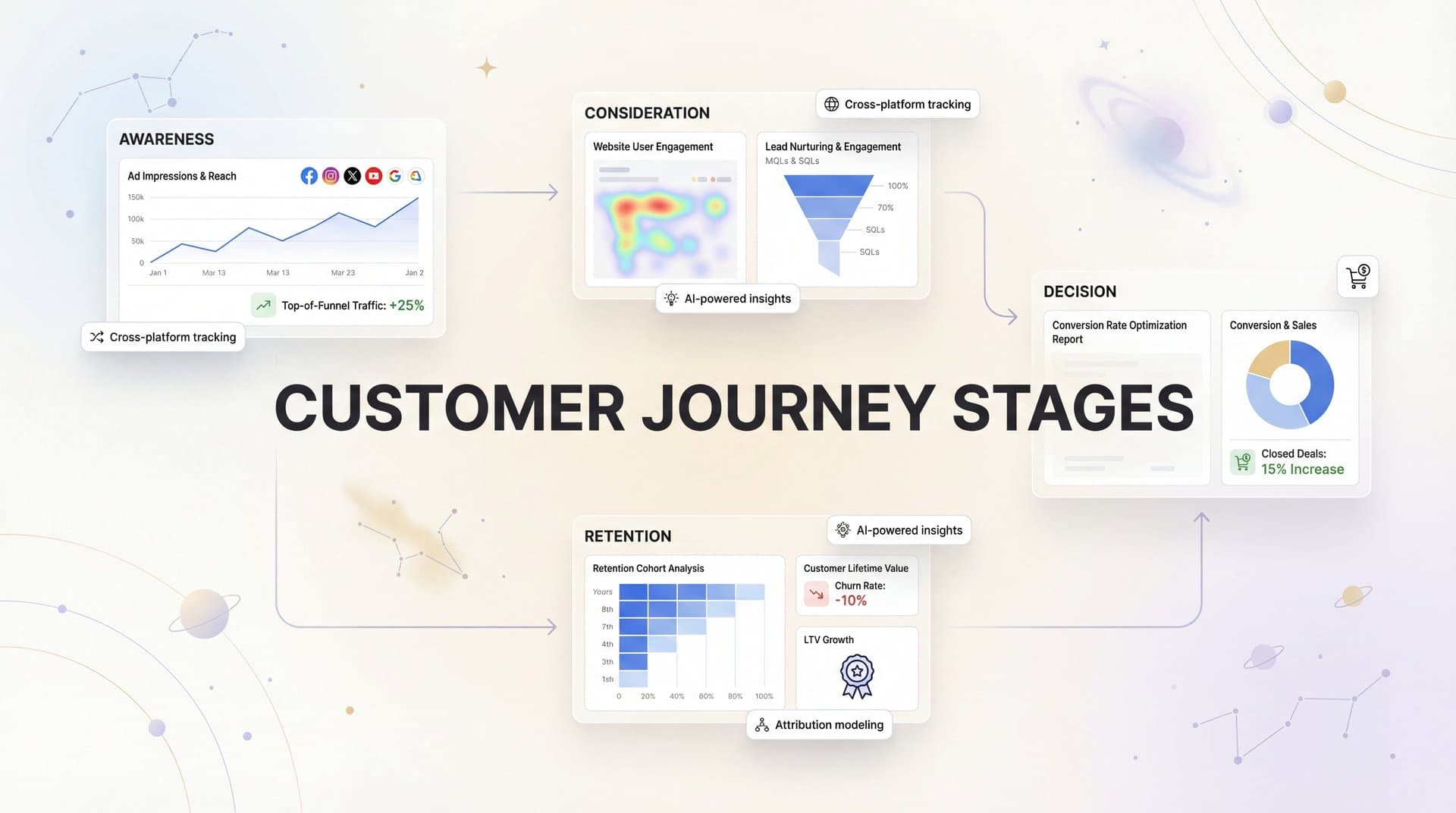
The Five Core Stages Every Customer Moves Through
Think of the customer journey like a relationship. You don't propose on the first date. There's a natural progression from "who are you?" to "I trust you enough to give you my money." Understanding these customer journey phases helps you meet customers where they are instead of asking for commitment before they're ready.
Awareness: The First Hello
This is where everything begins. Someone sees your Facebook ad while scrolling through their feed. A friend mentions your product in conversation. They stumble across your blog post while Googling a problem. At this stage, they're not evaluating your solution—they're barely aware you exist.
The awareness stage is all about visibility and first impressions. Your goal here isn't conversion; it's recognition. You want to plant a seed in their mind so when they're ready to solve their problem, your brand surfaces as an option. This might happen through paid ads, organic social content, SEO-driven blog posts, podcast sponsorships, or word-of-mouth referrals.
Consideration: The Research Phase
Now they know you exist, and they're interested enough to dig deeper. This is where prospects become active researchers. They're comparing your solution against competitors, reading reviews, watching demo videos, and asking their network for opinions.
During consideration, customers typically interact with multiple touchpoints across different channels. They might visit your website directly after Googling your brand name. They click through to your pricing page from an email. They watch a YouTube review from an influencer. Each interaction builds their understanding and moves them closer to a decision—or pushes them away if the experience doesn't align with their needs.
Decision: The Conversion Moment
This is the stage everyone obsesses over because it's measurable and feels like the finish line. The prospect becomes a customer. They fill out the form, swipe the card, or sign the contract. But here's what most marketers miss: the decision stage is rarely about that final touchpoint.
The conversion might happen after clicking a retargeting ad, but that ad isn't what convinced them to buy. It was simply the last nudge in a series of interactions that built trust over time. Understanding this distinction is crucial because it changes how you allocate budget and measure success.
Retention: Where Real Value Lives
The journey doesn't end at purchase—that's actually where the most valuable stage begins. Retention is about keeping customers engaged, satisfied, and actively using your product or service. This stage determines whether someone makes one purchase or becomes a long-term customer worth ten times their initial transaction value.
Retention happens through onboarding experiences, product updates, customer support interactions, email nurture sequences, and community engagement. Every touchpoint in this stage either strengthens the relationship or creates friction that pushes customers toward competitors. Implementing proven customer retention strategies can dramatically impact your bottom line.
Advocacy: Your Most Powerful Marketing Channel
When customers love your product enough to tell others about it, you've reached the advocacy stage. These are the people who leave five-star reviews, refer friends, create user-generated content, and defend your brand in social media comments.
Advocacy touchpoints include referral programs, review requests, social sharing features, and community forums. The beautiful thing about this stage is that advocates do your marketing for you—and prospects trust peer recommendations far more than any ad you could create.
Why Traditional Tracking Fails at Each Stage
Here's the uncomfortable truth: most marketing analytics tools are built for a world that no longer exists. They assume customers use one device, accept all cookies, and move linearly through a simple funnel. Reality is messier, and traditional tracking breaks down at every stage.
Awareness Stage: The iOS Privacy Wall
Let's say someone sees your Instagram ad on their iPhone while commuting to work. They don't click—they just notice your brand. Later that day, they Google your company name on their laptop and visit your website. Traditional tracking sees a direct visit with no attribution to that Instagram ad.
iOS privacy updates and cookie deprecation have created massive blind spots in awareness-stage tracking. When users opt out of tracking (and most do), ad platforms can't connect that initial impression to downstream behavior. You're spending money to create awareness, but your analytics show zero impact because the connection is invisible.
Consideration Stage: The Cross-Device Attribution Nightmare
Picture this journey: someone clicks your Facebook ad on their phone during lunch, browses your website, then closes the tab. That evening, they see a retargeting ad on their tablet and click through to read a case study. The next morning, they're at their desktop computer, they Google your brand name, and they sign up for a free trial.
Most analytics tools see three separate users. Facebook claims credit for the conversion because it was the last ad click. Google Search claims credit because it was the last click before conversion. Your website analytics shows a direct conversion. Everyone's taking credit, nobody's telling the truth, and you have no idea which channel actually drove the consideration.
Decision Stage: Last-Click Attribution Lies
Last-click attribution is the default model in most analytics platforms because it's simple to implement. It gives 100% credit to whatever touchpoint happened immediately before conversion. This creates a distorted reality where retargeting ads and branded search appear to be your best performers while the channels that actually created awareness and consideration get zero credit.
Imagine you're dating someone. You go on twelve amazing dates over three months. Then on the thirteenth date, your friend casually mentions, "You should propose." You propose, she says yes, and now your friend takes full credit for the engagement. That's last-click attribution. It completely ignores the twelve dates that actually built the relationship and gives all credit to the final nudge.
The decision stage is the culmination of everything that came before it. When your tracking model only sees the last click, you optimize for the wrong things and starve the channels that actually drive long-term growth.
Mapping Touchpoints Across the Complete Journey
If you want to understand how customers actually move through journey stages, you need to map every touchpoint—not just the ones that are easy to track. This means connecting data from ad platforms, your website, your CRM, and any other system where customer interactions happen.
Identifying All the Places Customers Interact With Your Brand
Start by listing every channel where prospects might encounter your brand. This typically includes paid advertising (Facebook, Instagram, Google Ads, LinkedIn), organic channels (SEO, social media, content marketing), email marketing, direct traffic (people who type your URL or have you bookmarked), and referral sources (affiliate partners, customer referrals, review sites).
Now here's where it gets interesting: each channel plays a different role at different stages. Facebook ads might excel at awareness but struggle with decision-stage conversions. Branded Google searches typically happen during consideration when someone's actively researching. Email nurture sequences bridge consideration and decision. Understanding customer journey touchpoints helps you allocate budget more intelligently.
Connecting Ad Platform Data With CRM Events
Ad platforms know about clicks and impressions. Your CRM knows about leads, opportunities, and closed deals. But these systems rarely talk to each other, which creates a massive gap in journey visibility.
Let's say someone clicks your Facebook ad, fills out a lead form, and enters your CRM. Three weeks later, your sales team closes the deal for $10,000. Facebook's analytics show a lead conversion but no revenue data. Your CRM shows a closed deal but no visibility into which marketing touchpoint started the journey. Neither system tells the complete story.
Connecting these data sources reveals the full journey: which ad campaign generated the lead, how many touchpoints happened between first click and closed deal, which consideration-stage content they consumed, and ultimately, which marketing efforts contributed to actual revenue. This is where customer attribution tracking moves from guesswork to precision.
Building a Touchpoint Map That Reveals Journey Patterns
Once you're capturing data from all sources, you can build a visual map of how touchpoints connect across stages. This isn't about creating a pretty diagram for presentations—it's about identifying patterns that inform strategy.
You might discover that customers who engage with three or more touchpoints during consideration convert at twice the rate of those who only interact once. Or that awareness-stage touchpoints from organic social lead to longer consideration periods but higher lifetime value. Or that certain ad campaigns drive immediate conversions but terrible retention rates.
These insights only emerge when you map the complete journey. Individual touchpoint performance tells you what happened; journey mapping tools tell you why it happened and how to replicate success.
Attribution Models That Match Journey Complexity
Choosing an attribution model is like choosing a lens for a camera. Different models reveal different aspects of the customer journey, and the "right" model depends on what you're trying to understand and optimize.
First-Touch Attribution: Who Opened the Door?
First-touch attribution gives 100% credit to the initial touchpoint that introduced someone to your brand. If a prospect's first interaction was clicking a Facebook ad, that ad gets full credit for the eventual conversion—even if it happened three months later after dozens of other touchpoints.
This model is useful when you want to understand which channels are best at generating new awareness and starting customer relationships. It helps you identify top-of-funnel performers and evaluate the long-term value of awareness campaigns. The downside is that it completely ignores everything that happened after that first touch, which means you're blind to the nurture and consideration touchpoints that actually closed the deal.
Last-Touch Attribution: Who Closed the Deal?
Last-touch is the opposite approach—it gives 100% credit to the final touchpoint before conversion. This is the default model in most analytics platforms because it's simple and aligns with how ad platforms report conversions.
Last-touch is helpful for understanding which channels are effective at converting prospects who are already in decision mode. Branded search campaigns and retargeting ads typically perform well in last-touch models because they capture people who are ready to buy. But this model systematically undervalues awareness and consideration touchpoints, which means you'll likely under-invest in channels that actually drive long-term growth.
Multi-Touch Attribution: Distributing Credit Across the Journey
Multi-touch attribution acknowledges that customer journeys are complex and multiple touchpoints contribute to conversion. Instead of giving all credit to one touchpoint, it distributes credit across all influential interactions based on predefined rules or algorithmic weighting.
There are several multi-touch models to consider. Linear attribution splits credit equally across all touchpoints—simple but assumes every interaction has equal value. Time-decay attribution gives more credit to touchpoints closer to conversion, which makes sense if you believe recent interactions matter more. Position-based attribution (also called U-shaped) gives extra credit to the first and last touches while distributing remaining credit to middle touchpoints.
The beauty of multi-touch attribution is that it reveals the complete picture. You can see which awareness channels feed the best consideration paths, which nurture touchpoints move prospects toward decision, and how different channels work together to drive conversions. This is especially valuable for businesses with longer sales cycles where multiple touchpoints over weeks or months influence the final decision.
Choosing Your Model Based on Business Reality
There's no universally "best" attribution model—the right choice depends on your sales cycle, channel mix, and strategic priorities. If you're running a direct-response e-commerce business where most customers convert within 24 hours of first touch, last-click attribution might be perfectly adequate. If you're selling enterprise software with six-month sales cycles and dozens of touchpoints, multi-touch attribution is essential.
The key is understanding what each model reveals and what it hides. Many sophisticated marketers actually use multiple models simultaneously, comparing how different lenses change the story. When first-touch and last-touch models tell wildly different stories about channel performance, that's a signal that multi-touch attribution will reveal important insights about journey complexity.
Turning Journey Data Into Campaign Optimization
Understanding customer journey stages is intellectually interesting, but the real value comes from using journey data to make smarter marketing decisions. This is where customer journey analytics moves from reporting to optimization.
Identifying High-Value Awareness Channels
Not all awareness is created equal. Some channels introduce prospects who move quickly through consideration and convert at high rates. Other channels generate lots of initial traffic but terrible conversion rates and low lifetime value.
Journey data reveals these patterns. You might discover that prospects who first encounter your brand through organic blog content have three times the lifetime value of those who first click a paid ad. Or that Facebook awareness campaigns feed consideration paths that convert 40% better than LinkedIn campaigns, even though LinkedIn drives more immediate conversions.
This insight completely changes budget allocation. Instead of optimizing purely for cost per click or immediate ROAS, you optimize for the quality of the journey that each awareness channel initiates. You might actually increase spend on channels that look expensive at first touch because journey data proves they drive better long-term outcomes.
Reallocating Budget Based on Revenue Contribution
Most marketers optimize campaigns based on vanity metrics—clicks, impressions, cost per lead. But these metrics don't correlate perfectly with revenue. Journey tracking connects marketing touchpoints to actual closed deals, which means you can optimize for what actually matters: revenue contribution.
Let's say your Google Search campaigns show a $50 cost per lead while Facebook campaigns show $80 cost per lead. Traditional optimization would shift budget toward Google. But journey data reveals that Facebook leads close at twice the rate and have 50% higher average order value. Suddenly, Facebook's higher cost per lead is actually more profitable.
This is the difference between managing campaigns based on proxy metrics versus actual business outcomes. Journey data lets you follow the money backward from revenue to the specific touchpoints that contributed, which means every budget decision is grounded in ROI reality. Understanding customer lifetime value analysis makes this optimization even more powerful.
Improving Ad Platform Algorithms With Better Data
Here's something most marketers miss: ad platforms like Meta and Google are constantly optimizing their algorithms based on the conversion data you send them. If you're only feeding them last-click conversions or basic purchase events, their algorithms are optimizing for an incomplete picture of customer value.
When you track the complete customer journey and feed enriched conversion data back to ad platforms, you're essentially training their AI to find better prospects. Instead of just saying "this person converted," you're saying "this person converted, they came from this consideration path, they have this predicted lifetime value, and these are the journey characteristics that made them valuable."
The ad platforms use this enriched data to improve targeting, identify lookalike audiences that match your best customer journeys, and optimize bidding strategies for higher-value conversions. This creates a virtuous cycle: better journey data leads to smarter ad optimization, which drives better results, which generates more journey data to refine the system further.
Building Your Journey Tracking System
You don't need to track everything perfectly on day one. The goal is to start capturing journey data, validate initial insights, and expand tracking as you prove value. Here's how to build a system that grows with your needs.
Essential Components You Need From Day One
Start with the foundational elements: website tracking that captures visitor behavior across sessions and devices, ad platform connections that feed impression and click data into your attribution system, and CRM integration that connects marketing touchpoints to actual revenue outcomes.
These three components create the backbone of journey tracking. Website tracking shows what happens between ad clicks and conversions. Ad platform connections reveal which campaigns generated awareness and consideration touchpoints. CRM integration closes the loop by showing which marketing efforts contributed to closed deals and long-term customer value. Investing in proper customer journey tracking software makes this integration seamless.
Starting Simple and Expanding Strategically
Begin by tracking your highest-volume channels and most important conversion events. If 80% of your traffic comes from Facebook ads and Google Search, start there. If your primary conversion goal is demo requests, focus on tracking the complete journey from first touch to demo signup.
Once you're capturing reliable data for your core channels, expand to secondary sources. Add organic social tracking, email touchpoints, referral sources, and any other channels that influence customer decisions. Layer in post-conversion tracking to understand retention and advocacy stages.
This incremental approach lets you validate that your tracking is accurate before building complexity. It also generates early wins that justify investment in more sophisticated attribution infrastructure. Learning how to track customer journey effectively is an ongoing process that improves over time.
Moving From Reactive Reporting to Proactive Optimization
The ultimate goal isn't just to understand what happened—it's to use journey data to predict what will happen and optimize proactively. This is where AI-assisted attribution becomes powerful.
Modern attribution platforms can analyze journey patterns and surface recommendations: "Prospects who engage with three touchpoints in the first week convert at 2x the rate—consider increasing retargeting frequency." Or "This Facebook campaign generates awareness touchpoints that feed high-value consideration paths—scale budget by 30%."
Instead of spending hours digging through reports to find optimization opportunities, AI surfaces insights automatically and suggests specific actions. This shifts your role from data analyst to strategic decision-maker, focusing on which recommendations to implement rather than which reports to build.
Making Journey Tracking Work for Your Business
Understanding customer journey stages transforms how you think about marketing. Instead of optimizing individual campaigns in isolation, you optimize the complete experience from first impression to loyal advocate. Instead of guessing which channels drive results, you follow the data backward from revenue to the specific touchpoints that contributed.
This isn't just about better reporting—it's about fundamentally better decision-making. When you know which awareness channels feed the highest-converting consideration paths, you allocate budget with confidence. When you understand how many touchpoints prospects need before converting, you adjust campaign timing and frequency. When you can prove which marketing efforts actually drive revenue, you defend budget during challenging economic periods.
The marketers who master journey tracking don't just have better analytics—they have a competitive advantage. They scale winning campaigns faster because they know what's actually working. They reduce wasted spend because they can identify channels that look good on vanity metrics but deliver poor results. They improve ad platform performance because they feed algorithms better conversion data.
Modern attribution technology has made this level of journey visibility accessible to businesses of all sizes. You don't need a data science team or custom analytics infrastructure. You need a platform that connects your ad channels, website, and CRM, tracks every touchpoint, and reveals how they work together to drive conversions.
Ready to elevate your marketing game with precision and confidence? Discover how Cometly's AI-driven recommendations can transform your ad strategy—Get your free demo today and start capturing every touchpoint to maximize your conversions.