You've spent thousands on ads this month. Your Google Analytics shows traffic is up. Your CRM reports new leads. Your email platform claims strong engagement. But here's the question that keeps you up at night: which of these touchpoints actually drove revenue?
Most marketing teams are flying blind. They see fragments of the customer journey—a Facebook click here, an email open there, a demo request somewhere else—but they can't connect the dots. They're making budget decisions based on incomplete data, scaling campaigns that might be riding on someone else's coattails, and cutting spend on channels that play crucial supporting roles.
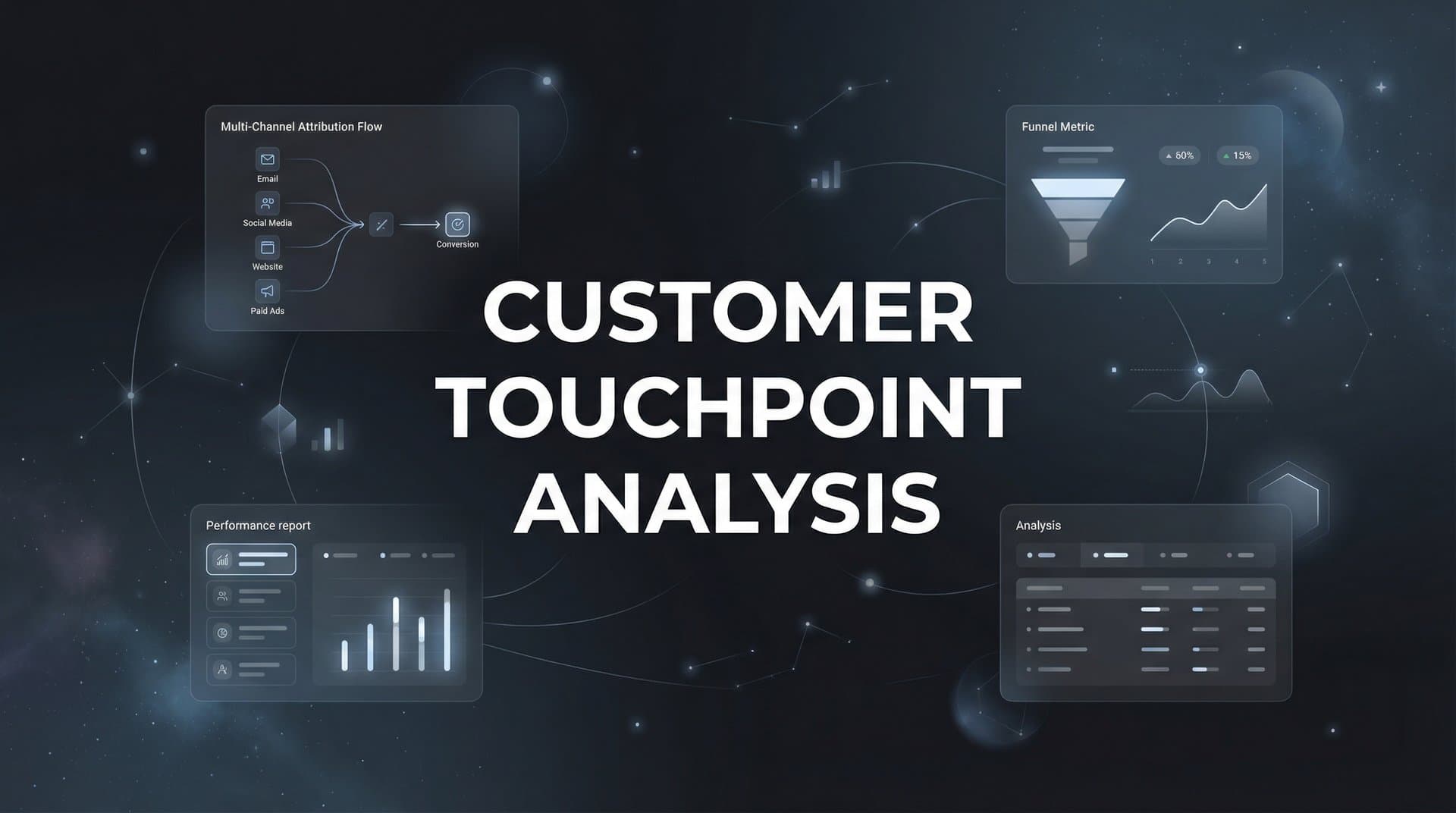
Customer touchpoint analysis changes everything. It's the systematic approach to capturing, measuring, and optimizing every single interaction a prospect has with your brand. Not just the obvious ones like ad clicks and form fills, but the entire journey: the LinkedIn post they scrolled past two weeks ago, the comparison article they read on mobile, the retargeting ad that brought them back, the sales call that sealed the deal.
The difference between good marketing and great marketing isn't creative genius or bigger budgets. It's knowing exactly which touchpoints drive revenue and which ones just create noise. When you can see the complete picture—when you understand that your bottom-of-funnel search ads are converting prospects who first discovered you through a podcast sponsorship three months earlier—you stop wasting money and start scaling strategically.
By the end of this guide, you'll understand how to implement touchpoint analysis that connects every marketing dollar to real business outcomes. No more guessing. No more debates about which channel "deserves credit." Just clear, actionable data that shows you where to invest and where to cut.
Breaking Down the Customer Journey Into Measurable Moments
Customer touchpoint analysis is the process of identifying, tracking, and evaluating every interaction a prospect has with your brand across all channels. Think of it as building a complete map of how strangers become customers—not just the final step where they convert, but every single moment that influenced their decision.
Here's what makes this challenging: your customers don't experience your brand in neat categories. They don't think "now I'm engaging with paid media" or "this is an organic touchpoint." They see an Instagram ad on their phone during lunch, Google your company name on their laptop that evening, read three blog posts over the next week, ignore two retargeting ads, click a third one, watch a demo video, and finally book a call.
That's seven touchpoints across four different platforms and two devices. If you're only tracking last-click conversions, you'd credit everything to that final retargeting ad. If you're looking at platform-specific analytics, you'd see disconnected data points that tell you nothing about how they work together.
Effective touchpoint analysis starts by categorizing every type of interaction. Paid media impressions and clicks are the obvious ones—your Facebook ads, Google search campaigns, LinkedIn sponsored content. But organic touchpoints matter just as much: the blog post that answered their question, the comparison page they found through search, the case study they downloaded. Understanding what is a customer touchpoint helps you identify every interaction worth measuring.
Then you have email interactions—opens, clicks, and replies that signal growing interest. Website visits tell you what content resonates and which pages create friction. Sales conversations, whether they're automated chat sequences or live calls, represent critical high-intent touchpoints. Even post-purchase touchpoints like onboarding emails and support interactions influence whether customers expand, renew, or churn.
The fundamental problem most teams face is fragmented tracking. Facebook shows you ad performance in Ads Manager. Google Analytics shows you website behavior. Your CRM tracks sales activities. Your email platform reports campaign metrics. Each system tells you a piece of the story, but none of them show you how these pieces connect.
This fragmentation creates blind spots that cost you money. You might see that your webinar landing page has a high conversion rate, so you invest more in promoting it. But you're missing that 80% of webinar attendees first discovered you through organic social posts weeks earlier. The webinar isn't the revenue driver—it's the final touchpoint in a sequence that started elsewhere.
Or you might cut budget from display advertising because it shows terrible last-click conversion rates. What you don't see is that display ads are introducing your brand to prospects who later convert through branded search. Kill the display campaigns, and your "high-performing" search campaigns start underperforming because the awareness pipeline dried up.
Real touchpoint analysis requires seeing the complete journey as a connected sequence. It means tracking not just individual interactions, but the order they happen in, the time between them, and how different combinations lead to different outcomes. When you can see that prospects who engage with three specific touchpoints in a particular sequence convert at 5x the rate of those who don't, you've found something worth optimizing around.
The Data Infrastructure Behind Effective Touchpoint Tracking
You can't analyze what you don't capture. Building a touchpoint analysis system that actually works requires connecting every data source into a unified layer where customer journeys stay intact across platforms.
The technical foundation starts with integration. Your ad platforms—Meta, Google, LinkedIn, TikTok—need to feed data into a central system that also receives information from your website analytics, CRM, email platform, and any other tool that touches customers. This isn't about exporting CSV files and manually matching records. It's about real-time data flows that preserve the connection between a Facebook click at 2 PM and a form submission on your website at 2:03 PM.
Most marketing teams rely on UTM parameters and cookies to track this journey. Someone clicks your ad, lands on your site with a UTM-tagged URL, and a cookie gets stored in their browser. When they return later and convert, that cookie tells you where they came from. Simple enough.
Except it's not simple anymore. iOS privacy changes have made browser-based tracking increasingly unreliable. Safari blocks third-party cookies by default and limits first-party cookie lifespan to seven days. If someone clicks your ad on their iPhone, browses your site, and converts on their laptop two weeks later, traditional tracking loses that connection entirely. Many teams struggle because they can't track customer journey accurately with outdated methods.
This is where server-side tracking becomes essential. Instead of relying on browser cookies that can be blocked or deleted, server-side tracking captures events on your server and matches them using first-party identifiers. When someone fills out a form, you capture their email. When they return to your site, you can match that email to their previous sessions—even if they're on a different device or their cookies were cleared.
First-party data collection is the foundation of reliable touchpoint tracking in the current privacy landscape. This means capturing identifiable information—email addresses, phone numbers, user IDs—at key conversion points and using those identifiers to connect touchpoints across sessions and devices. Learning how to capture every customer touchpoint is essential for building this foundation.
Real-time event tracking ensures you're not analyzing yesterday's data to make today's decisions. When someone clicks an ad, visits a pricing page, watches a demo video, or submits a form, those events should flow into your analysis system immediately. This real-time data layer powers both attribution analysis and optimization feedback loops.
The infrastructure also needs to handle offline conversions. If you're running lead generation campaigns where sales happen over the phone or through a CRM workflow, your touchpoint analysis must connect those closed deals back to the original marketing interactions. This requires CRM integration that feeds conversion events—qualified leads, opportunities created, deals closed—back into your attribution system.
Think of your data infrastructure as the nervous system of your marketing operation. Every touchpoint is a sensor sending signals. If those signals don't reach the brain (your analytics system) or arrive garbled and disconnected, you can't make intelligent decisions. But when the infrastructure works correctly—when every click, view, form fill, and conversion flows into a unified system that preserves the relationships between them—you gain something most marketers never achieve: a complete, accurate view of what's actually driving revenue.
Attribution Models: Assigning Value to Each Touchpoint
Once you're capturing every touchpoint, the next challenge is figuring out which ones actually matter. This is where attribution models come in—different frameworks for assigning credit to the various interactions that lead to a conversion.
First-touch attribution gives all the credit to the initial interaction. If someone first discovered you through a Facebook ad, that ad gets 100% credit for the eventual conversion, even if they engaged with a dozen other touchpoints before buying. This model answers the question: "What's filling the top of my funnel?" It's useful for understanding awareness channels and measuring how well you're attracting new prospects.
Last-touch attribution does the opposite—it credits the final touchpoint before conversion. If someone clicked a retargeting ad right before purchasing, that ad gets all the credit. This model tells you what's closing deals, but it completely ignores the journey that got prospects to that final step. It's the default in most analytics platforms because it's simple, but it creates a dangerously incomplete picture.
Linear attribution tries to be fair by splitting credit evenly across all touchpoints. If someone had eight interactions before converting, each one gets 12.5% credit. This approach acknowledges that multiple touchpoints contribute to conversions, but it treats a quick scroll past a display ad the same as a 30-minute demo video. Everything matters equally, which means nothing stands out as particularly important.
Time-decay attribution assigns more credit to touchpoints closer to conversion. The theory is that recent interactions have more influence on the final decision than things that happened weeks ago. This model makes intuitive sense for longer sales cycles where early touchpoints might be forgotten by the time someone converts. But it can undervalue the awareness and consideration touchpoints that got prospects interested in the first place.
Data-driven multi-touch attribution uses machine learning to analyze thousands of conversion paths and determine which touchpoints actually correlate with higher conversion rates. Instead of applying a predetermined rule, it looks at your actual data: prospects who engaged with touchpoint A and B converted at this rate, while those who engaged with A and C converted at a different rate. The model assigns credit based on each touchpoint's statistical contribution to conversion likelihood. This approach is central to multi-touchpoint marketing attribution strategies.
Here's the reality: no single attribution model tells the complete story. Each one reveals different insights about your marketing performance.
First-touch shows you which channels are best at generating awareness. If you're trying to reach new audiences or enter new markets, this matters. Last-touch reveals which touchpoints are most effective at converting ready-to-buy prospects. If you're optimizing for immediate conversions, this is valuable. Data-driven models help you understand the complex interplay between touchpoints—which combinations work together to drive conversions.
The most sophisticated marketing teams don't pick one model and ignore the rest. They compare multiple attribution models side by side. When you see that a channel gets 5% credit in first-touch but 40% credit in last-touch, you've learned something important: it's not great at generating new awareness, but it's excellent at converting prospects who are already familiar with your brand. That insight changes how you use that channel and what you're willing to pay for it. Understanding marketing attribution valuing the customer journey helps you make these comparisons effectively.
Sales cycle length should influence which models you prioritize. For e-commerce with short consideration periods, last-touch and time-decay models often provide the most actionable insights. For B2B SaaS with three-month sales cycles, you need multi-touch models that capture the entire nurture sequence. For businesses with both quick wins and long-tail conversions, comparing models reveals which channels serve which customer segments.
The goal isn't finding the "right" attribution model. It's using different models to ask different questions about your marketing performance and building a complete understanding of how touchpoints work together to drive revenue.
From Raw Data to Revenue Insights: Analyzing Touchpoint Performance
Collecting touchpoint data and running attribution models is just the beginning. The real value comes from analyzing that data to find patterns that inform smarter marketing decisions.
Start by identifying high-converting touchpoint sequences. Look beyond individual channel performance to understand which combinations of interactions lead to the best outcomes. You might discover that prospects who read a blog post, then watch a demo video, then attend a webinar convert at 3x the rate of those who only engage with one of those touchpoints. That's not a coincidence—it's a pattern worth replicating.
This sequence analysis reveals the optimal path to conversion. Maybe you find that prospects who engage with educational content before seeing product-focused messaging convert better than those who see product pitches first. That insight changes your retargeting strategy entirely. Instead of immediately hitting blog readers with demo requests, you nurture them with more educational content, then introduce product messaging once they've engaged with multiple pieces. Understanding the customer path to purchase reveals these critical patterns.
Pay attention to paths that stall. If you notice that prospects who land on your pricing page as their first touchpoint rarely convert, but those who visit pricing after reading case studies convert frequently, you've identified a friction point. The pricing page isn't the problem—the lack of trust-building context is. This might lead you to add case study links to your pricing page or adjust your ad targeting to avoid sending cold traffic directly to pricing.
Touchpoint efficiency is another critical metric. Some interactions move prospects forward quickly, while others add time and complexity to the journey without improving conversion rates. If you see that prospects who download a specific lead magnet take 40% longer to convert and close at the same rate as those who don't, that lead magnet isn't adding value—it's adding friction. You can test removing it from your funnel or replacing it with something that better qualifies prospects.
Channel contribution analysis goes deeper than simple attribution percentages. Look at how different channels support each other. Display advertising might show poor last-click conversions but excellent assisted conversions—it rarely gets the final touch, but it appears frequently in the journeys of people who eventually convert through other channels. This supporting role is valuable, even if traditional metrics don't capture it.
Device and timing patterns matter too. You might find that mobile touchpoints are common early in the journey but rare at conversion, suggesting that mobile ads should focus on awareness while desktop ads can push harder for conversions. Or you might discover that prospects who engage with touchpoints on weekends convert faster than those who only interact during business hours, indicating different levels of intent.
This is where AI becomes invaluable. Human analysts can spot obvious patterns, but machine learning can surface subtle correlations across thousands of variables. AI can identify that prospects who engage with a specific combination of three touchpoints within a five-day window convert at exceptional rates—a pattern too nuanced for manual analysis but incredibly actionable once discovered. Leveraging customer journey analytics powered by AI transforms how you interpret this data.
AI can also predict which active prospects are most likely to convert based on their touchpoint engagement so far. If someone's current journey matches the pattern of high-converting customers, you can prioritize them for sales outreach. If their pattern matches prospects who typically churn, you can adjust your approach before wasting resources.
The analysis process should be ongoing, not a one-time exercise. Customer behavior changes. New channels emerge. Competitors shift their strategies. What worked last quarter might not work next quarter. Regular touchpoint analysis ensures you're always optimizing based on current data, not outdated assumptions.
Turning Touchpoint Analysis Into Campaign Optimization
Analysis without action is just interesting data. The point of understanding touchpoint performance is making better marketing decisions that drive more revenue with less waste.
Budget allocation is the most direct application of touchpoint insights. When you know which channels contribute most to conversions—not just last-click, but throughout the journey—you can shift spend toward what works and away from what doesn't. If your analysis shows that LinkedIn ads generate high-quality prospects who convert at 2x the rate of Facebook prospects, even if LinkedIn's cost per click is higher, the cost per actual customer might be lower. That's where your budget should go.
But smart budget allocation isn't just about moving money to top-performing channels. It's about understanding channel roles. Some channels excel at awareness but struggle with conversion. Others are terrible at attracting cold traffic but exceptional at converting warm prospects. Your budget strategy should fund the entire ecosystem, not just the final-touch winners. Knowing how to reduce customer acquisition cost depends on this holistic understanding.
The feedback loop between analysis and ad platforms is where touchpoint tracking creates compounding returns. When you send accurate, enriched conversion data back to Meta, Google, and other platforms, their algorithms can better optimize targeting and bidding. This is called conversion optimization or conversion sync.
Here's how it works: instead of just telling Facebook "this person converted," you send additional context: "this person converted, they're worth $5,000 in lifetime value, and they engaged with these specific touchpoints before converting." Facebook's algorithm uses this enriched data to find more people who match the profile of your best customers, not just anyone who might click.
This creates a virtuous cycle. Better data leads to better ad targeting. Better targeting drives higher-quality traffic. Higher-quality traffic converts at better rates and provides more data to further refine targeting. Companies that implement this feedback loop often see ad performance improve by 30-50% without changing creative or increasing budgets—simply by feeding the algorithms better information.
Scaling strategies become clearer when you understand touchpoint sequences. If you've identified that a specific combination of touchpoints drives exceptional conversion rates, you can deliberately engineer more prospects into that sequence. Maybe you create lookalike audiences based on people who engaged with your top-performing blog posts, then retarget them with the specific video content that high-converters watched, then hit them with the offer that closed deals.
This is precision marketing—not spray and pray, but deliberately guiding prospects through the exact journey that your data shows works best.
You can also identify underperforming paths and cut them off. If certain landing pages or content pieces consistently appear in the journeys of prospects who never convert, stop driving traffic to them. If specific ad creatives generate clicks but those clicks rarely lead to valuable touchpoints, pause those ads and reallocate budget to creatives that start better journeys.
Creative optimization gets smarter too. When you know which messages resonate at different stages of the journey, you can match creative to context. Awareness-stage touchpoints should focus on education and problem identification. Consideration-stage touchpoints can introduce your solution and differentiation. Decision-stage touchpoints should emphasize proof, urgency, and clear calls to action. Mastering the stages of the customer journey helps you align creative with intent.
Testing becomes more sophisticated. Instead of just A/B testing landing pages in isolation, you can test entire touchpoint sequences. What happens when you change the order prospects encounter different content? What if you add a new touchpoint between two existing ones? Your analysis framework lets you measure the impact of these sequence changes on overall conversion rates, not just individual page performance.
The ultimate optimization goal is increasing the percentage of prospects who experience your highest-converting touchpoint sequences while reducing exposure to paths that waste time and budget. Every insight from your analysis should translate into a specific action: shift budget, adjust targeting, change messaging, add or remove touchpoints, modify sequencing.
Putting It All Together: Building Your Touchpoint Analysis System
Customer touchpoint analysis isn't a single tool or tactic—it's a comprehensive system with multiple interconnected components working together.
The foundation is unified tracking infrastructure that captures every interaction across all channels and preserves the connections between them. This means integrating your ad platforms, website analytics, CRM, email system, and any other customer touchpoint into a central data layer. Server-side tracking ensures accuracy despite browser limitations and privacy changes. Implementing customer journey tracking software provides this unified foundation.
Multi-touch attribution models sit on top of that data layer, helping you understand the relative contribution of each touchpoint. You need the flexibility to compare different attribution approaches—first-touch, last-touch, linear, time-decay, and data-driven models—because each reveals different insights about your marketing performance.
Ongoing analysis turns raw data into actionable insights. This includes sequence analysis to identify high-converting paths, efficiency analysis to spot friction points, channel contribution analysis to understand how touchpoints support each other, and AI-powered pattern recognition to surface opportunities humans might miss. Using customer journey analytics tools streamlines this ongoing analysis process.
Optimization feedback loops close the circle by turning insights into action. Budget flows toward high-performing channels and sequences. Enriched conversion data feeds back to ad platforms to improve their targeting. Creative and messaging align with what works at each stage of the journey. Underperforming paths get pruned while winning sequences get scaled.
The competitive advantage of comprehensive touchpoint analysis is profound. While your competitors are making decisions based on last-click data or gut instinct, you know exactly which marketing investments drive revenue. You can confidently scale what works because you've seen the complete picture of how it contributes to conversions. You can defend your marketing budget with data that connects every dollar spent to business outcomes.
This level of visibility transforms marketing from a cost center into a predictable revenue engine. You stop wondering if your campaigns are working and start knowing which specific touchpoints generate the best returns. You move from reactive budget cuts when revenue dips to proactive optimization based on real-time performance data.
For teams running paid campaigns across multiple platforms, touchpoint analysis solves the fundamental attribution problem: connecting ad spend to actual revenue in a world where customers interact with dozens of touchpoints before converting. It answers the questions that keep marketing leaders up at night: Which channels really drive results? Where should we invest more? What can we cut without hurting performance?
The Path Forward: From Data to Decisions
Customer touchpoint analysis transforms marketing from guesswork into a data-driven discipline. But let's be clear about what that means: the goal isn't tracking more data for its own sake. It's connecting every interaction to revenue outcomes so you can confidently scale what works and stop wasting money on what doesn't.
The marketers who win in the current landscape are those who can see the complete customer journey—not fragments from disconnected platforms, but the actual sequence of touchpoints that turn strangers into customers. They understand which channels deserve credit for revenue, not based on arbitrary attribution rules, but based on statistical analysis of what actually drives conversions.
This complete visibility changes everything. Budget decisions become straightforward when you can see which investments generate returns. Creative strategy gets sharper when you know which messages resonate at each stage. Scaling becomes confident when you've identified the exact touchpoint sequences that convert best.
The infrastructure required—unified tracking, multi-touch attribution, ongoing analysis, optimization feedback loops—might seem complex. But the alternative is worse: flying blind, making expensive mistakes, and never quite knowing if your marketing is actually working.
Ready to elevate your marketing game with precision and confidence? Discover how Cometly's AI-driven recommendations can transform your ad strategy—Get your free demo today and start capturing every touchpoint to maximize your conversions.