You're running campaigns on Meta, Google, TikTok, and LinkedIn. Your CRM shows leads coming in. Your analytics dashboard lights up with conversions. But when you try to figure out which channel actually deserves credit for that $50,000 deal that just closed, you hit a wall.
Meta says it drove the conversion. Google claims the same customer. Your sales team insists it was the email nurture sequence. Everyone's taking credit, but nobody has the full picture.
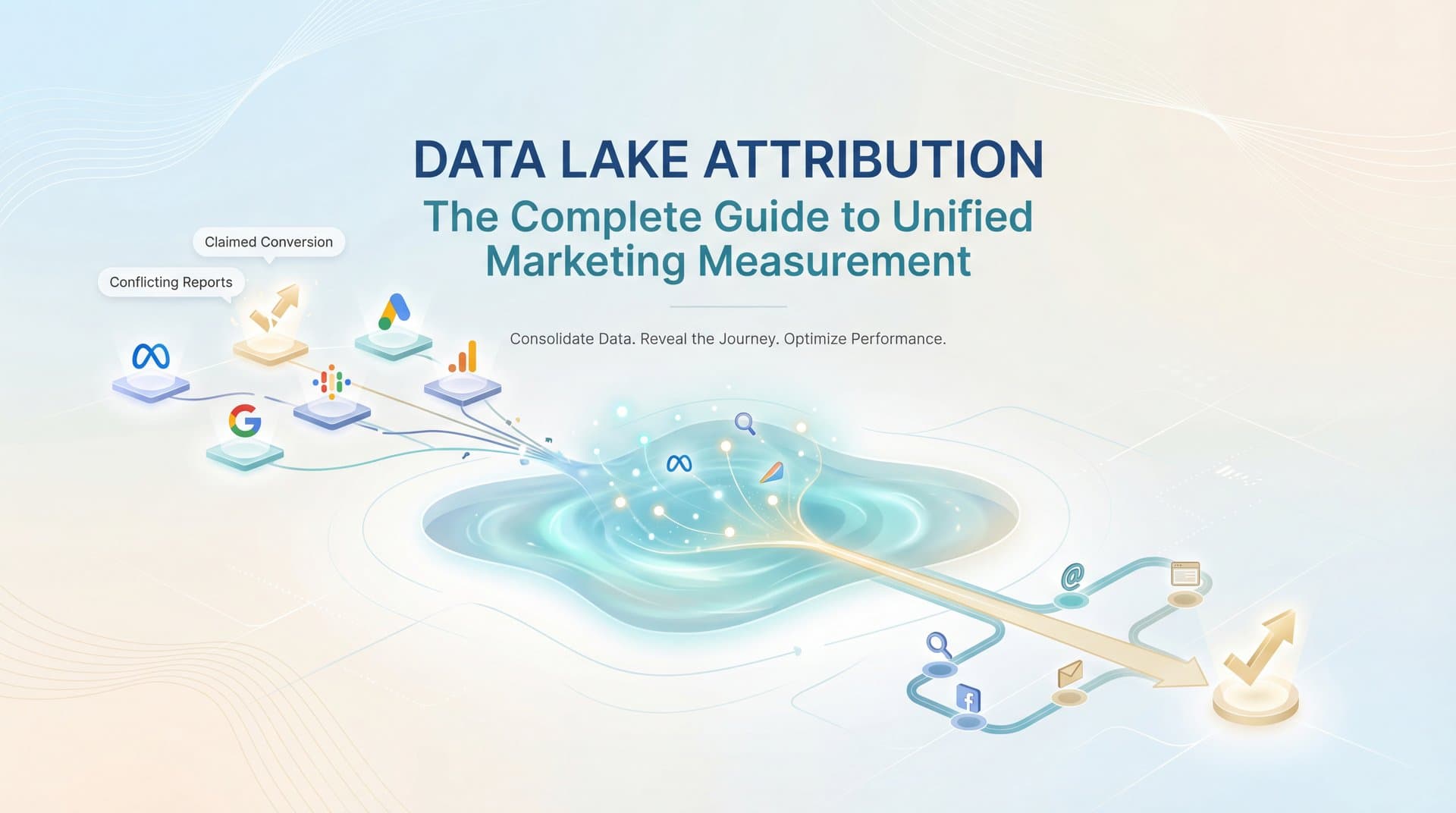
This is the core problem that data lake attribution solves. Instead of letting each platform tell its own version of the story, data lake attribution brings all your marketing data into one unified view before applying attribution logic. It's the difference between asking five blind people to describe an elephant versus actually seeing the whole animal.
For marketers managing complex, multi-channel campaigns, this unified approach transforms how you understand performance, allocate budgets, and optimize for real revenue growth. Let's break down exactly how it works and why it matters for your marketing strategy.
Why Traditional Attribution Falls Short in a Multi-Platform World
Here's the fundamental problem: every ad platform operates in its own data silo. Meta's pixel tracks what happens on Meta. Google's conversion tracking sees Google's world. TikTok measures TikTok. Each platform is essentially wearing blinders, only seeing the touchpoints it directly controls.
The result? Massive over-attribution. When you add up the conversions each platform claims credit for, you'll often find they total 150% or more of your actual conversions. It's mathematically impossible, yet this is how most marketers are currently measuring performance.
Think about a typical customer journey: Someone sees your Meta ad, clicks through but doesn't convert. Three days later, they search your brand name on Google and click your ad. A week after that, they receive a promotional email, click through, and finally make a purchase. In traditional platform-native attribution, both Meta and Google will claim that conversion. Your email platform might count it too.
This fragmentation creates blind spots that cost real money. You might be over-investing in channels that look great in isolation but are actually just intercepting customers who were already coming your way. Or you might be under-funding channels that play crucial early-stage roles in customer journeys, even though they rarely get last-click credit.
The problem compounds when you factor in modern privacy changes. iOS tracking limitations mean your Meta pixel misses significant portions of the customer journey. Ad blockers prevent your tracking scripts from firing. Cross-device behavior—someone browsing on mobile but converting on desktop—creates gaps in the data.
When you're making six-figure budget allocation decisions based on incomplete, conflicting data from siloed platforms, you're essentially flying blind. You need a better foundation for those decisions. That's where data attribution comes in.
How Data Lake Attribution Connects the Dots
Data lake attribution flips the traditional approach on its head. Instead of relying on each platform's limited view of customer behavior, you collect raw event data from every touchpoint and centralize it before applying any attribution logic.
Picture it like this: traditional attribution is like asking each department in your company to report their own revenue impact independently. Data lake attribution is like having one unified financial system that tracks every transaction and then determines how credit should be distributed.
The technical flow starts with comprehensive data collection. Every meaningful interaction—ad impressions, clicks, website visits, form submissions, email opens, CRM events, even offline conversions—gets captured as a structured event and sent to your centralized data lake.
Here's what makes this powerful: you're capturing the raw data before any platform applies its own attribution rules. You get the timestamp, the user identifier, the source, the specific ad or campaign, and any relevant metadata. This raw data becomes your source of truth.
The data lake pulls from multiple source types. Your ad platforms feed in impression and click data. Your website tracking captures browsing behavior and on-site conversions. Your CRM contributes lead creation events, opportunity stages, and closed deals. Your email platform adds engagement data. If you have a mobile app, those events flow in too.
But collecting data is only half the challenge. The real magic happens in the identity resolution layer. This is where the system stitches together all those individual events into unified customer profiles.
When someone clicks your Meta ad on their phone while browsing anonymously, then later visits your website on their laptop and fills out a form with their email, the data lake connects those dots. That anonymous mobile session gets linked to the known customer profile. Suddenly, you can see the complete journey from first touch to conversion.
This identity resolution happens through multiple signals: email addresses, phone numbers, device IDs, IP addresses, and behavioral patterns. Advanced systems use probabilistic matching to connect sessions even when there's no direct identifier overlap, looking at patterns like browsing behavior, timing, and location data.
Once you have unified customer profiles with complete journey histories, you can apply attribution models that actually reflect reality. Instead of each platform claiming credit independently, you have one system looking at the full sequence of touchpoints and distributing credit based on actual influence.
The difference in data quality is dramatic. You move from fragmented, conflicting reports to a single source of truth that shows exactly how your marketing channels work together to drive conversions.
Building Blocks of an Effective Attribution Data Lake
Building a data lake that delivers accurate attribution requires getting several foundational elements right. Miss any of these, and your unified view becomes just another source of confusion.
Identity resolution sits at the core. This is your system's ability to recognize that the anonymous visitor who clicked your ad yesterday is the same person who filled out a form today and made a purchase next week. Without accurate identity resolution, you can't build complete customer journeys.
The challenge is that modern users interact with your brand across multiple devices, browsers, and contexts. They might browse on mobile while logged out, research on their work laptop, and convert on their home desktop. Each session initially appears as a separate user.
Effective identity resolution uses a waterfall approach. First, it looks for deterministic matches—direct identifiers like email addresses or user IDs that definitively connect sessions. When someone logs in or submits a form, you can confidently link their current session to their known profile.
For sessions without direct identifiers, probabilistic matching takes over. The system analyzes patterns: device fingerprints, IP addresses, browsing behavior, timing patterns. If someone visits your site from the same IP address and shows similar browsing patterns as a known user, there's a high probability they're the same person.
Event tracking architecture is the second critical building block. You need a system that captures every meaningful touchpoint without gaps. This means implementing first-party data tracking alongside client-side tracking.
Client-side tracking—like pixels and JavaScript tags—has become increasingly unreliable. Ad blockers block them. iOS privacy features limit them. Browser restrictions constrain them. Server-side tracking solves these problems by capturing events on your server before sending them to your data lake, bypassing client-side limitations entirely.
Your event tracking needs to be comprehensive but structured. Each event should include standard fields: timestamp, user identifier, event type, source, campaign details, and any relevant metadata. Consistency in how you structure events makes downstream analysis possible.
Data quality requirements can make or break your attribution system. Garbage in, garbage out applies here more than almost anywhere else in marketing. If your tracking fires inconsistently, if events arrive out of order, if user identifiers don't match across systems—your attribution becomes unreliable.
Common pitfalls include duplicate events (the same conversion tracked multiple times), missing events (gaps in the customer journey), and timestamp issues (events recorded with incorrect times). These problems multiply when you're pulling data from multiple sources that each handle tracking differently. Understanding how to fix attribution discrepancies in data becomes essential for maintaining accuracy.
The solution is implementing validation at the point of collection. Check that required fields are present. Verify that timestamps are reasonable. Deduplicate events based on unique identifiers. Flag suspicious patterns for review. Building these quality controls into your data pipeline prevents bad data from poisoning your attribution analysis.
Attribution Models That Actually Work With Unified Data
Once you have complete customer journey data in your data lake, you can finally use attribution models the way they were meant to work. Traditional single-touch models—first-touch or last-touch—become obviously inadequate when you can see the full sequence of interactions.
First-touch attribution gives all credit to the initial touchpoint. It answers the question: "What made this person aware of us?" This model makes sense for top-of-funnel optimization, especially if you're trying to understand which channels are best at generating new awareness. But it completely ignores everything that happened afterward.
Last-touch attribution does the opposite, crediting only the final interaction before conversion. It answers: "What closed the deal?" This model is useful for understanding conversion drivers, but it misses all the nurturing and consideration-stage touchpoints that made that final conversion possible.
With unified data, you can move beyond these oversimplifications to multi-touch attribution models for data that distribute credit across the entire journey. Linear attribution spreads credit evenly across all touchpoints. If someone had five interactions before converting, each gets 20% credit.
Time-decay attribution gives more weight to touchpoints closer to conversion. The logic is that recent interactions matter more than early awareness. This model works well for businesses with shorter sales cycles where momentum builds toward a purchase decision.
Position-based attribution (also called U-shaped) gives more weight to the first and last touchpoints while distributing remaining credit to middle interactions. Typically, first and last touch each get 40% credit, with the remaining 20% split among middle touchpoints. This acknowledges that initial awareness and final conversion drivers both matter.
But here's where unified data really shines: data-driven attribution. Instead of applying arbitrary rules about how credit should be distributed, data-driven models analyze your actual conversion patterns to determine which touchpoints statistically influence outcomes.
The system looks at thousands of customer journeys—both those that converted and those that didn't—and identifies which touchpoints correlate with conversion. If customers who interact with a specific channel or campaign convert at significantly higher rates, that touchpoint earns more attribution credit.
This approach requires substantial data volume to be reliable, which is why it only becomes viable when you have a unified data lake capturing complete journeys at scale. You need enough conversion data to make statistically valid comparisons.
The key is matching your attribution model to your business goals. If you're focused on efficient customer acquisition, first-touch attribution helps you understand which channels are best at generating new prospects. If you're optimizing for immediate revenue, last-touch shows you what's closing deals. If you want to understand the full customer journey and optimize every stage, multi-touch or data-driven attribution gives you the complete picture.
Many sophisticated marketers use multiple attribution models simultaneously, comparing results to understand different aspects of their marketing performance. Your data lake makes this comparison easy because you're working from the same unified dataset regardless of which model you apply. For a deeper dive into understanding the difference between single source attribution and multi-touch attribution models, explore how each approach impacts your optimization strategy.
Turning Attribution Insights Into Smarter Ad Spend
Unified attribution data is only valuable if it changes how you allocate budgets and optimize campaigns. The real payoff comes when you translate insights into action.
Start by identifying channels and campaigns that are genuinely driving incremental conversions versus those that are just intercepting customers who were already coming. With complete journey visibility, you can spot patterns like branded search ads that look great on last-touch attribution but are actually just capturing people who were already searching for your brand.
This doesn't mean cutting those campaigns entirely—branded search still serves a defensive purpose—but it helps you understand their true incremental value. You might reduce bids or budgets on high-intent branded terms while increasing investment in channels that are genuinely creating new demand.
Look for channels that consistently appear early in high-value customer journeys, even if they rarely get last-touch credit. These are your awareness and consideration drivers. Many marketers under-invest in these channels because traditional attribution doesn't capture their value.
The next level of optimization involves feeding your enriched attribution data back to ad platforms. This is where unified data creates a powerful feedback loop. Instead of letting Meta or Google rely on their limited view of conversions, you send them complete conversion data including revenue values and customer lifetime value indicators.
When you sync this enriched data back to ad platforms, their machine learning algorithms get better training data. They can identify patterns in which users are most likely to become high-value customers, not just which users are most likely to click or convert at all.
This improved targeting compounds over time. As platforms receive better conversion data, they optimize toward genuinely valuable outcomes. Your cost per acquisition might not change dramatically, but your customer quality improves. You're acquiring customers who stick around longer and spend more.
Create regular review cycles where you analyze attribution data and make budget adjustments. Many marketers set quarterly or monthly reviews, but with real-time data lakes, you can identify optimization opportunities much faster.
The key is balancing responsiveness with statistical significance. Don't make dramatic budget shifts based on a few days of data, but don't wait so long that you miss opportunities either. Look for consistent patterns over 2-4 week periods, then test budget reallocations.
Use your attribution data to inform creative and messaging strategy too. If you notice certain value propositions or creative angles consistently appear in high-converting journeys, double down on those themes. If specific audience segments show stronger multi-touch engagement patterns, create campaigns specifically designed for their journey patterns. Learn more about how ad tracking tools can help you scale ads using accurate data to maximize your optimization efforts.
Implementing Data Lake Attribution Without the Complexity
The concept of data lake attribution sounds technically complex—and building it from scratch absolutely is. The build versus buy decision comes down to your resources, technical capabilities, and how core this capability is to your competitive advantage.
Building a custom data lake makes sense for very large enterprises with dedicated data engineering teams and unique requirements that off-the-shelf solutions can't address. You're looking at months of development time, ongoing maintenance costs, and the need for specialized expertise in data engineering, identity resolution, and attribution modeling.
For most marketing teams, purpose-built attribution platforms deliver better results faster. These platforms provide the data lake architecture, identity resolution, attribution modeling, and ad platform integrations out of the box. You get the benefits of unified attribution without building and maintaining complex data infrastructure.
This is where Cometly comes in. The platform delivers complete data lake attribution capabilities designed specifically for marketers who need accurate cross-channel measurement without requiring a data engineering team.
Cometly captures every touchpoint through server-side tracking that bypasses iOS limitations and ad blocker issues. The platform automatically handles identity resolution, stitching together anonymous sessions and known customer profiles to build complete journey views. All your ad platforms, CRM data, and website events flow into one unified system.
The attribution modeling happens automatically, with multiple models available so you can compare different perspectives on your marketing performance. But Cometly goes beyond just showing you attribution data—it feeds enriched conversion events back to your ad platforms, creating that feedback loop that improves targeting over time.
Getting started requires connecting your key data sources. Integrate your ad platforms—Meta, Google, TikTok, LinkedIn, or whatever channels you're running. Connect your CRM so you can track leads and revenue. Implement the Cometly tracking on your website to capture the full customer journey. For a detailed walkthrough, see our guide on how to setup datalake for marketing attribution effectively.
The platform handles the complex parts—identity resolution, event standardization, attribution calculation—while giving you intuitive dashboards that show which campaigns and channels are actually driving revenue. You can compare attribution models, analyze customer journey patterns, and identify optimization opportunities without writing SQL queries or building data pipelines.
The Future of Marketing Measurement Starts Here
Data lake attribution represents a fundamental shift in how marketers measure and optimize performance. Instead of piecing together fragmented reports from siloed platforms, you get a unified view of how your marketing channels work together to drive real business outcomes.
This approach isn't just more accurate—it's more actionable. When you can see complete customer journeys, you make smarter budget decisions. When you feed enriched data back to ad platforms, their algorithms optimize for genuinely valuable outcomes. When you understand which touchpoints truly influence conversions, you can design campaigns that work with the customer journey instead of fighting against it.
The technical complexity that once made this approach accessible only to enterprises with large data teams has been solved by purpose-built platforms. You no longer need to choose between accurate attribution and practical implementation.
Modern attribution platforms like Cometly make unified measurement accessible to any marketing team that wants to move beyond guesswork and optimize based on complete data. The platform captures every touchpoint, resolves identities across devices and sessions, applies sophisticated attribution models, and feeds better data back to your ad platforms—all without requiring you to build or maintain complex data infrastructure.
For marketers serious about understanding what's actually driving results and making data-driven decisions about where to invest their budgets, data lake attribution isn't optional anymore. It's the foundation for confident, profitable marketing at scale.
Ready to elevate your marketing game with precision and confidence? Discover how Cometly's AI-driven recommendations can transform your ad strategy—Get your free demo today and start capturing every touchpoint to maximize your conversions.