

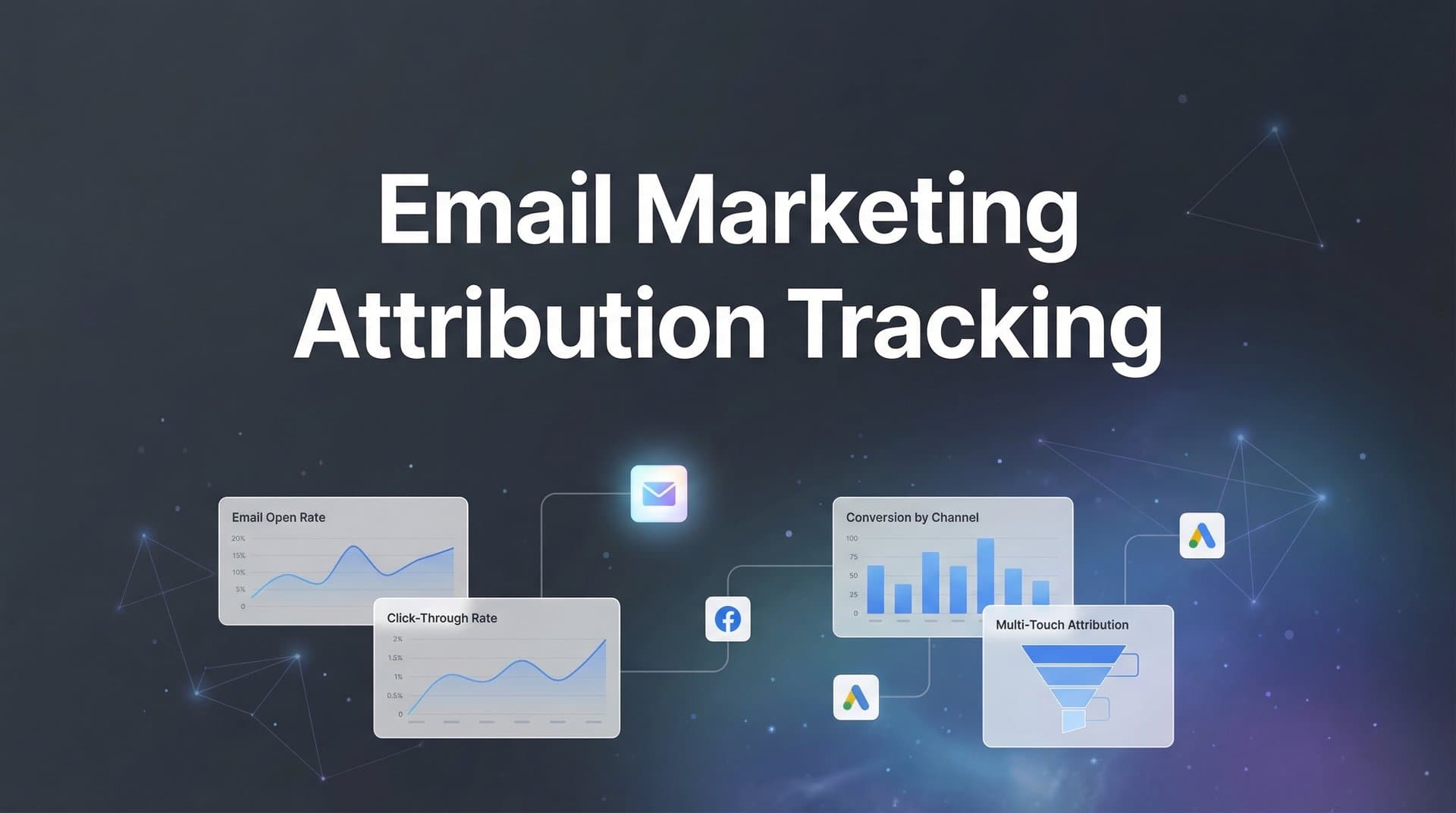
You've been watching your email metrics climb. Open rates are solid. Click-through rates look healthy. Your email platform's dashboard shows engagement trending upward. But when you sit down with your CFO to justify the email marketing budget, something doesn't add up. Those clicks aren't translating into clear revenue numbers, and you're left making educated guesses about which campaigns actually matter to the bottom line.
This disconnect happens because traditional email metrics tell you what people do inside their inbox, not what happens after they leave it. Someone might click your promotional email, browse your site, leave, see a retargeting ad three days later, and finally convert. Which channel gets credit? Without proper email marketing attribution tracking, you're flying blind—and potentially making decisions based on incomplete data.
Email marketing attribution tracking solves this problem by connecting the dots between email engagement and actual business outcomes. It shows you not just who clicked, but who converted, how much revenue they generated, and what role email played in their journey. This article breaks down exactly how attribution tracking works for email campaigns, which models make sense for different business types, and how to build a system that gives you real visibility into email's contribution to revenue.
Why Your Email Metrics Are Telling an Incomplete Story
Traditional email metrics live in isolation. Your ESP tells you that 2,500 people opened your product launch email and 400 clicked through to your landing page. That sounds promising until you realize you have no idea how many of those 400 actually bought something—or whether they converted immediately, came back later through a different channel, or never converted at all.
The problem intensifies when you consider how real customer journeys work. Someone might receive your welcome email, ignore it, see your Facebook ad two days later, click that ad, browse your site without buying, then receive your abandoned cart email and finally convert. If you're only looking at last-click attribution, that abandoned cart email gets all the credit. But the welcome email and the Facebook ad both played crucial roles in moving that customer toward conversion.
This fragmented view creates real business consequences. You might be over-investing in last-touch channels while undervaluing the emails that actually introduce prospects to your brand or keep them engaged during longer consideration periods. A welcome series might generate fewer direct clicks than your promotional emails, but if it's setting the foundation for conversions that happen weeks later through other channels, you're missing its true value. Understanding channel attribution in digital marketing helps reveal these hidden contributions.
The cost of this misattribution goes beyond budget allocation. You might be optimizing for the wrong metrics entirely—tweaking subject lines to boost opens when the emails with lower open rates actually drive more revenue. You could be sending promotional emails too frequently because they show strong immediate engagement, not realizing they're cannibalizing conversions that would have happened anyway or burning out your list over time.
Without attribution tracking, you're also blind to critical patterns. Maybe your educational content emails rarely drive immediate conversions but consistently appear in the journey of your highest-value customers. Perhaps your monthly newsletter doesn't generate many clicks, but subscribers who engage with it have significantly higher lifetime value. These insights remain hidden when you're stuck measuring email in isolation from revenue outcomes.
How Email Attribution Tracking Actually Works
Email attribution tracking works by creating a traceable path from the moment someone clicks a link in your email to the moment they convert—and every step in between. The foundation starts with UTM parameters, those tagged URLs that tell your analytics platform exactly where traffic came from. When you add parameters like utm_source=email and utm_campaign=product_launch to your email links, you're creating a digital breadcrumb trail.
But UTM parameters alone only capture the initial click. The real power comes from connecting that click to a specific person and then tracking what that person does across sessions, devices, and channels. This requires unique identifiers—typically email addresses or customer IDs—that persist throughout the customer journey.
Here's how it flows in practice. Someone clicks your email link with UTM parameters attached. Your analytics platform captures that click and associates it with a session. If that person fills out a form or logs into your site, you now have their email address connected to that session. Your attribution platform links that email address to their contact record in your CRM, which tracks all their interactions—website visits, ad clicks, content downloads, sales calls, and eventually, purchases.
This creates a unified customer timeline. You can see that Jane Smith first engaged with your welcome email on March 1st, visited your pricing page, left, clicked a retargeting ad on March 3rd, attended a webinar on March 5th (tracked through webinar registration), and finally converted on March 7th after receiving your case study email. Every touchpoint is connected to the same person and ultimately to the revenue they generated. This is the foundation of effective attribution marketing tracking.
Server-side tracking adds another critical layer. Traditional client-side tracking relies on cookies and browser pixels, which increasingly fail due to privacy settings, ad blockers, and browser restrictions. When someone opens your email on their iPhone with tracking prevention enabled, client-side pixels might not fire at all. Server-side tracking captures these interactions at the server level before they reach the browser, ensuring you don't lose visibility into email engagement just because someone has privacy protections enabled.
The technical integration typically involves connecting three core systems. Your email service provider sends data about sends, opens, and clicks. Your website tracking captures behavior after the email click. Your CRM records lead information and conversion events. An attribution platform sits in the middle, unifying all this data around individual customer records and applying attribution logic to distribute credit across touchpoints.
Modern attribution platforms also use conversion sync to feed data back to your email platform. When someone who clicked your email eventually converts, that conversion event gets sent back to your ESP, allowing you to measure true conversion rates and revenue per email sent, not just engagement metrics. This closed-loop system transforms email from a broadcast channel into a measurable revenue driver with clear ROI.
Choosing the Right Attribution Model for Email Campaigns
Attribution models determine how credit gets distributed across the touchpoints in a customer journey. The model you choose fundamentally changes how you evaluate email's contribution to revenue—and different models serve different strategic purposes. Before diving into specific models, it helps to understand what a marketing attribution model actually represents.
First-touch attribution gives all credit to the first interaction someone has with your brand. If a prospect's initial engagement was clicking your welcome email, that email gets 100% credit for any eventual conversion, even if they interacted with five other channels before buying. This model makes sense when your primary goal is understanding which channels are best at generating new leads and starting customer relationships. For top-of-funnel email campaigns focused on awareness and list building, first-touch attribution highlights their value in bringing new prospects into your ecosystem.
Last-touch attribution does the opposite—it gives all credit to the final touchpoint before conversion. If someone's last interaction before purchasing was clicking your promotional email, that email gets full credit regardless of what came before. This model favors bottom-of-funnel emails like abandoned cart reminders, limited-time offers, and conversion-focused campaigns. It's useful when you want to optimize for immediate revenue generation and understand which emails are most effective at closing deals.
The limitation of both single-touch models becomes obvious when you consider real customer journeys. Most conversions don't happen because of a single touchpoint—they result from a series of interactions that build awareness, establish trust, provide education, and finally drive action. Single-touch models inevitably over-credit one channel while ignoring the contributions of others.
Multi-touch attribution models address this by distributing credit across multiple touchpoints. Linear attribution splits credit evenly across all interactions in the journey. Time-decay attribution gives more credit to recent touchpoints while still acknowledging earlier ones. Position-based (U-shaped) attribution emphasizes both the first and last touch while giving some credit to middle interactions. For a deeper comparison, explore the differences between multi-touch attribution vs marketing mix modeling.
For email specifically, the right model depends on your business model and sales cycle. If you're running a simple e-commerce business with short consideration periods and primarily transactional relationships, last-touch attribution might suffice—most conversions happen quickly after email engagement. But if you're in B2B with multi-month sales cycles, nurture sequences, and multiple stakeholders involved in purchase decisions, multi-touch attribution becomes essential for understanding how your email nurture campaigns contribute to deals that close quarters later.
Many sophisticated marketers don't rely on a single model. They compare results across multiple attribution models to understand the full picture. Your welcome series might show strong performance under first-touch attribution, your weekly newsletter might shine under time-decay attribution, and your promotional campaigns might dominate last-touch attribution. Looking at all three views helps you understand each campaign type's true contribution and make informed decisions about resource allocation.
Building Your Email Attribution Tracking System
Building effective email attribution tracking starts with connecting your core marketing systems. Your email service provider, CRM, website analytics platform, and any advertising platforms you use all need to share data and speak the same language about customer interactions.
The first integration connects your ESP to your analytics platform. This typically involves setting up webhooks or API connections that automatically send email event data—sends, opens, clicks, unsubscribes—to your analytics system. Most modern ESPs offer native integrations with popular analytics platforms, but you may need middleware tools to connect systems that don't integrate directly.
Next, establish the connection between your website tracking and your CRM. When someone fills out a form, makes a purchase, or takes any conversion action on your site, that event needs to flow into your CRM and get associated with their contact record. This creates the link between anonymous website behavior and known customer identities, allowing you to connect email clicks to downstream conversions. Reliable marketing campaign tracking software makes this integration significantly easier.
UTM parameter consistency is critical for this system to work. Develop a clear naming convention and stick to it religiously. Your utm_source should always be "email" for email campaigns. Your utm_medium might differentiate between "newsletter," "promotional," or "transactional" emails. Your utm_campaign should identify the specific campaign or email send. Without consistent naming, your attribution data becomes fragmented and difficult to analyze.
Most ESPs allow you to set default UTM parameters for all links in an email, but verify that these are actually being applied correctly. Send test emails to yourself, click the links, and check that your analytics platform is capturing the UTM parameters as expected. Many attribution problems stem from simple implementation errors where UTM parameters aren't being added or are being added incorrectly.
The final piece is implementing a unified attribution platform that can ingest data from all these sources and apply attribution logic. This is where dedicated marketing attribution platforms become valuable—they connect your ad platforms, CRM, website tracking, and email data into a single view of the customer journey. These platforms track every touchpoint, from the first email click through multiple website visits and ad interactions to the final conversion and revenue generated.
Set up conversion events carefully within your attribution system. Define what conversions matter for your business—form submissions, trial signups, purchases, demo bookings—and ensure these events are being tracked consistently across all channels. Your attribution is only as good as the conversion data feeding into it.
Common Attribution Blind Spots and How to Fix Them
Cross-device behavior creates one of the most persistent attribution challenges for email marketers. Someone opens your email on their phone during their morning commute, clicks through to browse your site, but doesn't convert because they're on mobile. Three days later, they're at their desk, remember your product, Google your brand name, click the organic result, and purchase on their laptop. Traditional tracking sees these as two completely different users, breaking the attribution chain.
The solution requires identity resolution across devices. When users log in or provide their email address on either device, your tracking system can connect both sessions to the same person. This is why capturing email addresses early in the customer journey—through content downloads, account creation, or newsletter signups—becomes crucial for attribution accuracy. Server-side tracking also helps by using more persistent identifiers that aren't dependent on browser cookies.
Email forwarding and link sharing introduce another complexity. Someone receives your email, forwards it to a colleague, and that colleague clicks the link and converts. Your attribution system sees the conversion came from your email campaign, but it's attributed to the original recipient, not the person who actually converted. This can inflate the apparent value of certain email segments while hiding the viral spread of your content.
There's no perfect solution for forwarded emails, but you can minimize the impact by encouraging original signups rather than forwards. Include clear CTAs in your emails for recipients to subscribe themselves. Use personalized content that's less likely to be forwarded. And when analyzing email attribution data, look for patterns that might indicate forwarding—like unusually high conversion rates from specific recipients or conversions from people who never actually opened the original email.
Privacy changes have fundamentally altered email tracking capabilities. Apple's Mail Privacy Protection, enabled by default on iOS 15 and later, pre-loads email images on Apple's servers rather than when users actually open emails. This makes open rate tracking largely meaningless for Apple Mail users, who now represent a significant portion of most email lists. Click tracking still works, but open rates have become unreliable metrics for measuring engagement. These are among the common attribution challenges in marketing analytics that every marketer must navigate.
Adapt by shifting focus from open rates to click rates and downstream conversions. Open rates were always a vanity metric—what matters is whether people engage enough to click and whether those clicks lead to business outcomes. Privacy changes actually push marketers toward better measurement by forcing focus on actions that matter rather than superficial engagement metrics.
Browser tracking limitations also affect attribution accuracy. Intelligent Tracking Prevention in Safari, Enhanced Tracking Protection in Firefox, and the eventual deprecation of third-party cookies in Chrome all limit the lifespan and scope of browser-based tracking. This affects your ability to track users across sessions and attribute conversions that happen days or weeks after the initial email click.
Server-side tracking becomes increasingly important in this environment. By capturing data at the server level and using first-party cookies and identifiers, you maintain tracking capabilities even as browser restrictions tighten. Focus on collecting first-party data—email addresses, account IDs, customer numbers—that you own and control, rather than relying on third-party tracking mechanisms that are increasingly restricted.
Turning Attribution Data Into Smarter Email Decisions
Attribution data becomes valuable when it changes how you run your email program. Start by identifying which email types actually drive revenue versus which just drive engagement. You might discover that your weekly promotional emails generate lots of clicks but rarely appear in the journeys of high-value customers, while your monthly educational newsletter shows lower engagement but consistently appears in the path to conversion for your best accounts.
Use these insights to reallocate resources. If your welcome series shows strong first-touch attribution and consistently starts relationships with high-value customers, invest more in optimizing those emails. If your re-engagement campaigns show weak attribution across all models, consider whether that effort would be better spent on other campaigns or list segments. This approach aligns with how companies are applying marketing attribution to the whole company.
Attribution data also reveals optimal timing and frequency. By analyzing when email-influenced conversions happen, you can identify the natural rhythm of your customer journey. If conversions typically happen 7-10 days after someone joins your list, you know your welcome series needs to build toward that timeframe. If you see diminishing returns after the third email in a sequence, you know where to trim.
Segmentation becomes more sophisticated when you can see which segments actually convert. Traditional segmentation often relies on demographic data or engagement metrics, but attribution shows you which segments drive revenue. You might find that subscribers who engage with product update emails convert at 3x the rate of those who only open promotional content, suggesting you should create more educational content and segment based on content preferences rather than just engagement level.
Content optimization shifts from optimizing for opens and clicks to optimizing for conversions. Instead of A/B testing subject lines to maximize open rates, test which email content and CTAs appear most frequently in converting customer journeys. The email with the lower open rate might actually drive more revenue if it resonates with your highest-intent prospects.
Attribution data also helps you prove email's value to stakeholders. When you can show that email contributes $X in attributed revenue, appears in Y% of customer journeys, and drives Z% of first-touch interactions, you're having a completely different conversation than when you're reporting open rates and click rates. You're demonstrating email's role in the revenue engine, not just its ability to generate engagement. Leveraging marketing attribution analytics makes these conversations data-driven rather than speculative.
Making Email a Measurable Revenue Channel
Email marketing attribution tracking transforms email from a channel measured by vanity metrics into a revenue driver with clear, measurable impact. When you can see exactly how email contributes to conversions across the full customer journey, you stop guessing about what works and start making decisions based on actual business outcomes.
The competitive advantage goes to marketers who understand not just whether people opened their emails, but whether those emails actually moved prospects toward conversion. This requires connecting your email data to your broader attribution system, choosing models that match your business reality, and building technical infrastructure that captures the complete customer journey across devices and channels.
The insights you gain—which emails start valuable relationships, which ones nurture prospects through consideration, which ones close deals—allow you to optimize your entire email program for revenue rather than engagement. You can confidently invest in the campaigns that matter, cut the ones that don't, and prove email's contribution to the bottom line.
Ready to elevate your marketing game with precision and confidence? Discover how Cometly's AI-driven recommendations can transform your ad strategy—Get your free demo today and start capturing every touchpoint to maximize your conversions.


