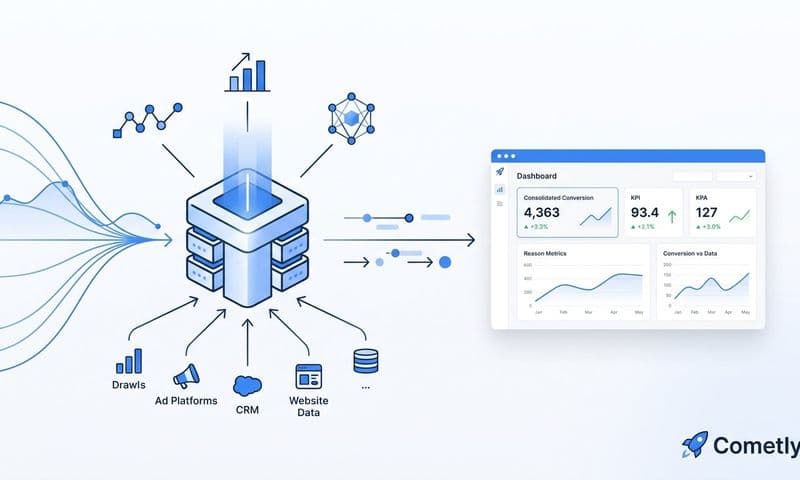
Enterprise marketing teams face a unique challenge: managing massive data volumes across dozens of channels, platforms, and campaigns while maintaining accuracy and actionable insights. Unlike smaller operations where a single dashboard might suffice, enterprise analytics requires a systematic framework that connects disparate data sources, aligns cross-functional teams, and delivers insights that drive meaningful business decisions.
Think about it. Your team is running campaigns across Meta, Google, LinkedIn, and programmatic channels. Sales is working deals in Salesforce. Customer success is tracking engagement in HubSpot. Meanwhile, your website analytics sit in Google Analytics, and your offline events generate leads through a separate system entirely.
Each platform tells part of the story, but none of them connect the dots from initial awareness through closed revenue. When your CEO asks which campaigns are actually driving growth, you're left stitching together spreadsheets and making educated guesses.
This guide walks you through building an enterprise-grade marketing analytics system from the ground up. You'll learn how to audit your current data infrastructure, establish unified tracking across all touchpoints, implement attribution models that reflect complex buyer journeys, and create reporting structures that serve everyone from campaign managers to the C-suite.
Whether you're overhauling an existing system or building from scratch, these steps will help you create an analytics foundation that scales with your organization.
Step 1: Audit Your Current Data Infrastructure and Identify Gaps
Before you can fix what's broken, you need to understand what you're working with. Start by mapping every single data source your marketing organization touches. This includes obvious platforms like Google Ads, Meta Ads Manager, and LinkedIn Campaign Manager, but also the less obvious ones: your CRM, marketing automation platform, customer support system, offline event tracking, and any third-party tools your team uses.
Create a comprehensive inventory. For each data source, document what data it collects, how frequently it updates, who has access, and most importantly, where the data goes. Many enterprise teams discover they're collecting the same data multiple times in different systems with no single source of truth.
Next, trace your current tracking implementations. How does a user journey from clicking an ad to becoming a customer get recorded? Walk through actual customer paths and identify where data breaks or goes missing. Common failure points include transitions between domains, mobile app to website crossovers, and the handoff from marketing to sales.
Pay special attention to data quality issues. Look for duplicate records with slightly different naming conventions, missing fields that should be populated, and inconsistent campaign tagging across teams or regions. In enterprise organizations, different regional teams often develop their own naming conventions, making it impossible to aggregate data accurately.
Document everything in a gap analysis that compares your current capabilities against enterprise requirements. What questions can you answer today? What questions do stakeholders ask that you can't answer? Where does data quality break down? Which integrations are missing?
Be brutally honest in this assessment. If your attribution only works for certain channels, document it. If your conversion data takes 48 hours to sync to ad platforms, note it. If executives don't trust your reports because numbers never match between systems, write it down. Understanding these common attribution challenges in marketing analytics is the first step toward solving them.
Create a scoring system for each data source based on completeness, accuracy, timeliness, and accessibility. This helps prioritize which gaps to address first. A critical system with low data quality deserves immediate attention. A less important system with minor issues can wait.
Your success indicator: A complete inventory of all data sources with documented quality scores and a clear understanding of where your analytics infrastructure falls short of enterprise needs.
Step 2: Establish Unified Tracking and Data Collection Standards
Once you understand your gaps, it's time to build the foundation for accurate data collection. The biggest shift enterprise teams need to make is implementing server-side tracking alongside traditional client-side methods.
Browser restrictions, ad blockers, and privacy features now block significant portions of client-side tracking. Safari's Intelligent Tracking Prevention and Firefox's Enhanced Tracking Protection can prevent your pixels from firing correctly. Server-side tracking captures data on your servers before it ever reaches a user's browser, ensuring you maintain visibility into your marketing performance regardless of browser settings.
This isn't just about data volume—it's about data accuracy. When your tracking relies entirely on browser-based pixels, you're missing conversions from privacy-conscious users, mobile app interactions, and offline touchpoints. Server-side tracking connects these dots by sending conversion data directly from your servers to ad platforms and analytics systems.
Next, establish standardized naming conventions across your entire organization. This sounds simple but becomes complex at enterprise scale. When you have regional teams in North America, EMEA, and APAC all running campaigns, plus separate product lines each with their own marketing teams, naming chaos is inevitable without clear standards.
Create a UTM parameter structure that everyone follows. Define what goes in utm_source, utm_medium, utm_campaign, and utm_content. Document it. Train every team member who touches campaign links. Build validation tools that flag non-compliant URLs before campaigns launch.
Set up cross-domain tracking so user journeys don't break when someone moves from your main website to a product subdomain or separate landing page domain. Configure cross-device tracking to connect mobile and desktop interactions from the same user. These technical implementations require coordination between marketing and IT teams, but they're essential for accurate journey mapping.
Deploy first-party data collection strategies that reduce reliance on third-party cookies. This means implementing your own tracking infrastructure using first-party domains and cookies. As privacy regulations tighten and browsers phase out third-party cookie support, first-party data becomes your most reliable asset. Mastering attribution marketing tracking requires this foundational shift.
Build data governance policies that define who can create tracking implementations, how changes get reviewed, and how you maintain consistency over time. Without governance, your carefully designed tracking standards will erode as teams make ad-hoc changes to meet immediate needs.
Your success indicator: A single source of truth for all marketing touchpoints with consistent data structure across channels, regions, and teams. When you pull campaign performance data, naming conventions align, tracking fires reliably, and user journeys connect seamlessly across domains and devices.
Step 3: Connect Your Marketing Stack to Your Revenue Systems
Marketing analytics without revenue data is just traffic reporting. Enterprise teams need to prove that marketing drives actual business outcomes, which means connecting ad platforms directly to your CRM and revenue systems.
Start by integrating your advertising platforms with your CRM. When someone clicks an ad and becomes a lead, that connection should flow automatically into Salesforce, HubSpot, or whatever CRM your sales team uses. But don't stop at lead creation—track the entire lifecycle from Marketing Qualified Lead through Sales Qualified Lead to Opportunity, Closed Won, and eventual customer lifetime value.
This integration needs to work bidirectionally. Marketing data flows into your CRM so sales teams understand lead source and campaign context. Conversion data flows back to ad platforms so their algorithms can optimize for actual revenue outcomes rather than just lead volume. When Meta or Google knows which leads became customers, their AI can find more people like your best customers.
Map the complete customer journey from first touch through purchase and beyond. In B2B especially, this journey often spans months and involves multiple stakeholders. Someone might discover your brand through a LinkedIn ad, visit your website several times through organic search, attend a webinar, download a whitepaper, and finally request a demo before sales ever gets involved. Understanding B2B marketing analytics is essential for capturing these complex journeys.
Each of these touchpoints contributes to the eventual conversion, but traditional analytics systems treat them as isolated events. Your integration needs to connect them into a unified journey that shows how marketing activities compound over time to generate revenue.
Set up automated data pipelines that sync in real-time rather than batch processing overnight. When a deal closes, that conversion data should reach your ad platforms within minutes, not days. Real-time data flow enables faster optimization and ensures your reporting always reflects current reality.
Consider implementing a customer data platform (CDP) if your marketing stack has grown complex enough that direct integrations become unmanageable. A CDP acts as a central hub that normalizes data from all sources and distributes it to wherever it's needed. This architecture scales better than trying to maintain dozens of point-to-point integrations. Selecting the right enterprise marketing data analytics software can simplify this entire process.
Your success indicator: The ability to trace any closed deal back to its originating marketing touchpoints. When sales closes a six-figure contract, you can see every ad, email, content piece, and event that influenced that buyer's journey.
Step 4: Implement Multi-Touch Attribution Models
Single-touch attribution models—first-click or last-click—fail spectacularly for enterprise marketing. When your sales cycles span three to six months and involve multiple decision-makers, giving all credit to the first or last touchpoint ignores the reality of how B2B buyers make decisions.
Multi-touch attribution distributes credit across all the touchpoints that contributed to a conversion. But choosing the right model requires understanding your specific buyer journey and what insights you need.
Linear attribution gives equal credit to every touchpoint. This works well when you want to understand overall channel contribution without overweighting any particular stage. If a buyer had ten interactions before converting, each gets 10% credit. Simple, but it doesn't reflect that some touchpoints matter more than others.
Time-decay attribution gives more credit to touchpoints closer to conversion. The logic: interactions that happened recently had more influence on the final decision. This model works well for understanding which activities push prospects over the finish line.
Position-based attribution (also called U-shaped) gives more credit to the first and last touchpoints while distributing the remainder across middle interactions. Typically, first touch gets 40%, last touch gets 40%, and the middle 20% is split among everything else. This model recognizes that initial awareness and final conversion moments deserve special attention.
Data-driven attribution uses machine learning to analyze your actual conversion patterns and assign credit based on what statistically correlates with conversions. This is the most sophisticated approach but requires substantial data volume to work effectively—typically thousands of conversions across multiple touchpoints. Leveraging data science for marketing attribution unlocks these advanced modeling capabilities.
Configure attribution windows that reflect your actual sales cycle length. If your average deal takes four months to close, using a 30-day attribution window will miss most of the journey. B2B enterprise sales often require 90-day or even 180-day attribution windows to capture the full influence of marketing activities.
Don't pick one model and call it done. Compare multiple attribution models side-by-side to understand how each values different channels. You might discover that first-click attribution heavily favors content marketing while last-click favors remarketing. Neither tells the complete story alone, but together they reveal how different channels play different roles in the buyer journey. Proper digital marketing attribution measurement requires this multi-model perspective.
Your success indicator: An attribution model selected and configured that accurately reflects buyer behavior, with the ability to compare models and understand how each channel contributes across the entire journey.
Step 5: Build Role-Based Dashboards and Reporting Hierarchies
Different stakeholders need different views of your marketing data. Executives care about revenue impact and ROI. Campaign managers need daily performance metrics and optimization opportunities. Analysts require granular access for deep-dive investigations. One dashboard can't serve all these needs effectively.
Design executive dashboards that focus on strategic KPIs: revenue attributed to marketing, customer acquisition cost, marketing ROI, pipeline contribution, and trend lines showing whether performance is improving or declining. Keep these dashboards simple and visual. Executives need to grasp the situation at a glance, not wade through dozens of metrics.
Include context that makes numbers meaningful. Don't just show that marketing generated $2M in pipeline this quarter—show how that compares to last quarter, whether you're on track for annual goals, and which channels drove the growth. Add annotations for major campaigns or market events that explain anomalies. Effective marketing analytics visualization transforms raw data into compelling narratives.
Create manager-level views focused on campaign performance, budget pacing, and optimization opportunities. Marketing managers need to see which campaigns are performing well, which are underperforming, where budget is being spent, and where opportunities exist to improve results. These dashboards should update daily and enable quick decision-making.
Build analyst dashboards with granular data access. Your analytics team needs the ability to slice data by any dimension, create custom segments, and investigate anomalies. Give them access to raw data exports and the flexibility to build ad-hoc reports when standard dashboards don't answer specific questions.
Establish automated reporting cadences that deliver insights without manual effort. Weekly performance summaries to campaign managers. Monthly business reviews for executives. Quarterly deep-dives for strategic planning. Automation ensures consistency and frees your team from repetitive reporting tasks. A solid understanding of marketing analytics and reporting best practices makes this process seamless.
Implement access controls that show each user only what's relevant to their role. Regional marketing managers don't need access to global data. Product marketing teams don't need visibility into other product lines. Focused access reduces noise and helps each stakeholder focus on what matters for their responsibilities.
Your success indicator: Each stakeholder group has access to relevant, actionable data in a format that matches their decision-making needs, with automated delivery that keeps everyone informed without manual reporting work.
Step 6: Operationalize Insights with AI-Powered Recommendations
Descriptive analytics tells you what happened. Predictive analytics forecasts what might happen. Prescriptive analytics—powered by AI—tells you what to do about it. This is where enterprise marketing analytics moves from reporting to driving action.
Implement automated anomaly detection that catches performance issues early. When campaign performance suddenly drops, conversion rates spike unexpectedly, or cost per acquisition jumps above normal ranges, AI can flag these anomalies immediately rather than waiting for someone to notice during their weekly review. Early detection means faster response and less wasted budget.
Use AI to surface optimization recommendations across channels and campaigns. Machine learning can analyze millions of data points to identify patterns humans would miss. Which audience segments consistently deliver the best ROI? Which ad creative elements correlate with higher conversion rates? Which times of day or days of week drive the most efficient conversions? Harnessing AI marketing analytics capabilities accelerates these discoveries exponentially.
These insights become actionable recommendations: increase budget for this high-performing campaign, pause this underperforming audience segment, adjust bidding strategy for this keyword group. AI doesn't just identify opportunities—it quantifies the expected impact and prioritizes recommendations by potential value.
Create workflows that turn insights into action with clear ownership and timelines. When AI recommends a budget reallocation, who makes the decision? Who implements the change? What's the deadline? Without clear workflows, even the best recommendations sit idle because nobody takes responsibility for acting on them.
Build feedback loops that help AI learn from outcomes. When you implement a recommendation, track the results. Did the predicted improvement materialize? If not, why? This feedback makes future recommendations more accurate and helps the system understand your specific business context.
Your success indicator: A regular flow of actionable recommendations that drive measurable improvements in campaign performance, with clear processes for evaluating, implementing, and measuring the impact of AI-driven optimizations.
Putting It All Together
Building enterprise marketing analytics isn't a one-time project—it's an ongoing capability that evolves with your organization. Start with your data audit to understand where you stand, then systematically address each layer: tracking infrastructure, system integration, attribution modeling, and reporting.
The payoff is substantial. Clear visibility into what's actually driving revenue. Confidence in budget allocation decisions. The ability to scale campaigns based on accurate data rather than assumptions. When executives ask tough questions about marketing's impact, you'll have answers backed by solid data.
Here's your quick-start checklist to get moving:
Complete a data source inventory with quality scores for each system. This gives you a baseline understanding of what you're working with and where the biggest gaps exist.
Implement server-side tracking to maintain data accuracy despite browser restrictions. This is increasingly non-negotiable as privacy features become more aggressive.
Connect your ad platforms directly to your CRM with bidirectional data flow. Marketing and sales alignment starts with shared data infrastructure.
Configure multi-touch attribution that reflects your actual buyer journey length and complexity. Single-touch models won't cut it for enterprise sales cycles.
Build stakeholder-specific dashboards that deliver the right information to the right people. One-size-fits-all reporting serves nobody well.
Establish AI-powered optimization workflows that turn insights into action. The goal isn't just better reporting—it's better decisions and better results.
Ready to see how this works in practice? Cometly connects your entire marketing stack to deliver the attribution clarity enterprise teams need. From capturing every touchpoint to feeding enriched conversion data back to ad platforms, it's built specifically for the complexity enterprise marketers face daily.
Discover how Cometly's AI-driven recommendations can transform your ad strategy. Get your free demo today and start capturing every touchpoint to maximize your conversions.