You launch a new Facebook campaign with solid creative, a tested offer, and a reasonable budget. Then the first few days hit: your cost per acquisition is all over the place, delivery feels erratic, and you start second-guessing everything. Before you make any changes, stop. What you're experiencing is almost certainly the learning phase, and how you respond to it will determine whether your campaign ever reaches its potential.
Meta's algorithm isn't just serving your ads from day one. It's actively experimenting, testing different audience segments, placements, and delivery times to figure out who is most likely to complete your chosen optimization event. This process requires data, and specifically, Meta needs roughly 50 optimization events within a 7-day window before it can stabilize delivery and give you predictable costs.
The problem is that most advertisers unknowingly work against this process. They edit campaigns too early, set budgets too low, over-segment their audiences, or operate with incomplete conversion data that starves the algorithm of the signals it needs. The result is campaigns stuck in "Learning Limited" status, burning budget without ever finding their footing.
This article breaks down exactly how the learning phase works, the mistakes that keep campaigns trapped in it, and the practical strategies that help you move through it faster so you can scale with confidence.
How Meta's Algorithm Actually Learns (And Why It Costs You Money)
Think of Meta's algorithm as a new employee who's incredibly talented but needs time to understand your specific customers. When you launch a new ad set, the algorithm doesn't yet know which users in your target audience are most likely to convert. So it explores. It tests different sub-segments, delivery times, placements, and creative combinations to gather the data it needs to make smarter decisions.
This exploration phase is inherently inefficient. The algorithm is making educated guesses, which means some of those guesses will be wrong. You'll see higher CPAs, inconsistent delivery, and unpredictable results. This isn't a sign that your campaign is broken. It's the cost of data collection.
The threshold Meta has established is approximately 50 optimization events within a 7-day window. Once an ad set crosses that threshold, Meta has enough data to shift from exploration to exploitation, meaning it stops guessing and starts confidently serving ads to the users most likely to convert. Delivery stabilizes, CPAs typically become more predictable, and you can start making meaningful performance decisions. For a deeper dive into what happens after this milestone, check out our guide on learning phase completion.
When an ad set can't reach that threshold, it enters "Learning Limited" status. This is Meta's way of telling you the algorithm doesn't have enough data to optimize delivery effectively. Campaigns stuck in Learning Limited often continue to show volatile performance indefinitely, because the algorithm never gets the signal it needs to lock in on the right audience.
It's also critical to understand the difference between the initial learning phase and a re-learning phase. Every time you make a significant edit to an ad set, including changing the creative, adjusting targeting, swapping the optimization event, or making a large budget change, Meta resets the learning clock. You're not just pausing progress; you're starting over. Each reset burns budget through another round of exploration, which is why frequent editing is one of the most expensive habits in paid social advertising.
The re-learning phase triggered by edits can be particularly painful because you're resetting a campaign that may have already gathered meaningful data. You lose that accumulated learning, and the algorithm has to rediscover the audience signals it had already identified. For campaigns with tight budgets or narrow conversion windows, a single premature edit can set you back days.
Five Mistakes That Keep You Stuck in Learning Limited
Understanding why campaigns get trapped in Learning Limited is half the battle. Most of the causes are avoidable once you know what to look for.
Editing ad sets too frequently: This is the most common culprit. When performance looks shaky in the first few days, the instinct is to make adjustments. But changing budgets by more than 20%, swapping creatives, or adjusting audience targeting all trigger a reset. Each reset restarts the 7-day clock, meaning a campaign that's been running for two weeks might have never actually accumulated more than a day or two of uninterrupted learning. Patience during the learning phase isn't passive; it's strategic.
Setting budgets too low for your conversion event: If your target CPA is $50 and you're running an ad set on a $20 daily budget, you're mathematically limiting how many conversions the algorithm can generate in a 7-day window. Meta needs 50 events in 7 days, which means roughly 7 conversions per day. At $20 a day with a $50 CPA, that's not possible. Budget sizing needs to be tied to your conversion goals, not just what feels comfortable. This is one of the most common ways advertisers end up wasting money on Facebook Ads.
Optimizing for rare conversion events: If you're running a low-traffic e-commerce site and optimizing for purchases, you may never accumulate 50 events in 7 days regardless of budget. In these cases, it's often smarter to optimize for a higher-funnel event like add-to-cart or initiate checkout, where volume is higher. Once you've gathered enough data at that stage, you can shift your optimization event to purchases.
Over-segmenting audiences into too many ad sets: Many advertisers split their targeting into dozens of small, tightly defined ad sets, each targeting a specific interest, demographic, or behavior. This fragments your conversion volume. Instead of one ad set accumulating 50 events, you have 10 ad sets each struggling to reach 5. None of them exit the learning phase, and you're paying exploration costs across all of them simultaneously.
Ignoring the impact of incomplete conversion data: If Meta isn't receiving accurate conversion signals, the algorithm can't count events it doesn't know happened. Browser-based pixels miss conversions due to iOS privacy changes, ad blockers, and cookie restrictions. When Meta sees fewer conversions than actually occurred, it's harder to reach the 50-event threshold, and the optimization signals the algorithm does receive are based on an incomplete picture of who actually converted. We'll cover this in depth later, but it's worth flagging here because it's often the invisible force keeping campaigns in Learning Limited.
Budget and Bid Strategies That Accelerate the Learning Phase
If the learning phase is fundamentally a data collection problem, the most direct solution is giving Meta the resources it needs to collect that data quickly. Budget strategy is where this starts.
A useful starting point for initial budget sizing is to work backward from your target CPA. If you want to exit the learning phase in roughly 7 days and need 50 conversions, you need about 7 conversions per day. Multiply your target CPA by 7 to get a rough daily budget floor. For example, if your target CPA is $30, you'd want at least $210 per day to give the algorithm a realistic shot at hitting the threshold. This may feel aggressive, especially for smaller accounts, but underfunding the learning phase often costs more in the long run through prolonged volatility and wasted spend.
Campaign Budget Optimization (CBO) is another powerful lever here. Instead of assigning fixed budgets to individual ad sets, CBO lets Meta allocate budget dynamically across your entire campaign based on where it sees the best opportunity. This means if one ad set is showing stronger early signals, Meta can funnel more budget toward it, accelerating its path to 50 events. CBO is particularly effective when you're running multiple ad sets and want to consolidate learning without micromanaging individual budgets. For a broader look at maximizing returns, our guide on Facebook Ads optimization covers additional strategies worth considering.
That said, CBO isn't always the right choice. If you have ad sets targeting very different audience segments with different expected CPAs, CBO might over-invest in the cheapest conversions rather than the most valuable ones. In those cases, ad set level budgets with thoughtful sizing for each segment may give you more control.
Bid strategy also plays a role. Many advertisers default to lowest cost bidding, which gives Meta the most flexibility to find conversions. This is generally the right approach during the learning phase because it allows the algorithm to explore broadly. Cost cap and bid cap strategies can be useful for controlling costs, but they can also restrict delivery if set too aggressively. If Meta can't find conversions at or below your cap, it simply won't spend, which means fewer events and a longer learning phase. If you're using cost cap, set it at a level that gives Meta room to operate, ideally 20 to 30 percent above your actual target CPA initially, then tighten it once you've exited learning.
Audience and Creative Structures Built for Faster Optimization
How you structure your audiences and creative has a direct impact on how quickly Meta can accumulate the 50 events it needs. The core principle here is consolidation over fragmentation.
Broader audiences give Meta more room to learn. When you stack narrow interest targets, layer in demographic restrictions, and exclude large segments of your potential audience, you're limiting the pool of users Meta can explore. The algorithm may find that your best converters don't fit the profile you expected, but it can only discover that if it has enough audience breadth to explore. Meta's Advantage+ audience options are specifically designed to address this, allowing the algorithm to expand beyond your defined targeting parameters to find users who are actually likely to convert. Many advertisers who have moved toward broader targeting report that their campaigns exit the learning phase faster and find more consistent performance over time.
Lookalike audiences at larger percentages (3 to 10 percent) give you a meaningful audience size while still maintaining relevance based on your seed data. Hyper-narrow interest stacks might feel more targeted, but they often result in small audience sizes that limit delivery and make it harder to accumulate events quickly. If your campaigns are struggling despite good structure, it's worth investigating whether your Facebook Ads are not converting due to audience or data issues rather than creative problems.
Creative structure matters just as much. A common mistake is creating a separate ad set for every creative variation you want to test. If you have 5 ad sets each with a different creative, each ad set needs its own 50 events. That's 250 total conversions required before any of them exit learning. Instead, consolidate your creative testing within fewer ad sets using dynamic creative or Advantage+ creative options.
Dynamic creative lets you upload multiple headlines, images, and copy variations within a single ad, and Meta automatically tests combinations to find what resonates. Advantage+ creative goes further, applying automated enhancements and testing creative elements without requiring you to create separate ad sets for each variation. Both approaches keep your conversion volume consolidated in fewer ad sets, which means each one can accumulate events faster and exit the learning phase sooner.
Why Accurate Conversion Data Is the Hidden Key to Exiting the Learning Phase
Here's something many advertisers overlook: even if you've structured your campaigns perfectly, sized your budgets correctly, and built consolidated audience groups, your campaigns can still get stuck in Learning Limited if Meta isn't receiving accurate conversion data.
The problem starts with browser-based tracking. Meta's pixel relies on a user's browser to fire a conversion event when someone completes a purchase, fills out a form, or takes another key action. But iOS privacy changes introduced through App Tracking Transparency, combined with browser cookie restrictions and ad blockers, have significantly reduced how many of those events actually reach Meta. A meaningful portion of real conversions simply go unreported. Understanding the full scope of underreporting conversions in Facebook Ads is essential to diagnosing learning phase issues.
From Meta's perspective, those conversions didn't happen. The algorithm is making optimization decisions based on an incomplete dataset. If your campaigns are generating 40 real conversions per week but Meta is only seeing 25 of them, you're not just getting inaccurate reporting. You're actively preventing the algorithm from reaching the 50-event threshold it needs to exit the learning phase. And the optimization signals Meta does receive are skewed, because the conversions that do get reported may not be representative of your actual best customers.
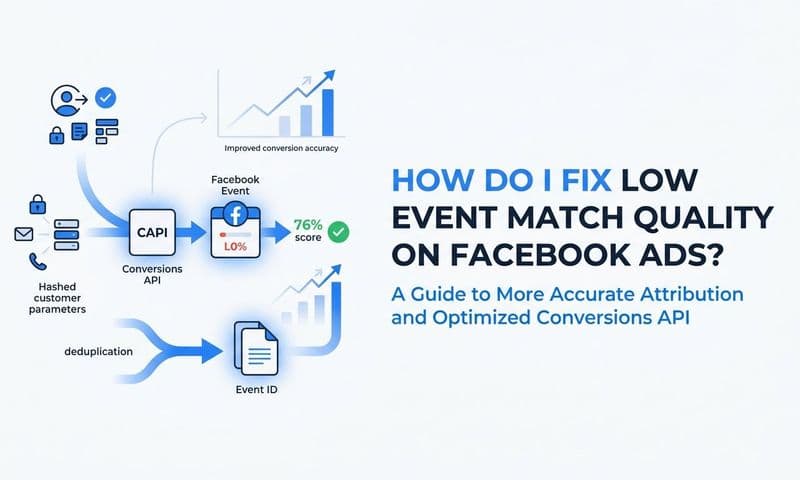
Server-side tracking addresses this directly. Rather than relying on the browser to fire a conversion event, server-side tracking sends conversion data directly from your server to Meta via the Conversions API. This approach bypasses the browser entirely, meaning iOS restrictions, cookie blockers, and other client-side limitations don't interfere with data transmission. Meta receives a more complete picture of which users actually converted, which translates to more accurate event counts and better optimization signals. For more on how iOS changes disrupted this ecosystem, see our analysis of why Facebook Ads stopped working after iOS 14.
This is where platforms like Cometly become particularly valuable. Cometly uses server-side tracking and conversion sync to send enriched, real-time conversion events back to Meta. Instead of Meta seeing a fraction of your actual conversions, it receives a complete, accurate dataset that includes the customer journey data needed to identify your best-converting audiences. The result is that the algorithm has better information to work with, which helps it reach the 50-event threshold faster and optimize toward the users who are actually driving revenue rather than just clicks.
Feeding accurate data back to Meta isn't just about reporting. It's about giving the algorithm the fuel it needs to learn effectively. Better data means faster learning, which means faster exit from the learning phase and more predictable performance at scale.
Monitoring Progress and Knowing When to Scale
Once you've set up your campaigns with the right budget, structure, and data infrastructure, the next challenge is knowing what to watch and when to act.
During the learning phase, the most important metric to monitor is your delivery status in Ads Manager. You want to see "Learning" rather than "Learning Limited," and you want to track how many optimization events your ad set is accumulating each day. If you're on pace to hit 50 events within 7 days, let the campaign run. Resist the urge to make changes based on early CPA volatility, which is normal and expected during this period.
CPA trends are worth watching, but interpret them carefully. It's common to see high CPAs in the first two or three days that gradually stabilize as the algorithm narrows in on your best audiences. A CPA that's elevated on day two but trending downward by day four is a healthy signal. A CPA that's elevated and showing no directional improvement by day five or six may warrant a closer look, though still not necessarily an immediate edit.
Frequency is another useful indicator. If your frequency is climbing quickly and your CPA is still high, it may signal that your audience is too narrow and the algorithm is running out of new users to show your ads to. This is a structural issue that's better addressed before you launch than during the learning phase, but it's useful diagnostic information.
One often-overlooked challenge is that last-click attribution can make learning-phase campaigns look significantly worse than they actually are. A user might see your Facebook ad, not click, then convert later through a Google search. Last-click attribution gives all the credit to Google and none to Facebook. Understanding Facebook Ads attribution and using multi-touch models gives you a more accurate view of how your campaigns are contributing to conversions even before they exit the learning phase, which helps you make more informed decisions about whether to continue, adjust, or cut a campaign.
When you do exit the learning phase, scale carefully. Increasing your budget by more than 20 percent in a single change can trigger a re-learning phase, which means you'd be starting over just as performance was stabilizing. Incremental budget increases of 15 to 20 percent every few days allow you to grow spend without resetting the algorithm. Horizontal scaling, launching new ad sets targeting different audience segments rather than dramatically increasing spend on existing ones, is another effective approach that lets you expand reach while keeping existing ad sets in their stable, post-learning state.
AI-driven recommendations can also help you identify which campaigns are ready for more investment. Tools that analyze performance patterns across your entire account can surface opportunities that aren't obvious from looking at individual campaign metrics in isolation.
Engineering Your Way Through the Learning Phase
The learning phase isn't something to dread. It's a process to engineer around. Every lever discussed in this article comes back to the same principle: give Meta's algorithm what it needs to learn quickly, and get out of its way while it does.
That means sizing your budgets to match your conversion goals, not just what feels safe. It means consolidating your campaign structure so conversion volume isn't fragmented across too many ad sets. It means using broader audiences and dynamic creative to give the algorithm room to explore. And it means having the patience to let the learning phase run without making premature edits that reset the clock.
But perhaps the most impactful thing you can do is ensure Meta is receiving accurate conversion data. iOS privacy changes and browser tracking limitations have created a gap between the conversions your campaigns are actually driving and the conversions Meta can see. That gap makes it harder to reach the 50-event threshold, produces skewed optimization signals, and ultimately costs you performance.
Cometly closes that gap. By using server-side tracking and conversion sync, Cometly sends enriched, real-time conversion events directly back to Meta, giving the algorithm a complete and accurate picture of your customer conversions. Better data means faster learning, more accurate optimization, and campaigns that exit the learning phase and scale with confidence.
If you're ready to stop fighting the learning phase and start engineering around it, see what accurate conversion data can do for your Facebook Ads performance. Get your free demo and discover how Cometly's server-side tracking and conversion sync can help your campaigns learn faster, optimize better, and scale smarter.