

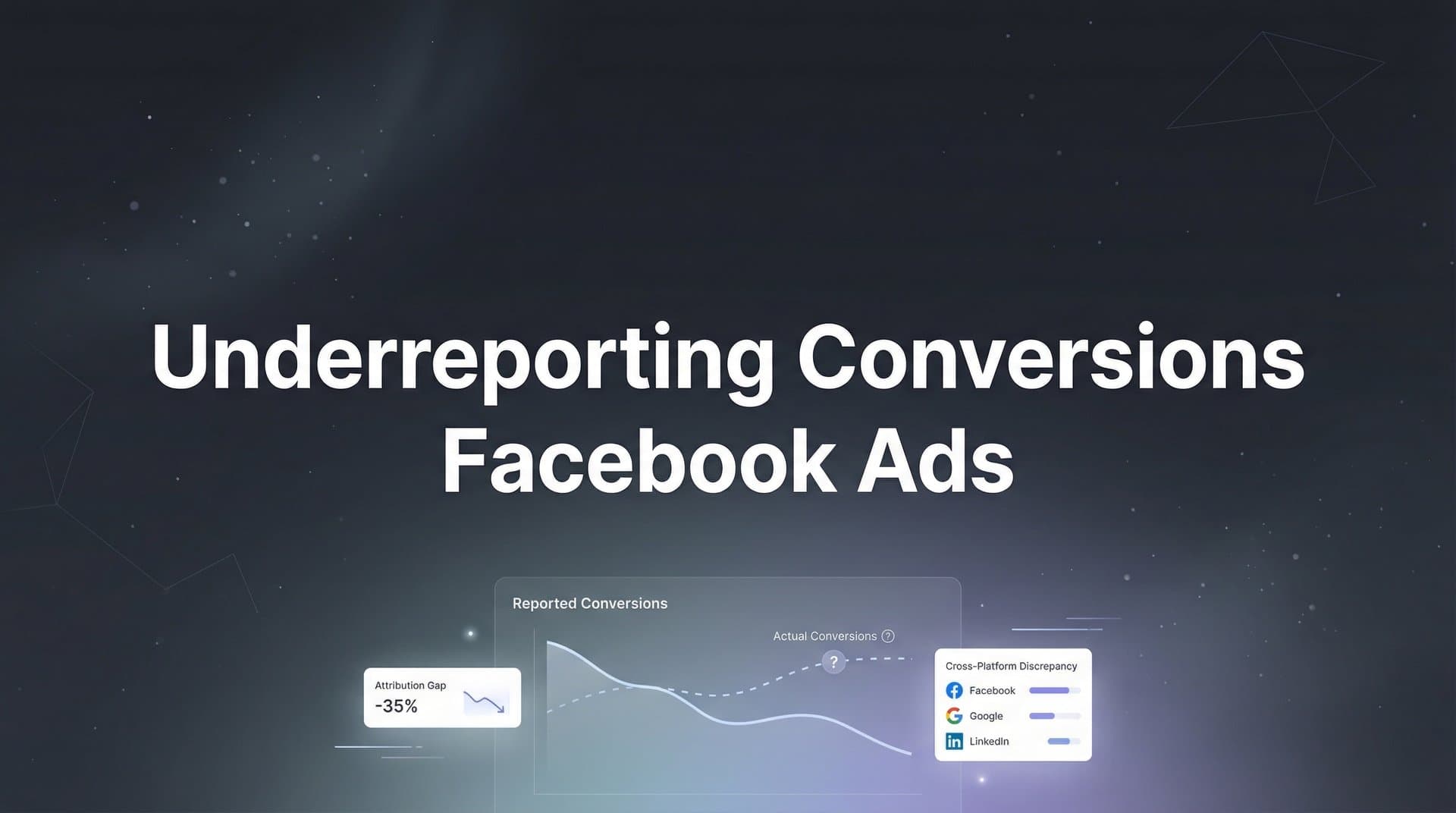
You check your Facebook Ads Manager and see 47 conversions this month. But when you pull up your CRM, the number staring back at you is 89 sales. Same time period. Same campaigns. Completely different story.
This isn't a glitch in your tracking. It's the new reality of digital advertising in 2026.
Since Apple's iOS 14.5 update fundamentally changed how tracking works, marketers have been operating with an incomplete picture of their Facebook ad performance. The conversions are happening. Your business is growing. But Facebook's reporting system is missing a significant portion of the results your campaigns are actually driving.
The frustrating part? You're making critical decisions about budget allocation, creative testing, and campaign optimization based on data that only tells half the story. You might be pausing campaigns that are actually profitable or scaling ads that look better than they perform simply because the numbers you're seeing don't reflect reality.
This guide breaks down exactly why Facebook underreports conversions, what it means for your campaigns, and the practical solutions that let you see the complete picture of your advertising performance.
The Hidden Gap Between Real Sales and Reported Results
Underreporting happens when conversions occur in your business but never show up in Facebook Ads Manager. A customer clicks your ad, browses your site, makes a purchase, but Facebook's tracking system never registers that sale. From the platform's perspective, that conversion doesn't exist.
The gap between reported and actual conversions varies widely depending on your audience composition and industry. Businesses with younger, mobile-first audiences on iOS devices typically see larger discrepancies. Companies with longer sales cycles face additional challenges as attribution windows have shortened.
Many marketers report that Facebook Ads Manager shows 40-60% fewer conversions than their actual sales data confirms. Some see even wider gaps. The exact magnitude depends on factors like your audience's device preferences, how long customers take to convert, and whether they switch devices during their journey.
This isn't just a reporting annoyance. It fundamentally changes how you run your business.
When Facebook shows half your actual conversions, your cost per acquisition appears twice as high as reality. Campaigns that are genuinely profitable look like they're bleeding money. You pause ads that are working. You shift budget away from channels that are driving real revenue. Understanding why this happens is the first step—many advertisers find their Facebook ads not tracking conversions properly due to these systemic issues.
The optimization decisions compound over time. You test new creative, but you're evaluating performance based on incomplete data. You try different audiences, but you can't accurately compare results. Every strategic choice you make is built on a foundation of partial information.
Your competitors face the same problem, but the marketers who solve it gain a decisive advantage. While others optimize blindly, accurate attribution lets you identify true winners, scale with confidence, and allocate budget based on actual performance rather than distorted metrics.
Why Facebook Ads Manager Misses Your Conversions
The primary culprit behind underreporting is Apple's App Tracking Transparency framework, which launched with iOS 14.5 in April 2021. This feature requires every app to explicitly ask users for permission before tracking their activity across other apps and websites.
When users open Facebook's app on their iPhone, they see a prompt asking if they'll allow tracking. The majority choose "Ask App Not to Track." That single tap blocks Facebook's ability to connect ad clicks to conversions for that user through traditional pixel-based tracking. These iOS tracking limitations have fundamentally reshaped how advertisers measure performance.
Facebook's pixel works by dropping a small piece of code in users' browsers when they visit your website. When someone later converts, that pixel fires and tells Facebook about the conversion. But when iOS users opt out of tracking, the connection between the ad click and the conversion event gets severed. Facebook knows someone clicked your ad. It knows someone converted on your site. It just can't confirm they're the same person.
Browser privacy features create additional tracking barriers beyond iOS. Safari's Intelligent Tracking Prevention limits how long cookies persist and restricts cross-site tracking capabilities. Firefox's Enhanced Tracking Protection blocks tracking cookies by default. Even Chrome, despite delaying its third-party cookie deprecation timeline, has implemented privacy features that affect measurement accuracy.
These browser restrictions mean that even desktop conversions can go unreported. A user might click your ad in Chrome, browse your site, close the tab, then return hours later through a direct visit to complete their purchase. The cookie that would have connected those sessions may have expired or been blocked.
Cross-device journeys present another measurement challenge. Someone scrolls Instagram on their iPhone during their commute, clicks your ad, browses your product catalog, then later that evening opens their laptop and completes the purchase. Traditional tracking struggles to connect those dots across devices.
Attribution window changes mechanically reduce reported conversions even when tracking works perfectly. Facebook shifted from 28-day click and 7-day view attribution windows to 7-day click and 1-day view as defaults. If your typical customer takes 10 days from first click to purchase, that conversion won't appear in your standard reporting even if everything tracked correctly. These attribution window limitations significantly impact how results appear in your dashboard.
For businesses with longer consideration periods, this window compression has dramatic effects. B2B companies, high-ticket products, and services with extended sales cycles see conversions fall outside the attribution window regularly. The sale happens. Facebook just doesn't claim credit for it within the shortened timeframe.
The Ripple Effect on Campaign Optimization
Incomplete conversion data doesn't just hide your results. It actively degrades Facebook's ability to optimize your campaigns.
Facebook's machine learning algorithm relies on conversion signals to understand what's working. When someone converts after clicking your ad, that signal teaches the algorithm about effective targeting. It learns which demographics, interests, behaviors, and placements drive results. Over time, it gets smarter about finding more people likely to convert.
But when 40-60% of your conversions go unreported, the algorithm is learning from a fraction of the actual performance data. It's like trying to solve a puzzle with half the pieces missing. The patterns it identifies are incomplete. The optimizations it makes are based on partial information.
This creates a destructive feedback loop. Fewer reported conversions mean the algorithm has less data to optimize delivery. With less optimization, your ads reach fewer high-intent users. Fewer high-intent users means fewer actual conversions. And the cycle continues. Learning how to improve Facebook Ads learning phase performance becomes critical when conversion signals are incomplete.
The problem compounds when you're testing new campaigns or audiences. Facebook's learning phase requires sufficient conversion volume to stabilize performance. When conversions are underreported, campaigns stay in the learning phase longer. They struggle to exit it entirely. Your performance remains volatile because the algorithm never gets enough signal to optimize confidently.
Budget allocation decisions become unreliable when your metrics don't reflect reality. You compare Campaign A showing 20 conversions against Campaign B showing 35 conversions. Based on those numbers, you shift budget toward Campaign B. But if Campaign A actually drove 45 conversions and Campaign B drove 40, you just made the wrong choice.
Creative testing suffers the same fate. You launch three ad variations to see which resonates best. Facebook reports that Creative A generated 12 conversions, Creative B generated 8, and Creative C generated 15. You kill Creative B and scale Creative C. But the actual numbers were 22, 18, and 16 respectively. You just paused your second-best performer and doubled down on your worst.
Relying solely on in-platform metrics creates a distorted view of channel performance across your entire marketing mix. Facebook might show a higher cost per acquisition than Google Ads, leading you to shift budget toward Google. But if Facebook's underreporting is more severe than Google's, you're comparing apples to oranges. The channel that looks less efficient might actually be your most profitable. A detailed Facebook Ads vs Google Ads tracking comparison reveals how differently each platform handles attribution.
Server-Side Tracking: Bypassing Browser Limitations
Server-side tracking solves the underreporting problem by sending conversion data directly from your server to Facebook, completely bypassing browser-based limitations.
Here's how it works. When someone converts on your website, your server captures that conversion event along with relevant customer data. Instead of relying on a browser pixel that can be blocked, your server sends the conversion information directly to Facebook through their Conversions API.
This approach sidesteps the privacy restrictions that plague pixel-based tracking. iOS App Tracking Transparency affects what happens in browsers and apps, but it doesn't prevent your server from communicating with Facebook's servers. Browser cookie restrictions don't matter when the conversion signal travels server-to-server. Cross-device tracking becomes more reliable when you're matching conversions based on hashed email addresses or phone numbers rather than browser cookies.
The Conversions API is Meta's official solution for server-side tracking. It accepts conversion events directly from your server, allowing you to send first-party data that your business collected through customer interactions. This includes purchase information, lead submissions, sign-ups, and any other valuable actions users take. Understanding how to sync conversion data to Facebook Ads is essential for maximizing this approach.
Implementation typically involves integrating the Conversions API with your website backend, e-commerce platform, or CRM system. When a conversion occurs, your system formats the event data according to Facebook's specifications and sends it through the API. The event includes details like the conversion type, value, timestamp, and customer information that helps Facebook match the conversion to the right user.
Best practices involve running both pixel-based tracking and server-side tracking simultaneously. The pixel captures conversions it can track, while the Conversions API fills in the gaps where browser-based tracking fails. This dual approach maximizes coverage across different user scenarios and device types.
Deduplication is critical when running both tracking methods. Without it, a single conversion might get reported twice—once through the pixel and once through the Conversions API. Facebook handles deduplication automatically when you assign the same event ID to conversions from both sources. If the pixel and the Conversions API both send an event with the same ID, Facebook counts it only once.
The technical implementation can get complex quickly. You need to ensure your server can reliably send events, handle errors gracefully, format data correctly, and maintain proper deduplication. For many marketing teams, building and maintaining this infrastructure diverts resources from actually running campaigns.
Building a Complete Picture with Multi-Touch Attribution
Server-side tracking captures more conversions, but understanding the full customer journey requires multi-touch attribution that connects every interaction across channels and devices.
Last-click attribution—the default model in most ad platforms—credits the final touchpoint before conversion. Someone sees your Facebook ad, clicks a Google search ad the next day, then converts. Google gets 100% of the credit. Facebook's contribution to that journey becomes invisible. Understanding the Facebook Ads attribution model helps clarify why these gaps exist.
Multi-touch attribution recognizes that customer journeys involve multiple touchpoints. That same customer might have first discovered your brand through a Facebook ad, researched on Google, clicked a retargeting ad, visited directly, and finally converted after clicking an email. Each touchpoint played a role. Multi-touch models distribute credit across the journey based on each interaction's contribution.
This comprehensive view requires connecting data from multiple sources. Your Facebook ad platform shows clicks and reported conversions. Google Ads shows its own engagement data. Your email platform tracks opens and clicks. Your CRM records when leads enter your pipeline and close as customers. Your analytics platform captures website behavior.
Bringing these data sources together creates a unified view of the customer journey. You can see that a customer first clicked your Facebook ad on Monday, searched your brand on Wednesday, clicked a Google ad on Thursday, and purchased on Friday. Instead of giving all credit to the last Google click, you understand Facebook's role in driving awareness and Google's role in capturing intent.
Revenue-based attribution takes this further by connecting marketing touchpoints to actual revenue rather than just conversion counts. Not all conversions are equal. A customer who purchases a $50 product generates different value than one who buys your $500 package. Attribution based on revenue shows which campaigns drive the most valuable customers, not just the most conversions.
The real power comes from feeding this enriched attribution data back to your ad platforms. Facebook's algorithm optimizes based on the conversion signals it receives. When you send more complete conversion data through the Conversions API—including conversions that the pixel missed—you give the algorithm better information to work with. This conversion sync for Facebook Ads approach dramatically improves optimization.
This creates a positive feedback loop. Better conversion data improves algorithmic optimization. Better optimization drives more conversions. More conversions generate more data to refine targeting further. Your campaigns get smarter over time because they're learning from complete information rather than partial signals.
Putting Accurate Data to Work for Better Results
Complete conversion data transforms how you run campaigns. Instead of guessing which ads work, you know. Instead of hoping your budget allocation is correct, you can verify it.
Identifying true top performers becomes straightforward when your data reflects reality. That campaign showing a $75 cost per acquisition in Ads Manager might actually be driving conversions at $45 when you account for unreported results. The creative you were about to pause could be your best performer. The audience that looks marginal might be highly profitable. You can improve Facebook Ads performance with better data once you have visibility into actual results.
Scaling with confidence requires knowing your actual unit economics. When your reported CPA is $80 but your customer lifetime value is $100, the math looks tight. You might hesitate to increase spend. But when accurate attribution shows your real CPA is $50, suddenly you have room to scale aggressively. The opportunity was always there. You just couldn't see it through incomplete data.
Enriched conversion events improve Facebook's algorithmic targeting by giving the machine learning system more examples of successful conversions. When you send conversion data through the Conversions API that includes details the pixel missed, Facebook's algorithm learns from a larger, more representative dataset. It can identify patterns across more conversions, refine its understanding of your ideal customer, and find more people likely to convert.
The conversion sync process sends your complete conversion data back to Facebook, effectively teaching the algorithm about results it couldn't track on its own. This helps the platform optimize delivery more effectively, even for conversions that occurred outside traditional attribution windows or across devices where tracking broke down.
Building a sustainable measurement framework means preparing for ongoing privacy changes rather than reacting to each new restriction. Browser vendors continue tightening tracking limitations. Platform policies evolve. Regulations like GDPR and CCPA shape what data you can collect and how you can use it.
A measurement approach built on first-party data, server-side tracking, and multi-touch attribution adapts to these changes more gracefully than pixel-dependent tracking. When the next privacy update arrives, you're not starting from zero. Your infrastructure already captures conversions through methods that bypass browser restrictions. Your attribution system already connects multiple data sources to maintain visibility into customer journeys.
Moving Forward with Complete Visibility
Underreporting isn't a permanent problem you have to accept. It's a technical challenge with proven solutions.
While privacy restrictions have made traditional tracking less reliable, server-side tracking and comprehensive attribution give you complete visibility into campaign performance. The conversions are happening. The revenue is real. You just need the right infrastructure to capture and connect the data.
The competitive advantage goes to marketers who solve this measurement gap. Your competitors are making decisions based on incomplete data, pausing profitable campaigns, and scaling underperformers. You can operate with clarity, optimize based on actual results, and allocate budget according to true performance.
This isn't about gaming the system or inflating metrics. It's about seeing reality clearly so you can make better decisions. When you know which campaigns genuinely drive revenue, which audiences convert at the highest rates, and which creative resonates most effectively, you can build a more profitable advertising program.
The technical complexity of implementing server-side tracking, managing deduplication, connecting multiple data sources, and maintaining attribution models can be substantial. Building this infrastructure in-house requires engineering resources, ongoing maintenance, and constant adaptation as platforms evolve.
Cometly handles this complexity automatically. The platform implements server-side tracking through the Conversions API, captures every touchpoint across your marketing channels, and provides multi-touch attribution that shows the complete customer journey. It enriches your conversion data and syncs it back to Facebook, giving the algorithm better signals to optimize delivery.
Instead of flying blind with incomplete metrics, you see exactly which ads and channels drive leads and revenue. Instead of guessing at optimization decisions, you make data-driven choices based on comprehensive performance data. Instead of accepting underreporting as inevitable, you capture every conversion and use that visibility to scale with confidence.
Ready to elevate your marketing game with precision and confidence? Discover how Cometly's AI-driven recommendations can transform your ad strategy. Get your free demo today and start capturing every touchpoint to maximize your conversions.


