Facebook advertising remains one of the most powerful channels for reaching customers, but it can also become one of the fastest ways to burn through a marketing budget when campaigns are not set up and managed with precision. Many advertisers find themselves pouring money into campaigns that generate clicks but not conversions, or targeting audiences that look great on paper but never turn into paying customers.
The frustrating part? Most of the budget waste is entirely preventable.
The root causes tend to fall into a few common categories: poor audience targeting, broken or incomplete tracking, creative fatigue, misaligned bidding strategies, and a lack of visibility into what is actually driving revenue. When you cannot see the full picture of how your ads connect to real business outcomes, every optimization decision is essentially a guess.
This guide breaks down seven actionable strategies that address the most common reasons marketers waste money on Facebook ads. Each strategy targets a specific leak in your ad spend pipeline and gives you a clear path to fix it. Whether you are spending a few hundred dollars a month or managing six-figure budgets, these approaches will help you make every dollar count.
1. Fix Your Tracking Before You Fix Your Ads
The Challenge It Solves
If your tracking is broken, every optimization you make is built on a foundation of sand. Since Apple's iOS 14.5 App Tracking Transparency rollout, pixel-based attribution has become significantly less reliable for Facebook advertisers. Meta has acknowledged these limitations directly in its own Business Help Center, and advertisers across the industry have experienced meaningful gaps in reported conversions as a result. You cannot fix what you cannot accurately measure, which is why so many marketers struggle with Facebook ads stopped working after iOS 14.
The Strategy Explained
The solution is to implement server-side tracking through Meta's Conversions API alongside your standard pixel. Unlike browser-based tracking, server-side tracking sends conversion events directly from your server to Meta, bypassing the limitations introduced by ad blockers, browser restrictions, and iOS privacy changes. This gives Meta's algorithm a much more complete picture of who is converting, which directly improves targeting and bidding efficiency.
Platforms like Cometly make this process significantly more straightforward by providing server-side tracking infrastructure that captures conversion events accurately and syncs enriched data back to Meta. This means fewer missed conversions and better signal quality feeding into your campaigns.
Implementation Steps
1. Audit your current pixel setup using Meta's Events Manager and check for duplicate or missing events.
2. Implement the Meta Conversions API to supplement browser-based tracking with server-side data.
3. Verify that your key conversion events, such as purchases, leads, and add-to-carts, are firing correctly and deduplication is enabled.
4. Use a third-party attribution tool to cross-reference Meta's reported conversions against your CRM or backend data.
Pro Tips
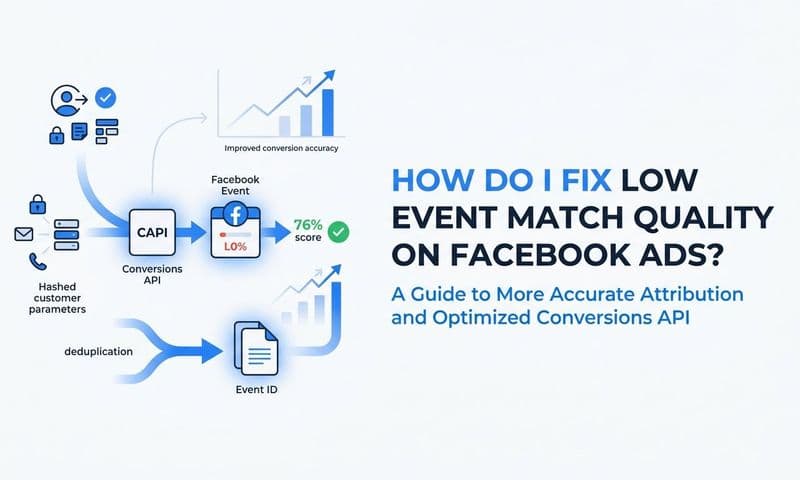
Pay close attention to event match quality scores in Meta's Events Manager. A low score means Meta is struggling to match your conversion events to real users, which weakens your campaign optimization. Improving your match quality by passing more customer data parameters, such as email, phone, and name, can meaningfully improve your ad delivery efficiency.
2. Stop Optimizing for Vanity Metrics
The Challenge It Solves
A campaign with a high click-through rate and low cost-per-click can feel like a win until you realize none of those clicks turned into customers. Clicks, impressions, and reach are easy to measure but they do not pay the bills. When marketers optimize for metrics that feel good rather than metrics that matter, budgets get allocated toward traffic that looks engaged but never converts. This is a core reason why many advertisers find their ads show conversions but no sales.
The Strategy Explained
The shift you need to make is from surface-level engagement metrics to revenue-based KPIs. This means connecting your Facebook ad performance to actual CRM data and sales outcomes through multi-touch attribution. Instead of asking "which ad got the most clicks?", you should be asking "which ad contributed to the most closed deals?"
Multi-touch attribution models, available through platforms like Cometly, allow you to see how Facebook ads interact with other touchpoints across the customer journey. A prospect might click a Facebook ad, then visit your site organically twice, then convert through a retargeting email. Without multi-touch attribution, Facebook gets no credit and you might cut the campaign that started the entire journey.
For a deeper dive, see our guide to AI ad generator for Facebook ads.
Implementation Steps
1. Define your primary KPI as revenue or pipeline value generated, not clicks or impressions.
2. Connect your ad platform data to your CRM so you can trace conversions back to specific campaigns and audiences.
3. Choose an attribution model, such as linear, time decay, or data-driven, that reflects how your customers actually buy.
4. Review campaign performance weekly using revenue-based metrics and pause or scale accordingly.
Pro Tips
Be cautious about relying solely on Meta's in-platform attribution, which naturally favors Meta-influenced conversions. Using an independent attribution platform gives you an unbiased view of how Facebook ads are actually contributing to revenue relative to your other channels.
3. Tighten Your Audience Targeting with Real Data
The Challenge It Solves
Broad or poorly constructed audiences are one of the most common sources of wasting money on underperforming ads. Many advertisers build lookalike audiences from generic website visitor data, which includes people who bounced after two seconds and never showed any real purchase intent. The result is a lookalike that resembles your traffic, not your buyers, and your budget gets spread across people who are unlikely to convert.
The Strategy Explained
The quality of your lookalike audience is only as good as the seed data you feed it. Meta's own advertising guides recommend using high-value customer lists, specifically verified purchasers or high-LTV customers, as the foundation for lookalike audiences. When you build a lookalike from your best customers rather than all website visitors, Meta's algorithm finds people who actually resemble buyers.
Equally important is what you exclude. Suppressing existing customers from acquisition campaigns, excluding recent converters from retargeting, and removing low-value segments like competitors or job seekers all help concentrate your budget on the people most likely to take action.
Implementation Steps
1. Export a list of your highest-value customers from your CRM, filtering for repeat purchasers or highest LTV segments.
2. Upload this list as a custom audience and build a 1-3% lookalike from it for acquisition campaigns.
3. Create exclusion audiences for existing customers, recent purchasers, and any segments that historically show high click but low conversion rates.
4. Regularly refresh your customer lists, ideally monthly, to keep your seed data current and accurate.
Pro Tips
Smaller, higher-quality seed audiences often outperform larger, lower-quality ones. A list of 500 verified high-value customers will typically produce a stronger lookalike than a list of 50,000 general website visitors. Prioritize data quality over list size when building your foundation.
4. Kill Creative Fatigue Before It Kills Your ROAS
The Challenge It Solves
Creative fatigue is a silent budget killer. When your audience sees the same ad repeatedly, engagement drops, costs rise, and your return on ad spend deteriorates without any obvious explanation. Meta's Ads Manager surfaces frequency data and relevance diagnostics that can signal when fatigue is setting in, but many advertisers do not monitor these signals until significant damage has already been done to campaign efficiency.
The Strategy Explained
The solution is a structured creative testing and rotation framework that keeps your ads fresh before fatigue becomes a problem rather than after. This means proactively testing new creative concepts, formats, and copy variations on a regular cadence, and having a library of ready-to-deploy assets so you are never scrambling when performance starts to decline. Proper Facebook ads optimization requires treating creative refresh as an ongoing process, not a reactive fix.
Think of your creative strategy as a pipeline, not a one-time project. You should always have creatives in testing, creatives performing, and new concepts in production simultaneously. This continuous cycle prevents any single ad from wearing out your audience and keeps your costs stable over time.
Implementation Steps
1. Monitor your ad frequency metric in Meta's Ads Manager. When frequency climbs above 3-4 for cold audiences, it is time to introduce fresh creative.
2. Establish a weekly creative review cadence where you evaluate relevance diagnostics and engagement rates across active ads.
3. Maintain a minimum of three to five active creative variations per ad set to give Meta's algorithm options to optimize toward.
4. Build a creative testing structure, such as isolating one variable at a time, whether headline, image, or format, so you can identify what actually drives performance improvements.
Pro Tips
Do not wait for performance to crash before refreshing creative. Set a proactive trigger, such as frequency exceeding a threshold or click-through rate declining by a set percentage week over week, and treat it as an automatic signal to rotate in new assets.
5. Align Your Bidding Strategy with Your Actual Goals
The Challenge It Solves
Meta offers several bid strategy options, including lowest cost, cost cap, bid cap, and minimum ROAS. Choosing the wrong strategy for where your campaign currently sits in its maturity cycle is a frequently cited reason for budget inefficiency. A new campaign with limited conversion data running on a strict cost cap will often struggle to spend its budget at all, while a scaled campaign running on lowest cost without guardrails can overspend on low-value conversions.
The Strategy Explained
Your bid strategy should match your campaign's learning phase status and your actual business economics. Early-stage campaigns with limited data typically benefit from lowest cost bidding to gather conversion signals quickly. As campaigns mature and accumulate data, you can layer in cost cap or minimum ROAS bidding to enforce efficiency thresholds that align with your actual margins. Understanding your Facebook ads ROI at each stage is essential for making the right bidding decisions.
The other critical piece is feeding accurate conversion values back to Meta's algorithm. When Meta knows not just that a conversion happened but how much revenue it generated, it can optimize delivery toward higher-value outcomes rather than just volume. This is where connecting your CRM data to your ad platform through a tool like Cometly becomes particularly valuable.
Implementation Steps
1. Assess your campaign's current conversion volume. If you are generating fewer than 50 conversions per week, prioritize lowest cost bidding to build data before adding constraints.
2. Once your campaign has sufficient conversion history, test cost cap bidding with a cap set at or slightly above your target cost per acquisition.
3. Pass conversion value data back to Meta through the Conversions API so the algorithm can optimize for revenue, not just event volume.
4. Avoid making frequent bid strategy changes, as each change resets the learning phase and disrupts campaign optimization.
Pro Tips
If you are using minimum ROAS bidding, set your threshold based on your actual margin requirements rather than an aspirational number. Setting it too aggressively will cause under-delivery, while setting it too loosely defeats the purpose of using a ROAS constraint at all.
6. Audit Your Funnel for Leaks Beyond the Ad
The Challenge It Solves
Your Facebook ad might be doing everything right and still producing poor results if the experience after the click is broken. Slow-loading landing pages, mismatched messaging between the ad and the page, confusing forms, and a lack of mobile optimization can all cause prospects to abandon before converting. When this happens, you are paying for qualified traffic that never had a real chance to become a customer, which is a key reason Facebook ads are not converting.
The Strategy Explained
Google's research, published through web.dev and Think with Google, has consistently demonstrated that page load speed has a meaningful impact on conversion rates, with slower pages leading to higher bounce rates. This principle applies directly to your Facebook ad landing pages, where users often arrive on mobile devices with variable connection speeds.
Beyond speed, the post-click experience needs to deliver on the promise made in the ad. If your ad promotes a specific offer, the landing page should lead with that offer. If your ad speaks to a specific pain point, the page should immediately address it. Misalignment between ad and landing page is a conversion killer that no amount of ad optimization can fix.
Implementation Steps
1. Test your landing page load speed using Google's PageSpeed Insights and prioritize any issues flagged as high impact, particularly on mobile.
2. Review the message match between your ads and landing pages. The headline, offer, and visual tone should feel like a seamless continuation, not a jarring shift.
3. Simplify your conversion path. Reduce form fields to only what is essential, eliminate unnecessary navigation that could pull visitors away, and make your primary CTA visually prominent.
4. Set up heatmaps or session recording tools to observe how real visitors interact with your landing pages and identify where drop-off occurs.
Pro Tips
Run a simple A/B test on your landing page headline before investing in complex redesigns. Often, a single copy change that better reflects the ad's promise can produce a meaningful lift in conversion rate without requiring a full page overhaul.
7. Use AI-Powered Insights to Reallocate Budget in Real Time
The Challenge It Solves
Even when tracking is solid and targeting is refined, managing budget allocation across multiple campaigns, ad sets, and audiences manually is slow and prone to error. By the time you identify an underperforming campaign through weekly reporting, you may have already wasted several days of budget on something that was not working. In fast-moving ad environments, delayed decisions are expensive decisions.
The Strategy Explained
AI-powered attribution and optimization tools change the speed at which you can act on performance data. Instead of waiting for weekly reports to identify what is working, you get real-time visibility into which campaigns, audiences, and creatives are driving actual revenue, and which are consuming budget without delivering results. The ability to quickly determine which ads are actually working is what separates profitable advertisers from those who waste budget.
Cometly's AI-driven platform does exactly this. It connects your ad spend to real revenue outcomes across every touchpoint, surfaces AI-generated recommendations for where to scale and where to cut, and gives you the confidence to make budget decisions based on data rather than instinct. The AI Ads Manager identifies high-performing ads across channels and flags underperformers before they drain your budget, while the AI Chat feature lets you query your data conversationally to get answers fast.
This kind of real-time intelligence is particularly valuable when managing multiple campaigns simultaneously, where manual monitoring cannot keep pace with the volume of decisions required. Having the right approach to scaling ads without losing money depends on this level of data-driven decision making.
Implementation Steps
1. Connect all of your ad platforms, CRM, and website data into a single attribution platform so you have a unified view of performance across channels.
2. Set up automated alerts for campaigns that fall below your target ROAS or exceed your target cost per acquisition thresholds.
3. Review AI-generated recommendations regularly and act on them quickly, particularly for budget reallocation from underperformers to top performers.
4. Use multi-touch attribution data to understand the full contribution of each campaign, not just last-click performance, before making scaling or cutting decisions.
Pro Tips
The quality of AI recommendations is directly tied to the quality of data feeding the system. Before relying on AI-driven insights, ensure your tracking is accurate and your conversion events are firing correctly. Clean data in means reliable recommendations out.
Pulling It All Together: Your Anti-Waste Action Plan
Stopping the bleed on Facebook ad spend is not about finding one magic fix. It is about systematically closing the gaps that allow budget to leak out at every stage of your campaign, from tracking and targeting to creative, bidding, and post-click experience.
Here is how to prioritize your implementation:
Start with tracking: Nothing else matters if your data is unreliable. Implement server-side tracking first and verify your conversion events are firing accurately before making any other changes.
Then refine your measurement framework: Shift your KPIs to revenue-based metrics and connect your ad data to your CRM through multi-touch attribution so you understand what is actually driving results.
Next, sharpen your targeting: Rebuild your lookalike audiences from verified purchaser data and set up exclusion audiences to concentrate your budget on high-probability converters.
Maintain creative momentum: Establish a proactive creative testing cadence so fatigue never gets the chance to quietly inflate your costs.
Align your bidding to your stage: Match your bid strategy to your campaign maturity and feed accurate conversion values back to Meta's algorithm to improve delivery efficiency.
Fix the funnel beyond the ad: Audit your landing pages for speed, message match, and conversion path clarity so you are not paying for traffic that has no real chance of converting.
Finally, layer in AI-powered optimization: Use real-time attribution and AI recommendations to reallocate budget continuously toward what is working and away from what is not.
The foundation of all of this is accurate tracking and attribution. Without it, every other strategy is weakened. With it, you have the data confidence to make faster, smarter decisions at every level of your campaigns.
Ready to stop guessing and start scaling with confidence? Get your free demo and discover how Cometly connects every ad dollar to real revenue outcomes, so you can finally see what is working, cut what is not, and grow with precision.