You check your Facebook Ads Manager for the third time today. The spend counter keeps climbing. The conversion column? Still painfully low. Your stomach tightens as you calculate how much budget has evaporated with nothing to show for it. If you're running ads for a client, there's the added pressure of explaining these numbers in your next report. If it's your own business, the weight feels even heavier—every dollar wasted is money that could have gone toward inventory, hiring, or growth.
Here's what makes this situation especially frustrating: you followed the playbook. You tested different audiences. You tried new creative. You tweaked your copy. Yet the conversions still aren't coming through, and you're left wondering if Facebook ads even work anymore or if you're missing something fundamental.
The truth is, low conversion rates rarely stem from a single problem. It's almost never just your creative or just your targeting. Instead, multiple factors—some visible, many hidden—work together to sabotage your results. The good news? Once you understand what's actually happening beneath the surface, you can fix it systematically rather than throwing random changes at the wall and hoping something sticks.
This isn't about assigning blame or questioning your skills as a marketer. It's about bringing clarity to a complex system that's changed dramatically in recent years. We're going to walk through seven critical areas where conversion problems hide, and more importantly, how to diagnose and fix each one. Think of this as a systematic audit of your entire conversion path—from the moment someone sees your ad to the moment Facebook's algorithm decides what to do with your budget.
The Tracking Blindspot Most Marketers Miss
Before you change a single thing about your ads, you need to answer a fundamental question: Is Facebook actually seeing your conversions? This isn't a theoretical concern—it's likely the most common reason marketers think their ads aren't working when they actually are.
Since Apple introduced App Tracking Transparency with iOS 14.5, the foundation of Facebook advertising has shifted. When users opt out of tracking (and most do), Facebook loses visibility into what happens after someone clicks your ad. A customer might click your ad on their iPhone, browse your site, add items to cart, and complete a purchase—but Facebook never receives that conversion signal. From the algorithm's perspective, that click led nowhere. Understanding why Facebook ads stopped working after iOS 14 is essential for diagnosing these tracking gaps.
This creates two critical problems. First, your dashboard shows artificially low conversion rates, making profitable campaigns look like failures. You might be achieving a 3x ROAS in reality while your Ads Manager reports barely breaking even. Second, and more damaging, Facebook's algorithm receives incomplete data about which users convert. When the algorithm doesn't know who's buying, it can't find more people like them. Your targeting gets worse over time, not because your strategy is wrong, but because the machine learning is starving for accurate signals.
The gap between reality and reported data isn't small. Depending on your audience demographics and the devices they use, you might be missing 20-40% of actual conversions in your Facebook reporting. Younger audiences who predominantly use iOS devices create even larger blind spots.
Server-side tracking solves this by sending conversion data directly from your server to Facebook, bypassing browser restrictions entirely. When someone completes a purchase, your server immediately notifies Facebook through the Conversions API, regardless of whether that person's browser allows tracking. This gives Facebook a complete picture of what's working—and gives the algorithm the conversion signals it needs to optimize effectively. Learning how to sync conversion data to Facebook Ads can dramatically improve your reported results.
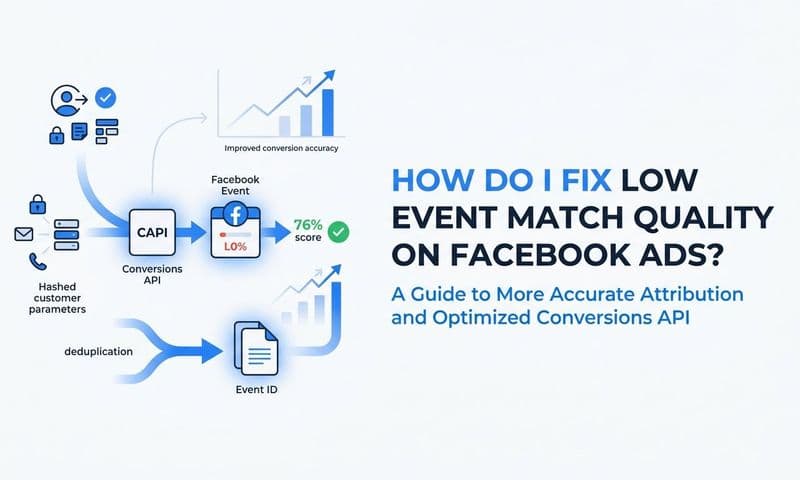
Here's how to diagnose if tracking gaps are your problem: Compare your Facebook-reported conversions against your actual sales or leads from your CRM or analytics platform. If there's a significant gap, you're likely dealing with tracking loss. Check your Events Manager for the "Event Match Quality" score—anything below "Good" means Facebook is struggling to match conversions back to ad clicks.
Implementing server-side tracking isn't optional anymore—it's foundational. Without it, you're essentially asking Facebook's algorithm to optimize with one hand tied behind its back. The conversions might be happening, but if Facebook can't see them, it can't help you generate more of them.
When Your Audience Targeting Works Against You
Your targeting strategy can quietly sabotage conversions in ways that aren't immediately obvious. The symptoms look like declining performance over time, even when nothing else has changed. You launch a campaign, it performs well for a week or two, then conversion rates gradually drop while costs creep up. This is audience fatigue in action.
Audience fatigue happens when the same people see your ads repeatedly. The first time someone sees your offer, they might be intrigued. The third time, they're neutral. By the seventh exposure, they're actively ignoring it—or worse, developing negative associations with your brand. Facebook's frequency metric will tell you this story: when frequency climbs above 3-4 within a short time window, you're likely hitting the same people too often.
The counterintuitive part? Audience fatigue often strikes campaigns that initially performed well. Success creates its own problem—Facebook found a pocket of highly responsive users and kept showing them your ads until they stopped responding. Your winning campaign becomes a losing one, not because your strategy was wrong, but because you exhausted your most receptive audience segment.
On the opposite end, overly broad targeting creates a different problem. When you target massive audiences with minimal qualification criteria, Facebook's algorithm faces an impossible task: finding the tiny percentage of people who might actually convert within an ocean of unlikely prospects. The algorithm burns through budget testing different user profiles, and your cost per conversion skyrockets while it searches for signal in the noise.
Overly narrow targeting is equally problematic. When you stack too many interest qualifiers or demographic restrictions, you box the algorithm into a corner. Facebook's machine learning works best when it has room to explore and optimize—when you define the audience too rigidly, you prevent the algorithm from discovering unexpected pockets of high-converting users. Your campaigns get stuck in "learning limited" status, never gathering enough data to optimize effectively. If you're experiencing this, understanding why ad campaigns are not optimizing properly can help you identify the root cause.
The solution involves strategic audience layering. Start with a core audience definition that's specific enough to be relevant but broad enough to give Facebook optimization room—typically 1-2 million people minimum. Use lookalike audiences based on your best customers, then layer in broad interest categories rather than hyper-specific ones. Exclude people who've already converted or engaged recently to prevent fatigue.
Refresh your creative regularly, even when performance is still acceptable. Don't wait for fatigue to kill your campaigns—introduce new angles, formats, and hooks proactively. This signals "newness" to audiences who've seen your previous ads, reducing the fatigue effect. Monitor your frequency metric closely: when it exceeds 3 within a 7-day window, it's time to expand your audience or refresh your creative.
The Landing Page Disconnect That Kills Momentum
Your ad did its job—it captured attention and generated a click. Then your landing page destroyed all that momentum in three seconds. This is where countless conversions die, and most marketers never realize it because they're focused on ad metrics rather than the full conversion path.
Message mismatch is the most common killer. Your ad promises one thing—a specific benefit, a particular offer, a solution to a clear problem. The visitor clicks, expecting to find exactly what was promised. Instead, they land on a generic homepage or a page that talks about something completely different. The cognitive friction is immediate: "Wait, is this the right place? Did I click the wrong thing?" That moment of confusion is often all it takes for them to bounce.
Think of it like this: if your ad headline says "Get 30% Off Your First Order Today," your landing page headline better reinforce that exact offer above the fold. If your ad focuses on solving a specific pain point, your landing page needs to acknowledge that pain point immediately. The visitor should feel an instant sense of continuity—that they've arrived exactly where they expected to be.
Mobile experience failures compound this problem. Most Facebook traffic comes from mobile devices, yet many landing pages are clearly designed with desktop in mind. The result? Tiny text that requires zooming. Forms with too many fields that are painful to complete on a small screen. CTAs buried below the fold. Load times that stretch beyond three seconds, causing impatient mobile users to abandon before the page even renders.
Page speed deserves special attention because it's invisible in your ad metrics but devastating to conversions. A landing page that takes five seconds to load on mobile loses roughly half its potential conversions before anyone even sees your offer. Users on cellular connections are particularly vulnerable—they click your ad, see a white screen or loading spinner, and bail. Facebook charged you for that click, but you never had a chance to convert them.
Here's your diagnostic checklist: Pull up your landing page on your phone right now. Does the headline match your ad's promise within the first screen? Can you identify the single most important action to take without scrolling? Is the form asking for more than three fields? Does the page load completely in under three seconds on a 4G connection? If you answered no to any of these, you've found a conversion leak.
The fix starts with ruthless simplification. One clear headline that matches your ad message. One compelling value proposition visible above the fold. One obvious CTA button that's large enough to tap easily on mobile. Remove everything that doesn't directly support the conversion action—navigation menus, multiple offers, lengthy explanations can all come later in the journey. Right now, you need to convert the click into a lead or sale before the visitor's attention wanders.
Test your load speed using Google's PageSpeed Insights, specifically looking at mobile performance. Compress images aggressively. Minimize scripts. Consider using a dedicated landing page platform rather than your main website if speed is an issue. Every second you shave off load time recovers conversions you were previously losing.
Why Facebook's Algorithm Might Be Starving
Facebook's machine learning is remarkably powerful when properly fed. But like any learning system, it requires sufficient data to make intelligent decisions. When your campaigns don't generate enough conversion volume, the algorithm never escapes the learning phase—and your performance suffers as a result.
The benchmark Facebook uses is roughly 50 conversions per ad set per week. Below that threshold, campaigns often get stuck in "learning limited" status. This isn't just a label—it's a warning that the algorithm doesn't have enough signal to optimize effectively. Your campaigns will continue running, but performance remains inconsistent and costs stay higher than they should be because the algorithm is still guessing rather than optimizing.
This creates a painful catch-22 for businesses with lower conversion volumes or higher-priced products. You need conversions to train the algorithm, but you can't get conversions because the algorithm isn't optimized. Breaking this cycle requires strategic thinking about what you're optimizing for.
Consider optimizing for a higher-funnel event temporarily. Instead of optimizing for purchases, optimize for "add to cart" or "initiate checkout" or even "landing page views." These events happen more frequently, giving the algorithm more data points to learn from. Yes, you're one step removed from your ultimate goal, but a well-optimized campaign for add-to-cart will still drive purchases—and it's better than a poorly optimized campaign that never escapes learning limited status.
Consolidating ad sets is another powerful lever. If you're running five ad sets that each generate eight conversions per week, you're spreading your learning across multiple campaigns that all perform poorly. Combine them into one or two ad sets that generate 20-40 conversions per week, and suddenly you're feeding the algorithm enough data to optimize. You might lose some targeting granularity, but you'll gain the algorithmic optimization that actually drives results. This approach is fundamental to understanding how to scale Facebook ads effectively.
Data quality matters as much as data quantity. If you're feeding Facebook bad conversion data—events triggered by bots, test purchases, or incomplete tracking—you're actively training the algorithm to find the wrong people. The algorithm will dutifully optimize for whatever signals you send it. If those signals are garbage, the optimization leads you in the wrong direction.
This is where clean conversion data becomes critical. Make sure your pixel or Conversions API is only firing on actual conversions, not test events or internal traffic. Exclude your own IP address and employee devices. If you're running lead generation campaigns, only send Facebook the "qualified lead" event for leads that meet your criteria, not every form submission including spam. Improving your Facebook ads accuracy starts with ensuring your data is clean and complete.
The algorithm also needs time to learn. Constantly tweaking campaigns—changing audiences, adjusting budgets, pausing and restarting ad sets—resets the learning process. Every significant change sends the algorithm back to square one. Once you've set up a campaign with clean data and sufficient budget, give it at least a week to gather signal before making major changes. Monitor performance, but resist the urge to constantly tinker.
Budget matters too. If you're optimizing for conversions but only spending $10 per day, you might not generate enough delivery volume for the algorithm to learn effectively. A general rule: your daily budget should be at least 2-3 times your target cost per conversion. If you typically pay $25 per conversion, budget at least $50-75 per day per ad set to give the algorithm room to optimize.
Creative Fatigue vs. Creative Failure: Knowing the Difference
When ad performance drops, the instinct is to blame the creative. But not all creative problems are the same, and misdiagnosing the issue leads to the wrong solution. Creative fatigue and creative failure look similar at first glance—both result in poor performance—but they require completely different fixes.
Creative fatigue happens to ads that once worked well. You launched a campaign, it delivered strong results for two or three weeks, then performance gradually declined. Cost per conversion crept up. Click-through rates dropped. The same ad that was crushing it last month is now barely breaking even. This is fatigue: your audience has seen the ad too many times, and it's lost its impact through overexposure.
Creative failure, by contrast, happens from day one. The ad never gained traction. Click-through rates were mediocre from launch. Conversions never materialized. This isn't about audience fatigue—it's about fundamental misalignment between your message and what resonates with your target audience. The creative simply doesn't work, regardless of how many or few times people see it.
Knowing the difference is critical because the fixes are opposite. Fatigued creative needs refreshing—new hooks, different formats, varied angles on the same core message. Failed creative needs replacement—a fundamentally different approach to messaging, positioning, or offer structure.
Here's how to diagnose which problem you're facing: Check your frequency metric first. If frequency is above 3-4 and performance has declined from previously strong levels, you're dealing with fatigue. Look at performance across different audience segments—if the ad performs poorly across all segments from launch, that's failure. For video ads, check hook retention: if people are dropping off in the first three seconds, your hook failed to capture attention. Understanding proper Facebook video ads size specifications can also impact how your creative performs across placements.
When refreshing fatigued creative, you don't need to reinvent everything. The core message and offer worked—they just became stale through repetition. Try these approaches: keep the same core message but change the hook or opening angle. If you were using a static image, switch to video (or vice versa). Introduce user-generated content or testimonials to break the pattern recognition that's causing people to scroll past.
Sometimes a simple visual refresh is enough. The same ad copy with a different image can feel new enough to recapture attention. Or flip the format: if you were using a carousel, try a single image. If you were using talking-head video, try text-on-screen with background footage. The goal is to signal "this is different" while maintaining the messaging that originally worked.
For failed creative, you need deeper changes. Test fundamentally different value propositions. If your ad focused on features, try focusing on outcomes. If you emphasized price, try emphasizing quality or results. Look at what your highest-performing competitors are doing—not to copy them, but to identify what messaging angles resonate with your shared audience.
Pay special attention to the first three seconds of video ads or the headline of static ads. This is where you either capture attention or lose it. Test multiple hooks for the same offer: a question hook ("Struggling with X?"), a result hook ("How we achieved Y"), a contrarian hook ("Everything you know about Z is wrong"). The right hook can transform a failing ad into a winner without changing anything else.
Don't fall into the trap of changing creative too quickly. Give new ads at least 3-5 days and a few thousand impressions before judging performance. The algorithm needs time to find your audience and optimize delivery. Pausing ads after 24 hours because they haven't converted yet doesn't give them a fair chance to succeed.
The Attribution Problem Hiding Your True Performance
Your Facebook ads might be working far better than your dashboard suggests. The problem isn't your campaigns—it's how conversions get attributed. This is particularly acute if you're running multiple marketing channels, have a longer sales cycle, or sell products that require consideration before purchase.
Facebook's default attribution uses a 7-day click and 1-day view window. This means Facebook only takes credit for conversions that happen within seven days of someone clicking your ad, or within one day of someone viewing it. But customer journeys rarely fit into these neat windows. Someone might see your Facebook ad on Monday, research your product on Google on Wednesday, receive a follow-up email on Friday, and finally purchase through a direct visit the following Tuesday. Facebook gets zero credit for that conversion, even though the ad was the critical first touchpoint that started the journey. Understanding the Facebook ads attribution model is crucial for interpreting your results correctly.
The last-click model compounds this problem. In most analytics systems, the final touchpoint before conversion gets 100% of the credit. If someone's journey involves Facebook ad → Google search → email → direct visit → purchase, the direct visit gets credited with the conversion. Facebook looks like it failed, when in reality it played a crucial role in introducing the customer to your brand.
This attribution gap creates a dangerous feedback loop. You look at your Facebook metrics, see poor conversion numbers, and conclude the ads aren't working. You cut budget or pause campaigns. Meanwhile, your overall conversion volume drops because you've eliminated the top-of-funnel awareness that was feeding your other channels. You've made your marketing less effective based on incomplete data.
The problem becomes more severe as your sales cycle lengthens. If you're selling B2B services or high-ticket products, the journey from first ad exposure to final purchase might span weeks or months. Facebook's attribution windows completely miss these conversions, making your ads look dramatically worse than they actually perform. Many marketers struggle with Facebook ads attribution issues without realizing how much revenue they're actually generating.
Multi-touch attribution solves this by tracking every touchpoint in the customer journey and assigning appropriate credit to each. Instead of giving 100% credit to the last click, it recognizes that the Facebook ad, the Google search, and the email all contributed to the conversion. Different attribution models weight these touchpoints differently—first-touch gives more credit to initial awareness, linear distributes credit evenly, time-decay gives more weight to recent interactions.
Here's what this looks like in practice: Your Facebook Ads Manager might show 50 conversions this month. But when you implement proper multi-touch attribution and track the full customer journey, you discover Facebook actually influenced 150 conversions—it just wasn't the final click for most of them. Suddenly your ROAS calculation changes dramatically. What looked like a barely profitable channel becomes one of your strongest performers.
Diagnosing attribution problems requires comparing data across platforms. Pull conversion data from Facebook, Google Analytics, your CRM, and your actual sales records. If there are significant discrepancies—especially if Facebook shows far fewer conversions than actually occurred—attribution gaps are likely hiding your true performance. Look for patterns: Do Facebook campaigns consistently show lower conversion rates for higher-ticket products or longer sales cycles? That's a strong signal that attribution windows are cutting off legitimate conversions. Understanding Facebook ads reporting discrepancies helps you make sense of conflicting data across platforms.
The fix requires implementing tracking that follows the entire customer journey across touchpoints. This means connecting your ad platforms, website analytics, CRM, and purchase data into a unified view. When someone converts, you need to see every marketing touchpoint they encountered along the way—not just the last one. This gives you accurate data about which channels actually drive results, allowing you to allocate budget based on true performance rather than attribution artifacts.
Putting It All Together
Diagnosing Facebook ad conversion problems isn't about finding one magic fix. It's about systematically working through the potential failure points until you identify what's actually breaking your funnel. Most marketers jump straight to creative changes or targeting tweaks without first ensuring their foundation is solid. That's like redecorating a house while ignoring the cracked foundation.
Start with tracking accuracy. Before you change anything about your campaigns, verify that Facebook is actually seeing your conversions. Check your Events Manager data quality. Compare Facebook-reported conversions against your actual sales. If there's a gap, implement server-side tracking before doing anything else. You can't optimize what you can't measure accurately, and incomplete data leads to poor decisions at every level. If you're struggling with this, our guide on how to improve Facebook ads tracking walks through the complete process.
Once you're confident in your data, assess audience health. Check frequency metrics for signs of fatigue. Evaluate whether your targeting is too broad or too narrow. Look at performance trends over time—gradual decline suggests fatigue, while consistently poor performance points to targeting misalignment. Refresh creative for fatigued audiences, expand or refine targeting for structural problems.
Next, audit your landing page experience. Load it on mobile. Time how long it takes. Verify that the message matches your ad promise. Simplify ruthlessly. Every unnecessary element is a potential conversion killer. Your landing page should feel like a natural continuation of your ad, not a jarring transition that creates doubt or confusion.
Then examine whether you're feeding Facebook's algorithm effectively. Are you generating enough conversion volume for the algorithm to optimize? Is your conversion data clean and accurate? Are you giving campaigns enough time to exit the learning phase? Consider optimizing for higher-funnel events if conversion volume is too low, and consolidate ad sets to pool learning rather than fragmenting it across multiple campaigns.
Evaluate your creative with proper context. Distinguish between fatigue and failure by looking at performance history and frequency metrics. Refresh fatigued creative with new angles on proven messages. Replace failed creative with fundamentally different approaches. Don't change creative too quickly—give the algorithm time to optimize delivery before judging results.
Finally, look beyond Facebook's native attribution. Implement tracking that reveals the full customer journey across all touchpoints. Understand that Facebook ads often contribute to conversions without being the final click, especially for longer sales cycles or multi-channel strategies. Make budget decisions based on true contribution to revenue, not just last-click attribution.
This systematic approach beats random changes every time. When you diagnose methodically, you find the actual problems rather than treating symptoms. You make informed decisions backed by data rather than guessing based on incomplete information. Most importantly, you build a foundation of accurate tracking and proper attribution that makes every future optimization more effective.
The marketers who consistently succeed with Facebook ads aren't necessarily more creative or more strategic. They're more systematic. They ensure their tracking is accurate. They feed the algorithm quality data. They maintain alignment between ads and landing pages. They refresh creative proactively rather than reactively. They understand attribution beyond last-click. These fundamentals compound over time into sustainable, profitable campaigns.
Your conversion problems are solvable. They might feel overwhelming when you're staring at disappointing metrics, but they're almost always traceable to specific, fixable issues in your conversion path. Start with tracking. Build from a foundation of accurate data. Work through the diagnostic framework systematically. The conversions you're looking for are there—you just need to remove the obstacles preventing them from happening.
Ready to elevate your marketing game with precision and confidence? Discover how Cometly's AI-driven recommendations can transform your ad strategy—Get your free demo today and start capturing every touchpoint to maximize your conversions.