Your enterprise marketing team gathers for the monthly budget review. The GA4 dashboard shows strong traffic growth and healthy engagement metrics. But when you pull up the CRM revenue report, the numbers tell a completely different story. Conversions attributed to your top-performing campaigns in GA4 don't align with the actual deals your sales team closed. Now you're facing a critical decision: which data source do you trust to guide next quarter's seven-figure ad budget?
This scenario plays out in enterprise marketing departments every day. GA4 serves as a foundational analytics tool for millions of websites, providing valuable insights into user behavior and traffic patterns. For many small to mid-sized businesses, it delivers exactly what they need.
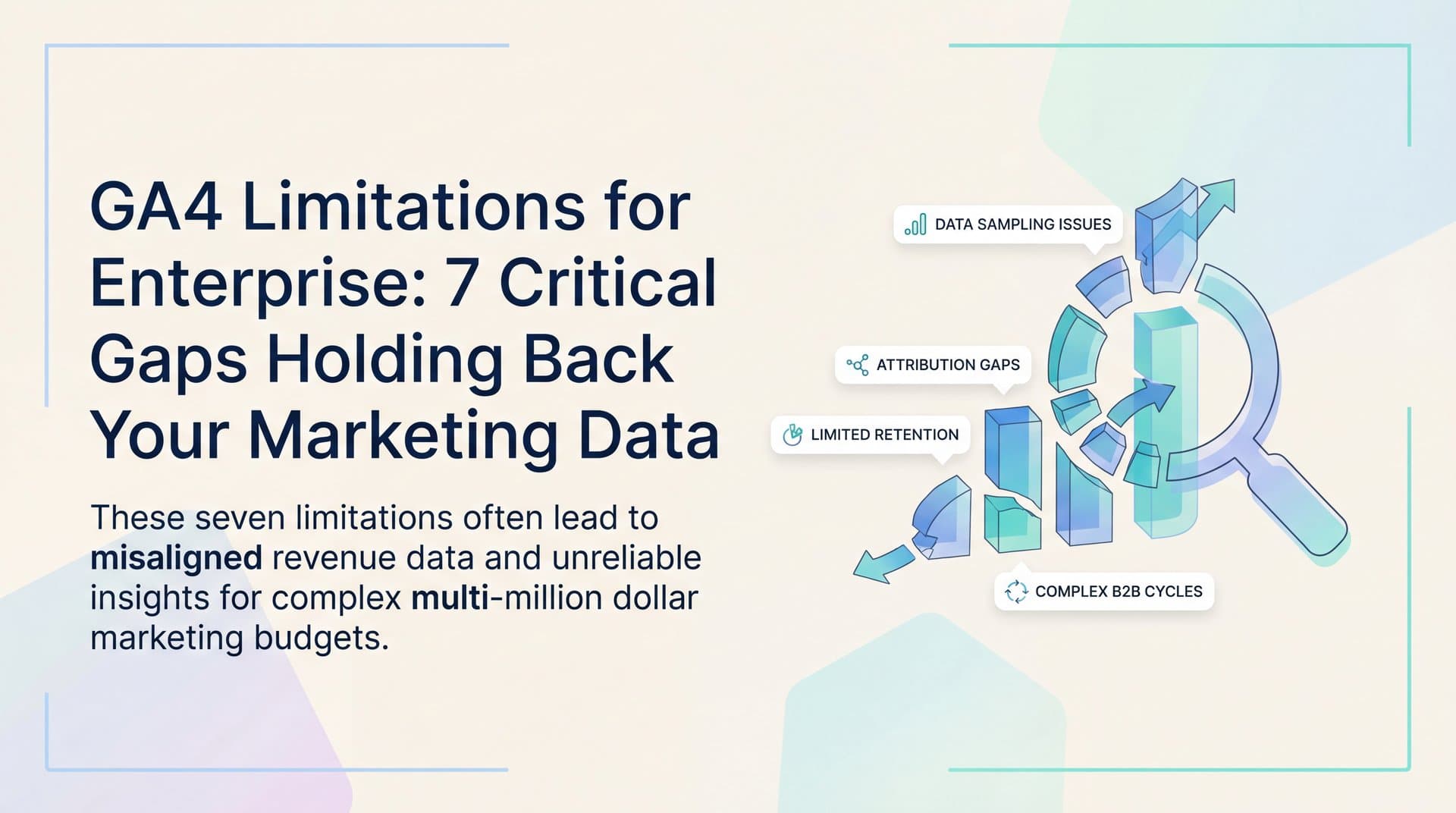
But enterprise-scale operations often expose constraints that become impossible to ignore. Complex customer journeys spanning multiple touchpoints, high-volume traffic triggering data sampling, lengthy B2B sales cycles, and the critical need to connect every dollar spent to actual revenue—these realities push GA4 beyond its design parameters. Understanding these limitations isn't about finding fault with the platform. It's about making informed decisions about your analytics infrastructure and knowing when you need additional tools to fill the gaps.
Data Sampling: When Your Reports Only Tell Part of the Story
Data sampling sounds technical, but the concept is straightforward. When GA4 processes certain queries—particularly custom explorations on large datasets—it analyzes a subset of your data rather than the complete picture. For an enterprise site processing millions of sessions monthly, this limitation activates frequently.
Here's why this matters for strategic decisions. Imagine analyzing which content topics drive the most qualified leads across your site. You build a custom exploration report combining content categories, user segments, and conversion events. GA4 applies sampling because the query complexity exceeds its processing thresholds. The report shows Topic A outperforming Topic B by 40%. But that 40% difference might be based on analyzing only 30% of your actual traffic data.
The practical impact becomes clear during budget allocation meetings. Your team decides to shift resources toward Topic A content based on sampled data. Three months later, when you examine the full dataset through BigQuery exports, you discover Topic B actually had stronger performance. The sampling created a distorted view that led to misallocated resources. Organizations seeking complete data visibility often explore BigQuery GA4 marketing attribution solutions to overcome these sampling constraints.
GA4's standard reports—the pre-built dashboards showing overview metrics—typically don't trigger sampling. They work well for high-level monitoring. But enterprise marketing teams rarely make strategic decisions from standard reports alone. You need custom explorations to answer specific questions about campaign performance, audience segments, and conversion paths.
The moment you start building these custom analyses—comparing multiple dimensions, applying complex filters, or examining specific user cohorts—you enter sampling territory. GA4 doesn't always make it obvious when sampling occurs. A small indicator appears in your report, easy to miss during a quick review. Many enterprise teams have made significant decisions without realizing their reports showed sampled data rather than complete information.
This limitation creates a fundamental tension. The deeper your analysis needs to go, the more likely you'll encounter sampling. Yet deep analysis is precisely what enterprise operations require to optimize complex marketing systems and justify substantial budget investments.
Attribution Blind Spots That Cost Enterprise Budgets
Attribution determines which marketing touchpoints receive credit for conversions. Get it wrong, and you'll systematically underfund your best-performing channels while overinvesting in underperformers. GA4's attribution capabilities work reasonably well for straightforward customer journeys, but enterprise marketing rarely deals with straightforward journeys.
GA4's data-driven attribution model uses machine learning to distribute conversion credit across touchpoints. The system analyzes patterns in your data to determine which interactions genuinely influence outcomes. This approach represents a significant improvement over simple last-click attribution. But it operates within a 90-day lookback window.
For B2B enterprises with sales cycles stretching six, nine, or twelve months, this constraint creates a massive blind spot. A prospect might first discover your solution through a LinkedIn ad in January, engage with your content throughout spring, attend a webinar in summer, and finally convert in October. GA4's attribution model can't see that initial January touchpoint because it falls outside the 90-day window. Your LinkedIn campaigns appear less effective than they actually are, potentially leading you to reduce budget from a channel that's driving valuable top-of-funnel awareness.
Cross-device and cross-platform tracking adds another layer of complexity. Modern buyers research on mobile during their commute, compare options on their work desktop, and make purchase decisions on tablets at home. They interact with your brand across Google, Meta, LinkedIn, and industry-specific platforms. Each platform operates in its own ecosystem with its own tracking mechanisms. Understanding these complex journeys requires robust customer journey analytics software designed for enterprise complexity.
GA4 attempts to connect these dots using Google signals—data from users signed into Google accounts who've enabled ads personalization. This provides some cross-device visibility, but it's far from complete. iOS privacy changes have significantly reduced tracking accuracy. Cookie deprecation continues to erode the ability to follow users across domains. The result is fragmented journey data with gaps GA4 can't fill.
Consider the challenge of connecting ad spend to actual revenue. You're running campaigns across Meta, Google, LinkedIn, and programmatic display. Each platform has its own conversion tracking pixel. GA4 sees traffic from these sources arriving at your site. But when that visitor converts three weeks later through a direct visit after receiving a sales email, how do you accurately attribute value back to the original ad interaction?
GA4's model makes educated guesses based on the data it can see. But it fundamentally cannot track what happens outside the browser—phone calls with sales reps, in-person meetings, email exchanges, CRM interactions. For enterprise B2B operations where these offline touchpoints often determine whether deals close, this represents a critical attribution blind spot.
The business impact extends beyond reporting accuracy. Ad platforms like Meta and Google use conversion data to optimize their algorithms. When you feed them incomplete conversion information from GA4, their machine learning systems optimize toward an incomplete picture of success. Your campaigns improve at driving the conversions GA4 can track while potentially missing the conversions that actually matter most to your revenue goals. Implementing multi-touch attribution tools helps capture the complete picture across all touchpoints.
The CRM Disconnect: Revenue Data That Never Meets Your Analytics
GA4 excels at tracking what happens on your website. It captures page views, button clicks, form submissions, and video engagement with impressive detail. But for enterprise businesses, the website represents just one chapter in a much longer story. The critical moments that determine revenue often happen elsewhere entirely.
Your marketing team generates a lead through a content download. GA4 tracks this conversion event perfectly. That lead enters your CRM, where a BDR qualifies them and books a discovery call. The sales team conducts three meetings over two months. The prospect requests a custom proposal. Legal reviews the contract. Procurement negotiates terms. Finally, six months after that initial content download, the deal closes for $250,000.
GA4 knows about the content download. It has no visibility into the $250,000 deal that resulted from it. This disconnect between marketing analytics and revenue reality creates a fundamental problem for enterprise budget planning. You're making million-dollar investment decisions based on proxy metrics—form fills, demo requests, trial signups—without clear line of sight to the actual revenue those actions generated. Bridging this gap requires revenue attribution tools that connect marketing activities to closed deals.
Many enterprise teams attempt manual workarounds. They export GA4 data and CRM data separately, then try to match them up in spreadsheets using email addresses or other identifiers. This process is time-consuming, error-prone, and typically happens monthly at best. By the time you've reconciled last month's data to understand which campaigns drove actual revenue, you've already spent this month's budget based on incomplete information.
Phone calls represent another significant blind spot. For many B2B enterprises, high-value prospects prefer to call rather than fill out forms. They see a Google Ad, visit your site, find your phone number, and call directly. GA4 can track that they visited your site, but it cannot connect that visit to the phone call that happened five minutes later or the $500,000 deal that resulted from it three months down the line.
The challenge intensifies with multi-location enterprises. A prospect researches your solution online, influenced by your digital marketing. But they ultimately visit a physical location or connect with a regional sales team. The attribution chain breaks at the moment they move from digital to offline, leaving your digital marketing efforts systematically undervalued in performance reports. Effective sales attribution software can track these offline conversions back to their digital origins.
Some enterprises implement server-side tracking or use Google Tag Manager to push offline conversion data back into GA4 through the Measurement Protocol. This helps bridge the gap, but it requires significant technical implementation, ongoing maintenance, and careful data governance. Even with these systems in place, the time lag between online interactions and offline conversions creates reporting delays that limit real-time optimization capabilities.
The core issue isn't that GA4 fails at what it's designed to do. It's that enterprise revenue attribution requires connecting data across systems that were never designed to talk to each other—your website, ad platforms, CRM, sales tools, and customer success systems. GA4 sits at the center of this ecosystem but lacks the native integration depth to pull it all together into a unified attribution view.
Real-Time Reporting Gaps and Data Processing Delays
Enterprise marketing teams managing substantial daily ad spend need fast feedback loops. When you're investing thousands or tens of thousands of dollars daily across multiple campaigns, waiting 24-48 hours to understand what's working creates expensive blind spots. GA4's data processing architecture introduces latency that can affect time-sensitive optimization decisions.
GA4 processes data in batches rather than truly real-time streams. The platform offers a "real-time" report, but this shows only the last 30 minutes of activity and provides limited dimensions for analysis. For understanding immediate traffic patterns and basic engagement, it serves its purpose. For making informed budget allocation decisions or identifying performance issues before they consume significant spend, it falls short.
Standard GA4 reports typically reflect data with a 24-48 hour delay. Custom explorations can take even longer to populate with complete information. This latency creates a fundamental challenge for performance marketers who need to react quickly to changing conditions. A campaign might be underperforming due to creative fatigue, audience saturation, or competitive pressure. Every hour that campaign continues running at reduced efficiency represents wasted budget.
Consider a practical scenario. You launch a new campaign Monday morning with aggressive daily budgets. By Monday afternoon, you want to check early performance signals—which ad variations are resonating, which audience segments are engaging, what the preliminary conversion rates look like. GA4's real-time report shows traffic arriving, but you can't segment it meaningfully or see conversion data with confidence. The detailed reports you need won't be fully populated until Tuesday or Wednesday.
This delay forces enterprise teams into a reactive rather than proactive optimization posture. Instead of catching issues within hours and adjusting course, you discover problems a day or two later after significant budget has been spent. The cumulative impact across dozens of campaigns and millions in annual ad spend becomes substantial. Teams focused on improving ad performance need faster feedback loops than GA4 can provide.
Data processing delays also affect how quickly you can feed conversion data back to ad platforms. Modern advertising systems rely on rapid feedback loops. When someone converts, you want that signal reaching the ad platform's algorithm as quickly as possible so it can optimize future delivery. GA4's processing latency means conversion events may not sync to your ad platforms for 24-48 hours, reducing the effectiveness of platform-native optimization algorithms.
For enterprise teams running sophisticated testing programs—multivariate creative tests, audience experiments, bidding strategy comparisons—these delays extend the time required to reach statistical significance. What could be a three-day test with real-time data becomes a week-long test when you factor in reporting delays. Slower iteration cycles mean fewer optimization opportunities throughout the year.
Customization Ceilings: When Standard Dimensions Aren't Enough
Enterprise marketing operations generate complex tracking requirements. You need to analyze performance across product lines, customer segments, account tiers, regional teams, partner channels, and countless other dimensions specific to your business model. GA4 provides custom dimensions and metrics to extend its standard tracking capabilities, but these come with hard limits that enterprise implementations frequently hit.
GA4 allows 50 custom dimensions and 50 custom metrics per property. For a small business tracking a few key attributes, this provides plenty of room. For an enterprise with multiple product categories, various customer segments, complex organizational structures, and detailed campaign taxonomies, these limits become constraints that force difficult prioritization decisions.
You might need custom dimensions for product SKU, product category, customer lifetime value tier, account type, sales region, partner source, campaign theme, content topic, and dozens of other business-specific attributes. Hitting the 50-dimension ceiling means choosing which aspects of your business you can analyze in GA4 and which require separate tracking systems or manual data joining. Many organizations turn to dedicated marketing analytics tools to overcome these constraints.
Event parameters offer another customization avenue, but GA4 limits you to 25 unique event parameters per event. For complex conversion events that need to capture detailed context—deal size, product mix, discount applied, sales rep involved, lead source, campaign attribution—25 parameters can disappear quickly. Once you exceed this limit, additional parameters simply don't get collected, creating gaps in your conversion data.
Data retention represents another critical ceiling. GA4 retains user-level data for a maximum of 14 months. For enterprises needing to analyze year-over-year trends, understand seasonal patterns across multiple years, or maintain historical records for compliance purposes, this limitation creates significant challenges. After 14 months, you can still see aggregated data in standard reports, but you lose the ability to create custom explorations on that historical data.
The 14-month retention limit particularly affects enterprises in regulated industries or those with long-term customer relationships. If you need to demonstrate marketing attribution for customers acquired three years ago, or analyze campaign performance trends across five years of data, GA4's native retention won't support these requirements.
Google's recommended solution for enterprises hitting these ceilings is BigQuery integration. By exporting your raw GA4 data to BigQuery, you gain unlimited retention, unlimited custom analysis capabilities, and the ability to join GA4 data with other business data sources. This approach works, but it introduces substantial complexity.
BigQuery requires SQL expertise to query effectively. You need data engineering resources to build and maintain data pipelines. Storage and query costs scale with your data volume, adding infrastructure expenses. For enterprises with the technical resources and budget to implement BigQuery properly, it provides powerful capabilities. For marketing teams without dedicated data engineering support, it represents a significant barrier to accessing the full depth of their analytics data.
Building an Enterprise Analytics Stack That Actually Works
Understanding GA4's limitations doesn't mean abandoning the platform. It means approaching enterprise analytics architecture with clear eyes about what each tool does well and where you need additional capabilities. The most effective enterprise analytics stacks use GA4 as a foundational component while adding specialized tools to fill critical gaps.
Start by identifying what GA4 genuinely excels at for your organization. It provides robust website behavior tracking, solid audience insights, and valuable engagement metrics. For understanding how users navigate your site, which content resonates, and where friction points exist in your digital experience, GA4 delivers real value. These insights should inform your content strategy, user experience optimization, and website development priorities.
Next, map the gaps between GA4's capabilities and your enterprise requirements. Most organizations discover gaps in these areas: complete customer journey attribution across all touchpoints, real-time performance visibility for active campaigns, integration between marketing data and revenue outcomes, and long-term historical analysis beyond 14 months. Each gap represents an opportunity to add a specialized tool that addresses that specific need.
Server-side tracking represents a critical evolution for enterprise analytics infrastructure. Rather than relying solely on browser-based tracking pixels that are increasingly blocked by privacy tools and browser restrictions, server-side tracking captures data at your server level and sends it to analytics platforms through secure server-to-server connections. This approach improves data accuracy, reduces dependency on third-party cookies, and gives you more control over what data gets shared with which platforms.
Implementing server-side tracking requires technical investment, but it pays dividends across your entire analytics stack. You capture more complete data, reduce discrepancies between different analytics tools, and maintain better data quality as privacy regulations continue evolving. Server-side tracking also enables you to enrich data before sending it to analytics platforms—adding CRM attributes, customer lifetime value, or other business context that improves analysis depth. Robust conversion tracking solutions leverage server-side implementations for maximum accuracy.
First-party data strategies become increasingly important as third-party cookies disappear and platform tracking becomes less reliable. Building systems that capture and connect your own customer data—email addresses, account IDs, CRM records—provides a foundation for accurate attribution that doesn't depend on cookies or cross-domain tracking. When you can identify users through your own first-party identifiers, you can connect their journey across devices, platforms, and time periods with confidence.
Dedicated attribution platforms fill the gap between what GA4 tracks and what enterprise marketing teams need to understand about revenue impact. These platforms are specifically designed to connect data across your entire marketing ecosystem—ad platforms, website analytics, CRM systems, and offline conversion sources. They provide the multi-touch attribution models, extended lookback windows, and revenue-focused reporting that enterprise budget decisions require. Evaluating enterprise marketing attribution software options helps identify the right fit for your organization's needs.
Platforms like Cometly exemplify this specialized approach. Rather than trying to be everything to everyone, they focus specifically on solving the attribution challenge that GA4 leaves unaddressed. By capturing every touchpoint across your marketing channels and connecting them to actual revenue outcomes in your CRM, these tools provide the complete journey visibility that enterprise marketing teams need. The AI-powered recommendations help identify which campaigns and channels genuinely drive results, enabling confident scaling decisions based on complete data rather than fragmented insights.
Building an effective enterprise analytics stack isn't about finding one perfect tool. It's about assembling complementary capabilities that work together. GA4 provides your website analytics foundation. A dedicated attribution platform connects marketing touchpoints to revenue. Your CRM tracks sales progression and deal outcomes. Together, these systems create comprehensive visibility that no single platform can deliver alone.
Moving Forward with Clear-Eyed Analytics Strategy
GA4 serves an important role in the enterprise analytics ecosystem, but expecting it to be your complete attribution and analytics solution sets up inevitable frustration. The platform was designed with specific priorities—privacy-first data collection, event-based tracking flexibility, and integration with Google's advertising ecosystem. These design choices create real value for many use cases while introducing constraints that affect enterprise-scale operations.
The enterprises that succeed with analytics aren't those that find the perfect single tool. They're the ones that build thoughtful data infrastructures matching their complexity. They understand which questions GA4 answers well and which require additional tools. They invest in server-side tracking and first-party data strategies that improve accuracy across all their analytics platforms. They implement specialized attribution systems that connect marketing spend to actual revenue outcomes.
Most importantly, they recognize that accurate attribution isn't just a reporting nicety. It's the foundation for confident scaling decisions. When you know with certainty which campaigns, channels, and strategies drive real revenue, you can invest aggressively in what works and cut what doesn't. You stop making budget decisions based on proxy metrics and incomplete data. You move from educated guessing to data-driven confidence. Understanding GA4 marketing attribution capabilities and limitations helps you make informed decisions about your analytics infrastructure.
The analytics landscape continues evolving rapidly. Privacy regulations expand, browser tracking capabilities diminish, and customer journeys grow more complex across devices and platforms. The enterprises that thrive in this environment will be those that build flexible, comprehensive analytics stacks capable of adapting to these changes while maintaining accurate attribution and clear ROI visibility.
Your analytics infrastructure should serve your business decisions, not constrain them. If you're hitting GA4's limitations—whether through data sampling, attribution blind spots, CRM disconnects, or customization ceilings—that's a signal to expand your analytics capabilities, not lower your analytical ambitions.
Ready to elevate your marketing game with precision and confidence? Discover how Cometly's AI-driven recommendations can transform your ad strategy. Get your free demo today and start capturing every touchpoint to maximize your conversions.