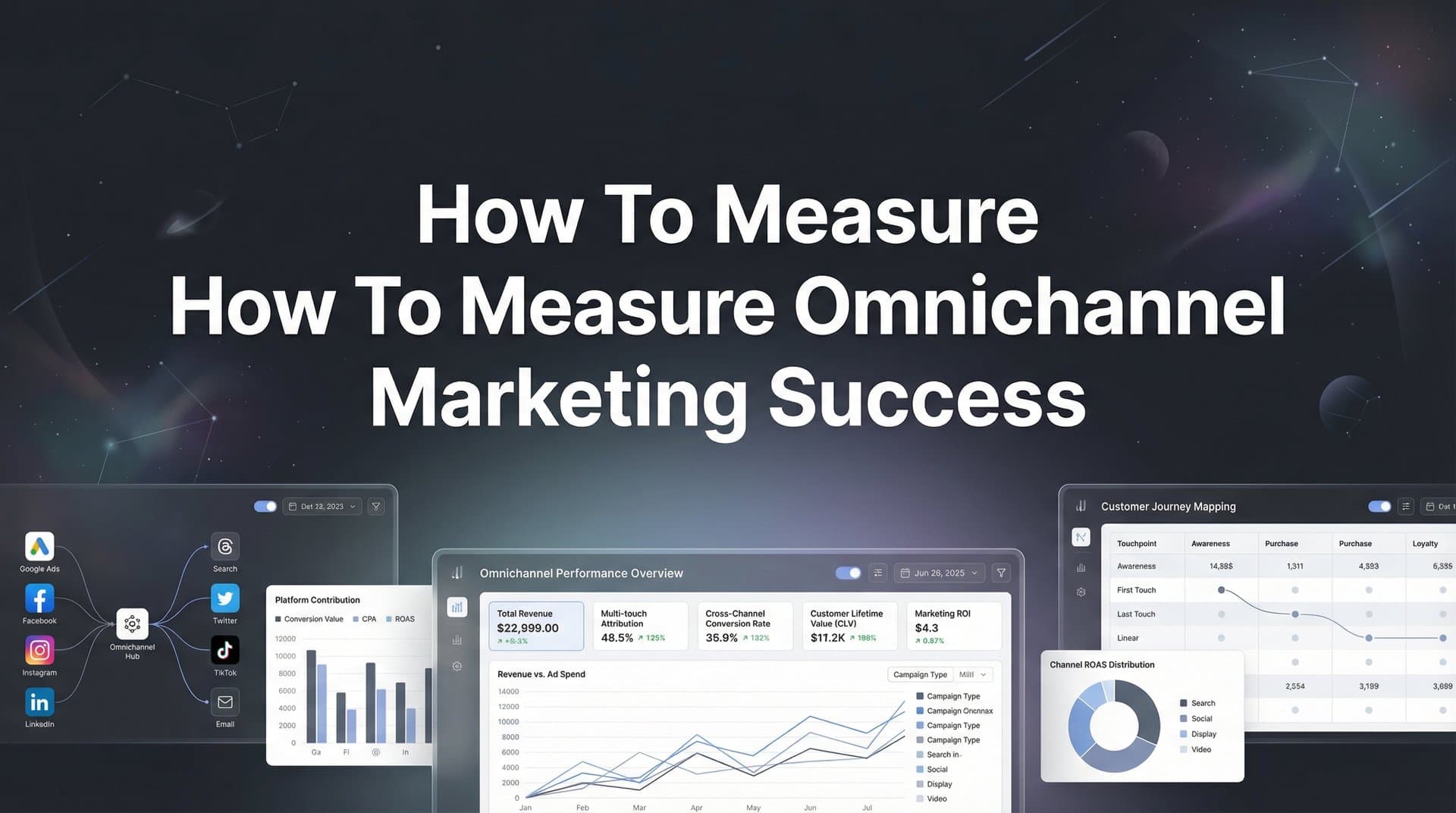
Running campaigns across Meta, Google, TikTok, email, and organic channels creates a measurement nightmare. Each platform claims credit for conversions, your spreadsheets tell different stories, and you're left guessing which channels actually drive revenue.
Sound familiar? You launch a campaign on Meta. Google Ads shows assisted conversions. Your email platform reports click-throughs. Your CRM records the sale. But which channel actually deserves credit for that customer?
The problem isn't your marketing—it's fragmented measurement. When every platform operates in its own data silo, you're measuring pieces of the customer journey instead of the complete picture. This leads to budget waste, missed opportunities, and decisions based on incomplete information.
This guide walks you through a proven 6-step framework to measure omnichannel marketing success accurately. You'll learn how to unify your data sources, establish meaningful KPIs, implement cross-channel tracking, and build reporting systems that reveal true performance.
By the end, you'll have a clear methodology to identify which touchpoints contribute to conversions and confidently allocate budget to your highest-performing channels. Let's start with understanding exactly what you're working with.
Step 1: Audit Your Current Channel Ecosystem and Data Sources
Before you can measure omnichannel success, you need a complete inventory of what you're actually measuring. Most marketing teams underestimate how many channels they're running and where their data lives.
Start by mapping every active marketing channel. This includes paid channels like Meta Ads, Google Ads, TikTok Ads, and LinkedIn Ads. Don't forget organic channels: SEO, social media posts, YouTube content, and partnerships. Then add email marketing, SMS campaigns, retargeting, and direct traffic.
Create a simple spreadsheet with columns for channel name, platform, monthly spend, and current tracking status. Be thorough—that abandoned retargeting campaign still running in the background counts.
Next, document where conversion data currently lives. Your Meta Ads Manager shows one set of conversions. Google Analytics shows another. Your CRM records closed deals. Your email platform tracks purchases from campaigns. These numbers rarely match, and that's the core problem you're solving.
For each channel, note which tracking method it uses. Is it relying on browser cookies? Pixel tracking? UTM parameters? Server-side tracking? Understanding your current tracking infrastructure reveals where data gaps exist.
Now identify your tracking blind spots. Common gaps include iOS users who opt out of tracking, cross-device journeys where someone clicks an ad on mobile but converts on desktop, and offline conversions that never connect back to digital touchpoints.
Look for inconsistencies in your UTM parameter naming. If your Meta campaigns use "facebook" while Google campaigns use "cpc" and email uses "newsletter," you're creating data fragmentation before it even reaches your analytics platform. Learning what UTM tracking is and how it helps your marketing can prevent these common mistakes.
Document which channels connect to your CRM and which don't. If your ad platforms aren't feeding data into your CRM, you're missing the connection between marketing activity and actual revenue. This disconnect makes it impossible to calculate true customer acquisition costs or lifetime value by channel.
The output of this audit should be a clear picture of your measurement landscape: what you're tracking well, what you're tracking poorly, and what you're not tracking at all. This becomes your roadmap for the improvements in the following steps.
Step 2: Define Your Omnichannel KPIs and Success Metrics
Platform metrics tell you what happened. Business metrics tell you what matters. The difference is everything when measuring omnichannel success.
Start by distinguishing between channel-specific metrics and unified business metrics. Channel-specific metrics like click-through rate, cost per click, and impression share matter for optimization within that channel. But they don't tell you if that channel contributes to your business goals.
Your primary KPIs should connect marketing activity directly to revenue outcomes. Customer Acquisition Cost (CAC) shows how much you spend to acquire each customer across all channels combined. Return on Ad Spend (ROAS) reveals revenue generated per dollar spent. Lifetime Value (LTV) indicates the long-term value of customers acquired through different channels.
Revenue attribution by channel becomes your north star metric. This shows which channels contribute to actual sales, not just clicks or form fills. When you can see that Meta drives 35% of revenue while Google drives 28%, you can allocate budget based on real business impact instead of vanity metrics. Understanding how to attribute revenue to marketing channels is essential for this visibility.
Set up secondary metrics for engagement and micro-conversions across touchpoints. These include email open rates, content downloads, demo requests, and trial signups. While not revenue events themselves, they indicate customer journey progression and channel effectiveness at different funnel stages.
Create a measurement framework that maps each metric to a specific business question. If your question is "Which channels drive our highest-value customers?" your metrics should include LTV by acquisition channel and average order value by source. If your question is "Where should we increase budget?" you need ROAS and CAC by channel with trend data.
Avoid the trap of tracking too many metrics. Focus on five to seven primary KPIs that directly inform budget allocation and strategy decisions. Everything else is secondary data for context.
Document your KPI definitions clearly. When you say "conversion," does that mean form submission, trial signup, or closed sale? When calculating ROAS, are you using attributed revenue or last-click revenue? Consistent definitions across your team prevent misalignment and bad decisions.
Your KPI framework should also account for your sales cycle length. If you run B2B campaigns with 90-day sales cycles, measuring ROAS weekly creates false signals. Match your measurement timeframe to your actual customer journey length. Exploring how to evaluate marketing performance metrics helps you establish the right cadence.
The goal is a measurement framework where every KPI connects to a specific business decision. If a metric doesn't influence how you allocate budget or optimize campaigns, it's noise.
Step 3: Implement Unified Cross-Channel Tracking
Fragmented tracking creates fragmented data. Unified tracking reveals the complete customer journey across every touchpoint.
Start with consistent UTM parameters across all paid and organic channels. Create a UTM naming convention document that everyone on your team follows. Define exactly how you'll name sources (facebook, google, email), mediums (cpc, social, newsletter), and campaigns.
Your convention might look like this: source = platform name, medium = traffic type, campaign = specific campaign identifier, content = ad variation, term = targeting details. The specific structure matters less than consistency. When every channel uses the same naming logic, your analytics platform can accurately group and compare performance.
Build a UTM generator spreadsheet or use a tool that enforces your naming convention. This prevents the common problem where different team members create URLs with inconsistent parameters, making data analysis nearly impossible.
Next, connect your ad platforms to your CRM for complete customer journey visibility. Most modern CRMs offer native integrations with major ad platforms. Set these up so that when someone converts, your CRM records which ads they clicked, which emails they opened, and which content they consumed before purchase. Learning how to connect all marketing data sources streamlines this process significantly.
This connection transforms your measurement from "this ad got 50 clicks" to "this ad generated three customers worth $15,000 in revenue." That's the difference between guessing and knowing.
Implement server-side tracking to capture data that browser limitations miss. iOS privacy changes and cookie restrictions mean browser-based tracking now misses significant portions of your traffic. Server-side tracking bypasses these limitations by sending conversion data directly from your server to analytics and ad platforms.
For e-commerce sites, this means when someone completes a purchase, your server sends that conversion event to Meta, Google, and your attribution platform—regardless of whether the user's browser allows tracking. This dramatically improves data accuracy and gives ad platform algorithms better information for optimization.
Verify tracking accuracy by testing conversion paths across devices. Click your own ads on mobile, then convert on desktop. Submit test leads through different channels. Check that these conversions appear correctly in all your tracking systems with proper attribution.
Common tracking issues include conversion events firing multiple times, UTM parameters getting stripped during checkout, and mobile app conversions not connecting to web sessions. Test thoroughly to catch these problems before they corrupt your data.
Set up conversion tracking for multiple event types, not just purchases. Track micro-conversions like email signups, content downloads, and demo requests. These events help you understand the full customer journey and which channels contribute at different stages.
The result of unified tracking is a data foundation where every customer interaction connects to its source, every conversion links back to the touchpoints that influenced it, and your measurement systems speak the same language.
Step 4: Choose and Configure Your Attribution Model
Attribution models determine which channels get credit for conversions. Choose the wrong model, and you'll optimize based on misleading data.
Start by understanding your attribution model options. First-touch attribution gives all credit to the first channel a customer interacted with. Last-touch attribution credits the final touchpoint before conversion. Linear attribution splits credit equally across all touchpoints. Data-driven attribution uses algorithms to weight each touchpoint based on its actual influence on conversion.
Each model tells a different story about channel performance. First-touch attribution favors top-of-funnel channels like content marketing and social media. Last-touch attribution rewards bottom-funnel channels like branded search and retargeting. Neither single-touch model captures the reality of multi-channel customer journeys.
Match your attribution model to your sales cycle length and buying journey complexity. For simple, single-session purchases like impulse e-commerce, last-touch attribution might suffice. For complex B2B sales with multiple touchpoints over months, multi-touch attribution becomes essential. Understanding how to calculate marketing attribution helps you select the right approach.
Think about your typical customer journey. If prospects usually discover you through content, engage on social media, click a retargeting ad, and then convert through branded search, a single-touch model will either overvalue your content or overvalue your branded search—but never show the full picture.
Configure multi-touch attribution to credit all contributing touchpoints. This reveals how your channels work together rather than competing for credit. You might discover that while branded search gets last-touch credit for most conversions, those customers typically discovered you through organic content or social media weeks earlier.
Multi-touch models include position-based attribution (giving more credit to first and last touch), time-decay attribution (giving more credit to recent touchpoints), and algorithmic attribution (using data to determine credit distribution). Position-based models work well when you want to value both awareness and conversion channels. Time-decay models suit businesses where recent interactions matter most.
Compare attribution models side-by-side to understand how each values your channels. Most attribution platforms let you view the same data through different attribution lenses. This comparison reveals which channels are undervalued by last-touch attribution and which are overvalued by first-touch.
You might see that your content marketing drives 5% of last-touch conversions but influences 40% of all customer journeys. Or that your retargeting campaigns get 30% last-touch credit but only influence 15% of new customer acquisition. These insights reshape budget allocation strategy.
For most omnichannel marketers, data-driven multi-touch attribution provides the most accurate picture. It accounts for channel interactions, weights touchpoints based on actual influence, and adapts as your marketing mix changes. This sophistication comes with complexity, but the measurement accuracy justifies the effort. Implementing strategies to measure cross-channel marketing attribution effectively ensures you capture the full picture.
The key is choosing an attribution model that matches your business reality, then sticking with it long enough to gather meaningful data. Constantly switching models prevents you from identifying true trends in channel performance.
Step 5: Build Your Omnichannel Performance Dashboard
Scattered data across multiple platforms forces manual reconciliation and slows decision-making. A centralized dashboard creates a single source of truth.
Start by centralizing data from all platforms into one location. This might be a dedicated attribution platform, a business intelligence tool, or a custom dashboard built on your analytics infrastructure. The specific tool matters less than having one place where all your marketing data converges.
Your dashboard should automatically pull data from ad platforms, analytics tools, CRM systems, and email marketing software. Manual data entry creates errors and becomes unsustainable as your channel mix grows. Set up API connections or native integrations that refresh data automatically. Adopting a unified marketing measurement approach ensures consistency across all data sources.
Create views that show channel performance individually and collectively. Your individual channel view might display Meta Ads performance with spend, impressions, clicks, conversions, and attributed revenue. Your collective view shows how all channels perform together, revealing total marketing spend, blended CAC, overall ROAS, and revenue contribution by channel.
The collective view is where omnichannel measurement delivers value. You can see that while Google Ads has higher individual ROAS, Meta Ads influences more customer journeys. Or that email marketing shows low last-touch conversions but assists 60% of purchases from other channels.
Set up automated reporting to track KPIs without manual data pulling. Configure daily, weekly, and monthly reports that deliver key metrics to your inbox or team Slack channel. This automation ensures consistent measurement and frees your team from spreadsheet work.
Include customer journey visualizations to see how channels work together. Path analysis shows common sequences of touchpoints before conversion. You might discover that most customers follow a pattern: organic search → content download → email nurture → Meta retargeting → purchase. This insight informs how you structure campaigns and allocate budget across the funnel.
Build separate dashboard views for different stakeholders. Your executive team needs high-level metrics: total marketing spend, blended ROAS, CAC trends, and revenue attribution. Your channel managers need granular performance data for their specific platforms. Your finance team needs revenue reconciliation between marketing attribution and actual bookings. Knowing how to prove marketing impact to executives helps you design the right executive-level views.
Add context to your dashboard with goal lines, benchmarks, and trend indicators. Show current ROAS against your target ROAS. Display month-over-month changes in CAC. Include year-over-year revenue growth by channel. Context transforms numbers into actionable insights.
Test your dashboard by asking it questions. "Which channel drove the most revenue last month?" "How has our Meta ROAS trended over the past quarter?" "What's our current blended CAC across all channels?" If your dashboard can't answer these questions quickly, refine your setup.
The goal is a dashboard that becomes your team's daily reference point—where you check performance, identify issues, and make optimization decisions without jumping between five different platforms.
Step 6: Analyze, Optimize, and Feed Data Back to Ad Platforms
Data without action is just expensive record-keeping. The final step transforms measurement into continuous improvement.
Review attribution data weekly to identify underperforming and overperforming channels. Look beyond surface metrics to understand why performance changed. Did your Meta ROAS drop because of creative fatigue, audience saturation, or increased competition? Did Google's CAC improve because of better targeting or seasonal demand shifts?
Weekly reviews catch problems early and capitalize on opportunities quickly. If a channel's performance deteriorates, you can pause spending before wasting significant budget. If a test campaign outperforms expectations, you can scale it immediately.
Reallocate budget based on true revenue contribution, not platform-reported conversions. This is where omnichannel attribution delivers ROI. When you see that TikTok Ads generates lower last-touch conversions but influences high-value customer journeys, you can justify continued investment despite weak platform-reported metrics. Understanding how to measure ROI from multiple marketing channels gives you the framework for these decisions.
Create a budget reallocation framework based on your KPIs. If a channel maintains ROAS above your target threshold and has room to scale, increase budget. If a channel falls below CAC targets for two consecutive weeks, reduce spend and investigate. Let data drive decisions instead of gut feeling or platform rep recommendations.
Send enriched conversion data back to ad platforms to improve their targeting algorithms. This feedback loop—often called server-side tracking or conversion APIs—helps platforms like Meta and Google optimize for actual conversions, not just clicks or pixel fires.
When you send complete conversion data including revenue value, customer type, and lifecycle stage, ad platforms can identify patterns in who converts and optimize delivery accordingly. This improves targeting efficiency and reduces wasted spend on low-intent audiences.
The technical implementation involves setting up Meta's Conversions API, Google's Enhanced Conversions, or TikTok's Events API. These systems send conversion events from your server directly to ad platforms, bypassing browser limitations and providing more accurate data than pixel-based tracking alone.
Establish a monthly optimization cadence for continuous improvement. Your monthly review should analyze longer-term trends, test new attribution model configurations, and adjust your measurement framework as your business evolves. This is when you ask bigger questions: Are we measuring the right KPIs? Has our sales cycle changed? Should we adjust our attribution model?
Document your optimization decisions and their outcomes. When you reallocate budget from Google to Meta based on attribution data, track whether that decision improved overall performance. This creates institutional knowledge and helps you refine your decision-making framework over time. Implementing top strategies for effective marketing measurement ensures your optimization process stays rigorous.
Test incrementally rather than making massive changes. If attribution data suggests increasing Meta budget by 50%, test a 20% increase first. Measure the impact. Scale further if results validate the data. This approach reduces risk while still acting on insights.
The optimization cycle never ends. As you gather more data, your attribution becomes more accurate. As your attribution improves, your optimization decisions become more effective. As your campaigns perform better, you generate more data. This virtuous cycle is how omnichannel measurement compounds value over time.
Your Omnichannel Measurement System Is Now Complete
You've built a complete framework for measuring omnichannel marketing success. Let's recap your implementation checklist:
Channel audit completed: All data sources documented with tracking status and gaps identified.
KPIs defined: Revenue-focused metrics established that connect marketing activity to business outcomes.
Unified tracking implemented: Consistent UTM parameters, CRM integrations, and server-side tracking capturing complete customer journeys.
Attribution model configured: Multi-touch attribution revealing how channels work together to drive conversions.
Centralized dashboard built: Single source of truth with automated reporting and customer journey visualizations.
Optimization process established: Weekly reviews, data-driven budget allocation, and conversion data feedback loops to ad platforms.
Measuring omnichannel marketing success requires moving beyond siloed platform metrics to unified, revenue-focused attribution. The difference between fragmented measurement and omnichannel attribution is the difference between guessing which channels work and knowing exactly where to invest your next dollar.
Start with Step 1 this week—audit your channels and identify your biggest tracking gaps. Each subsequent step builds on the last, creating a measurement system that reveals exactly which marketing efforts drive your business forward.
The complexity of omnichannel measurement often overwhelms marketing teams. You're juggling multiple platforms, reconciling conflicting data, and trying to make confident decisions with incomplete information. This is exactly why purpose-built attribution platforms exist—to handle the technical complexity while you focus on strategy and optimization.
Ready to elevate your marketing game with precision and confidence? Discover how Cometly's AI-driven recommendations can transform your ad strategy—Get your free demo today and start capturing every touchpoint to maximize your conversions.