

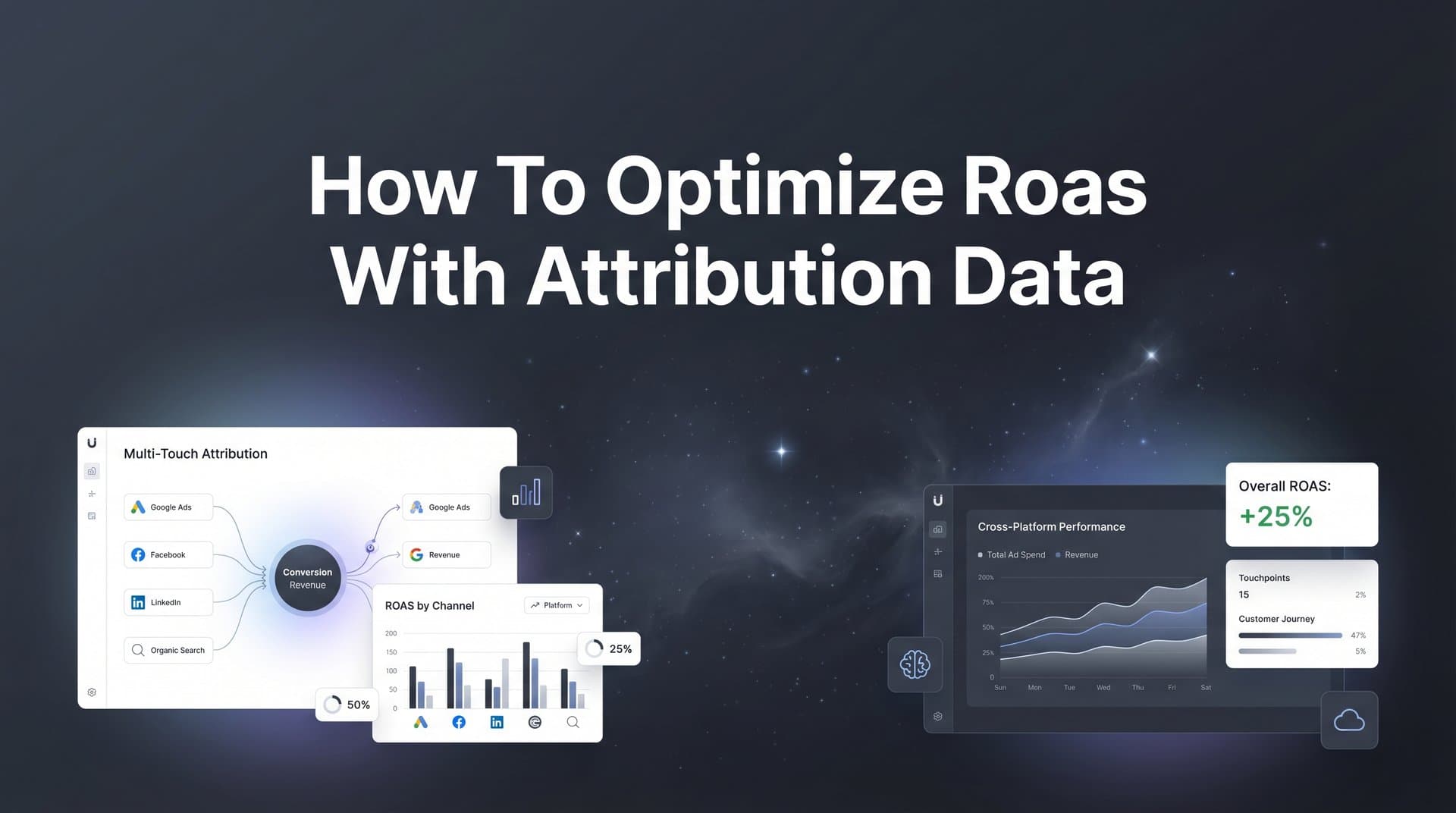
Every dollar you spend on advertising should work harder for you. Yet many marketers struggle to improve their return on ad spend because they are making decisions based on incomplete or misleading data.
The problem is not your creative, your targeting, or even your budget. It is that you cannot see which touchpoints actually drive revenue.
Attribution data changes everything. When you can trace the complete customer journey from first click to final purchase, you gain the clarity needed to cut wasteful spending and double down on what works.
This guide walks you through the exact process of using attribution data to systematically improve your ROAS. You will learn how to set up proper tracking, interpret multi-touch data, identify your highest-performing channels, and make budget decisions that compound your results over time.
Whether you are managing campaigns across Meta, Google, TikTok, or multiple platforms simultaneously, these steps will help you move from guessing to knowing exactly where your ad dollars deliver the best returns.
Step 1: Audit Your Current Tracking Setup and Identify Data Gaps
Before you can optimize anything, you need to know what you are actually measuring. Start by reviewing every pixel and tracking tag you have installed across your ad platforms.
Log into your Meta Ads Manager, Google Ads account, and any other platforms where you run campaigns. Check the Events Manager or conversion tracking sections to see which actions are being recorded. Are you capturing page views, add-to-cart events, purchases, and form submissions?
Now comes the critical part. Compare what your pixels claim to track against what actually happens in your customer journey.
Many marketers discover that their tracking breaks at crucial moments. A customer clicks an ad on mobile, browses on desktop later, then converts on a different device entirely. Your pixel-based tracking might miss this completely, crediting the conversion to direct traffic or organic search instead of the ad that started the journey.
Check for these common tracking failures:
iOS Attribution Gaps: Apple's privacy changes have made it nearly impossible for browser-based pixels to track conversions from iOS users accurately. If you are running mobile campaigns, you are likely missing significant conversion data. Understanding how to fix attribution data gaps is essential for recovering this lost visibility.
Cross-Domain Tracking Issues: If your checkout process happens on a different domain than your main site, or if you send traffic through landing page builders, your tracking chain might break. Users who click your ad, land on your site, then move to a subdomain for checkout often appear as new sessions with no ad attribution.
Offline Conversion Blind Spots: Do you have sales that happen over the phone, through sales teams, or via in-person interactions after someone clicks an ad? If these conversions are not being fed back into your tracking system, you are dramatically undervaluing the channels that drive them.
CRM Disconnection: Your CRM holds the truth about which leads actually turn into revenue. If it is not connected to your ad platform data, you are optimizing for lead volume instead of lead quality. A channel might send fewer leads but convert them at three times the rate.
Document everything you find. Create a simple spreadsheet listing each touchpoint in your customer journey and mark whether you are currently tracking it accurately. This audit reveals exactly where you are flying blind.
The gaps you identify here will guide your next steps. Most marketers are shocked to discover they are only seeing 60-70% of their actual conversion path.
Step 2: Implement Server-Side Tracking for Accurate Data Collection
Browser-based pixels are no longer enough. Privacy restrictions, ad blockers, and cross-device journeys have created too many blind spots. Server-side tracking solves this by capturing conversion data directly from your server rather than relying on browser cookies.
Think of it like this. A browser pixel is like trying to track a customer by following their footprints in the sand. Every time the tide comes in or they switch beaches, you lose the trail. Server-side tracking is like having a GPS tracker that follows them continuously regardless of where they go.
Start by choosing an attribution platform that supports server-side tracking. You need a system that can receive conversion data from your website, CRM, and other sources, then match it back to the original ad clicks. Many businesses are now implementing marketing attribution without cookies to maintain accuracy in this privacy-first landscape.
The technical setup involves installing tracking code on your server that sends conversion events directly to your attribution platform. When someone completes a purchase, fills out a form, or takes any valuable action, your server sends that information along with identifying details that allow the system to connect it to their earlier ad interactions.
Here is what you need to connect:
Ad Platform Integration: Link your Meta, Google, TikTok, and other ad accounts so the system can pull in click data and ad spend information automatically.
Website Tracking: Install a lightweight tracking script on your site that captures visitor behavior and passes it to your server-side system without relying on third-party cookies.
CRM Connection: Set up an integration that sends lead and customer data from your CRM into your attribution platform. This ensures you can track the complete journey from ad click through closed deal. An attribution software with CRM integration makes this process seamless.
First-Party Data Collection: Configure your system to use first-party cookies and your own domain for tracking. This maintains accuracy even as browsers tighten privacy restrictions.
Once everything is connected, run test conversions to verify the data flows correctly. Make a purchase on your own site, fill out a lead form, or complete whatever action you are tracking. Then check your attribution platform to confirm the conversion appears with the correct source attribution.
The difference in data quality is immediate. You will start seeing conversions you were missing entirely before. Cross-device journeys become visible. iOS users who were previously invisible show up in your reports. The fog lifts, and you can finally see what is actually happening.
Step 3: Choose the Right Attribution Model for Your Business
Not all attribution models are created equal, and the one you choose dramatically affects which channels appear to perform best. Understanding these differences is crucial because they determine where you will allocate your budget.
Last-click attribution gives 100% of the credit to the final touchpoint before conversion. If someone clicks a Google ad and purchases immediately, that ad gets full credit. Simple, but deeply flawed for most businesses.
The problem? It completely ignores everything that happened before. Maybe the customer first discovered you through a Facebook ad three weeks ago, then saw a YouTube video, then clicked an email, and finally searched for your brand on Google. Last-click attribution credits only that final Google search, making it look like your brand search campaigns are your best performers while the channels that actually created awareness get zero credit.
First-click attribution does the opposite. It gives all credit to the initial touchpoint. This makes your top-of-funnel awareness campaigns look amazing but ignores the nurturing and retargeting that actually closed the sale.
Linear attribution divides credit equally across all touchpoints. If there were five interactions before purchase, each gets 20% credit. This is more fair but still oversimplifies the reality that some touchpoints matter more than others.
Data-driven attribution uses machine learning to analyze thousands of customer journeys and determine which touchpoints actually influence conversions. It might give 40% credit to the initial Facebook ad, 30% to a retargeting campaign, 20% to an email, and 10% to the final search click based on statistical patterns in your data.
So which model should you use? It depends on your sales cycle and customer journey complexity.
If you sell low-consideration products with short sales cycles, where people typically buy within hours or days of first discovering you, last-click or linear models might work fine. The customer journey is simple enough that attribution complexity matters less.
If you have a longer sales cycle with multiple touchpoints, you need multi-touch attribution. B2B companies, high-ticket products, and anything requiring significant consideration benefits from seeing the complete journey. Explore multi-touch attribution models for data to understand your options.
Here is the strategic move. Set up multiple attribution models and compare them side by side. Look at the same conversion through last-click, first-click, linear, and data-driven lenses.
You will likely discover that channels you thought were underperforming were actually driving significant assisted conversions. That expensive display campaign might look terrible in last-click attribution but show strong performance in first-click, revealing its role in creating awareness that your retargeting campaigns later converted.
Most modern marketers are moving toward data-driven multi-touch attribution because it provides the most accurate picture of how channels work together. But start by comparing models to understand how each one values your marketing efforts differently.
The model you choose becomes the foundation for every optimization decision you make. Choose wisely.
Step 4: Analyze Channel Performance Using True Revenue Data
Now that you have accurate tracking and the right attribution model, it is time to see what your channels are actually delivering. This is where many marketers experience a revelation. The performance they thought they were getting often looks dramatically different when viewed through proper attribution.
Pull attribution reports that show actual revenue generated per channel, not just the conversions that ad platforms report in their own dashboards. This distinction matters enormously.
Meta might tell you that your campaign generated 50 conversions. But when you look at your attribution data, you might discover that only 35 of those conversions actually happened, while 20 conversions that Meta did not claim were actually influenced by your Meta ads earlier in the journey. Understanding why your ad platform shows wrong data helps you interpret these discrepancies.
Calculate true ROAS for each channel by dividing attributed revenue by spend. If you spent $5,000 on Google Ads and your attribution platform shows those campaigns influenced $25,000 in revenue, your true ROAS is 5x.
Compare this across all your channels. You might find something like this:
Meta Ads: Platform-reported ROAS of 3.2x, but true attributed ROAS of 4.8x when you include assisted conversions.
Google Search: Platform-reported ROAS of 6x, but true attributed ROAS of 4.2x because many of those conversions were actually driven by earlier touchpoints from other channels.
TikTok Ads: Platform-reported ROAS of 2.1x, but true attributed ROAS of 3.5x when you account for cross-device conversions and iOS users the platform could not track.
These discrepancies reveal the gap between what ad platforms claim and what actually happens. Platforms are incentivized to show you the best possible numbers, and their tracking limitations mean they often miss conversions or claim credit for sales they did not truly drive. Learn more about solving attribution data discrepancies to address these issues systematically.
Now go deeper. Segment your performance data by campaign type, audience, and creative to find specific optimization opportunities.
You might discover that your prospecting campaigns have a true ROAS of 2.8x while your retargeting campaigns deliver 7.2x. Or that video ads outperform image ads by 40% when you look at complete customer journeys. Or that one specific audience segment converts at three times the rate of others.
Look for patterns in your highest-performing campaigns. What do they have in common? Are they targeting specific demographics, using particular messaging, or running at certain times of day?
The goal is not just to know your overall channel performance but to identify the specific levers you can pull to improve results. Every insight you extract here becomes a decision you can make in the next step.
Document your findings. Create a clear picture of which channels, campaigns, audiences, and creatives are actually driving revenue. This becomes your roadmap for budget reallocation.
Step 5: Reallocate Budget Based on Attribution Insights
You now have a clear picture of what works. The next step is shifting your budget to do more of what drives results and less of what does not. But this requires discipline and patience.
Start by ranking all your channels and campaigns by true ROAS. Create a simple list from highest to lowest performing based on the attribution data you analyzed in the previous step.
The temptation is to immediately kill everything below a certain threshold and dump all your money into your top performer. Resist this urge. Budget reallocation should be incremental and strategic. Understanding how to optimize ad spend with data helps you make these decisions confidently.
Move 10-20% of your budget at a time. If you are spending $10,000 monthly on a channel with a 2x ROAS, do not cut it to zero overnight. Reduce it by $1,000-2,000 and reallocate that amount to higher-performing channels.
Why move slowly? Because attribution windows and lag time mean you will not see the full impact of your changes immediately. A conversion that happens today might be attributed to an ad click from two weeks ago. If you make massive budget changes all at once, you will struggle to isolate what caused your results to improve or decline.
Here is a practical reallocation framework:
Week 1: Document your baseline metrics. Record current spend, ROAS, and conversion volume for each channel. This is your before snapshot.
Week 2: Make your first budget shift. Increase spend on your highest-performing channel by 15-20% and decrease spend on your lowest performer by the same amount.
Weeks 3-4: Monitor results but do not make additional changes yet. Let the data stabilize and account for attribution lag.
Week 5: Analyze the impact. Did your overall ROAS improve? Did the increased spend on your top channel maintain its performance or show diminishing returns?
Week 6: Make your next adjustment based on what you learned. Continue this cycle of incremental change and measurement.
Account for attribution windows when judging results. If you are using a 28-day attribution window, you need to wait at least that long before fully evaluating the impact of budget changes. Conversions from ads you ran before the change will still be rolling in during the transition period.
Watch for diminishing returns on your top performers. A channel that delivers 5x ROAS at $5,000 monthly spend might only deliver 3.5x ROAS at $15,000 monthly spend. You are reaching audience saturation or bidding up your own costs. When you see this pattern, cap your spend at the point where returns start declining and look for the next best opportunity. Avoiding marketing budget allocation without clear data prevents these costly mistakes.
Some channels work best in combination. You might find that cutting your awareness campaigns to fund more retargeting actually hurts overall performance because you are shrinking the pool of people who can be retargeted later. Attribution data helps you see these interdependencies.
The goal is continuous optimization, not perfection. Each cycle of analysis and reallocation compounds your results over time. Small improvements of 10-15% per quarter add up to dramatic gains over a year.
Step 6: Feed Better Data Back to Ad Platform Algorithms
Your attribution insights do not just inform your decisions. They can also improve how ad platforms optimize your campaigns automatically. This creates a powerful feedback loop that amplifies your results.
Modern ad platforms like Meta and Google use machine learning to optimize your campaigns. They analyze which users convert and adjust targeting to find more people like them. But their algorithms are only as good as the data you feed them.
If your tracking is incomplete, the platforms are optimizing based on partial information. They might think certain audiences convert well when actually they are missing most of the conversions from other segments. Learning how to feed quality data to ad algorithms is critical for maximizing platform performance.
This is where conversion sync becomes powerful. By sending enriched conversion events back to your ad platforms, you give their algorithms a complete, accurate picture of what drives results.
Set up your attribution platform to pass conversion data back to Meta, Google, and other channels. Include not just that a conversion happened, but the revenue value and quality signals that matter to your business.
For example, instead of just telling Meta that someone converted, send the actual purchase value. If one customer spent $500 and another spent $50, the platform needs to know this so it can optimize for high-value customers, not just volume. Discover how to sync conversion data to Facebook Ads for step-by-step implementation guidance.
Send customer quality signals when possible. If you can identify that certain conversions came from enterprise customers versus small businesses, or that some leads closed while others went cold, pass this information back. The more context you provide, the smarter the platform optimization becomes.
Monitor how improved data quality affects your campaign performance over time. You should see your cost per acquisition gradually decrease as the algorithms learn to target more effectively. Your conversion rates might improve as platforms show your ads to people more likely to complete valuable actions.
Many marketers notice that their campaigns become more stable and predictable after implementing conversion sync. The wild fluctuations in performance smooth out because the optimization algorithms have better data to work with.
Use AI-powered recommendations from your attribution platform to identify scaling opportunities. When the system notices that a particular campaign or audience segment is performing exceptionally well, it can suggest increasing budget before you might notice the pattern yourself.
The combination of your strategic decisions based on attribution insights and improved platform optimization creates a virtuous cycle. You make better budget allocation choices, which generates better data, which improves platform optimization, which delivers better results, which gives you even clearer insights for the next round of decisions.
This is how you move from linear improvement to exponential growth. Each component reinforces the others.
Putting It All Together
Optimizing ROAS with attribution data is not a one-time project but an ongoing practice. By auditing your tracking, implementing server-side data collection, choosing the right attribution model, analyzing true channel performance, reallocating budget strategically, and feeding better data back to ad platforms, you create a continuous improvement loop.
Each cycle of analysis and optimization compounds your results. The marketers who consistently outperform their competitors are not necessarily more creative or better at targeting. They simply have better data and use it more effectively.
Start with step one today by reviewing your current tracking setup. Identify one gap in your data visibility and fix it this week. Maybe it is connecting your CRM to your ad platforms, or implementing server-side tracking to capture iOS conversions, or setting up multi-touch attribution to see the complete customer journey.
Then move through each subsequent step, building a foundation of accurate attribution that transforms how you make advertising decisions. The difference between knowing and guessing is the difference between growing profitably and burning budget on channels that do not deliver.
Your competitors are likely still making decisions based on incomplete data, crediting the wrong channels, and missing optimization opportunities that are obvious when viewed through proper attribution. This is your advantage.
The marketers who win are not those with the biggest budgets. They are the ones who know exactly where their money works hardest. They can confidently scale what performs and cut what does not because they have eliminated the guesswork.
Ready to elevate your marketing game with precision and confidence? Discover how Cometly's AI-driven recommendations can transform your ad strategy. Get your free demo today and start capturing every touchpoint to maximize your conversions.


