Picture this: it's Monday morning, and you're pulling together the weekly performance report. Google Ads shows 120 conversions. Meta reports 95. Your CRM logged 78 actual sales. Three tools, three completely different stories, and a team meeting that's about to turn into a 45-minute debate about which number to trust.
Sound familiar? This is the daily reality for marketing teams running paid campaigns across multiple platforms. Inconsistent marketing data, where metrics conflict across tools, platforms, or reports for the same campaigns and time periods, is one of the most frustrating and costly problems in modern digital marketing.
The frustration goes beyond the inconvenience of messy spreadsheets. When your data doesn't agree with itself, every budget decision becomes a gamble. Do you scale the campaign that Google says is crushing it, or do you trust your CRM that shows a fraction of those conversions actually closed? The uncertainty compounds, eroding confidence at every level from daily bid adjustments to quarterly planning.
This article breaks down exactly why inconsistent marketing data happens, what it's actually costing your team, and the practical steps you can take to fix it. By the end, you'll have a clear framework for moving from data chaos to a single, trustworthy source of truth.
The Hidden Ways Your Data Falls Out of Sync
Inconsistent marketing data rarely has a single cause. It's usually the result of several compounding issues happening simultaneously across your tech stack. Understanding each one is the first step toward fixing them.
Attribution model mismatches: Every ad platform measures conversions using its own logic. Meta's default attribution window is 7-day click and 1-day view, meaning it will claim credit for a conversion that happened up to seven days after a click or one day after a view. Google Ads uses different default settings. When a customer sees a Meta ad on Tuesday, clicks a Google ad on Thursday, and converts on Friday, both platforms claim that conversion as their own. Your CRM records one sale. The platforms report two conversions between them. Neither is lying exactly, but neither is giving you the full picture either.
Tracking gaps from privacy changes: Apple's App Tracking Transparency framework, introduced with iOS 14.5, fundamentally changed how platforms like Meta can observe user behavior after an ad click. Browser-level protections in Safari and Firefox have added further restrictions on third-party cookies and tracking scripts. The result is a growing blind spot where a meaningful portion of conversions either go unrecorded or are estimated using statistical modeling. The problem is that each platform models these gaps differently, which means their estimated numbers diverge from reality in different directions. These marketing analytics data gaps are becoming increasingly difficult to manage without dedicated infrastructure.
Siloed tools and fragmented tech stacks: Most marketing teams operate with a collection of tools that were never designed to talk to each other. Your ad platforms, Google Analytics, CRM, email platform, and reporting dashboard each capture data independently. At every handoff point between these systems, there's an opportunity for data to be lost, duplicated, or misattributed. A lead that enters through a paid ad might get attributed to organic search in one tool, direct traffic in another, and the paid campaign in a third, depending on how each system interprets the referral chain.
The compounding effect is what makes this so damaging. Each individual discrepancy might seem minor in isolation. But when attribution mismatches, privacy-driven tracking gaps, and tool fragmentation all operate simultaneously, the gap between what your platforms report and what's actually happening in your business can grow to a point where the data becomes genuinely unreliable for decision-making. Understanding how to unify marketing data sources is critical to closing these gaps.
This is why inconsistent marketing data is not just a technical problem. It's a strategic one. The root causes are structural, and fixing them requires more than tweaking a few settings.
What Bad Data Actually Costs Your Marketing Team
It's tempting to treat data discrepancies as an annoying but manageable inconvenience. The reality is that inconsistent marketing data carries real, measurable costs that affect every layer of your marketing operation.
Misallocated budgets: When platforms over-report conversions, teams scale campaigns that look successful on paper but aren't actually driving revenue. When platforms under-report, genuinely high-performing campaigns get starved of budget because the data doesn't reflect their true impact. Either way, dollars flow in the wrong direction. Over time, these misallocations accumulate into significant wasted spend, with the team none the wiser because the reporting never flags the problem clearly. Learning how to allocate marketing budget based on data becomes impossible when the underlying numbers can't be trusted.
Eroded stakeholder trust: Presenting conflicting numbers to leadership or clients is one of the fastest ways to lose credibility. When your weekly report shows different conversion figures depending on which platform you pull from, the natural reaction from stakeholders isn't to dig into attribution models. It's to question whether the marketing team has control of its data at all. This leads to decision paralysis, where teams default to gut instinct or political consensus rather than data-driven judgment. The irony is that you invested in analytics tools specifically to avoid this outcome.
Wasted optimization cycles: This is the cost that's easiest to overlook but potentially the most damaging in the long run. Ad platform algorithms, particularly Meta's Advantage+ and Google's Smart Bidding, rely on conversion signals to optimize ad delivery, targeting, and bids. When those signals are inaccurate or incomplete, the algorithms learn from flawed inputs. They optimize toward the wrong outcomes, target the wrong audiences, and allocate impressions based on a distorted picture of what's actually converting.
Think of it like training a new employee with incorrect information. The harder they work, the more efficiently they execute the wrong strategy. Ad algorithms operate the same way. Feed them bad conversion data, and they'll become increasingly good at doing the wrong thing. The compounding nature of this problem means that the longer inaccurate data flows into your platforms, the worse your campaign performance gets, even as your spend stays constant.
There's also an operational cost that rarely gets quantified. Marketing teams often spend hours each week reconciling data across platforms, chasing down discrepancies, and preparing explanations for why the numbers don't match. That's time not spent on strategy, creative testing, or campaign optimization. Understanding why marketing data accuracy matters for ROI helps teams prioritize fixing these issues before they compound further.
Five Common Sources of Data Discrepancies
Understanding that data is inconsistent is one thing. Knowing exactly where the discrepancies originate is what allows you to fix them systematically. Here are the five most common sources and what triggers each one.
Platform self-reporting bias: Ad platforms have a structural incentive to claim as much credit as possible for conversions. Each platform's proprietary pixel and SDK is designed to measure performance in the way that makes that platform look most valuable. Meta's view-through attribution, for example, counts a conversion even when the user only saw an ad and never clicked it. This isn't deceptive by design, but it does mean that every platform's self-reported numbers will tend to be inflated compared to what an independent measurement system would show. When you add up the conversions reported by all your platforms, the total almost always exceeds your actual sales volume. This is one of the most persistent marketing analytics data accuracy issues teams face today.
Time zone and date range misalignment: This one catches teams by surprise more often than you'd expect. If your Google Ads account is set to Pacific Time and your CRM records timestamps in Eastern Time, a conversion that happened at 11 PM Eastern on a Friday gets attributed to Saturday in Google Ads. Multiply this across weeks and multiple platforms with different time zone settings, and you end up with phantom discrepancies in daily and weekly reports that have nothing to do with tracking quality and everything to do with configuration.
Client-side tracking failures: Browser-based pixels are fragile. Ad blockers prevent them from loading. Slow page loads cause them to fire after a user has already bounced. Redirect chains break the referral data that pixels rely on to attribute conversions. JavaScript errors silently stop pixels from executing. Any one of these issues can cause a meaningful percentage of conversions to go unrecorded by certain tools while being captured by others, creating gaps that look like discrepancies but are actually just failures in data collection.
Cookie and session expiration differences: Different tools use different session lengths and cookie durations to stitch together a user's journey. One tool might define a session as 30 minutes of inactivity, while another uses a different threshold. When a user visits your site, leaves, and returns later, some tools count this as a new session while others treat it as a continuation. These differences in session logic affect how conversions are attributed and can create significant divergence in reported numbers across tools.
Cross-device journey fragmentation: A user who sees your ad on their phone, researches your product on their laptop, and converts on their tablet creates a tracking challenge that most client-side tools handle poorly. Each device may be treated as a separate, unrelated visitor. One platform might capture the mobile touchpoint, another might only see the desktop conversion, and your CRM records the final purchase with no visibility into what drove it. The result is a fragmented picture where every tool sees a different slice of the same customer journey. Addressing inconsistent data between marketing tools requires understanding how each system handles these cross-device scenarios.
Building a Single Source of Truth for Marketing Performance
Fixing inconsistent marketing data isn't about choosing which platform to trust. It's about building an independent measurement infrastructure that sits above all your platforms and captures the full picture. Here's what that looks like in practice.
Server-side tracking as a foundation: The most impactful shift you can make is moving conversion tracking from browser-based pixels to server-side infrastructure. Instead of relying on a JavaScript pixel that loads in a user's browser (and can be blocked, delayed, or broken by any number of factors), server-side tracking sends conversion events directly from your server to the measurement destination. This bypasses ad blockers, browser restrictions, and client-side failures entirely. The result is more complete, more reliable data capture that doesn't degrade as privacy protections tighten. Cometly's server-side tracking is built specifically to address the gaps that iOS restrictions and cookie deprecation have created, giving you a more accurate baseline to work from.
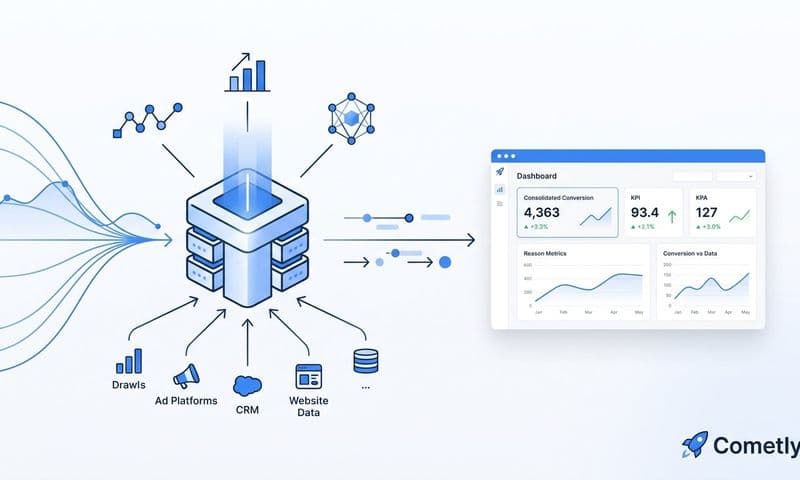
Multi-touch attribution to replace platform silos: Rather than trusting each platform's self-reported numbers, a unified multi-touch attribution model tracks the full customer journey across all touchpoints, from the first ad impression to the closed deal. This approach assigns credit based on actual contribution to the conversion rather than each platform's proprietary logic. You get a single, consistent view of how your channels work together, which makes budget allocation decisions dramatically more reliable. The data science for marketing attribution behind these models has matured significantly, making unified measurement more accessible than ever. Cometly connects your ad platforms, CRM, and website to track every touchpoint in real time, replacing the fragmented, self-serving reports from individual platforms with a unified picture of what's actually driving revenue.
Conversion syncing to align platform algorithms: Once you have accurate, verified conversion data from your unified attribution system, the next step is feeding that data back into your ad platforms. This process, often called conversion syncing, sends enriched conversion signals back to Meta, Google, TikTok, and other platforms so their algorithms can optimize based on real outcomes rather than incomplete or estimated signals. When Meta's algorithm receives accurate conversion data that reflects actual sales rather than modeled estimates, it makes better targeting and bidding decisions. This creates a direct performance improvement that compounds over time as the algorithms learn from higher-quality inputs.
The combination of these three elements, server-side tracking for data capture, multi-touch attribution for measurement, and conversion syncing for optimization, creates a closed loop where your data is accurate, consistent, and actively improving your campaign performance. Learning how to connect marketing data to revenue is what makes this infrastructure transformative rather than just informational.
A Practical Framework for Auditing Your Current Data
Before you can build a better measurement system, you need to understand exactly where your current setup is breaking down. Here's a structured approach to auditing your data and prioritizing fixes.
Start with a cross-platform conversion comparison: Pull conversion data from every platform you're running for the same 30-day period. Include Google Ads, Meta, any other paid channels, your analytics tool, and your CRM. Line them up in a single spreadsheet. The goal is to see the full scope of the discrepancy. If Google reports 400 conversions, Meta reports 320, and your CRM shows 210 closed deals, you now have a clear picture of the gap you're working with. This baseline is essential before you start changing anything. Following best practices for using data in marketing decisions starts with establishing this kind of honest baseline.
Trace each discrepancy back to a root cause: For each significant gap, work backward to identify whether it's caused by an attribution model difference, a tracking gap, or a tool configuration issue. Attribution model differences will show up as over-reporting across platforms (total platform conversions significantly exceeding CRM records). Tracking gaps will show up as under-reporting in specific tools. Configuration issues like time zone mismatches will show up as discrepancies in daily breakdowns that smooth out over longer periods.
Set up recurring reconciliation checkpoints: Create a weekly process where CRM-confirmed revenue is compared against platform-reported conversions. This doesn't need to be elaborate. A simple comparison of total conversions reported by each platform versus actual closed deals in your CRM, tracked week over week, gives you a consistent baseline for measuring whether your data accuracy is improving or degrading. This process also surfaces new discrepancies quickly before they compound into larger problems.
Prioritize fixes by revenue impact: Not every discrepancy deserves equal attention. Focus first on the channels with the largest spend and the biggest gaps between reported and actual conversions. If your Google Ads campaigns represent the majority of your budget and show a 40% discrepancy with CRM data, that's where fixing tracking will have the most immediate impact on your decision-making. Smaller channels with minor discrepancies can wait until the high-impact issues are resolved.
A systematic audit like this typically reveals that a small number of root causes are responsible for the majority of your data inconsistency. Fixing those core issues will resolve most of the problem without requiring a complete overhaul of your entire tech stack.
From Clean Data to Confident Scaling
Fixing inconsistent marketing data isn't the end goal. It's the foundation for something much more valuable: the ability to make fast, confident decisions about where to invest your budget next.
When your conversion data is accurate and unified, AI-powered tools can do what they're actually designed to do. Cometly's AI analyzes performance across every channel and identifies which ads and campaigns are genuinely driving revenue, not just which ones look good according to their own platform's reporting. These recommendations are only as reliable as the data behind them. Clean, consistent data transforms AI-driven insights from interesting suggestions into actionable intelligence you can act on immediately.
There's also a compounding performance benefit that flows back through your ad platforms. When Meta, Google, and other platforms receive accurate, enriched conversion signals, their algorithms improve their targeting and bidding over time. Better signals lead to better optimization, which leads to better results, which generates more accurate conversion data. This virtuous cycle is the opposite of what happens when bad data feeds platform algorithms. Instead of compounding waste, you're compounding efficiency. Embracing tools for data-driven marketing strategies accelerates this cycle significantly.
Perhaps most importantly, consistent data changes how your team operates. Instead of spending Monday mornings reconciling conflicting reports and defending your numbers in meetings, you're making forward-looking decisions about where to invest next. The shift from reactive reporting to proactive strategy is what separates marketing teams that scale confidently from those that stay stuck in the weeds of data management.
The Bottom Line
Inconsistent marketing data is not just a reporting annoyance. It's a strategic liability that affects every decision your team makes, from daily bid adjustments to quarterly budget planning. The root causes are structural: attribution model mismatches, privacy-driven tracking gaps, platform self-reporting bias, and fragmented tech stacks that were never designed to work together.
The path forward is clear. Audit your current setup to understand where the discrepancies originate. Implement server-side tracking to capture conversions that client-side pixels miss. Adopt a unified multi-touch attribution model that gives you an independent view of the full customer journey. Feed accurate conversion data back to your ad platforms so their algorithms can optimize based on real outcomes.
Each of these steps builds on the last, creating a measurement infrastructure that doesn't just reduce confusion but actively improves your campaign performance over time.
If your team is ready to stop debating which number to trust and start making decisions with confidence, Cometly can help. It connects your ad platforms, CRM, and website into a single source of truth, tracks every touchpoint from first click to closed deal, and uses AI to surface the insights that actually move the needle. Get your free demo today and see exactly which campaigns are driving your revenue.