If you've been running paid advertising since 2021, you already know the feeling. Campaigns that used to hum along efficiently started showing cracks. Retargeting audiences shrank. Reported conversions stopped matching actual revenue. Cost per acquisition crept upward, and no amount of creative testing seemed to fully explain why. The culprit, at least in large part, was a small permission prompt that Apple added to every iPhone and iPad in the world.
Apple's App Tracking Transparency framework, launched with iOS 14.5 in April 2021, didn't just tweak the rules of digital advertising. It rewrote them. And while the initial shock has faded, the structural impact on how ads are tracked, attributed, and optimized continues to shape every campaign you run today in 2026.
The good news is that effective advertising didn't die. What died was the ability to be passive about your data infrastructure. Marketers who treat iOS privacy changes as a one-time disruption to weather are still struggling. Marketers who adapted their tracking stack, embraced server-side solutions, and took ownership of their data are scaling with more clarity than ever. This guide breaks down exactly what changed, what it means for your campaigns right now, and the specific strategies that restore visibility and confidence in your numbers.
How Apple Rewrote the Rules of Ad Tracking
Before iOS 14.5, advertising platforms could access a device-level identifier called the IDFA, or Identifier for Advertisers. Think of it as a unique tag attached to every iPhone that allowed apps and ad networks to follow a user's behavior across different apps and websites. If someone clicked a Facebook ad, downloaded a game, made a purchase in a retail app, and then browsed a news site, all of those actions could be connected to a single device profile. That profile powered retargeting, lookalike audiences, and conversion attribution across the ecosystem.
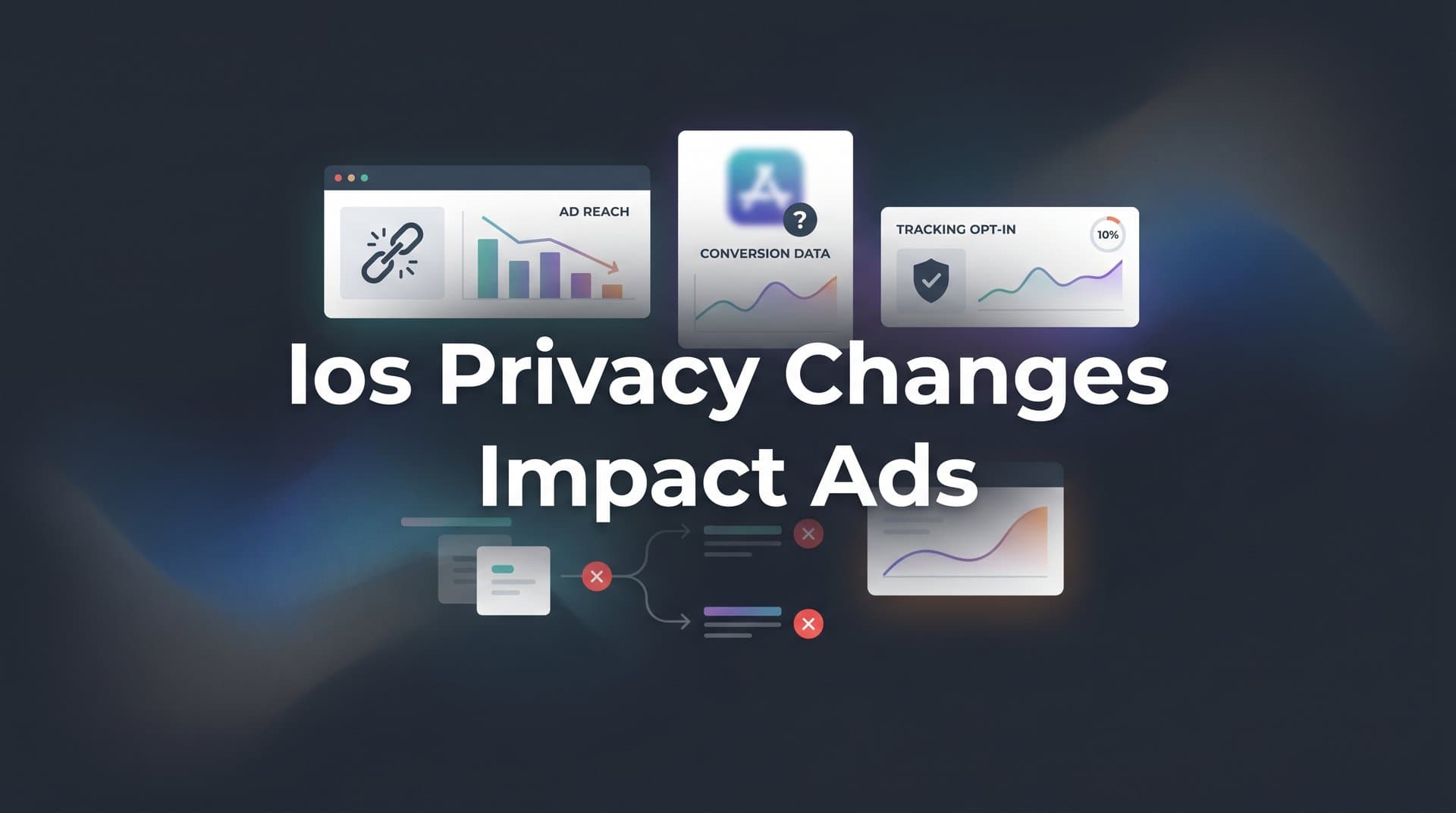
App Tracking Transparency changed one fundamental thing: apps now have to ask permission before accessing that identifier. The opt-in prompt is simple and direct, asking users whether they want to allow the app to track them across other companies' apps and websites. Industry observers have widely noted that the majority of users, when presented with this choice, decline. The result is that for a large portion of your iOS audience, the IDFA is effectively blank, and cross-app, cross-site tracking at the device level is gone.
Apple didn't stop there. The timeline of privacy tightening has continued steadily. SKAdNetwork, Apple's privacy-preserving attribution framework, has gone through multiple iterations and was rebranded as AdAttributionKit starting with iOS 17. It provides aggregated, delayed conversion data rather than user-level signals, which gives advertisers some attribution information but with significant limitations in granularity and reporting speed. Apple also introduced Mail Privacy Protection, which masks email open tracking, and iCloud Private Relay, which obscures IP addresses for Safari users, further reducing the fingerprinting signals that some advertisers had used as a workaround.
Here's the critical distinction that many marketers miss: Apple blocked device-level cross-app and cross-site tracking. It did not block everything. First-party data collected directly by a business from its own customers remains entirely valid. Server-side signals sent from your own infrastructure to ad platforms are still permitted and effective. The tracking methods that broke were the ones that relied on third-party identifiers and browser or app-level pixels to stitch together cross-platform user journeys without explicit consent. That distinction matters enormously for how you build your strategy going forward.
The Real-World Fallout for Paid Advertising
The scale of the disruption became impossible to ignore when Meta disclosed in its February 2022 earnings call that App Tracking Transparency was expected to cost the company approximately $10 billion in ad revenue for that year. That single figure, widely reported and attributed directly to Meta's financial disclosures, captured the magnitude of what happened. But the financial impact on the platform was just one dimension. The more immediate problem for advertisers was what it did to campaign performance.
Ad platform algorithms, particularly Meta's and Google's, are optimization engines. They learn from conversion signals: who clicked, who purchased, who became a high-value customer. When iOS privacy changes stripped away a significant portion of those signals from iPhone users, the algorithms were essentially flying with fewer instruments. The result was broader, less precise targeting, because the platforms had less data to identify who was actually likely to convert. Broader targeting typically means higher costs to reach the same quality of customer, and many advertisers found themselves watching ad performance decline after privacy changes took effect.
The attribution gap created a second, equally disorienting problem. Conversions were still happening. People were still buying. But because the platforms could no longer see or claim many of those conversions, campaign dashboards started showing results that looked dramatically worse than reality. A campaign that was actually driving strong revenue appeared to be underperforming based on reported ROAS. Marketers who trusted platform dashboards at face value started pulling budget from campaigns that were working, which compounded the problem.
Downstream effects rippled through every part of campaign management. Retargeting audiences, which had always been built from pixel-based website visitor data, shrank considerably because iOS users who declined tracking were no longer populating those pools. Lookalike audiences lost fidelity because the source audiences they were modeled on became smaller and less representative. The seed data that powered some of the most efficient prospecting campaigns was degraded.
Reporting discrepancies across platforms added another layer of confusion. Meta might report one conversion count, Google another, and your CRM a third, entirely different number. Each platform was modeling, estimating, and attributing based on the signals it could see, and none of them had the complete picture. Many marketers found themselves unable to answer a basic question with confidence: which campaigns are actually driving revenue?
Why Platform-Native Reporting No Longer Tells the Full Story
If you've ever compared your Meta Ads Manager conversions to your Google Ads conversions and noticed the numbers don't add up to what your CRM shows, you've experienced this problem firsthand. Each platform reports conversions based on the signals it can observe, and each uses its own methodology for handling the gaps that privacy restrictions created.
Meta uses modeled conversions, applying statistical modeling to estimate conversions it can no longer directly observe due to ATT opt-outs. Google uses its own data-driven attribution models. TikTok handles delayed attribution differently again. The result is that each platform's dashboard reflects a version of reality filtered through its own methodology, its own attribution window settings, and its own interest in demonstrating the value of its inventory. These are not neutral measurements.
The double-counting problem is particularly common and particularly misleading. A customer might click a Meta ad, later see a Google remarketing ad, and then convert through a direct visit. Meta claims the conversion. Google claims the conversion. Your CRM records one sale. When you add up platform-reported conversions across your channels, the total can be two or three times your actual revenue, making it genuinely difficult to understand where your money is best spent.
Under-counting is the opposite problem and often more dangerous. When conversions happen on iOS devices where tracking is restricted, platforms may not see them at all, or see them only partially through aggregated SKAdNetwork data. A campaign targeting iPhone users heavily might look like it's generating minimal return when it's actually driving meaningful revenue that simply isn't being reported back to the platform dashboard. This is the core challenge of lost conversion data from iOS privacy restrictions.
This is where independent, server-side attribution becomes essential. Rather than relying on each platform to tell you how well its own ads performed, server-side attribution collects data from your own infrastructure, your website, your CRM, your checkout system, and maps the full customer journey based on what actually happened. It acts as the neutral third party that reconciles what platforms report against what your business actually experienced. That reconciliation is the foundation of trustworthy marketing data.
Strategies That Actually Work in a Privacy-First World
Understanding the problem is half the battle. The other half is building the systems that solve it. There are three core strategies that consistently deliver results for marketers operating in today's privacy-constrained environment: server-side tracking, first-party data infrastructure, and multi-touch attribution.
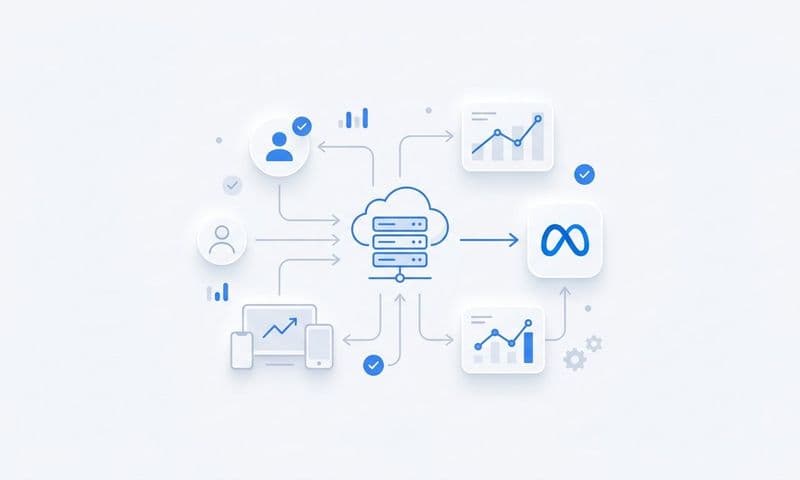
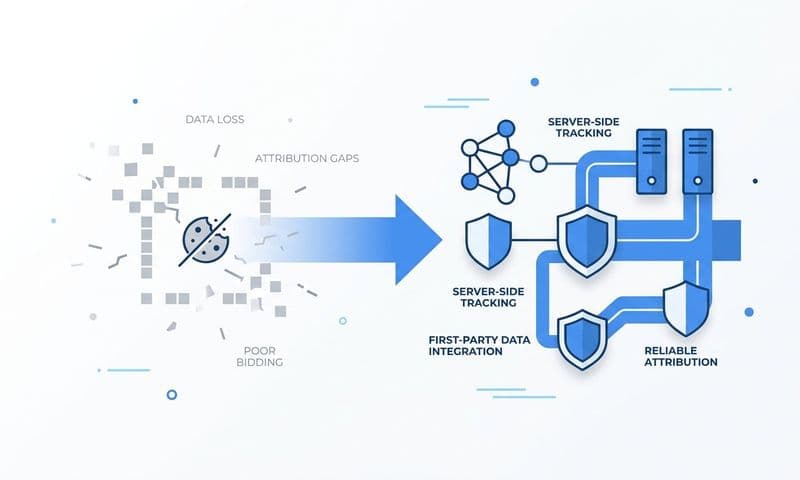
Server-Side Tracking and Conversions API: The most impactful technical shift available to advertisers right now is moving from browser-based pixels to server-side event tracking. Browser pixels fire from the user's device and are subject to browser restrictions, ad blockers, and iOS privacy controls. Server-side tracking fires from your own server, completely bypassing those limitations. The data travels directly from your infrastructure to the ad platform, delivering richer, more reliable conversion signals.
Meta's Conversions API, Google's Enhanced Conversions, and similar implementations from other platforms all operate on this principle. They are not workarounds or exploits. They are officially supported, privacy-compliant methods that Meta, Google, and industry experts actively recommend. When implemented correctly, they restore a significant portion of the conversion visibility that pixel-only setups lost after iOS 14.5. Many marketers who have made this transition report substantially better optimization performance, and you can learn more about how to improve Facebook Ads conversion tracking through these methods.
First-Party Data Strategies: If device-level identifiers are restricted, the answer is to build audiences from data you own. Email lists, CRM databases, customer purchase histories, and loyalty program data are all first-party assets that iOS changes cannot touch. Building custom audiences from hashed email lists, creating suppression lists from existing customers, and developing CRM-connected workflows for audience segmentation are all strategies that have become central to modern advertising.
The marketers who invested early in growing their email lists and connecting their CRMs to their ad platforms found themselves with a significant structural advantage after ATT. Their targeting didn't degrade the same way because it wasn't dependent on third-party identifiers. Building that owned audience infrastructure is not a short-term fix; it is a long-term competitive asset.
Multi-Touch Attribution: Last-click attribution was always an oversimplification, but in a world where some touchpoints are invisible to individual platforms, it became actively misleading. Multi-touch attribution maps the complete customer journey across every interaction, from the first ad impression to the final conversion, and distributes credit in a way that reflects how each touchpoint actually contributed. This approach restores visibility into the full funnel, helps you understand which channels are building awareness versus driving decisions, and gives you a much more accurate picture of where your budget is generating real returns.
Feeding Better Data Back to Ad Platform Algorithms
Here's a perspective shift that changes how you think about server-side tracking: it's not just about improving your own reporting. It's about making the ad platform algorithms work better for you.
Meta's algorithm, Google's Smart Bidding, and similar systems are fundamentally dependent on conversion signal quality. They use that data to identify patterns: what does a high-value customer look like? Which placements, audiences, and creative combinations generate the best outcomes? When iOS privacy changes reduced the volume and accuracy of conversion signals flowing back to these platforms, the algorithms lost the fuel they needed to optimize effectively. The result was degraded targeting precision across the board, which is why so many advertisers found themselves losing money on ads and unable to find winning campaigns.
When you implement server-side tracking and sync enriched conversion events back to Meta and Google, you are directly improving the quality of data those algorithms receive. You are sending more complete information about who converted, what they purchased, and what their value was. The algorithm uses that information to find more people like your best customers, bid more accurately for the placements most likely to convert, and avoid wasting budget on audiences that look good on paper but don't actually buy.
This is where a defensive response to privacy changes becomes an offensive competitive advantage. Most advertisers are still running pixel-only setups or have only partially implemented server-side solutions. Marketers who build complete, enriched conversion pipelines are feeding their ad platform AI significantly better data than their competitors. Over time, that data quality advantage compounds: better signals lead to better optimization, better optimization leads to better results, and better results justify higher investment and further refinement. Understanding how ad tracking tools can help you scale ads using accurate data is essential to capitalizing on this advantage.
Platforms like Cometly are built specifically for this dynamic. By capturing every touchpoint from ad clicks to CRM events, Cometly gives the AI a complete, enriched view of every customer journey. That data can then be synced back to Meta, Google, and other platforms as conversion-ready events, improving targeting, bidding, and overall ad ROI in a direct, measurable way.
Building a Tracking Stack That Lasts
The most important mindset shift for marketers in 2026 is this: stop treating ad platform pixels as your primary data infrastructure. They were always a borrowed convenience, and iOS privacy changes made that dependency expensive. The marketers who are scaling confidently now are the ones who took ownership of their data, built their own measurement layer, and use platform tools as distribution channels rather than sources of truth.
Here's a practical action checklist for building a durable tracking stack:
1. Audit your current tracking setup. Identify where you are still relying solely on browser pixels. Map every conversion event and determine whether it has a server-side equivalent sending data to your ad platforms. If your ad tracking broke after privacy changes, this audit is your essential first step.
2. Implement server-side solutions. Deploy Conversions API for Meta, Enhanced Conversions for Google, and equivalent implementations for any other platforms you use. Ensure your server-side events are enriched with customer data like hashed emails where available.
3. Adopt independent attribution. Connect your CRM and revenue data to an attribution platform that operates outside of any single ad platform's reporting. Use this as your source of truth for campaign performance decisions.
4. Build and maintain first-party data assets. Invest in email list growth, CRM hygiene, and audience segmentation so that your targeting capabilities are not dependent on third-party identifiers.
5. Continuously feed platforms better data. Treat conversion syncing as an ongoing process, not a one-time setup. Regularly review signal quality and ensure your enriched events are flowing correctly to each platform.
Privacy regulations will continue evolving. Google's approach to third-party cookies has shifted multiple times. Regulatory frameworks in different markets continue to develop. The specific technical implementations will change, but the underlying principle will not: owning your data infrastructure and maintaining independent measurement will always be more resilient than depending on any single platform's tracking. Understanding the full scope of ad attribution after privacy changes helps you build this foundation so you are not starting from scratch every time the landscape shifts again.
The Bottom Line for Modern Advertisers
iOS privacy changes did not kill effective advertising. They killed the passive approach to advertising data. The marketers who are winning in 2026 are not the ones who found a clever workaround. They are the ones who built better systems: server-side tracking that captures conversions accurately, independent attribution that tells the truth about which channels drive revenue, first-party data assets that don't depend on third-party identifiers, and conversion syncing pipelines that feed ad platform algorithms the quality signals they need to optimize.
The result is not just surviving the privacy-first era. It is operating with more confidence and clarity than was possible even before these changes, because the discipline required to adapt forces a level of measurement rigor that most advertisers never had before.
If you're ready to stop guessing and start knowing exactly which ads and channels are driving your revenue, Get your free demo of Cometly today. See how AI-driven attribution and server-side tracking can restore full visibility into your customer journey and give your campaigns the data foundation they need to scale.