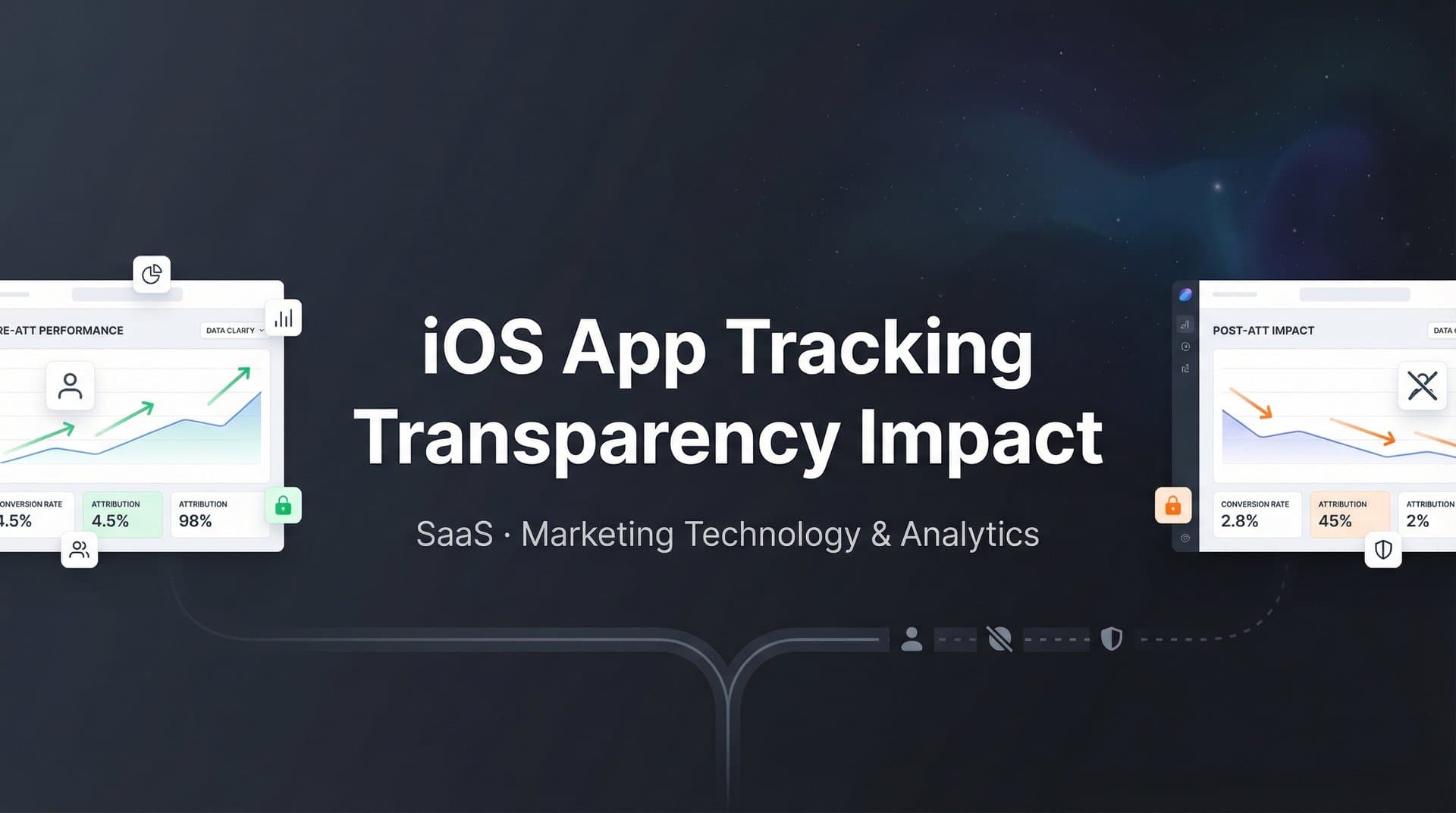
In April 2021, Apple flipped a switch that changed digital advertising forever. With the release of iOS 14.5, App Tracking Transparency (ATT) became mandatory—every app had to ask users for permission before tracking their activity across other companies' apps and websites. The result? Most users said no. Opt-in rates hovered around 15-25% globally, and suddenly the data that powered billions in ad spend simply vanished.
For marketers, the impact was immediate and brutal. Conversion tracking broke. Retargeting audiences shrank. Lookalike models lost their signal. Cost per acquisition climbed as algorithms struggled to optimize with incomplete data. What seemed like a privacy feature for consumers became an existential crisis for digital advertising.
Five years later, the ripple effects continue. Marketers still wrestle with attribution gaps, dark funnels, and ad platforms that can't see the full picture. But here's what's changed: the smartest marketers have adapted. They've rebuilt their measurement infrastructure around first-party data, server-side tracking, and privacy-compliant attribution methods that actually work.
This guide breaks down exactly what ATT does, how it continues to affect your campaigns, and the strategic shifts you need to make to thrive in this privacy-first landscape.
How Apple's Privacy Framework Actually Works
At the heart of ATT sits the IDFA—the Identifier for Advertisers. This unique device identifier allowed apps and advertisers to track user behavior across different apps and websites, building detailed profiles of interests, purchase intent, and conversion paths. Before ATT, this tracking happened automatically. Advertisers could follow a user from seeing an Instagram ad to browsing a retail app to making a purchase, connecting every touchpoint along the way.
When a user opts out of tracking (or simply doesn't opt in), apps lose access to that IDFA. The identifier becomes unavailable, and the cross-app tracking chain breaks. The app can still see what happens within its own environment, but it cannot connect that activity to behavior in other apps or attribute it to specific ad campaigns.
The opt-in prompt itself is deceptively simple. Users see a message explaining that the app wants to track their activity across other companies' apps and websites. Two buttons appear: "Ask App Not to Track" and "Allow." The framing matters—most users instinctively choose the first option. Industry data consistently shows opt-in rates between 15-25% globally, though rates vary by region and app category. Gaming apps tend to see slightly higher opt-in rates, while social media apps often see lower acceptance.
What data remains available? Apps can still track behavior within their own ecosystem. Facebook can see what you do on Facebook. Instagram knows what you engage with on Instagram. But they cannot automatically connect your Instagram activity to your behavior in a shopping app or attribute a purchase to an ad you saw three days ago—unless you opted in. Understanding these iOS privacy changes affecting tracking is essential for any modern marketer.
Apple also provides SKAdNetwork, a privacy-preserving attribution framework that allows some level of campaign measurement without exposing individual user data. But it comes with severe limitations: conversion data arrives delayed by 24-48 hours minimum, you can only pass 64 possible conversion values (severely limiting the detail you can track), and there's no view-through attribution. For marketers used to real-time, granular conversion tracking, SKAdNetwork feels like trying to navigate with a blindfold.
The framework also affects web tracking when users browse on Safari with iOS devices. Intelligent Tracking Prevention (ITP) works alongside ATT to limit third-party cookies and cross-site tracking, creating additional attribution challenges even outside of apps. Marketers should also be preparing for iOS17 Link Tracking Shield, which introduces even more restrictions.
This isn't just a technical change—it's a fundamental shift in how digital advertising infrastructure operates. The pipes that carried conversion data from apps back to ad platforms developed leaks, and marketers suddenly found themselves making optimization decisions with incomplete information.
The Cascading Effects on Paid Advertising Performance
The most immediate impact marketers noticed was the attribution gap. Conversions that definitely happened simply didn't appear in ad platform dashboards. A customer clicks your Facebook ad, downloads your app, makes a purchase—but if they opted out of tracking, Facebook never sees that conversion. Your Ads Manager shows zero return while your bank account shows real revenue.
We compare the leading options in our Facebook ads company roundup.
Some marketers report seeing only 40-60% of their actual conversions reflected in platform reporting. This creates what's known as the "dark funnel"—conversions happening in the shadows, invisible to the tools you use to measure performance. You're flying blind, making budget decisions based on incomplete data, potentially cutting campaigns that are actually profitable.
Meta publicly acknowledged this impact in their earnings calls, stating that ATT changes would cost them billions in advertising revenue. The problem wasn't just lost ad spend—it was the inability to prove value to advertisers who could no longer see clear ROI in their dashboards. The iOS tracking limitations on Facebook Ads have fundamentally changed how advertisers approach the platform.
For a deeper dive into this space, see our guide to Facebook ads companies.
Audience targeting took an equally severe hit. Lookalike audiences, once the gold standard for scaling campaigns, lost the signal quality that made them effective. When you can't track user behavior across apps, you can't build detailed profiles of your best customers. Your lookalike audience becomes based on incomplete data, resulting in broader, less precise targeting that drives up costs and reduces conversion rates.
Retargeting audiences shrank dramatically. You can't retarget users you can't identify. That sophisticated retargeting funnel you built—showing different ads based on specific pages viewed or actions taken—suddenly reaches a fraction of your previous audience. The users are still there, but you've lost the ability to recognize them across platforms.
Interest-based targeting suffered similar degradation. Ad platforms build interest categories by observing user behavior across multiple apps. When that cross-app tracking stops, the interest profiles become stale and less accurate. Your "interested in fitness equipment" audience becomes less reliable when the platform can't see recent app behavior indicating active purchase intent.
Perhaps the most insidious effect is on algorithm optimization. Modern ad platforms rely on machine learning algorithms that need conversion data to improve delivery. The algorithm learns which users are most likely to convert and automatically optimizes toward those patterns. When conversion data becomes sparse and delayed, the algorithm loses its ability to learn effectively.
This creates a vicious cycle: incomplete conversion data leads to poor optimization, which leads to higher costs per acquisition, which makes campaigns appear less profitable, which leads to reduced budgets, which provides even less data for the algorithm to learn from. Breaking this cycle requires fundamentally different approaches to data collection and attribution.
Marketers also noticed conversion events appearing 24-72 hours delayed in ad platforms. This lag makes real-time optimization nearly impossible. By the time you see that a campaign isn't converting, you've already spent days of budget on ineffective delivery.
The cumulative effect has been rising CPAs across most industries. When targeting becomes less precise and algorithms optimize with less data, you pay more to acquire each customer. For businesses with thin margins, this shift from profitable to unprofitable happened almost overnight.
Platform-Specific Responses and Limitations
Meta responded to ATT with two primary solutions: Aggregated Event Measurement and the Conversions API. Aggregated Event Measurement allows advertisers to configure up to eight conversion events per domain, prioritized by business importance. The platform uses statistical modeling to estimate conversions that can't be directly tracked, filling some of the attribution gap with probabilistic data.
The Conversions API provides a way to send conversion data directly from your server to Meta, bypassing browser-based tracking limitations. When a conversion happens on your website or in your CRM, your server sends that data to Meta via API. This server-to-server connection is more reliable than pixel-based tracking and isn't affected by browser privacy features or ad blockers.
But these solutions have limitations. Aggregated Event Measurement's statistical modeling is helpful but not perfectly accurate—it's making educated guesses about conversions it can't directly observe. The eight-event limit forces prioritization decisions that can leave important micro-conversions unmeasured. And the Conversions API requires technical implementation and proper server-side tracking infrastructure, which many smaller advertisers struggle to set up correctly. Exploring pixel tracking alternatives for iOS users has become a necessity for serious marketers.
Google has taken a different approach with Privacy Sandbox initiatives, attempting to balance privacy with advertising utility through technologies like Topics API and Protected Audience API. Rather than blocking tracking entirely, these frameworks aim to provide aggregated, privacy-preserving signals that still allow for relevant advertising and measurement.
Topics API categorizes browsing interests into broad topics rather than tracking individual behavior. Protected Audience API enables remarketing without cross-site tracking by running ad auctions locally on the user's device. These solutions are more advertiser-friendly than Apple's approach but still represent significant changes from the unrestricted tracking that existed before.
Google's challenge is different from Apple's—they're an advertising company trying to preserve their business model while responding to privacy concerns. Their solutions attempt to thread the needle between user privacy and advertising effectiveness, but they're still evolving and face regulatory scrutiny in multiple markets. The broader cookie deprecation impact on tracking affects marketers across all platforms.
If you're evaluating vendors, our cookie deprecation solutions breakdown can help.
Apple's SKAdNetwork deserves deeper examination because it's the official attribution solution for iOS app install campaigns. When a user installs an app after seeing an ad, SKAdNetwork can attribute that install to the campaign without exposing individual user data. The ad network receives an attribution notification with basic campaign information.
The limitations are significant. Conversion values are limited to 64 possible values (6 bits of data), forcing advertisers to map complex conversion events into simple numerical ranges. If you want to track both purchase value and user quality, you must compress that information into a single 0-63 value. Attribution windows are fixed, and postbacks are delayed and sent at random times within windows to prevent user identification.
There's no view-through attribution—only click-through conversions count. This undervalues upper-funnel campaigns that drive awareness and consideration without immediate clicks. And because the data is aggregated and delayed, you can't optimize campaigns in real-time based on individual user behavior.
For marketers used to granular, real-time attribution data, SKAdNetwork feels like a massive step backward. It provides just enough data to prove that advertising has some effect, but not enough to optimize effectively or understand true customer lifetime value at the campaign level. Proper mobile app attribution tracking requires supplementing SKAdNetwork with additional measurement approaches.
Server-Side Tracking: The Foundation of Modern Attribution
Browser-based tracking became unreliable not just because of ATT, but because of a convergence of privacy features across browsers and operating systems. Safari's Intelligent Tracking Prevention, Firefox's Enhanced Tracking Protection, and Chrome's planned privacy changes all limit third-party cookies and cross-site tracking. Pixels that fire in the browser can be blocked by privacy features, ad blockers, and user settings.
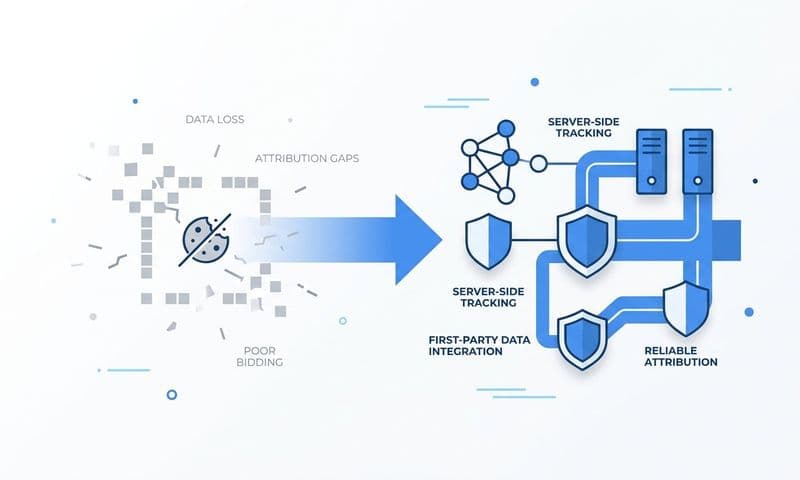
Server-side tracking solves this by moving data collection from the browser to your server. When a conversion happens—a purchase, a form submission, a qualified lead—your server captures that event and sends it directly to ad platforms via their APIs. This server-to-server connection bypasses browser limitations entirely.
The data flow works like this: A user clicks your ad and arrives at your website. Your website tracks their session server-side, not just with browser cookies. When they convert, your server knows exactly what happened and sends that conversion data to Meta, Google, or other platforms through their respective APIs. The ad platform receives accurate conversion data regardless of browser privacy settings or tracking opt-outs. Choosing the best server-side tracking platform is critical for implementing this approach correctly.
This approach provides more accurate conversion signals because it's based on actual server events, not pixel fires that may or may not succeed. If someone makes a purchase, your server definitively knows it happened. There's no question about whether a pixel loaded or whether a cookie was blocked.
Server-side tracking also enables you to send enriched conversion data back to ad platforms. You're not limited to "conversion happened"—you can include purchase value, product categories, customer lifetime value predictions, and other signals that help algorithms optimize more effectively. This enriched data feeds the machine learning models that determine ad delivery, improving their ability to find high-value customers.
The importance of feeding better data to ad platform algorithms cannot be overstated. These algorithms are only as good as the data they receive. When you send comprehensive, accurate conversion data through server-side methods, you give the algorithm better training data. It learns more accurately which users convert and at what value, leading to more efficient ad delivery and lower acquisition costs. You can review server-side tracking tools compared to find the right solution for your needs.
Implementation requires technical setup. You need server-side tracking infrastructure that captures conversion events, a way to connect those events back to the original ad click (typically through click IDs passed in URL parameters), and proper API integration with each ad platform. Many marketers use tag management systems with server-side capabilities or dedicated attribution platforms that handle this complexity.
The shift to server-side tracking represents a fundamental change in how marketing measurement works. Instead of relying on third-party tracking that users can block, you're building first-party data infrastructure that you control. This approach is more privacy-compliant (you're tracking behavior on your own properties with proper consent) and more reliable in the face of ongoing privacy changes.
Building an ATT-Resilient Marketing Measurement Strategy
Multi-touch attribution becomes essential when individual touchpoints become harder to track. Rather than relying on last-click attribution or platform-reported conversions, you need systems that connect all touchpoints across the customer journey—from initial ad impression through multiple interactions to final conversion and beyond.
This requires capturing data at every stage: ad clicks, website visits, content engagement, email opens, demo requests, sales conversations, and closed revenue. When you connect these touchpoints, you can see the full path to conversion even when individual platforms can't track it themselves. You might discover that Facebook ads drive initial awareness, Google search captures consideration, and LinkedIn retargeting closes the deal—insights that no single platform can provide. Implementing customer journey tracking tools helps visualize these complex paths.
The technical challenge is identity resolution: connecting anonymous ad clicks to known users in your CRM. This typically involves passing click IDs through your marketing funnel, storing them in cookies or local storage, and matching them to user records when someone identifies themselves through form submissions or account creation.
CRM integration is the linchpin of modern attribution. Your CRM contains the ultimate truth about what happened—which leads converted, which deals closed, which customers generated revenue. When you connect this CRM data back to marketing touchpoints, you can measure true marketing contribution, not just platform-reported conversions that miss significant portions of the funnel.
This integration allows you to track the complete journey from ad click to closed revenue. You can see which campaigns generated qualified leads, which channels influenced deals, and which marketing touchpoints correlate with higher customer lifetime value. This level of insight is impossible when you rely solely on ad platform dashboards that only see their own slice of the journey. The right attribution tracking tools make this integration seamless.
AI-powered analysis becomes valuable when traditional metrics are unreliable. Machine learning models can identify patterns in your attribution data that aren't obvious from basic reporting. Which campaign combinations work best together? Which audiences show higher intent signals? Which creative approaches correlate with faster sales cycles?
These AI systems can also provide recommendations based on your complete data set. Rather than manually analyzing attribution reports, the AI surfaces insights like "campaigns targeting this audience segment show 40% higher conversion rates" or "ads with these characteristics generate more qualified leads." This helps you make optimization decisions even when individual platform metrics are incomplete.
The mindset shift is crucial: move from tracking individuals to measuring outcomes. You don't need to follow every user across every app to understand what's working. You need accurate measurement of what happens on your own properties, proper attribution of conversions back to marketing sources, and the ability to feed quality data back to ad platforms for optimization. Understanding how to fix iOS 14 tracking issues is the first step toward building this resilient infrastructure.
This approach is actually more privacy-compliant than the old tracking methods. You're focusing on first-party data (behavior on your own websites and apps with proper consent), using server-side methods that you control, and not relying on invasive cross-site tracking. You can measure effectively while respecting user privacy.
Putting It All Together: Thriving in a Privacy-First Landscape
The fundamental shift is from tracking individuals across the internet to building robust data infrastructure that captures what matters: conversions on your properties and the marketing touchpoints that drive them. This isn't about finding workarounds to privacy features. It's about building measurement systems that work within privacy boundaries while providing the insights you need.
Accurate attribution is still possible—it just requires different tools and approaches. Server-side tracking provides reliable conversion data. Multi-touch attribution connects the customer journey. CRM integration reveals true marketing contribution. AI-powered analysis surfaces optimization opportunities. These components work together to restore visibility into campaign performance even when traditional tracking methods fail.
The marketers who thrive in this landscape are those who invested in proper measurement infrastructure. They're not waiting for ad platforms to solve attribution problems. They're taking control of their own data collection, building first-party data assets, and using attribution platforms that connect all the pieces together.
This approach delivers competitive advantages beyond just fixing attribution. You own your customer data. You understand the complete customer journey. You can make optimization decisions based on actual revenue, not platform-reported conversions that miss half the picture. You feed better data to ad algorithms, improving their performance. And you build measurement systems that remain resilient as privacy regulations continue to evolve.
The privacy-first landscape isn't going away. If anything, privacy features will become more restrictive as regulations expand and user expectations shift. The measurement infrastructure you build today needs to work not just now, but through whatever privacy changes come next.
Ready to elevate your marketing game with precision and confidence? Discover how Cometly's AI-driven recommendations can transform your ad strategy—Get your free demo today and start capturing every touchpoint to maximize your conversions.