

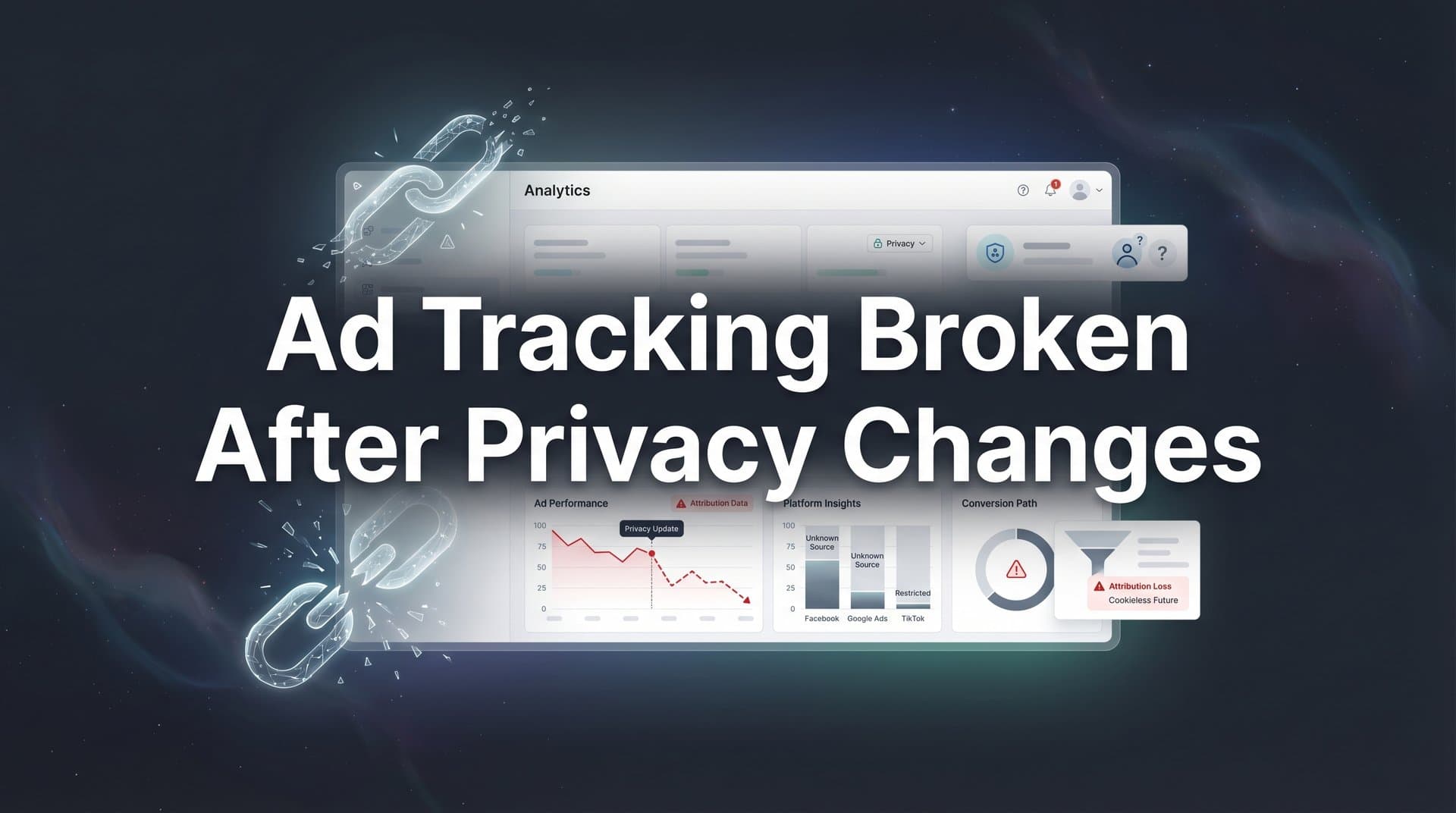
You launch a campaign. The numbers look promising at first. Then you check your analytics platform, and the conversion count doesn't match what Facebook is reporting. Google Ads shows different numbers entirely. Your CRM tells yet another story. You're spending real money, but you have no idea which ads are actually working.
This isn't a technical glitch you can refresh away. It's the new reality of digital advertising after privacy changes fundamentally rewired how tracking works. Between iOS 14.5, cookie deprecation, and browser privacy features, the data flow that powered attribution for years has been permanently disrupted.
The frustrating part? Most marketers know something broke. They just don't know exactly what happened or how to fix it. This article breaks down the technical changes in plain language, explains where your tracking actually fails, and shows you practical paths to restore visibility into what drives revenue.
The Privacy Shift That Rewrote Digital Advertising Rules
April 2021 marked a turning point. Apple released iOS 14.5 with App Tracking Transparency, requiring apps to ask explicit permission before tracking users across other apps and websites. The impact was immediate and severe. Most users, when presented with a prompt asking "Allow this app to track your activity?", chose no.
This wasn't the first privacy restriction, and it wouldn't be the last. Safari had already deployed Intelligent Tracking Prevention in 2017, progressively limiting cookie lifespans and blocking cross-site tracking. Firefox followed with Enhanced Tracking Protection. Then Google announced plans to phase out third-party cookies in Chrome entirely, though the timeline has shifted multiple times as the industry scrambles to adapt.
Here's what actually changed at the technical level. Before these updates, when someone clicked your ad and later converted on your website, the tracking pixel could follow that journey across devices and sessions. A cookie placed in the user's browser connected the initial ad click to the final purchase, even if days passed between the two events.
Privacy changes broke this connection. Safari and Firefox now automatically delete or restrict cookies from third-party domains. iOS requires explicit permission to track users across apps. Browser features actively block tracking scripts from loading. The seven-day attribution window you relied on? Now it might be 24 hours, or the tracking might not work at all.
The gap between what ad platforms used to see versus what they can access now is staggering. Facebook previously tracked users across apps, websites, and devices to build comprehensive profiles of behavior and intent. Now, when users opt out of tracking on iOS, Facebook loses visibility into a significant portion of mobile activity. The platform can still show ads, but it cannot confirm whether those ads led to conversions.
Google faces similar constraints. Third-party cookies enabled cross-site tracking that connected ad clicks to conversions across different domains. As browsers restrict these cookies, that connection weakens. The Chrome cookie phase-out will eliminate this tracking method entirely for the world's most popular browser.
These aren't temporary bugs or settings you can adjust. Privacy restrictions are built into operating systems and browsers at the core level. Apple, Mozilla, and Google have made clear commitments to user privacy that will only tighten over time. The tracking infrastructure that powered digital advertising for the past decade is fundamentally incompatible with this new privacy-first environment.
Where Your Tracking Actually Breaks Down
Let's get specific about where the failures happen. Client-side pixels, the JavaScript tracking codes you install on your website, depend on browser cooperation. When a user visits your site, the pixel fires, sets a cookie, and reports the event to the ad platform. This process now fails at multiple points.
First, browsers block or delete the cookies your pixels need. Safari's Intelligent Tracking Prevention caps cookie lifespans at seven days for first-party cookies and blocks third-party cookies entirely. If someone clicks your ad, browses your site, then returns nine days later to purchase, Safari has already deleted the cookie that would connect those events. Your tracking shows a direct visit conversion when it was actually an ad-driven sale.
Cross-domain tracking compounds the problem. If your ad sends users to a landing page on one domain, then they complete checkout on another domain, the cookie doesn't transfer. Each domain operates in isolation. Your tracking sees two separate users instead of one complete journey.
The iOS reality is even more restrictive. App Tracking Transparency requires explicit opt-in before any cross-app or cross-site tracking occurs. Industry observations suggest that opt-in rates remain low. When users decline tracking, apps lose the ability to share the Identifier for Advertisers, the unique ID that previously connected ad exposure to app installs and in-app events.
Apple introduced SKAdNetwork as a privacy-preserving alternative, but it operates under severe constraints. The data is aggregated rather than user-level. Attribution happens on the device, then gets reported to ad networks with a delay of 24 to 48 hours. You receive conversion counts without detailed user information. Campaign IDs are limited to 100 values, forcing you to sacrifice granular campaign tracking. Understanding tracking pixel limitations after privacy updates is essential for adapting your strategy.
This explains why your Facebook and Google dashboards now show numbers that don't align with reality. When tracking fails, ad platforms use statistical modeling to estimate conversions they cannot directly measure. Facebook's modeled conversions fill in gaps where iOS restrictions prevent direct attribution. Google uses similar estimation techniques for Chrome users who have disabled third-party cookies.
The problem? Modeled data is inherently less accurate than direct measurement. Platforms might inflate numbers by attributing conversions that would have happened anyway. Or they might deflate numbers by missing conversions they cannot track. You're making budget decisions based on estimates rather than facts.
Attribution windows have collapsed across the board. Facebook reduced its default window from seven days to one day for iOS users. Google's cookie-based tracking degrades as browser restrictions tighten. If your customer journey typically spans multiple days or sessions, a significant portion of your conversions now appear as direct traffic or organic instead of paid ads.
The Real Cost of Flying Blind on Campaign Data
Incomplete tracking creates a cascade of problems that extend far beyond reporting discrepancies. When you cannot see which channels actually drive conversions, you inevitably misallocate budget. Campaigns that appear to underperform might be your strongest revenue drivers, but tracking gaps hide their true impact.
Think about what happens when your attribution shows that Facebook drives 50 conversions this month, but your actual sales data reveals 80 purchases from new customers who first discovered you through ads. You're seeing 63% of reality. That missing 37% might lead you to cut budget from a profitable campaign because the numbers look weak.
The inverse happens too. A campaign might show strong conversion numbers in the ad platform dashboard, driven by modeled data and statistical estimates. You scale budget aggressively based on those promising metrics. Then you discover that actual revenue didn't increase proportionally. The platform overcounted conversions that would have happened organically, and you scaled a campaign with lower true ROI than reported.
Budget misallocation is just the surface problem. The deeper issue is algorithmic degradation. Ad platforms use machine learning to optimize targeting and bidding. These algorithms need accurate, timely conversion data to learn which audiences and placements perform best. When conversion tracking is broken after privacy updates, the algorithms cannot optimize effectively.
Facebook's algorithm, for example, needs to see at least 50 conversions per week per ad set to exit the learning phase and optimize reliably. If tracking gaps mean the algorithm only sees 30 of the 50 actual conversions, it stays in learning mode longer or optimizes toward the wrong signals. Your campaign performance degrades not because the targeting is wrong, but because the algorithm is working with incomplete information.
This creates a compounding feedback loop. Incomplete data leads to poor algorithmic optimization. Poor optimization leads to worse campaign performance. Worse performance generates fewer conversions. Fewer conversions mean even less data for the algorithm to learn from. The cycle continues until campaign performance deteriorates to the point where scaling becomes impossible.
Attribution gaps also lead to scaling the wrong campaigns while cutting winners. Your top-of-funnel awareness campaigns might drive significant traffic and brand discovery, but if tracking cannot connect those early touchpoints to eventual conversions, the campaigns appear to have zero ROI. You cut budget from awareness, focusing spend on bottom-funnel retargeting that shows clear last-click attribution. Your overall conversion volume drops because you eliminated the campaigns that filled the top of your funnel.
Server-Side Tracking: The Foundation for Accurate Data
Server-side tracking fundamentally changes where and how conversion data gets collected. Instead of relying on browser-based pixels that execute JavaScript and set cookies, server-side tracking sends conversion data directly from your server to ad platforms. This architectural shift bypasses the browser restrictions that break client-side tracking.
Here's how it works in practice. When a user completes a conversion on your website, your server captures that event along with relevant data like purchase amount, product details, and customer information. Your server then sends this data directly to the ad platform's API. No browser cookies required. No JavaScript execution that can be blocked. The data flows from your infrastructure to the ad platform through a direct server-to-server connection.
This approach survives privacy restrictions because it doesn't rely on third-party cookies or cross-site tracking. You're collecting first-party data from your own properties with user consent, then sharing it with ad platforms through official APIs. Safari cannot block your server from making an API call. iOS restrictions don't apply to server-side data transmission. Browser privacy features that target client-side tracking have no impact on server-to-server communication.
The difference between first-party data tracking for ads and third-party data collection is crucial here. First-party data comes directly from your relationship with customers. They visit your website, create an account, make a purchase. You collect this data on your own domain with appropriate consent. This data remains accessible and usable regardless of browser restrictions.
Third-party cookies, by contrast, are set by domains other than the one the user is visiting. An ad platform pixel on your site sets a cookie from the ad platform's domain. Browsers classify this as third-party tracking and increasingly block it. Server-side tracking eliminates the need for third-party cookies by using first-party data collection combined with server-side transmission.
Server-side solutions also maintain tracking accuracy as privacy restrictions tighten. When Google completes the Chrome cookie phase-out, client-side pixels will lose functionality across all major browsers. Server-side tracking will continue working because it operates independently of browser cookie policies. As privacy regulations evolve and new restrictions emerge, server-side infrastructure adapts more easily than client-side pixels that depend on browser cooperation.
Feeding Better Data Back to Ad Platforms
Collecting accurate data is only half the solution. You need to send that data back to ad platforms in a format their algorithms can use for optimization. This is where conversion APIs become essential. Meta's Conversions API and Google's Enhanced Conversions are the primary tools for transmitting server-side data to major ad platforms.
Meta's Conversions API works by accepting conversion events directly from your server. When someone makes a purchase, your server sends the conversion details to Facebook through the API. This includes the conversion value, timestamp, and customer information that helps Facebook match the conversion to the correct user. Facebook then attributes the conversion to the appropriate ad campaign and feeds this data into its optimization algorithms.
The matching process uses multiple data points to connect conversions to users. Email addresses, phone numbers, and other customer information get hashed before transmission for privacy protection. Facebook compares these hashed identifiers against its user database to determine which ad exposure led to the conversion. This matching works even when browser tracking fails because it relies on customer data you collected directly rather than cookies.
Google's Enhanced Conversions follows a similar approach. You send conversion data from your server to Google Ads, including hashed customer information. Google uses this data to improve conversion measurement and attribution accuracy. The enhanced data helps Google's algorithms understand which keywords, ads, and audiences drive results, enabling better optimization even when third-party cookies are unavailable.
The role of enriched conversion data in improving ad platform algorithm performance cannot be overstated. When platforms receive complete, accurate conversion information through APIs, their machine learning models can optimize more effectively. They learn which audience segments convert at higher rates. They identify which creative elements drive action. They adjust bidding strategies based on true conversion patterns rather than incomplete browser-based data.
Connecting your CRM and website data creates a complete customer journey picture. Someone might click an ad on mobile, browse your site on desktop, then call your sales team to complete a purchase. Client-side tracking sees three disconnected events. Implementing privacy compliant tracking solutions combined with CRM integration connects all three touchpoints to one customer journey.
This unified view reveals attribution insights that would otherwise remain hidden. You discover that most customers interact with multiple channels before converting. You identify which combinations of touchpoints drive the highest lifetime value. You understand the true impact of each marketing channel within the broader customer journey rather than relying on last-click attribution that credits only the final interaction.
Building a Privacy-Resilient Attribution Strategy
Moving from platform-reported metrics to unified, first-party attribution requires a fundamental shift in how you measure marketing performance. Ad platform dashboards will always show you their perspective on attribution, crediting their own channels for conversions. A privacy-resilient strategy means building your own source of truth that tracks the complete customer journey across all touchpoints.
This starts with implementing a unified attribution system that collects data from all your marketing channels in one place. Your paid ads, organic search, email campaigns, social media, and direct traffic all feed into a single platform that tracks how these channels work together. You stop asking "How many conversions did Facebook drive?" and start asking "What role did Facebook play in the journeys that led to conversions?"
Multi-touch attribution provides the framework for understanding the full path to conversion. Instead of crediting only the last click before purchase, multi-touch models assign value to every touchpoint in the customer journey. Someone might discover your brand through a Facebook ad, research on Google, read your email newsletter, then return directly to purchase. Multi-touch attribution shows you that all four touchpoints contributed to the conversion. Following attribution tracking best practices ensures you capture these insights accurately.
Different attribution models serve different purposes. First-touch attribution shows which channels drive initial awareness. Last-touch reveals what closes deals. Linear attribution distributes credit evenly across all touchpoints. Time-decay models give more weight to interactions closer to conversion. The key is having the flexibility to analyze your data through multiple lenses rather than being locked into a single platform's attribution methodology.
Practical steps to audit your current tracking setup start with testing the complete user journey. Click your own ads from different devices and browsers. Disable third-party cookies. Opt out of tracking on iOS. Then check whether your analytics platform correctly attributes these test conversions. You'll likely discover gaps where tracking fails under privacy restrictions.
Identify specific failure points. Does cross-domain tracking work when users move from your landing page to your checkout domain? Can you track conversions that happen days after the initial ad click? Do you capture mobile app installs and in-app events accurately? Does your CRM data sync with your marketing analytics? Each gap represents lost attribution visibility and optimization opportunity. If you're struggling with these issues, learning how to fix broken conversion tracking should be your priority.
Compare conversion counts across platforms to spot discrepancies. Your ad platform dashboards, Google Analytics, and internal sales data should tell roughly the same story about conversion volume. Significant differences indicate tracking problems. If Facebook reports 100 conversions but your actual sales records show 150 purchases from new customers, you have a 33% attribution gap that's likely causing budget misallocation.
Building a privacy-resilient strategy also means preparing for future restrictions. Privacy regulations will continue evolving. Browser tracking will become more limited. The solutions you implement now should work regardless of how browser policies change. Server-side tracking, first-party data collection, and unified attribution platforms provide this future-proof foundation.
Moving Forward with Confidence
Privacy changes are permanent, not temporary disruptions. Browser restrictions will tighten further. New regulations will emerge. The tracking methods that worked five years ago will never return. Marketers who treat this as a temporary inconvenience to work around will fall further behind as restrictions intensify.
The competitive advantage goes to marketers who adapt their tracking infrastructure now. While others struggle with incomplete data and degraded campaign performance, you'll have clear visibility into what actually drives revenue. Your ad platform algorithms will optimize based on complete conversion data. Your budget allocation will reflect true performance rather than tracking gaps.
This isn't about finding clever workarounds to privacy restrictions. It's about building a measurement strategy that respects user privacy while maintaining the data accuracy you need to run profitable campaigns. Server-side tracking, conversion APIs, and unified attribution provide this balance. They work within privacy frameworks while delivering the insights that power growth.
The path forward starts with evaluating your current attribution accuracy. Run the audit tests outlined earlier. Identify where your tracking breaks down. Quantify the gap between what you can measure and what's actually happening. This assessment reveals the true cost of incomplete data and builds the case for investing in better infrastructure.
Ready to elevate your marketing game with precision and confidence? Discover how Cometly's AI-driven recommendations can transform your ad strategy. Get your free demo today and start capturing every touchpoint to maximize your conversions.



