You log into your ad dashboard on a Monday morning, coffee in hand, ready to review last week's performance. The numbers look rough. Meta is reporting a fraction of the conversions you expected, your cost-per-acquisition appears to have doubled, and campaigns that were printing money three months ago now look like they're bleeding budget. But here's the strange part: your CRM tells a completely different story. Revenue is holding steady. Leads are coming in. Something doesn't add up.
This is one of the most common and frustrating experiences marketers face today, and it's not a platform glitch or a targeting problem. It's the downstream effect of Apple's privacy changes, which have fundamentally altered how user data flows between apps, browsers, and ad platforms. The gap between what your ad dashboard reports and what's actually happening in your business is real, and it's growing.
The root causes span two major Apple initiatives: the App Tracking Transparency (ATT) framework, which requires apps to ask permission before tracking users across other apps and websites, and Safari's Intelligent Tracking Prevention (ITP), which aggressively limits cookies and blocks third-party tracking on the web. Together, these changes have broken the traditional tracking infrastructure that digital advertising was built on. This guide breaks down exactly what changed, why it matters, and what you can do to build a tracking and attribution setup that actually works in today's privacy-first environment.
How Apple's Privacy Updates Reshaped Digital Advertising
To understand the problem, you need to understand the timeline. Apple didn't flip a single switch overnight. These changes have been building for years, and each update has tightened the screws a little further.
App Tracking Transparency arrived with iOS 14.5 in April 2021. Before ATT, apps could track user behavior across other apps and websites using Apple's Identifier for Advertisers (IDFA) without asking permission. ATT changed that by requiring every app to display a prompt asking users to opt in to cross-app tracking. The result was predictable: the majority of iOS users, when explicitly asked, chose not to be tracked. This single change severed the connection between ad exposures and conversions for a massive portion of mobile traffic. For a deeper look at this pivotal shift, read about how iOS 14 changed digital advertising forever.
On the web side, Safari's Intelligent Tracking Prevention has been evolving since 2017, but its current form is particularly restrictive. ITP blocks all third-party cookies by default and limits the lifespan of first-party cookies to as little as seven days, or in some cases just 24 hours for cookies set via JavaScript. For marketers, this means that a user who clicks an ad on Monday and converts the following week may not be attributed back to that original click at all. The attribution window that ad platforms depend on simply doesn't exist anymore for Safari users.
Apple also introduced SKAdNetwork as a privacy-preserving attribution framework for mobile, later evolving it into AdAttributionKit in 2023. In theory, this gives advertisers a way to measure campaign performance without accessing user-level data. In practice, it comes with significant constraints. Reporting is aggregated rather than individual, delayed by up to 24 to 48 hours, and limited in the number of campaign IDs it can support. You lose the granularity needed to make confident optimization decisions. You can see that a campaign drove some conversions, but the detail required to understand which creative, audience, or placement was responsible is largely gone.
The cumulative effect of ATT, ITP, and SKAdNetwork's limitations is a fundamentally different data environment. The tracking infrastructure that powered performance advertising for the better part of a decade was built on assumptions about cookie persistence, device identifiers, and cross-site tracking that Apple has systematically dismantled. Every marketer running paid campaigns needs to understand this shift at a mechanical level, because the strategies that follow only make sense once you understand why the old approach broke.
The Real-World Impact on Campaign Performance and Reporting
Here's where the iOS tracking challenges for marketers move from technical problem to business problem. When conversion signals are lost, every platform that depends on those signals starts making worse decisions, and so do you.
The most immediate effect is underreporting. Meta, Google, TikTok, Snapchat, and virtually every other ad platform rely on pixel-based tracking to count conversions. When a user opts out of ATT or browses in Safari with ITP active, those pixels can't fire properly. The platform doesn't see the conversion. It reports a lower number than what actually happened. Marketers commonly report seeing significant discrepancies between the conversions their ad platforms claim credit for and the actual leads or purchases recorded in their CRM, with the gap being most pronounced on iOS traffic. Understanding tracking paid ads after the iOS update is essential for quantifying this gap.
This underreporting creates a dangerous illusion. Your campaigns look less effective than they are. Your reported cost-per-acquisition climbs. Return on ad spend appears to fall. If you're making budget decisions based on platform-reported data alone, you will cut spend on channels that are actually driving real revenue. This isn't a hypothetical risk. It's a pattern playing out across marketing teams right now.
The damage doesn't stop at reporting. Ad platforms use conversion signals to power their machine learning algorithms. When Meta's algorithm doesn't see enough conversions, it can't properly optimize your campaigns toward the people most likely to convert. Lookalike audiences, which are built from the profiles of people who have converted, become less accurate because the conversion pool is incomplete. Retargeting audiences shrink because fewer users can be identified and matched. The algorithm is essentially flying with instruments that are only partially working.
Meta publicly acknowledged the scale of this problem. During their Q4 2021 earnings call, CFO Dave Wehner stated that ATT changes were expected to cost the company an estimated $10 billion in ad revenue in 2022. That figure reflects advertiser loss of confidence in the platform's ability to measure and optimize effectively, not just a technical hiccup.
The downstream effects compound over time. Degraded optimization leads to higher costs. Higher costs lead to reduced budgets. Reduced budgets lead to less data for the algorithm to learn from. It's a cycle that marketers need to interrupt by fixing the data problem at its source rather than simply adjusting bids or shifting budgets based on inaccurate numbers.
Why Traditional Tracking Methods No Longer Work
If you're still relying primarily on the Meta Pixel, Google Tag, or UTM parameters to measure your campaigns, you're working with an incomplete picture. These tools were built for a different era, and understanding their limitations is the first step toward replacing them with something more resilient.
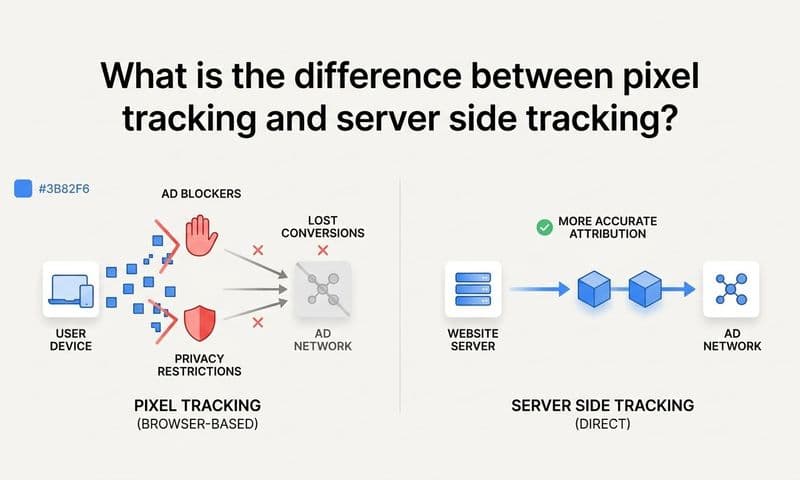
Client-side tracking, which is what pixels and browser-based tags use, works by loading JavaScript in a user's browser and sending data to an ad platform when a specific action occurs. The fundamental vulnerability here is that it depends entirely on the browser cooperating. Safari with ITP actively restricts what that JavaScript can do and how long the cookies it sets will persist. Users who have opted out of ATT on iOS block the tracking signals that would link their app behavior to ad exposures. Ad blockers, which are increasingly common, prevent the pixel from loading at all. Client-side tracking is structurally exposed to every privacy control Apple has introduced.
UTM parameters and last-click attribution models have a different but equally serious problem. They can only credit the last touchpoint a user interacted with before converting, and they completely miss conversions where the tracking link was never clicked or where the user switched devices. To better understand this limitation, explore what UTMs are and how marketers use them for campaigns.
Many marketers have a false sense of security because they're using platform-native tools. "I have the Meta Pixel installed and the Google Tag set up, so I'm covered." But these tools face exactly the same iOS restrictions as any other client-side tracker. Installing them correctly is necessary but not sufficient. They cannot, on their own, bridge the gap created by ATT opt-outs and ITP cookie limitations. Dedicated conversion tracking platforms can help fill in the blind spots that native tools leave behind.
The honest reality is that the tools most marketers are still using as their primary measurement layer were designed before these privacy changes existed. They haven't fundamentally changed. The environment they operate in has. That mismatch is the core of the iOS tracking challenge, and it requires a different technical approach to solve.
Server-Side Tracking: The Foundation for Accurate Data
Server-side tracking is the most important technical shift you can make to address iOS tracking challenges for marketers. Understanding how it differs from client-side tracking makes it clear why it works where pixels fail.
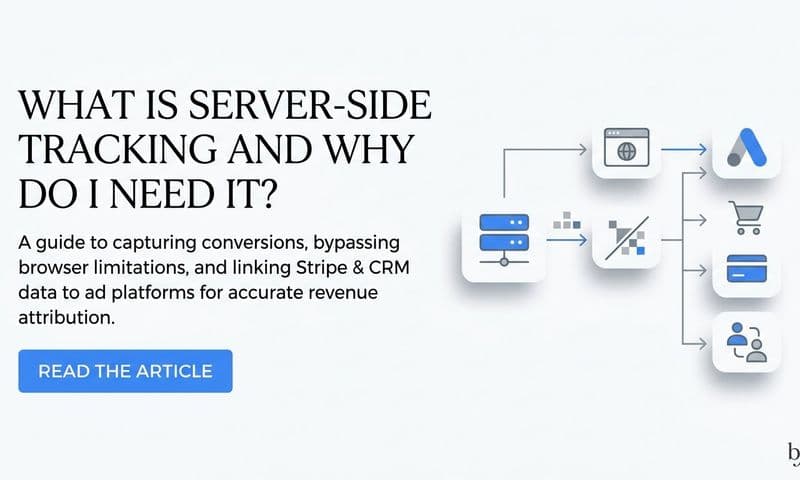
With client-side tracking, the conversion event is detected and reported by code running in the user's browser. With server-side tracking, the conversion event is detected by your own server and reported directly to the ad platform's API. The user's browser is no longer in the middle of that transaction. Apple's restrictions on what Safari can do with cookies don't apply to a server-to-server data transfer. ATT opt-outs don't block a signal that was never sent through the device in the first place. Learn more about what server-side tracking for ads entails and why it's become essential.
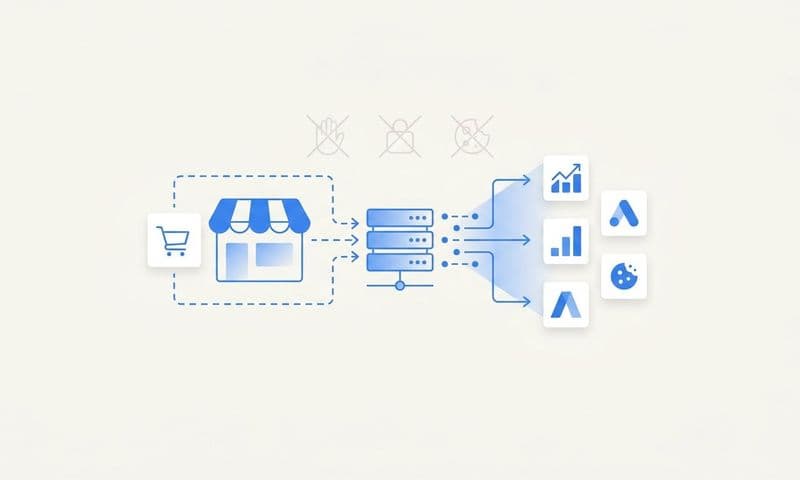
In practice, this means that when someone purchases on your website using Safari on an iPhone, your server can capture that conversion event and send it directly to Meta's Conversions API or Google's Enhanced Conversions endpoint. The pixel might have failed to fire. The cookie might have expired. But the server-side event still gets through. You're recovering conversions that would otherwise be invisible to your ad platforms.
Every major ad platform has developed a server-side solution in response to these tracking limitations. Meta has the Conversions API (CAPI). Google has Enhanced Conversions. TikTok and Snapchat have their own API-based event endpoints. These tools exist precisely because the platforms know their pixel-based tracking is losing data and they need a more reliable signal to power their algorithms.
The impact of server-side tracking extends beyond just recovering lost conversions. When you feed more complete conversion data back to ad platform algorithms, those algorithms become significantly better at finding and targeting users who are likely to convert. The server-side tracking benefits for advertisers include better pattern recognition, more efficient optimization, and lower costs over time.
Think of it like this: if you were trying to train someone to identify your best customers, but you could only show them half the examples, their judgment would be limited. Give them the full picture and they get much better at the job. Server-side tracking gives the algorithm the full picture.
Implementing server-side tracking does require more technical setup than dropping a pixel on your site, but the investment pays for itself quickly in recovered attribution and improved campaign performance. For any marketer running meaningful ad spend, it's no longer optional. It's foundational.
Building a Multi-Touch Attribution Strategy That Survives iOS Restrictions
Server-side tracking solves the data capture problem. Multi-touch attribution solves the data interpretation problem. You need both to make confident decisions about where your marketing budget should go.
Multi-touch attribution connects the full customer journey from the first ad impression through the final conversion, assigning credit to each touchpoint along the way rather than giving all credit to the last click. This matters enormously in a world where users interact with multiple ads across multiple channels before converting, and where individual tracking signals are increasingly limited by iOS restrictions. Choosing the right attribution platform is a critical step in building this capability.
The foundation of a resilient multi-touch attribution strategy is first-party data. Instead of depending on third-party cookies or device identifiers that Apple has restricted, you build your attribution model on data you own: CRM records, website events, ad platform data, and server-side conversion signals. When these sources are connected and unified, you can trace the customer journey even when individual tracking links are broken.
Here's a practical example. A user clicks a Facebook ad, visits your site, opts out of tracking on their iPhone, and then converts three days later after receiving an email. A pixel-based last-click model might give all the credit to email or show no attribution at all. A multi-touch model that pulls from your CRM, email platform, and server-side events can recognize that the Facebook ad was the acquisition touchpoint and email was the conversion assist. Both channels get appropriate credit, and your budget decisions reflect reality. Effective tracking for multi-channel campaigns makes this kind of cross-platform visibility possible.
This is where AI becomes genuinely valuable rather than just a buzzword. Analyzing attribution data across thousands of customer journeys, identifying which combinations of touchpoints actually drive revenue, and surfacing optimization recommendations is exactly the kind of pattern recognition that AI handles well. Rather than manually comparing reports across platforms, AI can synthesize the full picture and tell you which ads and campaigns are actually working, not just which ones are claiming credit.
The goal is a unified view of your marketing performance that doesn't depend on any single tracking mechanism. When one signal is limited by iOS restrictions, others compensate. The overall picture remains accurate because it's built on multiple data sources rather than a single point of failure.
Practical Steps to Overcome iOS Tracking Challenges Today
Understanding the problem is one thing. Fixing it requires a prioritized action plan. Here's where to focus your energy.
Implement server-side tracking first: This is your highest-leverage move. Set up the Meta Conversions API and Google Enhanced Conversions at a minimum. If you're running TikTok or Snapchat campaigns, implement their server-side event APIs as well. Running server-side tracking alongside your existing pixels, rather than replacing them, gives you the best data coverage. The pixel captures what it can; the server-side integration captures the rest. If you're unsure where to begin, review the top server-side tracking platforms available today.
Audit your current attribution setup for data gaps: Compare your ad platform reported conversions against your CRM or backend data for the same time periods. Look specifically at iOS traffic. If you're seeing a significant discrepancy, that gap represents the conversions your current setup is missing. Quantifying this gap helps you understand the scale of the problem and prioritize the fix.
Sync enriched conversion events back to your ad platforms: Don't just send basic conversion signals. Enrich those events with first-party data like customer lifetime value, lead quality scores, or purchase amounts. When ad platform algorithms optimize toward enriched conversion signals rather than simple binary conversion events, they get much better at finding high-value users. Proper tracking ROI for performance marketing depends on this level of signal enrichment.
Compare attribution models side by side: Don't rely on any single attribution model or any single platform's reporting. Use platform-independent analytics to validate what your ad dashboards are telling you. If Meta says a campaign drove 100 conversions and your CRM shows 80 leads from that period, understanding that discrepancy helps you calibrate how much to trust each data source.
Invest in first-party data collection: Build email lists, use CRM integrations, and create logged-in user experiences where possible. First-party data is not subject to Apple's third-party tracking restrictions. The more of your attribution model you can ground in data you own and control, the less vulnerable you are to future privacy changes.
The marketers who are winning right now aren't the ones who found a workaround for iOS restrictions. They're the ones who rebuilt their measurement infrastructure on a foundation that doesn't depend on those restrictions in the first place.
Moving Forward in a Privacy-First World
iOS tracking challenges for marketers are not a temporary inconvenience. Apple continues to tighten privacy controls with each software update, and the broader industry is moving in the same direction. Google has made similar moves on Chrome. Regulatory pressure around data privacy is increasing globally. The tracking environment of 2019 is not coming back.
The marketers who will thrive in this environment are those who stop trying to patch their old tracking setup and instead build something better. That means server-side tracking as the foundation, multi-touch attribution as the analytical layer, and first-party data as the fuel that powers both. It means feeding better signals back to ad platform algorithms so they can optimize toward real revenue rather than incomplete pixel data. And it means having the analytical confidence to make budget decisions based on what's actually working, not what an underreporting dashboard suggests.
Cometly is built specifically to solve these problems. It captures every touchpoint from ad clicks to CRM events, connects that data to real revenue, and feeds enriched conversion signals back to Meta, Google, and other platforms so their algorithms can do their best work. With server-side tracking, multi-touch attribution, and AI-powered recommendations, Cometly gives you a clear, accurate view of your marketing performance even in a world where iOS restrictions have made traditional tracking unreliable.
If you're ready to close the gap between what your ad dashboards report and what's actually driving your business, Get your free demo today and start capturing every touchpoint to maximize your conversions.